

How is a security infraction different from a security violation?
If you are asking how a security infraction is different from a security violation, the shortest accurate answer is this: an infraction breaks a security rule but cannot reasonably be expected to cause, and does not cause, the loss or compromise of classified information. A violation crosses that risk line because the incident results in, or could reasonably be expected to result in, loss or compromise.
That sounds simple until you try to classify a real event. An unlocked container might be an infraction in one setting and a violation in another, depending on the room, access controls, time unattended, people present, information involved, and what the inquiry establishes.
While researching this guide, I tried sorting common examples by intention alone. That method failed because an accidental email can create a serious potential compromise, while a procedural mistake may remain an infraction after officials rule out any reasonable chance of exposure.
The better method is to examine the failed requirement, the information at risk, the realistic opportunity for unauthorized access, and the evidence found during an inquiry. This guide explains that method, shows where popular shortcuts go wrong, and gives you a practical response plan without pretending that an employee should make the final classification alone.
Security Infraction vs Security Violation
Both an infraction and a violation begin with a security incident or a failure to follow a requirement. The dividing question is not simply whether the employee meant to do it, but whether the circumstances did or reasonably could lead to the loss, suspected compromise, or compromise of classified information.
The current DoD information-security manual gives the formal distinction. It says an infraction cannot reasonably be expected to cause loss or compromise and does not do so, while a violation results in or could be expected to result in loss or compromise.
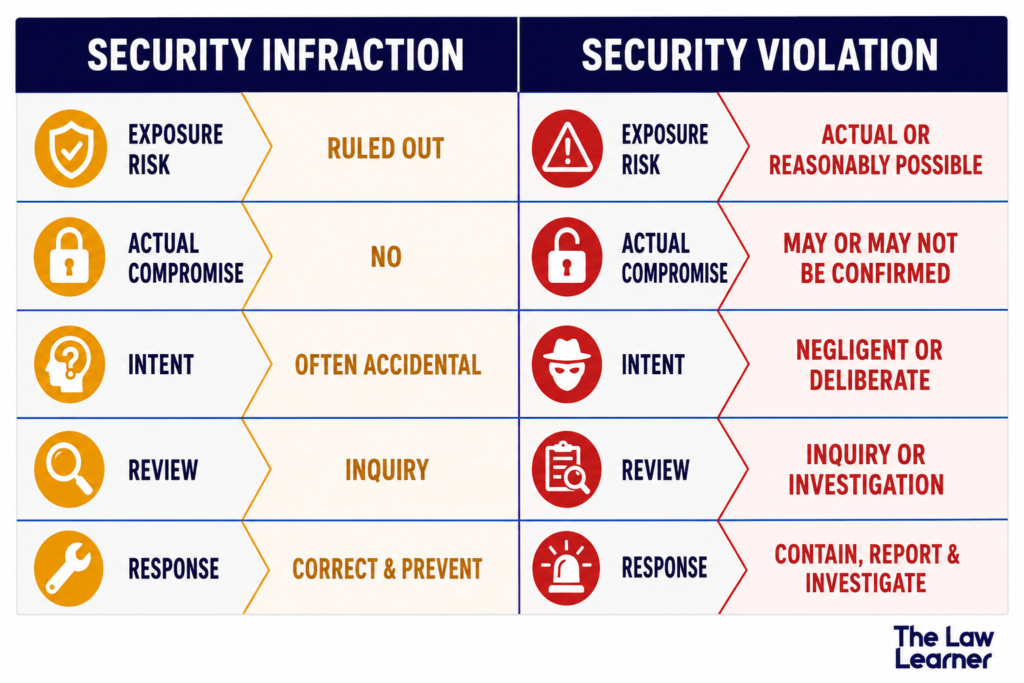
| Point of comparison | Security infraction | Security violation |
|---|---|---|
| Basic meaning | A security requirement was not followed, but the incident could not reasonably be expected to cause loss or compromise, and none occurred | A security requirement was not followed, and the event caused or could reasonably be expected to cause loss or compromise |
| Classified information | No loss, suspected compromise, or compromise after the facts are assessed | Loss, compromise, potential compromise, or a reasonable exposure path exists |
| Intent | Often unintentional or inadvertent | May be knowing, willful, or negligent; malicious intent is not required |
| Actual harm required | No actual compromise exists | Actual compromise is not always required because reasonable expected risk can meet the threshold |
| Initial official action | An inquiry supports prompt correction and determines the facts | An inquiry, an investigation, or both may be required |
| Typical response | Correct the weakness, document as required, retrain, and prevent recurrence | Safeguard, contain, preserve evidence, report, investigate, assess damage when needed, and correct the cause |
| Employee’s role | Report the facts and follow instructions rather than declaring the matter harmless | Report immediately and avoid deleting, forwarding, altering, or independently investigating the material |
| Possible personnel effect | Often corrective, but patterns and local policy still matter | May affect duties, access, employment, or eligibility, depending on the full facts and governing process |
The table is a learning aid, not a self-classification form. If you discover an incident, your safest assumption is that the security office needs facts quickly enough to protect the information and decide which category applies.
Why Many Quick Answers Get This Wrong
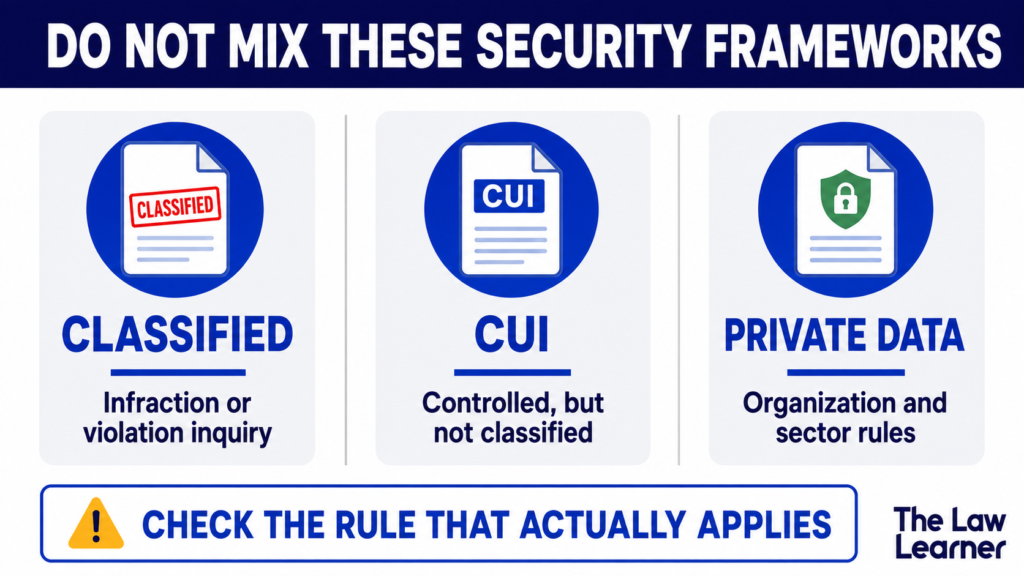
The first mistake is using these terms for every small cybersecurity problem. This question comes from a classified-information setting, while private employers may define similar words differently in their own policies.
The second mistake is saying an infraction is accidental and a violation is intentional. The executive order governing classified national-security information includes knowing, willful, or negligent conduct, so an accidental transmission can still be a violation when it creates a reasonable disclosure path.
The third mistake is demanding proof that somebody read the material or assigning a fixed label to every visible act. A violation can rest on reasonable potential compromise, and an inquiry may need access logs, system routes, time, location, classification, need-to-know, and other safeguards to determine that risk.
The fourth mistake is treating every business document marked “Confidential” as federally classified. Read how a Security Classification Guide works to see who makes classification decisions and why a private label does not create classified national-security information.
What Is a Security Infraction?
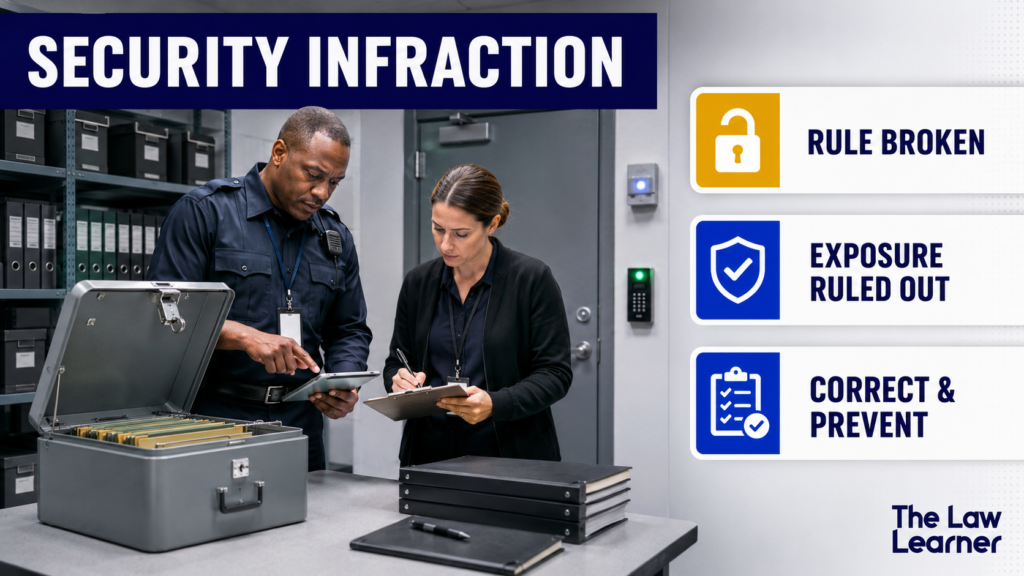
A security infraction is still a real security incident. A requirement was missed, ignored, or performed incorrectly, but the facts establish that the lapse could not reasonably be expected to cause, and did not cause, the loss, suspected compromise, or compromise of classified information.
The word “minor” is often used as shorthand, but it can mislead. The better description is a procedural failure that remains below the loss-or-compromise threshold after the surrounding facts are checked.
An infraction may be inadvertent or unintentional, yet intention alone does not define it. The essential finding is that the realistic exposure concern has been ruled out, not merely that the employee says no harm was intended.
The elements of an infraction
A security office usually needs enough information to establish several connected points. These points help separate a correctable lapse from an incident that needs deeper investigation.
- A requirement applied and was not followed. There must be a policy, manual, local procedure, contract instruction, system rule, or other applicable safeguard. A disliked habit is not automatically a security infraction unless it conflicts with a real requirement.
- Classified information was not lost or compromised. Officials must be able to account for the material and rule out unauthorized disclosure. An employee’s quick visual check may help, but it is not always enough to settle that question.
- The circumstances could not reasonably be expected to cause compromise. This is stronger than saying nobody has admitted seeing the information. The inquiry should consider who could enter, what they could access, how long the condition existed, and whether technical or physical records support the conclusion.
- Immediate correction is possible and appropriate. The failed control should be restored, and the cause should be addressed through the applicable process. Correction may include counseling, focused retraining, a checklist change, supervision, equipment repair, or a procedural redesign.
Context-based examples of possible infractions
An unlocked container inside a secured, continuously controlled room may remain an infraction when reliable evidence rules out unauthorized access and all material is accounted for. Change the access, time, location, or information, however, and the same visible mistake may cross the violation threshold.
What Is a Security Violation?
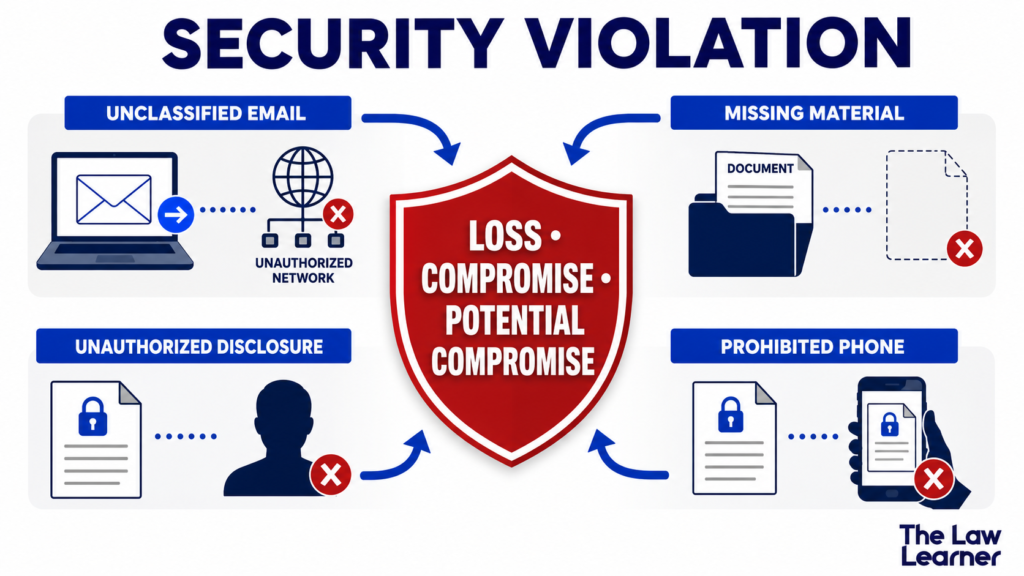
A security violation is a security incident that crosses the loss-or-compromise threshold. It results in, or could reasonably be expected to result in, the loss or compromise of classified information, and it calls for an inquiry, an investigation, or both under the applicable rules.
The important phrase is “could reasonably be expected.” It focuses on a credible exposure route shown by the facts, not a remote imaginary possibility and not only a confirmed disclosure.
A violation does not require malicious intent
Some violations are deliberate, such as knowingly giving protected information to an unauthorized recipient. Others arise from negligence, including conduct performed without an intention to harm national security.
For example, emailing classified details through an unclassified account can create a violation even when the sender selected the wrong system by mistake. The motive may matter later when officials assess responsibility, mitigation, training, discipline, or eligibility, but it does not reverse the technical exposure.
A violation does not always require proven compromise
A compromise is a type of violation involving unauthorized disclosure to a person who lacks the required clearance, authorized access, or need-to-know. A loss occurs when classified information cannot be physically located or accounted for, while a potential or suspected compromise calls for fact-finding because unauthorized access may have been possible.
This is why “nobody says they opened it” is not a complete defense. If a classified document sat in a public area, a classified email reached an unclassified network, or a prohibited recording device captured protected material, the opportunity and technical path may be enough to require violation-level handling before every downstream fact is known.
Examples that commonly point toward a violation
- Classified information sent through an unclassified system. The transmission creates an unauthorized environment and may spread copies across servers, backups, endpoints, or accounts. Deleting the visible email does not prove that every copy is gone.
- Protected information disclosed to someone without access or need-to-know. A clearance level by itself is not enough because access also depends on authorization and a valid need for the information. A discussion among cleared colleagues can still be improper when one person lacks program access or need-to-know.
- A personal electronic device used to photograph protected material. The device can create, store, synchronize, or transmit copies outside the approved environment. The current incident-reporting training guide uses scenarios involving spillage and a prohibited personal device to show why containment, preservation, notification, inquiry, and possible damage assessment matter.
The Four Questions That Usually Decide the Category
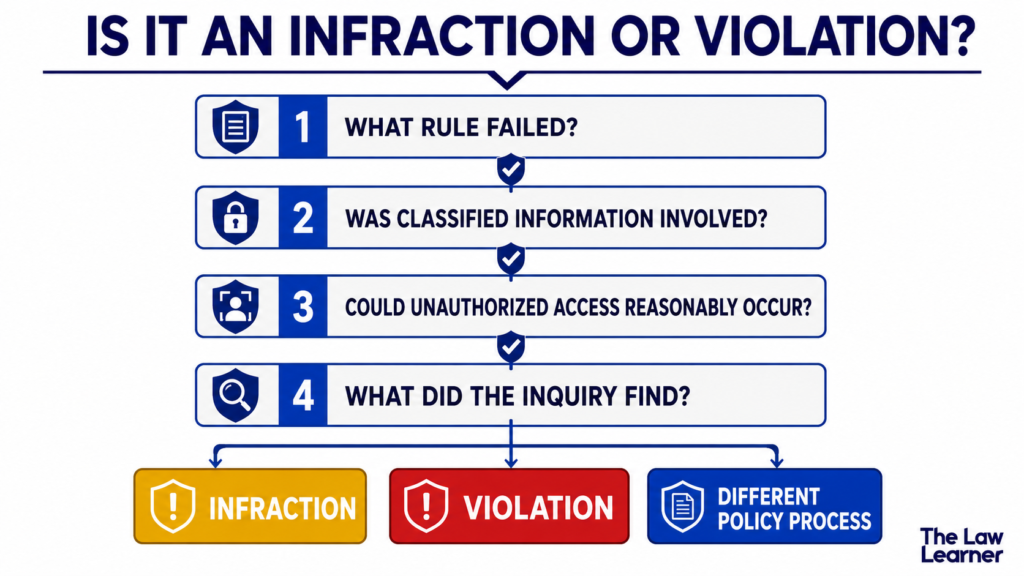
I recommend a four-question test because it keeps the analysis tied to the official threshold. It is useful for learning and triage, but only the authorized security process should make the final incident finding.
1. What exact requirement failed?
Start with the rule, not the desired label. Identify the storage, access, marking, transmission, destruction, escort, system, area, or reporting requirement that applied at the time.
2. What information or material was involved?
Confirm whether classified information was actually present and validate the applicable level, controls, compartments, and need-to-know restrictions. Do not assume that a document is unclassified because the cover looks ordinary, or classified because a private company used the word confidential.
Classification by compilation also matters. Several individually unclassified details can reveal classified information when combined, so a proper review may need to consider the full message, attachment, title, metadata, and context.
3. Was loss or unauthorized access actual or reasonably possible?
This is the decisive risk question. Examine the people, place, period, access records, system routes, physical controls, copies, backups, forwarding, synchronization, and any other evidence that shows who had or could have had access.
Do not replace “reasonably possible” with “anything is theoretically possible.” The conclusion should rest on concrete circumstances, and the inquiry should record why compromise was ruled out, suspected, or confirmed.
4. What did the inquiry establish about cause and response?
An inquiry gathers and analyzes facts, characterizes the incident, identifies causes and responsible persons when possible, records corrective action, and decides whether deeper investigation is needed. The event may look small at discovery but become more serious when access logs, recipients, or system evidence are reviewed.
| Facts found during review | Likely direction | Reason |
| A requirement failed, all material is accounted for, and credible access controls rule out unauthorized exposure | Infraction | The loss-or-compromise threshold is not met |
| A requirement failed and unauthorized access actually occurred | Violation and compromise | Classified information reached an unauthorized recipient |
| A requirement failed and classified material cannot be located | Violation and loss | The information cannot be physically accounted for |
| A requirement failed and evidence shows a realistic exposure path, but access is not yet confirmed | Treat as potential or suspected compromise pending inquiry | Actual compromise need not be proven before protective action begins |
| No applicable security requirement failed and no classified information was involved | Possibly outside this taxonomy | Another policy, cyber, privacy, CUI, or HR process may still apply |
What You Should Do When You Discover an Incident
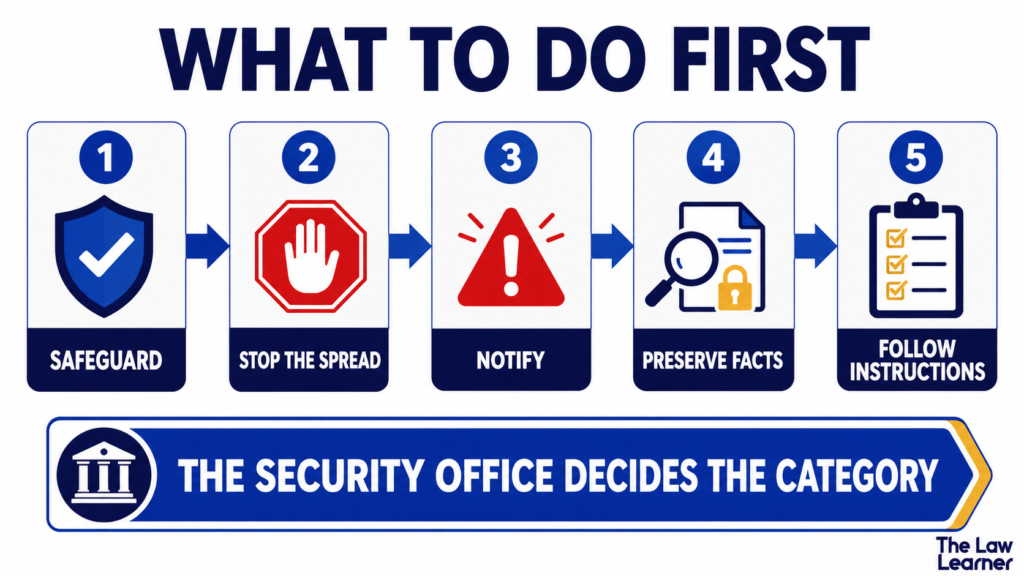
Your first job is not to prove that an incident is minor, but to control the information, prevent further exposure, preserve facts, and report. The exact route varies, and official self-reporting guidance directs personnel to their relevant security office, with contractor personnel generally working through their Facility Security Officer.
A safe immediate response sequence
- Secure the information without expanding access. Cover, isolate, close, or guard it only as trained, and never move it to a personal device.
- Stop further spread while preserving evidence. Do not delete, wipe, destroy, forward, or unnecessarily open material because officials may need its original state.
- Notify the right official promptly. Use the route in your brief, policy, contract, or procedure, including the alternate route when the usual official may be involved.
- Give facts, not conclusions. Record what you observed, when and where it occurred, what you did, who was present, and what systems or material may be involved.
Inquiry versus investigation
An inquiry is the initial fact-finding and analysis used to determine what happened, whether material was lost, and whether unauthorized people had or could have had access. It can classify the matter as an infraction or violation, identify causes, document corrective measures, and recommend whether an investigation is needed.
An investigation is more detailed and comprehensive. It is used when a violation cannot be resolved through the inquiry or when the circumstances justify deeper examination, and it may support damage assessment, accountability, or additional action.
For cleared contractors, the reporting rule for loss, compromise, or suspected compromise requires a preliminary inquiry after a security violation report involving classified information. It also addresses initial and final reports, corrective action, employee culpability, patterns of negligence or carelessness, and a graduated scale of administrative or disciplinary action.
Can an Infraction or Violation Affect a Security Clearance?
Neither label produces one automatic outcome in every organization. An infraction may lead mainly to correction and training, while a violation can lead to more serious review, but the response depends on the incident, history, candor, position, policy, contract, and adjudicative process.
The national adjudicative guidelines use a whole-person approach and include Guideline K for handling protected information. Relevant concerns include deliberate or negligent disclosure, storing or handling protected information contrary to rules, and patterns of behavior, while mitigation can include factors such as prompt good-faith correction, infrequency, unusual circumstances, and evidence that the problem is unlikely to recur.
This is another reason not to hide a mistake. Prompt, accurate reporting helps officials contain the event and may demonstrate honesty and a constructive attitude, while delay, concealment, destruction of evidence, or a false account can create separate concerns.
What matters beyond the label
- The exposure and sensitivity of the information matter. A short exposure can still be serious if the recipient or system was unauthorized. A procedural lapse can remain below the violation threshold when strong controls and reliable evidence rule out loss or compromise.
- A pattern matters differently from one isolated event. Repeated failures may show inadequate training, a broken process, poor supervision, negligence, or unwillingness to follow requirements. The response should examine the cause instead of assuming that every repeat event has the same explanation.
- Candor and corrective behavior matter. Reporting promptly, cooperating, following containment instructions, and changing the underlying habit can be relevant mitigating facts. They do not erase the event, but they give decision-makers a more complete picture.
- Access, clearance eligibility, and employment are different decisions. An organization can temporarily adjust duties or access while facts are reviewed without that action itself being a final clearance revocation. Employment consequences also depend on the role, employer rules, contract needs, and any applicable process.
If an incident has led to a proposed suspension, revocation, termination, criminal inquiry, or formal adverse action, general internet advice is not enough. Preserve the notice and deadlines, follow authorized security instructions, and consider advice from a qualified lawyer who can review the actual record and governing process.
Security Infraction, Violation, Compromise, Spillage, and CUI
These terms sit close together, but they are not interchangeable. Keeping them separate prevents a reader from importing the wrong response, reporting deadline, or legal consequence into a real event.
| Term | Plain-English meaning | Key distinction |
| Security incident | The broad event that requires assessment under the applicable classified-information program | It may ultimately be an infraction, a violation, or another defined incident type |
| Security infraction | A failed requirement with no loss or compromise and no reasonable expectation of either | The exposure concern is ruled out after facts are assessed |
| Security violation | A failed requirement that causes or could reasonably cause loss or compromise | Intent is relevant, but actual malicious purpose is not required |
| Compromise | Unauthorized disclosure of classified information | This is a violation with actual unauthorized disclosure |
| Loss | Classified information cannot be located or accounted for | Recovery later does not justify delaying the initial report |
| Spillage | Classified information is transferred to an unclassified or unauthorized information system | It can create multiple copies and requires controlled technical response |
| CUI incident | Mishandling of controlled but unclassified information under its own rules | CUI requires safeguards but is not classified under the national-security order |
| Private data breach | Unauthorized access or acquisition defined by the applicable privacy, cyber, contract, or sector rule | The legal definition and notification duties come from that separate framework |
The distinction between classified information and CUI is especially important. Official CUI guidance explains that CUI requires safeguarding or dissemination controls but is not classified under the national-security classification order or the Atomic Energy Act.
The legal hierarchy also matters because an agency manual, regulation, executive order, statute, and local procedure do not all perform the same job. For a beginner-friendly explanation of how higher and lower authorities relate, see the Constitution’s place as the supreme law of the land, then return to the exact authority that governs your organization and information.
How Context Can Change the Result
Examples are useful only when they include context. I would not label every unlocked screen an infraction or every personal device a violation because access, system behavior, time, and evidence often decide the category.
| Visible event | Facts pointing toward an infraction | Facts pointing toward a violation |
| Container left unlocked | The room stayed secured, authorized access is verified, and all material is accounted for | Unauthorized people could enter, material is missing, or exposure cannot reasonably be ruled out |
| Classified workstation left active | A controlled area and reliable logs rule out unauthorized access | Another person could view, copy, photograph, or transmit the information |
| Incorrect document marking | Review catches the error before distribution and no unsafe handling follows | The marking causes unclassified transmission or disclosure beyond authorized access |
| Phone enters a secure area | It is promptly reported, unused, and technical findings rule out capture or transmission | It records, photographs, synchronizes, or transmits protected information |
Repetition is a separate responsibility factor. It may show negligence, a broken workflow, inadequate supervision, or poor training, but officials should still assess the exposure threshold of each event rather than rewriting earlier facts automatically.
Expert Tips for Employees, Security Managers, and Buyers
For managers, paired scenarios in which one access fact changes teach better judgment than fixed labels for every unlocked cabinet or marking error. Organizations should also record procedural, training, equipment, and supervision failures because discipline alone does not correct every cause.
What to look for when buying training or incident support
- The content should name the governing framework. A course that mixes classified information, CUI, personal data, and generic cyber alerts into one unexplained scale can teach the wrong reporting behavior. Ask which current orders, regulations, manuals, contracts, and agency procedures the material maps to.
- Scenario answers should explain context. Good training states the room, system, access, time, information, and evidence before assigning a label. Avoid products that promise a universal answer from one visible act or from intention alone.
- The system must fit the approved environment. Incident records can contain sensitive personnel, security, system, and classified details. Confirm authorization, access control, data location, retention, export, audit, and need-to-know requirements before placing information into any software or outside service.
- The workflow should preserve human authority. Automation can route notifications, preserve timestamps, manage tasks, and identify missing fields, but it should not pretend to replace the security manager, classification authority, inquiry, legal review, or damage assessment. Ask who approves the final finding and how changes are recorded.
Benefits and limits of the two-category framework
The framework supports proportionate action. It allows an organization to correct lower-risk failures without treating every mistake as a confirmed compromise, while still escalating incidents that create a realistic path to loss or unauthorized disclosure.
Its main limitation is context dependence. The labels cannot replace prompt reporting or a factual inquiry, and they should not be copied into a private-sector policy without defining scope, thresholds, authority, response, and legal duties.
Frequently Asked Questions
1. How is a security infraction different from a security violation?
A security infraction is a failure to follow a security requirement that cannot reasonably be expected to result in, and does not result in, the loss or compromise of classified information. A security violation results in, or could reasonably be expected to result in, loss or compromise, so actual malicious intent or confirmed disclosure is not always required.
2. Do security infractions have to be reported?
You should follow your organization’s reporting rules and promptly notify the security official identified in your training rather than deciding on your own that an incident is harmless. Reporting lets authorized personnel protect the material, examine the facts, document any required action, and determine whether the event is truly an infraction.
3. Can an accidental mistake be a security violation?
Yes. An accidental transmission to an unauthorized system, loss of classified material, or other negligent act can create an actual or reasonably possible compromise even when the person had no harmful intention.
Intent may affect culpability, mitigation, discipline, and eligibility review. It does not by itself determine whether the exposure threshold was crossed.
4. Does a violation require proof that someone read the information?
No. A confirmed unauthorized disclosure is a compromise, but an incident can be a violation when the circumstances could reasonably be expected to result in loss or compromise.
Officials should use evidence rather than speculation to assess the access path. That evidence may include recipients, access logs, room controls, device functions, backups, forwarding, synchronization, time, and location.
5. Will one infraction automatically end a clearance?
No universal rule makes one infraction an automatic clearance loss. Decision-makers consider the nature, seriousness, frequency, circumstances, candor, correction, recurrence risk, and other relevant facts under the applicable process.
Do not rely on that answer as permission to delay reporting. A prompt and truthful response protects the information and gives officials the facts needed for a fair assessment.
6. What should I do first if I find unsecured classified information?
Safeguard the information as your training permits and notify the designated security authority immediately. Do not take it home, send it to yourself, photograph it, forward it, destroy it, or leave it exposed while trying to locate the owner.
Give a factual account of what you found and what you did. Then follow official instructions so the organization can contain the incident, preserve evidence, identify access, and decide the proper classification and response.
Conclusion
The best answer to how is a security infraction different from a security violation is not simply “small mistake versus serious mistake” or “accidental versus intentional.” An infraction is a failed requirement where loss and compromise did not occur and could not reasonably be expected, while a violation causes or creates a reasonable possibility of loss or compromise.
Remember the practical rule: do not decide that your own incident is harmless. Safeguard the information, stop further spread, preserve the facts, report through the approved channel, and let the authorized inquiry determine what happened.
If this guide helped you understand the distinction, bookmark it for study and share it with someone preparing for security awareness training. For a live incident, use your current official procedure and contact your security office now rather than relying on any general article.
