

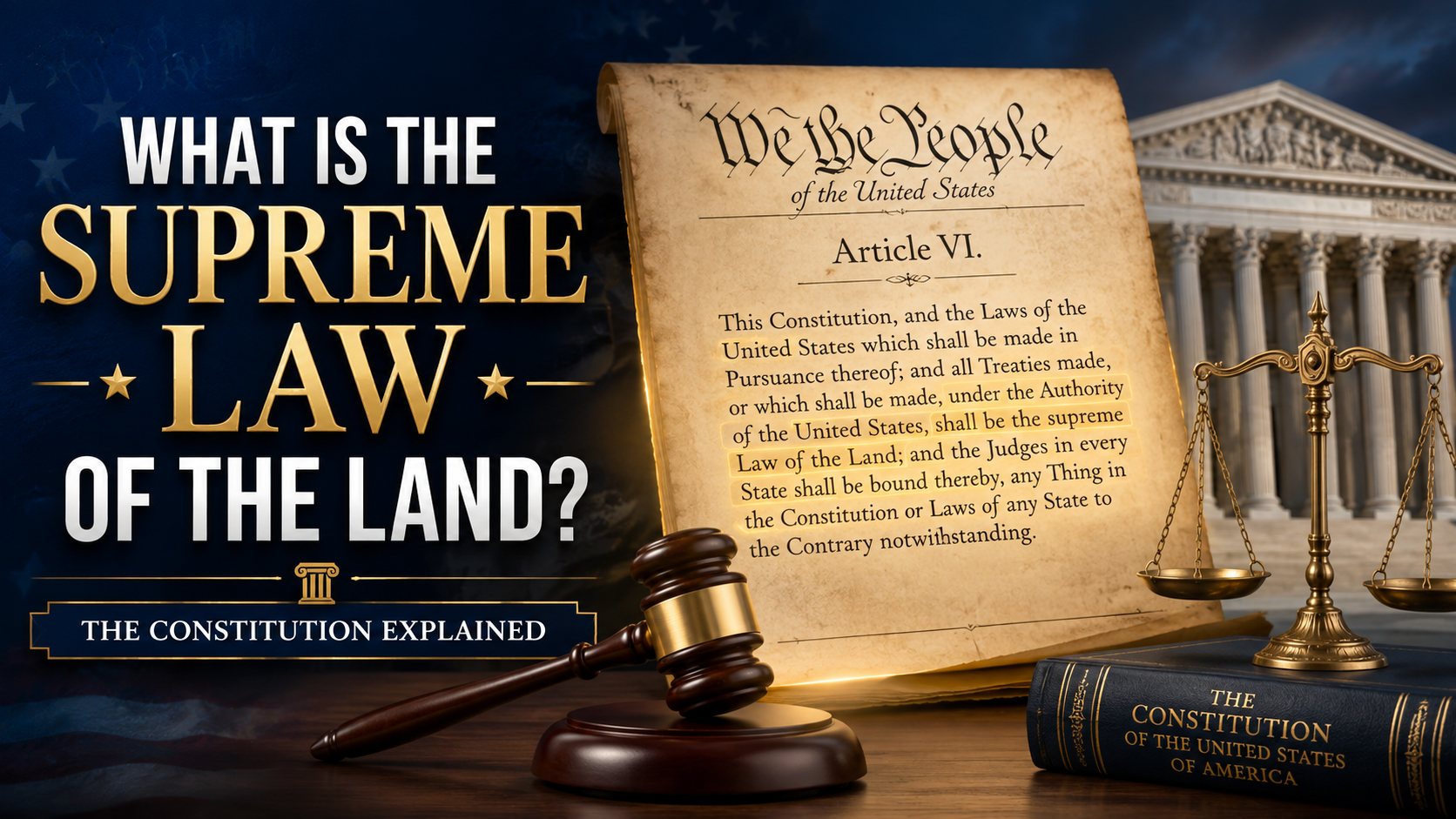
If you are asking what is the supreme law of the land?, the direct answer is the Constitution. It is the highest source of legal authority, so a government rule, statute, or official action cannot lawfully stand when it violates the Constitution.
That one-line answer is correct, but it leaves out the part that usually causes confusion. Article VI, Clause 2 also identifies valid federal laws and treaties as part of the “supreme Law of the Land,” which means courts must follow them when they conflict with a state rule.
When I worked through this question for this guide, I noticed that many explanations stopped after saying, “The Constitution.” They did not explain why some state laws still survive, why an ordinary federal rule cannot violate the Constitution, or how a court decides whether a real conflict exists.
This guide fills those gaps. You will learn what the phrase means, what Article VI actually says, how legal authority is ranked, when federal law overrides state law, and when it does not.
Quick answer: The Constitution is the highest law. Valid federal statutes and treaties made under constitutional authority also bind state courts, but they do not outrank the Constitution itself.
What Does “Supreme Law of the Land” Mean?
The phrase “supreme law of the land” refers to the rule that takes precedence over all lower government rules. It gives courts a legal standard for deciding what to follow when two laws point in different directions.
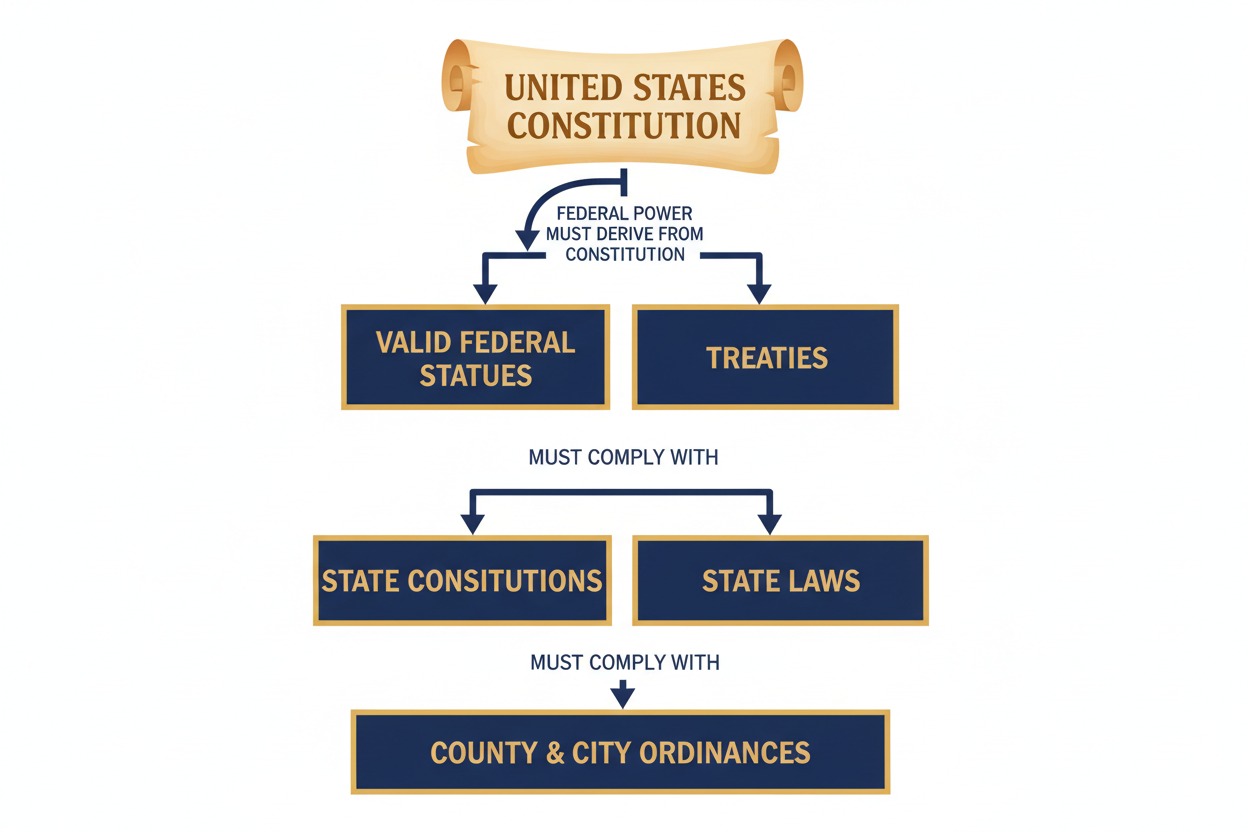
Think of it as a legal instruction manual with a built-in priority system. A city cannot use an ordinance to cancel a state constitution, and a state cannot enforce a rule that directly conflicts with a valid federal law made under constitutional authority.
The word “supreme” does not mean that every action taken by the national government is automatically lawful. It means that the Constitution and federal law validly enacted under it govern when a true legal conflict exists.
That final point matters. The modern doctrine on the Supremacy Clause recognizes express and implied forms of federal preemption, but courts still have to identify valid federal authority and an actual reason state law must give way.
What Does the Constitution Say Is the Supreme Law of the Land?
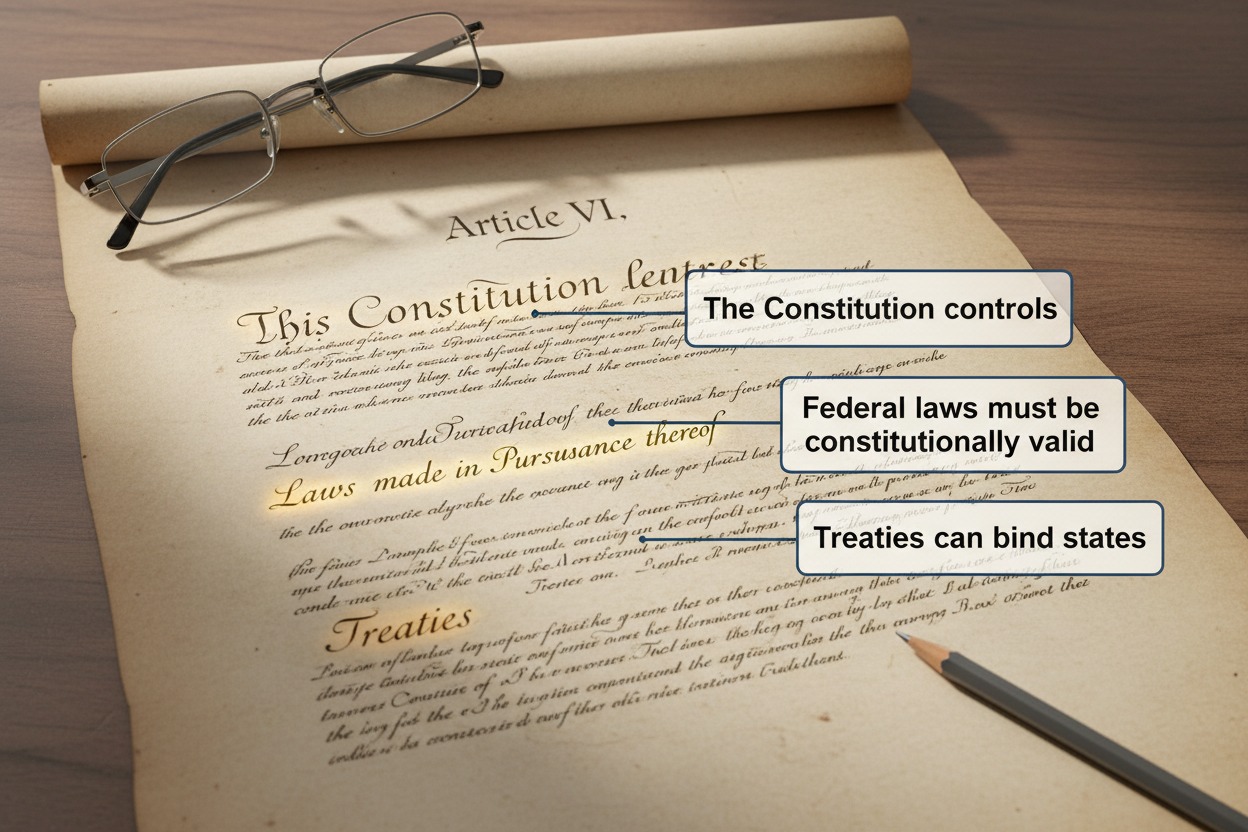
The exact answer appears in Article VI, Clause 2, commonly called the Supremacy Clause. It states that the Constitution, federal laws made “in Pursuance thereof,” and treaties made under national authority are the supreme law, and state judges are bound by them even when state law says otherwise.
The words “in Pursuance thereof” are easy to skip, but they are essential. They mean that a federal statute receives supreme status only when Congress acted within the powers granted by the Constitution.
In other words, Congress cannot make an unconstitutional law supreme simply by passing it. The Constitution remains the controlling authority because it creates Congress, defines its powers, limits government, and provides the framework within which federal laws are made.
You can read the complete constitutional text and see how Article VI fits with the powers assigned to Congress, the President, and the courts. The document contains a preamble, seven original articles, and later amendments that are part of the Constitution itself.
A Plain-English Translation of Article VI
Article VI can be reduced to three practical rules. First, the Constitution controls every level of government.
Second, valid federal statutes and treaties control when they conflict with state law. Third, state judges must apply controlling federal law even when their own state constitution, statute, or policy points in another direction.
This does not turn state courts into federal agencies. State courts still decide large numbers of cases under state law, but they cannot treat valid federal law as optional when it governs the dispute.
What Document Is the Supreme Law of the Land?
The document is the Constitution, including its valid amendments. The Bill of Rights is not a separate lower document because its ten amendments became part of the Constitution after ratification.
Later amendments also carry constitutional authority. For example, the Fourteenth Amendment limits state action through protections such as due process and equal protection, while the First Amendment limits national government action and has also been applied against states through constitutional doctrine.
The Declaration of Independence is historically important, but it is not the supreme law used in the same way as the Constitution. It explains foundational ideals and the reasons for independence, while the Constitution establishes the government and creates enforceable legal rules.
Federal statutes are also not the highest document in an absolute sense. They may be supreme over conflicting state rules, but courts can refuse to enforce them when they violate the Constitution.
Is the Bill of Rights the Supreme Law?
The Bill of Rights forms part of the supreme law because it is part of the Constitution. The first ten amendments protect freedoms and place limits on government power, but they do not sit above or outside the rest of the Constitution.
It is more accurate to say that the Constitution, as amended, is supreme. This wording includes the original text and all twenty-seven ratified amendments without creating a false ranking among constitutional provisions.
Is a Supreme Court Decision the Supreme Law?
A court decision is not another constitution. Courts interpret and apply constitutional text, federal statutes, treaties, and prior legal principles to the facts of a case.
Supreme Court decisions are binding on lower courts regarding federal law, but the Court’s authority comes from the Constitution and federal judicial structure. A later constitutional amendment, a properly enacted statute within constitutional limits, or a later judicial decision may change the legal rule, depending on the issue.
This is why it helps to separate the source of law from its interpretation. The Constitution is the source at the top, while judicial decisions explain what that source means in real disputes.
The Legal Hierarchy: Which Rule Wins?
A simple hierarchy is useful for beginners, but it should not be treated as an automatic answer to every dispute. The better approach is to ask both where a rule came from and whether the body that created it had legal authority.
| Level | Source of Law | Basic Effect |
|---|---|---|
| 1 | Constitution and amendments | Controls all government action |
| 2 | Valid federal statutes and treaties | Override conflicting state law |
| 3 | Valid federal regulations | May preempt state law when supported by delegated authority |
| 4 | State constitutions | Control state government unless they conflict with federal authority |
| 5 | State statutes and regulations | Govern matters within state power |
| 6 | County and city ordinances | Apply locally but must follow higher law |
| 7 | Private contracts and policies | Bind parties only within legal limits |
This table does not mean the national government has unlimited power over every local subject. States retain broad authority in areas such as property, contracts, family matters, professional licensing, health, safety, and local government, unless the Constitution vests controlling power in the national government or a valid federal law displaces state law.
That is why the law can differ from one state to another. You can see this in practical subjects such as how state tattoo-age rules differ and legal name-change costs and court steps, where state statutes and local procedures often control.
Why a Straight Pyramid Can Mislead You
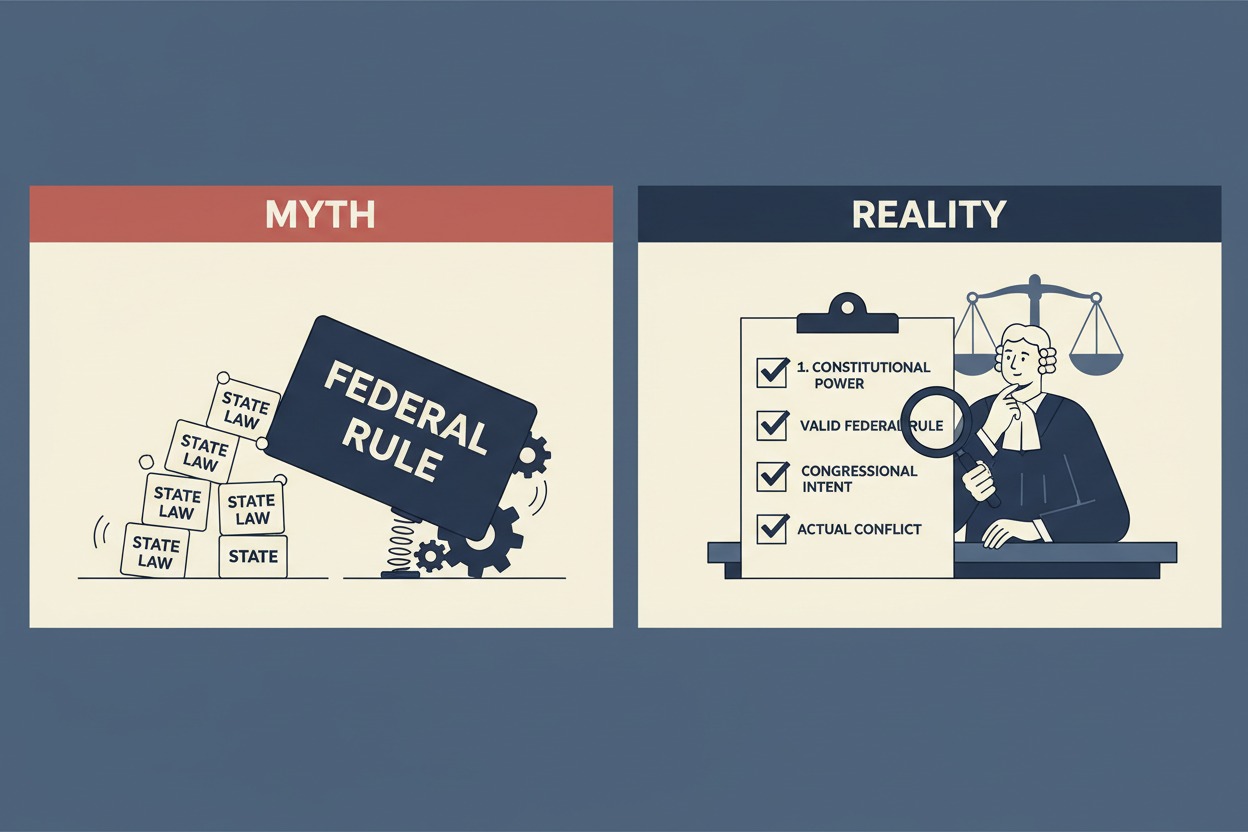
A pyramid suggests that every federal rule defeats every state rule, but constitutional federalism is more careful than that. The national government must act within a power granted to it, and state law continues to operate where no controlling federal conflict exists.
For example, a federal law may set a minimum safety standard while allowing states to create stronger protections. In that situation, the two laws may work together rather than compete.
A federal statute may also expressly preserve state authority. When Congress writes a savings clause into a law, courts examine that language before deciding whether state claims or regulations remain available.
How the Supremacy Clause Works in a Real Dispute
A Supremacy Clause problem usually begins when a person, business, state agency, or local government is subject to two different legal commands. One rule may permit conduct while another prohibits it, or one rule may impose a duty that the other makes impossible to perform.
Courts do not normally begin by asking which government is more powerful in the abstract. They study the constitutional source, the federal text, the state text, the regulated activity, and whether both laws can operate together.
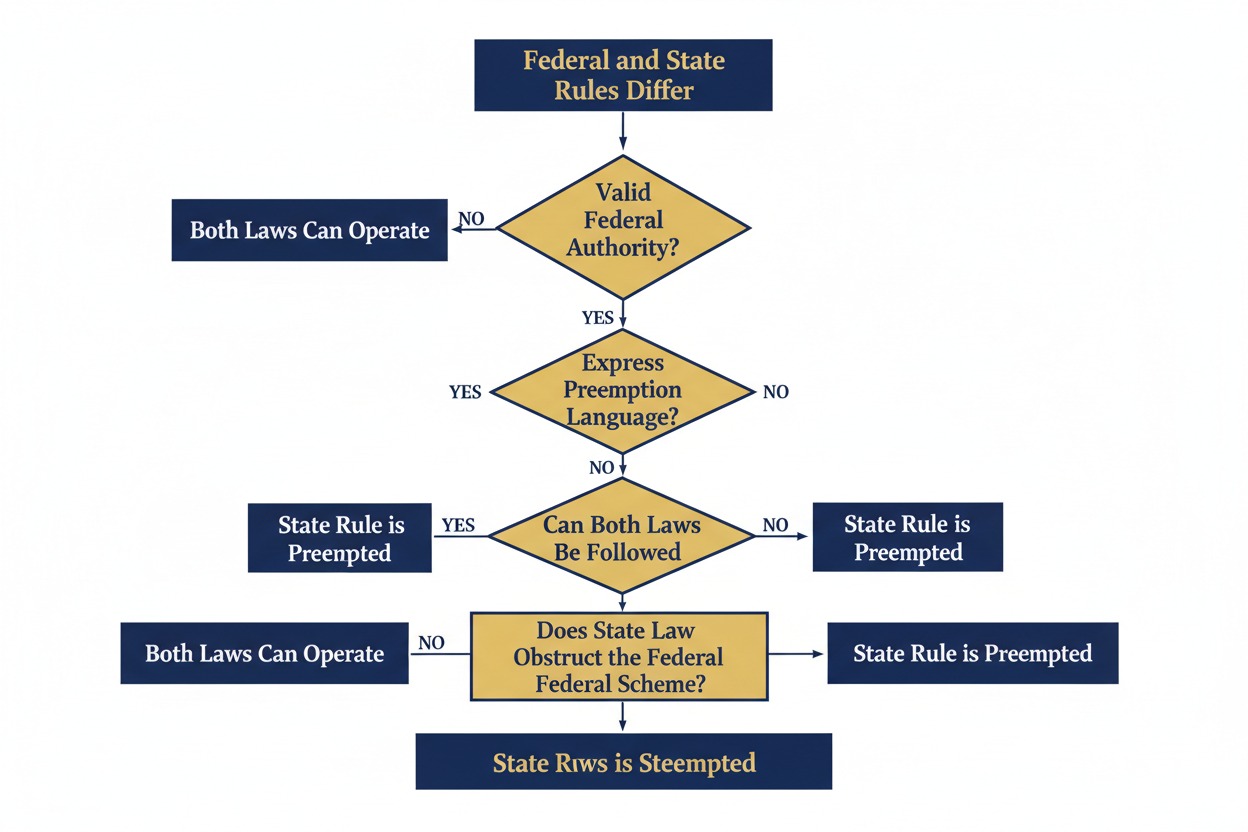
A practical court analysis often follows these questions:
- Is there a valid federal source of law? The court first identifies a constitutional provision, federal statute, treaty, or valid regulation that actually governs the issue. A general federal preference is not enough.
- Did the federal body act within its authority? A law must be supported by constitutional authority, and an agency rule must remain within the authority delegated by Congress. An unsupported action does not gain supremacy merely because a federal official issued it.
- Did Congress address state law directly? Some federal statutes contain an express preemption clause saying which state rules are displaced. Others include a savings clause preserving certain state rights or remedies.
- Can both rules be followed? If a person can obey both laws simultaneously, courts may find no direct conflict. If obeying one necessarily violates the other, state law usually must yield.
- Would state law block the federal scheme? Even when literal compliance is possible, a state rule may interfere with the operation of a lawful federal system. Courts examine the text, structure, subject, and purpose with care.
The current congressional explanation of preemption divides the doctrine into express preemption and implied preemption. Implied preemption usually includes field preemption and conflict preemption.
Express Preemption
Express preemption occurs when Congress places language in a statute describing the state laws that are displaced. This can be broad or narrow, so the exact wording matters more than a general claim that the federal government has entered the subject.
A careful reader should check definitions, exceptions, savings clauses, enforcement sections, and effective dates. One sentence may appear to displace state regulation, while another preserves state tort claims, licensing rules, or stronger consumer protections.
Field Preemption
Field preemption occurs when federal law is understood to occupy an entire regulatory field, leaving no room for additional state regulation. This finding is more likely where the federal framework is comprehensive, and the subject has a strong national character.
Courts do not assume field preemption merely because federal regulations are detailed. They still look for evidence that the federal scheme was intended to be exclusive.
Conflict Preemption
Conflict preemption applies when it is impossible to comply with both federal and state law, or when state law obstructs the lawful federal system. This is the form most people imagine when they hear that federal law overrides state law.
A recent 2026 Supreme Court opinion stressed that preemption cannot exist in empty space. The claimed conflict must be tied to constitutional text or a federal statute, and a broad federal interest alone does not automatically erase state law.
That is an important update because it corrects an overly broad statement that has been repeated online: “Federal law always wins.” A more accurate sentence is: valid federal law wins when the Constitution makes it controlling, and the state rule truly conflicts with it.
What the Supremacy Clause Does Not Mean
The clause is powerful, but misunderstandings can make it sound much broader than it is. Knowing its limits is just as important as knowing its basic rule.
It Does Not Give Congress Unlimited Power
The Supremacy Clause is a priority rule, not a blank check. Congress still needs a constitutional source of legislative power, such as authority over interstate commerce, taxation, spending, naturalization, bankruptcy, or another assigned subject.
The Supreme Court explained this clearly in Murphy v. NCAA. The clause tells courts which valid law controls in a conflict, but it does not create a general power for Congress to regulate anything it chooses.
It Does Not Make Every Executive Order Supreme
An executive order may direct federal agencies or carry legal effect when it rests on constitutional or statutory authority. It cannot amend the Constitution, invent congressional power, or automatically cancel state law simply because it comes from the President.
The same caution applies to agency guidance, press releases, manuals, and policy letters. A document’s federal origin does not answer whether it has binding legal force or preemptive effect.
It Does Not Erase State Sovereignty
States remain important governments with their own constitutions, courts, legislatures, executive officers, and police powers. Most daily legal matters continue to be governed in part or in whole by state law.
The better description is divided authority, not total national control. The Constitution assigns and limits powers, while the Supremacy Clause resolves genuine conflicts inside that system.
It Does Not Mean Every Difference Is a Conflict
Federal and state laws can regulate the same activity differently without becoming legally incompatible. A state may add a requirement that works alongside a federal minimum, provided Congress did not forbid that addition and compliance with both remains possible.
This is where people often make a costly mistake. They see two different standards and assume one must be invalid, even though the laws may be designed to operate together.
It Does Not Let a State Declare Federal Law Invalid
A state may challenge a federal statute in court and argue that Congress exceeded its power. It may also decline to use state personnel to administer some federal programs where anti-commandeering principles apply.
However, a state cannot make controlling federal law disappear by passing a declaration that the federal rule is invalid. Courts decide constitutional conflicts through the judicial process.
Key Cases That Shaped the Meaning
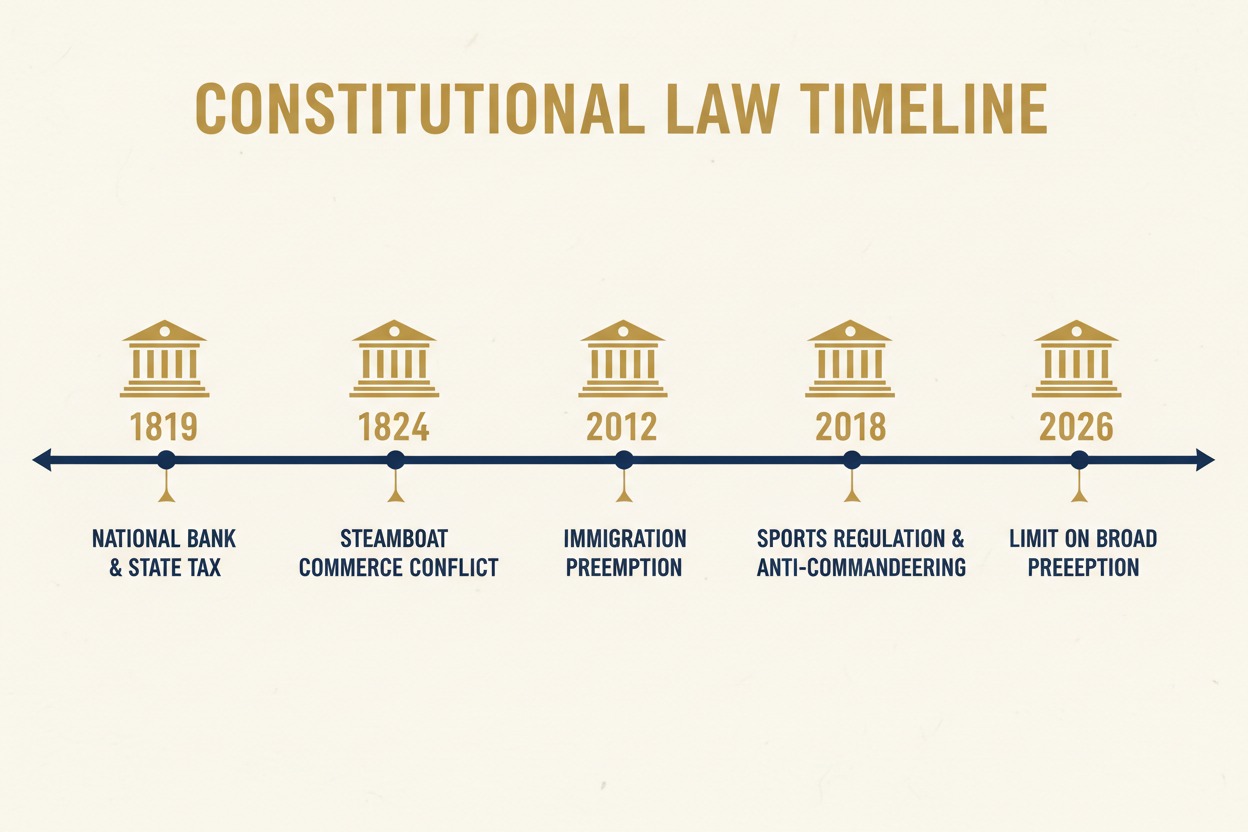
The Supremacy Clause was put into practice through court decisions. These cases show how an eighteenth-century sentence became a working rule for banks, commerce, immigration, medicine, sports regulation, and many other areas.
McCulloch v. Maryland
In 1819, Maryland tried to tax the federally created national bank. The Supreme Court held that the Constitution allowed Congress to create the bank through its enumerated and implied powers, and Maryland could not use taxation to control or burden that lawful federal instrument.
The case remains important because it connects federal power with constitutional limits. The state rule lost not because every federal activity is untouchable, but because the bank was lawfully created and the state tax interfered with national authority.
The historical constitutional analysis of McCulloch explains that the Supremacy Clause barred Maryland’s tax on the national bank.
Gibbons v. Ogden
In 1824, a state-granted steamboat monopoly conflicted with a federal coastal license. The Supreme Court ruled that the controlling federal license displaced the conflicting state monopoly.
This case helped establish that a valid federal rule governing interstate commerce could override inconsistent state restrictions. It also demonstrated that supremacy applies to practical economic disputes, not only abstract constitutional debates.
The early doctrine of the Supremacy Clause identifies Gibbons as a major example of federal law displacing a state-created monopoly.
Arizona v. United States
This 2012 case examined portions of an Arizona immigration law in light of the federal immigration framework. The Court held that several provisions were preempted because immigration enforcement and alien registration were governed by federal authority in ways that rendered the state provisions inoperable.
The case also shows that courts can treat different provisions of the same state law differently. One section may be preempted while another survives further review.
Murphy v. NCAA
In 2018, the Court struck down a federal law that prohibited states from authorizing sports gambling. The decision is useful because it separates lawful preemption from unconstitutional federal commands directed at state legislatures.
Congress may regulate private activity within its constitutional powers and preempt conflicting state rules. It generally may not order a state legislature to keep or repeal a particular state law.
Hencely v. Fluor Corporation
The Court’s 2026 decision rejected an overly broad theory that would have displaced state tort law without a sufficient constitutional or statutory basis. The opinion repeated that preemption needs an identifiable federal rule that actually conflicts with the state claim.
For readers, the lesson is simple. Courts should not invent federal supremacy from a vague policy interest when no controlling federal command supports it.
Real-Life Examples You Can Understand
Legal hierarchy becomes clearer when you apply it to ordinary situations. These examples are simplified for education, but they show how the analysis works.
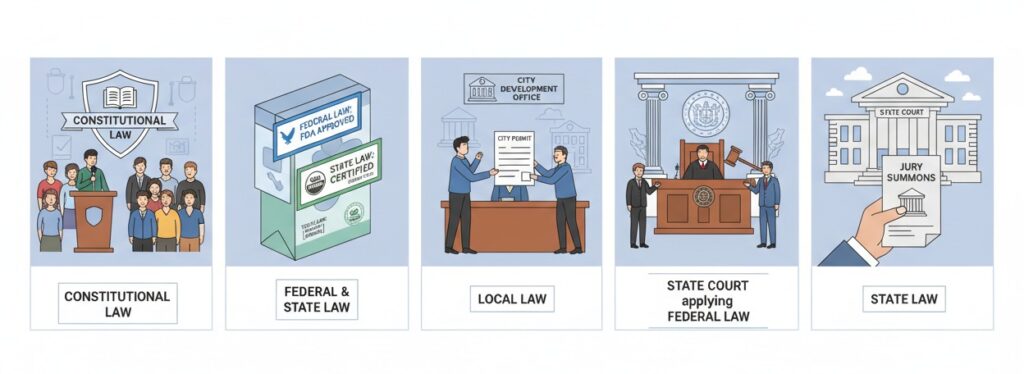
Example 1: A State Rule Conflicts With a Constitutional Right
Suppose a state passes a law banning peaceful criticism of government officials. The state cannot defend that restriction merely by saying public order is a local concern.
A court would test the law against constitutional free-speech protections. If the restriction violates the Constitution, the state rule cannot be enforced.
Example 2: Federal and State Safety Rules Work Together
Suppose federal law requires a basic warning label on a product, while a state requires an additional notice. The state rule does not automatically fail just because it is different.
A court would examine whether Congress intended the federal label to be the only permitted label, whether both requirements can be met, and whether the state notice frustrates the federal scheme. Without a real conflict or exclusive federal field, both may remain effective.
Example 3: A City Ordinance Violates State Law
Suppose a city creates a licensing requirement that state law expressly forbids local governments from imposing. This may be a state preemption issue rather than a federal Supremacy Clause case.
The city ordinance can still be struck down because local governments derive their authority from state law. Not every “higher law wins” dispute involves Article VI.
Example 4: A State Court Applies Federal Law
Suppose a federal statute creates a right that can be raised in state court. A state judge cannot refuse to consider it simply because the state legislature dislikes the federal policy.
Article VI specifically binds state judges to controlling federal law. This feature helps create nationwide legal consistency without requiring every federal issue to begin in a federal courthouse.
Example 5: Jury Service and Court Authority
A jury summons may come from a state court or a federal court, and the applicable excuses, forms, and procedures can differ. The Constitution does not provide a single detailed list of excuses for every court.
That is why a reader dealing with a real summons should check the issuing court and the governing rules rather than rely on a broad constitutional phrase. Our jury duty guide explains how practical court procedures and state-level differences affect the next step.
Why the Constitution Is the Supreme Highest Law of the Land
People sometimes ask, “What is the supreme highest law of the land?” The wording is repetitive because “supreme” already means highest, but the intended answer remains the Constitution.
The Constitution stands at the top for four connected reasons. It creates the national government, grants and separates powers, restricts government action, and provides the process for changing the constitutional text.
Congress receives its legislative authority from the Constitution. The President receives executive authority from it, and federal courts receive judicial authority from it.
State governments also operate within constitutional limits. Their own constitutions remain important, but they cannot authorize action forbidden by the national Constitution.
The Constitution Creates Government Power
Government bodies do not possess unlimited legal authority merely by virtue of their existence. Their powers must come from a constitution, charter, statute, or another lawful source.
At the national level, the Constitution establishes the branches and assigns their major responsibilities. It also creates checks and balances so that no single branch has all the power.
The Constitution Limits Government Power
The Constitution does more than create institutions. It restricts what those institutions may do, particularly through structural limits and protected rights.
This is why a popular law can still be unconstitutional. A majority vote cannot remove a constitutional protection through an ordinary statute when the Constitution requires a formal amendment.
The Constitution Controls the Lawmaking Process
A bill must pass through constitutional institutions before becoming a federal statute. Even after enactment, it remains subject to constitutional review.
This gives law two tests. It must be created through the proper procedure, and its substance must stay within constitutional boundaries.
The Constitution Can Be Amended, but Not Like an Ordinary Law
Article V provides a demanding amendment process. That process has allowed the constitutional system to change while protecting the document from ordinary political swings.
An amendment can alter an earlier constitutional rule. An ordinary statute cannot do that because it sits below the Constitution.
Benefits and Limits of Constitutional Supremacy
Constitutional supremacy brings stability, but it also creates hard questions. A fair explanation should include both its strengths and its limits.
Main Benefits
- It protects basic rights from ordinary political changes. A legislature cannot remove a constitutional protection through a normal vote when an amendment is required.
- It creates a shared legal foundation. States may make different policy choices, but they remain connected by a common constitutional framework.
- It gives courts a rule for resolving conflicts. Judges can identify controlling law rather than choosing between governments based on personal preference.
- It limits public officials. Presidents, lawmakers, governors, agencies, judges, and local officers remain subject to legal boundaries.
- It supports predictable government. People and businesses can plan around an organized hierarchy instead of facing fifty completely separate national systems.
Practical Limits and Difficulties
- Constitutional language may be broad. Terms such as due process, equal protection, unreasonable searches, and freedom of speech require interpretation in new settings.
- Judges can disagree. Different methods of interpretation may produce different conclusions about the same text or historical record.
- Preemption analysis can be technical. A small clause in a federal statute may determine whether a state remedy survives.
- Legal rules change over time. New statutes, amendments, regulations, and court decisions can alter the controlling answer.
- A constitutional claim is not automatically successful. A person still needs standing, a proper court, a valid cause of action, evidence, and a suitable remedy.
What Is the Supreme Law of the Land in the Philippines?
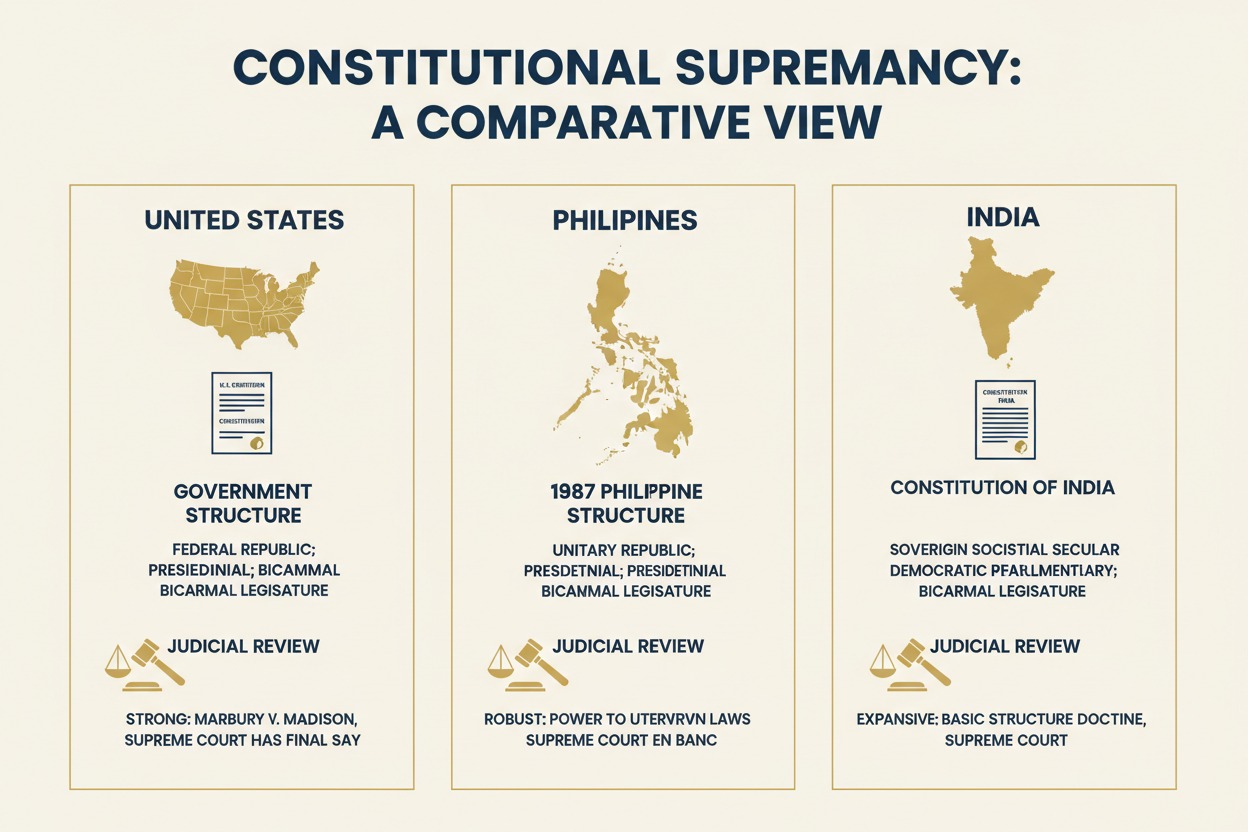
The 1987 Constitution is the supreme law in the Philippines. It establishes the governmental structure, protects rights, defines public powers, and provides standards against which statutes and government actions can be reviewed.
The 1987 constitutional text includes a preamble and eighteen articles. It also states that sovereignty resides in the people and that government authority comes from them.
One wording issue deserves attention. The Philippine Constitution says generally accepted principles of international law form part of the “law of the land,” but that phrase does not mean every international statement automatically outranks the Constitution.
The system differs from the American federal model because the Philippines uses a unitary constitutional structure rather than a union of states with separate sovereignty. Still, both systems treat the Constitution as the controlling legal framework.
What Is the Supreme Law of the Land in India?
The Constitution of India is the supreme legal authority. It binds the legislative, executive, and judicial branches and allows courts to invalidate laws or government action that violate constitutional limits.
The official constitutional overview describes the Constitution as the authority that binds all three organs of government. The complete constitutional document contains the operative articles, schedules, and amendments.
India and the United States both use written constitutions and judicial review, but their structures and constitutional texts differ. A legal answer from one system should not be copied into the other without checking the local constitution, statutes, and court decisions.
What Is the Most Basic Supreme Law of the Land?
The most basic supreme law of the land is the Constitution, as all lower public authorities depend on it. It answers who may govern, how power is divided, what procedures must be followed, and which rights government must respect.
A “basic law” is sometimes used as another name for a constitution. In this context, it does not refer to the easiest law or the shortest rule; it refers to the foundational legal instrument.
The Constitution is basic in another sense too. Many complicated legal disputes eventually return to a small number of structural questions: Who has power, what limit applies, what right is protected, and which rule controls?
A Practical Checklist for Checking a “Supreme Law” Claim
When someone says a rule is “federal, so it wins,” do not stop there. Use this checklist before accepting the claim.
- Identify the exact legal document. Find the constitutional provision, statute, treaty, regulation, executive order, court opinion, or state rule being discussed.
- Check whether the text is current. Confirm amendments, repeals, effective dates, later cases, and whether the cited section still exists.
- Ask where the authority came from. Congress, an agency, a state legislature, and a city council do not all have the same powers.
- Read the preemption and savings clauses. These provisions often tell you whether Congress meant to displace or preserve state law.
- Compare the actual commands. Do not compare general topics. Compare what each rule requires, forbids, allows, or protects.
- Check whether both rules can be followed. A difference is not always a conflict, and a stricter state rule may sometimes coexist with a federal minimum.
- Look for controlling court decisions. A statute may have already been interpreted in a way that narrows or expands its effect.
- Check the remedy. Even when a rule is unconstitutional or preempted, the available court order, damages claim, defense, or appeal may depend on separate law.
I recommend saving the relevant text as a PDF or screenshot when the issue affects a filing deadline, license, benefit, lawsuit, or business decision. Government pages can be reorganized, and having the exact version you relied on makes later review easier.
Expert Tips for Students, Readers, and Legal Researchers
The first expert tip is to avoid starting with summaries alone. Summaries are useful for orientation, but the controlling answer usually depends on the actual constitutional text, statute, regulation, and case.
Second, separate constitutional invalidity from federal preemption. A state law may be unconstitutional because it violates a protected right, or it may be preempted because it conflicts with a valid federal statute; those are related but different legal theories.
Third, use dates carefully. A case from decades ago may still state the basic doctrine, but a newer decision may refine how courts apply that doctrine to modern facts.
Fourth, do not treat the phrase “supreme law” as a substitute for jurisdiction. A court must still have jurisdiction over the parties and the dispute, and the person bringing the case must follow the correct procedure.
Fifth, read dissents and concurrences when a doctrine is contested. The majority opinion controls the judgment, but separate opinions can reveal which questions may return in future cases.
Finally, be cautious with personal stories online. Another person’s court result may have depended on a different state, judge, statute, deadline, contract, or factual record.
When You Should Speak With a Lawyer
You probably do not need a constitutional lawyer to answer a school civics question. You may need legal help when a federal-state conflict affects your property, professional license, immigration status, criminal exposure, government benefit, employment, medical care, or pending lawsuit.
Consider speaking with a qualified lawyer when:
- A government agency says federal law blocks your state-law right or remedy. Ask for the exact statute, regulation, and preemption provision.
- A state or local office is enforcing a rule that appears to conflict with a constitutional right. Deadlines for injunctions, appeals, and administrative review can be short.
- You are deciding whether to challenge a statute or government action. Constitutional cases require more than showing that a law feels unfair.
- Two agencies give you opposite instructions. Written guidance, notices, applications, and correspondence may become important evidence.
- A business operates in several states. Compliance may require following a federal floor plus different state rules rather than choosing only one system.
Bring the actual documents to the consultation. A lawyer can give a more useful answer when you provide the notice, statute number, agency letter, contract, deadline, prior decision, and a short timeline of events.
Frequently Asked Questions
What is the supreme law of land?
The Constitution is the supreme law of the land, and Article VI also gives controlling status to valid federal statutes and treaties when they conflict with state law. The Constitution itself remains above ordinary federal legislation.
What is supreme law of the land?
The Constitution is the supreme law of the land because it creates government authority and limits every branch and level of government. Lower laws remain valid only when they comply with constitutional requirements.
What is the supreme law of the land in the United States?
The Constitution is the supreme law of the land in the United States. Under Article VI, valid federal laws made pursuant to the Constitution and treaties made under national authority also bind state judges when state law conflicts with them.
Does federal law always override state law?
No. Federal law overrides state law when the federal rule is constitutionally valid, and Congress intended displacement or an actual conflict makes the state rule unable to operate.
State law may continue when Congress preserves it, when both rules can be followed, or when the national government lacks constitutional authority over the issue.
Can a state constitution override the Constitution?
No. A state constitution may provide broader protections under state law, but it cannot authorize conduct prohibited by the Constitution or override a controlling federal rule.
State courts may interpret their own constitutions independently in many cases. They must still respect federal constitutional minimums and valid federal law.
Conclusion
The answer to what is the supreme law of the land? is the Constitution. Article VI adds an important second layer by requiring state judges to follow valid federal statutes and treaties when those rules conflict with state law.
The most useful lesson is not the civics-test sentence alone. It is the method behind the sentence: identify the source, confirm constitutional authority, read the actual text, test for a real conflict, and check how courts have interpreted it.
Use this guide as a starting point, not as a substitute for advice about a live legal dispute. When a government rule affects your rights, money, case, license, or deadline, verify the current law and get help from a qualified professional who can review your exact facts.
