

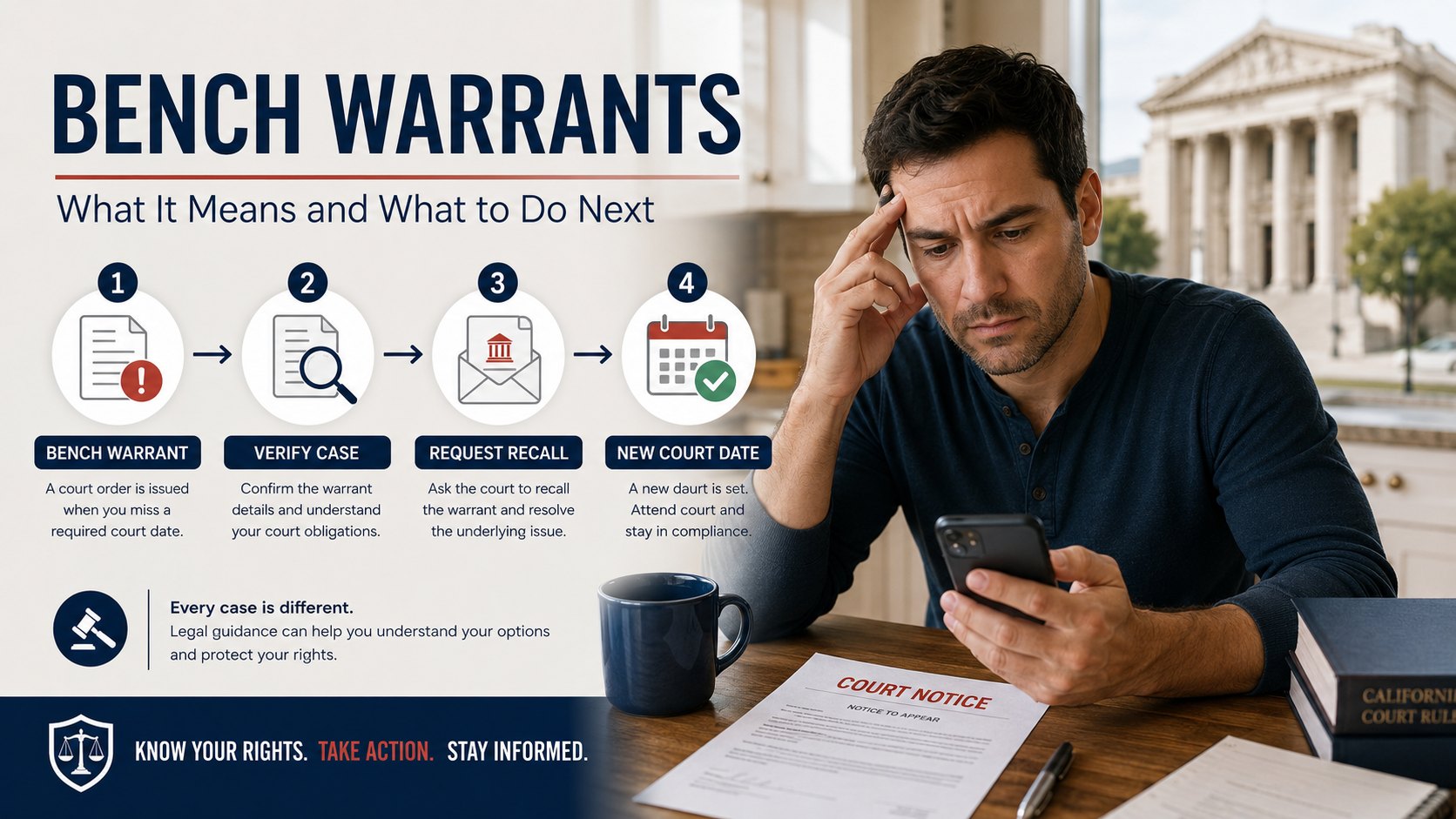
How to Clear a Bench Warrant Without Going to Jail
Finding out that a judge issued a bench warrant for you can turn an ordinary day into a stressful one. You may immediately wonder whether calling the court will get you arrested, whether police will show up at your home, or whether fixing the problem automatically means spending a night in jail.
If you are searching for how to clear a bench warrant without going to jail, the most important thing to know is that jail is not automatic in every bench warrant case. Depending on the court, the reason for the warrant, the original charge, your prior history, and local procedure, you may be able to ask the judge to recall or quash the warrant before an arrest occurs.
There is also no single procedure that works in every court. Some courts allow a written motion. Some provide warrant calendars. Others allow remote hearings, attorney appearances, administrative warrant recalls, payment options, or scheduled surrender procedures. For example, official court guidance shows that some defendants can schedule a hearing to ask a judge to quash a warrant, while another court system allows certain defendants to submit an online request to quash a warrant.
That difference is important. The safest first move is usually not rushing into a police station or blindly appearing at a courthouse. It is figuring out exactly what warrant exists, which court issued it, why it was issued, and what that specific court allows you to do about it.
Important: This guide provides general legal information. A bench warrant can expose you to arrest, and local rules differ significantly. If jail, probation, felony charges, immigration consequences, or significant bail are possible, getting advice from a criminal defense lawyer in the court where the warrant was issued can be especially important.
Quick Answer: Can You Clear a Bench Warrant Without Going to Jail?
Yes, it may be possible. The judge must generally cancel, recall, withdraw, or quash the warrant, but the procedure used to reach that result varies from court to court.
A bench warrant is commonly issued after someone fails to appear when ordered or fails to comply with another court requirement. An official court definition of a bench warrant describes it as a warrant issued by a judge for a defendant’s arrest after a required failure to appear. Other courts also note that failing to comply with a court order can trigger one.
Here is the practical difference between several possible situations:
| Situation | Possible Route | Jail Guaranteed? |
|---|---|---|
| You missed one court date | Motion to recall or quash, new hearing | No |
| Court records contain an error | Motion asking the judge to correct and recall warrant | No |
| You never received notice | Present address and notice evidence to judge | No |
| Minor traffic or fine matter | Payment, administrative recall, or hearing may be available | Not necessarily |
| Probation violation | Court hearing usually required | Possible |
| Serious underlying charge | Lawyer-arranged appearance or surrender may be needed | Possible |
| Repeated missed appearances | Judge may impose stricter release conditions | Possible |
| Court allows attorney appearance | Lawyer may seek recall without your personal appearance | Not necessarily |
The word possible matters. Nobody can responsibly promise that you will avoid custody because the judge and local rules control what happens.
When I compared current court instructions while researching this guide, that was the biggest weakness I noticed in many quick explanations online. They tell you to “call a lawyer and quash the warrant,” but they rarely explain what you should verify before anyone files anything.
What a Bench Warrant Actually Means
A bench warrant is different from the original criminal charge, citation, support matter, probation condition, or other case that brought you into court. It is an additional court order authorizing law enforcement to take you before the court because something in the court process was not completed.
The most common trigger is a missed appearance. Official criminal-case guidance explains that when a person misses a required court date, a judge may treat the absence as a failure to appear and issue an order for arrest.
Other situations can involve:
- Failing to follow a court order.
- Missing a probation hearing.
- Failing to complete court-ordered requirements.
- Missing a required payment hearing.
- Ignoring a summons or notice.
- Failing to appear in some child support proceedings.
If your issue relates to support enforcement rather than an ordinary criminal case, my detailed guide on how far behind in child support before a warrant is issued explains why court attendance and compliance often matter as much as the unpaid amount itself.
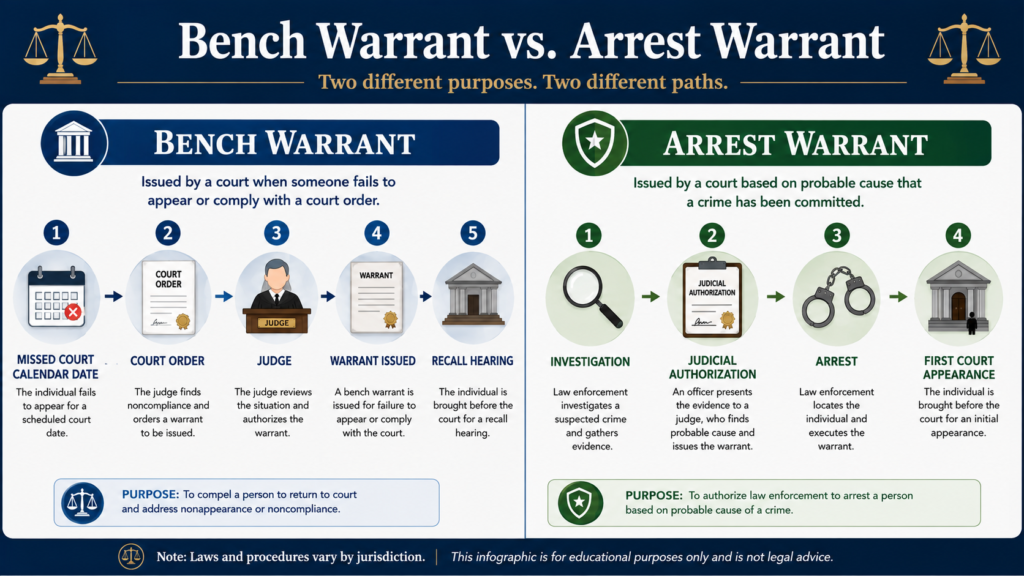
Bench Warrant vs. Arrest Warrant
People often use “bench warrant” and “arrest warrant” as if they mean exactly the same thing. Both can authorize an arrest, but they usually arise at different stages.
A traditional arrest warrant is commonly connected with initiating an arrest in a criminal investigation or case. A bench warrant usually comes directly from the judge after a person who is already connected to a court matter fails to appear or comply.
That distinction matters because a bench warrant may sometimes be addressed by putting the existing case back before the judge. The original problem does not disappear, but the judge may agree to remove the active warrant and schedule the underlying matter again.
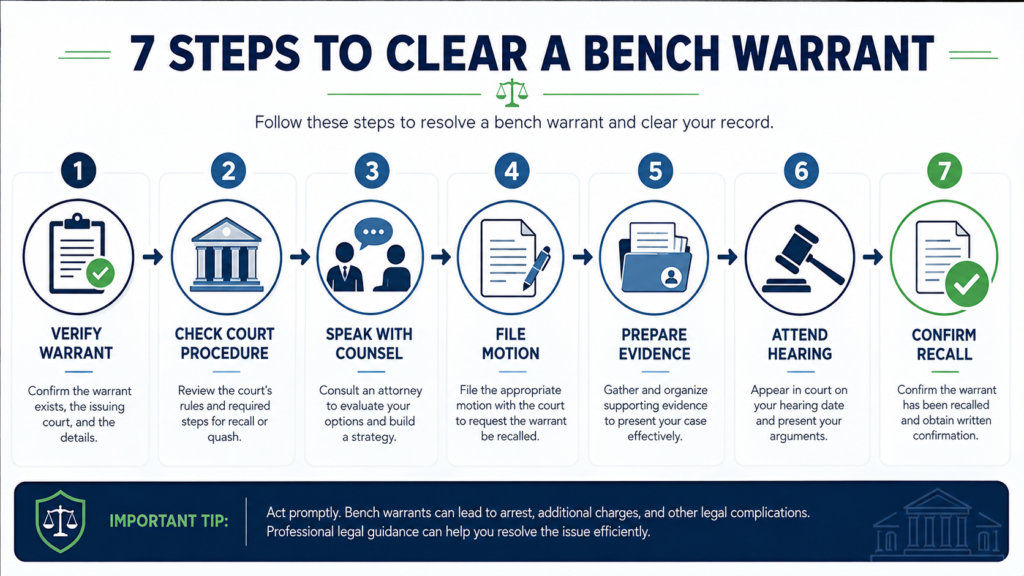
How to Clear a Bench Warrant Without Going to Jail Step by Step
There is no secret loophole that erases a warrant. The goal is to get the matter before the correct court in the safest available way and ask the judge to recall or quash the warrant.
I would approach the situation in the following order. Doing these steps out of order can create unnecessary risk.
1. Confirm That the Warrant Actually Exists
Do not rely only on what a friend, relative, bondsman, collection caller, or random search website tells you. Confirm the information through the court that supposedly issued the warrant, an official court case-search system, or a licensed attorney.
You want to identify:
- Your exact legal name on the case.
- Case number.
- Court name and location.
- Date the warrant was issued.
- Type of warrant.
- Reason listed for the warrant.
- Original charge or case type.
- Any bond or bail amount shown.
- Whether a new charge for failure to appear was filed.
- Whether another court date is already scheduled.
Some official court systems specifically tell people to use an online case portal when they do not know their case number.
This step also protects you from scams. Government guidance on warrant scams warns that callers may falsely claim that a warrant can be cleared by sending an immediate prepaid-card payment, while legitimate payments relating to warrants are handled through the court.
2. Find Out What the Court Allows Before Appearing in Person
This is one of the most useful steps and one that many warrant articles skip. Court procedures differ even between counties in the same state.
Ask or research whether the court has:
- A warrant recall calendar.
- Walk-in warrant hours.
- A motion-to-quash procedure.
- Online motion filing.
- Video or telephone hearings.
- Attorney-only appearances.
- Administrative warrant recall.
- A payment option for eligible cases.
- A surrender procedure.
- Warrant amnesty days.
- A requirement to post bond first.
One court, for example, expressly allows warrant recall hearings by video or telephone and provides a motion form for people who do not have an attorney. Another local court allows online criminal motions specifically requesting that a judge quash a warrant.
That is why I would never assume that advice from a different county automatically applies to your case.
3. Talk to a Lawyer Before a High-Risk Appearance
Hiring a lawyer does not magically cancel a warrant. What a lawyer can sometimes do is determine the local procedure, communicate with court staff, file the proper motion, address bond issues, and tell you whether you personally need to appear.
If you cannot afford private representation and the underlying proceeding exposes you to incarceration, check whether you qualify for appointed counsel. Eligibility rules vary, but official public-defender guidance in some jurisdictions specifically covers qualifying criminal and traffic cases where incarceration is possible.
You can also use a lawyer referral resource to find licensed local counsel rather than relying on an advertisement from someone who may not regularly practice in the issuing court.
4. Ask Whether a Motion to Recall or Quash Is Available
A motion is a formal request asking the judge to take a particular action. In a warrant case, that action may be recalling, withdrawing, or quashing the active warrant.
Some courts expressly list a request to quash a warrant as a normal criminal motion.
Your motion or attorney’s request may explain:
- Why you missed court.
- Why the absence was not intentional.
- Whether you received proper notice.
- Whether your address changed.
- Whether you were hospitalized.
- Whether you were in another court or custody elsewhere.
- Whether transportation failed unexpectedly.
- Whether the warrant resulted from a clerical mistake.
- What you have done to correct the problem.
- Why you are likely to attend future hearings.
Do not invent an emergency. A weak but truthful explanation is far safer than a dramatic story that court records, medical records, employment records, or other evidence can contradict.
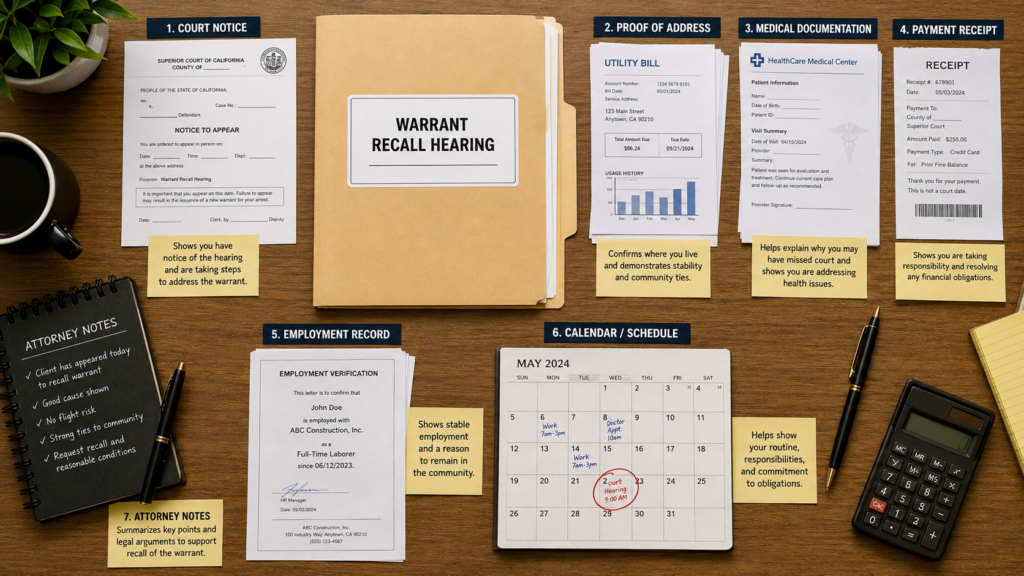
5. Build a Small Evidence Packet
If there was a legitimate reason for missing the hearing, documentation can make your explanation easier for the judge to evaluate. I would keep the packet short and organized instead of bringing a pile of unrelated papers.
Useful documents may include:
- Hospital discharge paperwork.
- Medical appointment documentation.
- Employer records.
- Proof of incorrect address.
- Returned mail.
- Travel disruption records.
- Proof that you were incarcerated elsewhere.
- Documentation of a family emergency.
- Evidence that you already completed the requirement at issue.
- Proof of payment if the warrant concerns money.
- Copies of earlier court notices.
- Your current contact information.
Your goal is not to prove that life has been difficult in general. Your goal is to explain the specific failure that caused the warrant.
6. Attend the Recall Hearing or Follow the Court’s Approved Procedure
If the court schedules a hearing, treat it as seriously as a trial date. Arrive early if it is in person, test your camera and microphone if it is remote, and have every requested document ready.
Some local systems specifically allow defendants to request a hearing at which the judge decides whether to quash the warrant. Until the judge actually grants the request, however, the warrant may remain active. One court rule expressly states that merely scheduling a quash hearing does not change warrant status.
This distinction matters. Filing a motion is not the same as having the motion granted.
7. Confirm That the Warrant Was Actually Recalled
Do not leave the process halfway finished. After the judge grants your request, confirm the docket shows the warrant as quashed, recalled, vacated, withdrawn, or otherwise inactive.
Also write down:
- Your next court date.
- Courtroom or virtual hearing information.
- Payment deadline.
- Probation requirement.
- Program deadline.
- Attorney contact information.
- Any new release conditions.
Clearing the warrant usually addresses the arrest order. You may still need to finish the underlying case.
The Bench Warrant Decision Tree Most People Actually Need
Instead of asking only “Can I clear it?” ask which route fits the facts of your case. The table below gives you a practical starting point, although the issuing court’s rules always control.
| What You Discover | Your Next Question | Possible Route |
| Warrant appears to be a mistake | Can the judge review records without custody? | Motion to correct and quash |
| You missed one hearing | Does the court offer a recall calendar? | Schedule recall hearing |
| Minor misdemeanor case | Can counsel appear for you? | Attorney appearance if permitted |
| Traffic matter | Is payment or administrative recall available? | Pay or follow clerk procedure |
| Significant bond is listed | Can bond be reviewed before surrender? | Attorney motion or arranged appearance |
| Probation violation | Must you personally appear? | Revocation/warrant hearing |
| Child support matter | What compliance triggered the warrant? | Family court or enforcement hearing |
| Multiple missed dates | What release conditions will the judge consider? | Lawyer-prepared appearance |
| You live far away | Are remote hearings allowed? | Video or phone hearing if approved |
One mistake I see in general legal content is treating “turn yourself in” as a universal first step. It may eventually be required, but you should first determine whether the court offers another authorized procedure.
There are places where courts specifically encourage people to appear and clear warrants, and local policies can reduce the risk of arrest while entering court for that purpose. For example, one public defender office states that deputies do not arrest people simply while they are walking into that courthouse to clear a warrant. That is a local policy, not a rule you should assume exists everywhere.
What Makes Avoiding Jail More or Less Likely?
No legitimate article can give you a percentage chance of avoiding jail based only on the phrase “bench warrant.” Judges look at the surrounding case.
The following issues can affect what happens:
- The seriousness of the underlying charge.
- Why the warrant was issued.
- Whether this was your first missed date.
- How long the warrant has been outstanding.
- Whether you voluntarily addressed it.
- Whether you received notice.
- Whether you can document your explanation.
- Whether you previously violated release conditions.
- Whether another warrant exists.
- Your probation or supervision status.
- Whether the court permits attorney appearances.
- Whether bond has already been set.
- Whether the judge believes you will return.
Voluntarily fixing the problem is not a guarantee of release. It does, however, put you in a much better position to explain what happened than waiting until the issue appears during an unrelated law-enforcement encounter.
I would also avoid waiting for the warrant to “expire.” At least some jurisdictions explicitly state that bench and arrest warrants have no expiration date and remain unresolved until the required court process occurs.
If You Have a Bench Warrant Will They Come to Your House?
They can. A bench warrant authorizes your arrest, so you should not assume that staying home prevents the warrant from being executed.
Whether officers actively go to your residence depends on the warrant, underlying case, local enforcement priorities, available resources, and other circumstances. Some sheriff departments maintain warrant divisions specifically responsible for locating people with outstanding warrants, while other low-level warrants may first surface during another police contact.
Police can also have legal authority to enter a residence in certain circumstances when they possess an arrest warrant for someone who lives there. Official rights guidance explains that officers with an arrest warrant for a resident may be able to enter without the resident’s permission under applicable legal rules.
That does not mean officers will knock on your door tonight simply because a bench warrant exists. It means you should treat an active warrant as a real arrest risk rather than assuming police must wait for a traffic stop.
If officers arrive, do not physically resist, threaten anyone, destroy evidence, or lie about your identity. You can ask to speak with a lawyer and should get case-specific legal advice about questioning and searches.

If You Have a Warrant Can You Just Pay It?
Sometimes, but not always. The answer depends on why the warrant was issued and what the issuing court allows.
Some courts permit eligible warrants to be resolved through payment or an administrative procedure. One official local rule, for example, allows certain qualifying warrants to be administratively quashed after a $50 fee and completion of specified court requirements.
Other courts expressly state that a warrant can be recalled after the required amount is paid in certain traffic matters.
However, paying the original fine does not automatically erase every type of warrant. You may still need a judge to recall it, appear at a hearing, sign for another date, post bond, or comply with a separate order.
If your issue started with a traffic citation, my guide on how long before an unpaid ticket becomes a warrant explains why paying a ticket, responding to a citation, missing court, and receiving a warrant are separate stages of the process.
Before paying anything, confirm three things with the issuing court:
- Whether payment alone recalls the warrant.
- The exact amount the court requires.
- How long the court system takes to update warrant status.
Never send money because someone claiming to be law enforcement calls and demands immediate payment through gift cards, cryptocurrency, or another unusual payment method. Official scam warnings specifically caution against that tactic.
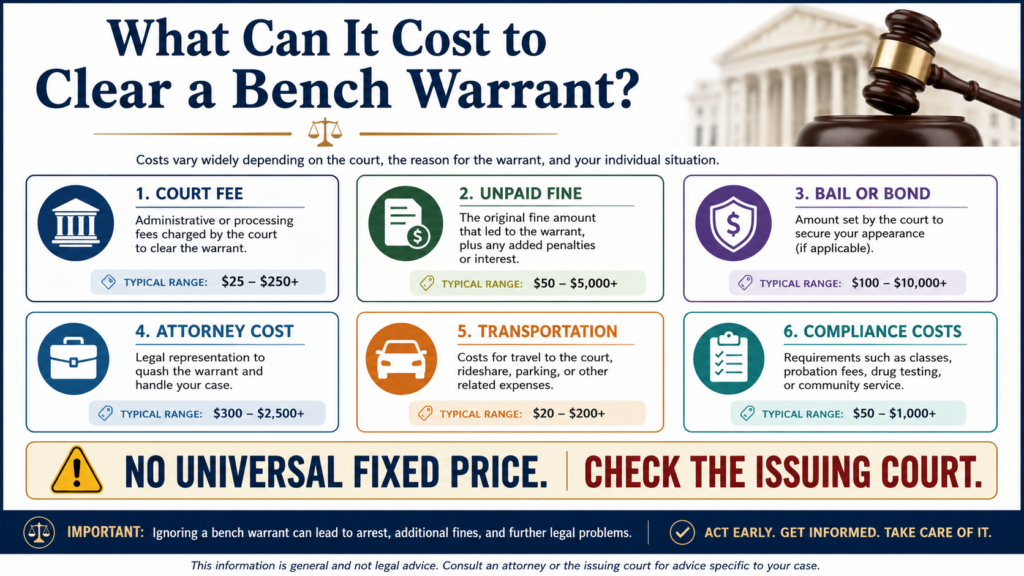
How Much Does It Cost to Lift a Bench Warrant?
There is no universal price for lifting a bench warrant. The direct court cost can range from no separate recall fee in some procedures to an administrative fee, outstanding fine, bond requirement, or other court-ordered amount in another case.
As one concrete example, a published local court rule uses a $50 administrative warrant-quash fee for certain eligible warrants. The same rule also shows why you should not turn that number into a general answer because different warrant amounts and circumstances use a different hearing procedure.
Your total cost might include:
| Possible Cost | When It May Apply |
| Warrant or administrative fee | Some local courts |
| Outstanding fine | Fine or traffic cases |
| Court costs | Depending on case |
| Bail or bond | When ordered |
| Lawyer fee | Private representation |
| Transportation | If personal appearance is required |
| Program or probation cost | Underlying compliance issue |
A lawyer’s fee also varies widely based on location, case complexity, charge level, hearings required, and whether representation covers only the warrant or the entire criminal case.
If money is the main reason you have delayed dealing with the case, do not assume that means you have no options. Ask whether appointed counsel, payment plans, bond review, community service, or another approved procedure is available.
How Long Will You Be in Jail for a Bench Warrant?
If you are asking how long will you be in jail for a bench warrant, there is no single number. You may spend no time in jail if the warrant is recalled before an arrest, while someone who is arrested may remain in custody until release conditions, bond, transportation, or the required court appearance are addressed.
The timeline can depend on:
- When you are arrested.
- Whether court is currently in session.
- Whether you are arrested in the issuing county.
- The warrant instructions.
- Whether bond is preset.
- Whether you can post the required amount.
- Whether the judge orders release.
- Whether another hold or warrant exists.
- The seriousness of the underlying case.
This is why advice such as “you will only spend a few hours in jail” is unreliable. A person with a simple missed-date warrant and no other complications is in a very different position from someone facing a probation violation, felony case, multiple warrants, or no-bond order.
The best way to reduce uncertainty is to investigate the warrant before an unexpected arrest whenever possible. A local lawyer can also check whether an arranged appearance, motion, or bond request can be handled before you enter custody.
How Long Do You Stay in Jail for a Bench Warrant for Missing Court?
Missing court does not create one automatic jail sentence. The bench warrant primarily gives the court a way to bring you back before the judge.
What happens afterward depends on why you missed court and what else is happening in the case. The court may recall the warrant, schedule a new date, reconsider bail, impose conditions, address a separate failure-to-appear allegation, or continue with the original matter.
Your explanation can therefore matter. If you were hospitalized and can prove it, that is different from intentionally ignoring repeated notices.
Official court guidance also shows why missing even a seemingly minor hearing should not be treated casually. A missed appearance can lead to an order for arrest and additional consequences depending on the case.
What Evidence Can Help at a Bench Warrant Hearing?
Judges usually need facts, not a long emotional speech. Give the court a clear timeline explaining why you failed to comply and what you have done since.
For example, instead of saying, “I had a lot going on,” a stronger explanation is supported by specific records showing what happened on the date of the hearing.
Evidence can include:
- A hospital admission dated the same day.
- Documentation showing the court notice went to an old address.
- A letter showing you were required to work during an unexpected emergency.
- Records showing you were already detained somewhere else.
- Proof that a court-required program was completed.
- Documentation showing you already paid the amount in dispute.
- A transportation cancellation record.
- Evidence of a genuine scheduling conflict involving another court.
You should also be ready to explain what will be different next time. Judges are not only looking backward at why you missed court. They may also care about whether you are likely to comply going forward.
Common Mistakes That Can Make a Bench Warrant Harder to Resolve
Ignoring It Because the Original Case Was Minor
A minor ticket or misdemeanor can become much more disruptive once an active warrant exists. The problem may appear during another encounter when you have no documents, lawyer, transportation plan, or money available.
Resolve the warrant while you have some control over the timing.
Assuming Filing a Motion Automatically Cancels the Warrant
It does not. Some court rules expressly state that a warrant remains active until the judge grants the request, the warrant is served, or another authorized condition occurs.
Check the case record after the judge rules.
Walking Into the Wrong Place Without Checking Procedure
I would not treat a police station, courthouse, clerk window, or jail as interchangeable. What happens when you appear can vary by court.
Research the issuing court’s procedure first.
Paying a Random Caller
Warrant scams deliberately exploit fear. Verify every payment through official court contact information, not through a phone number supplied by the person threatening arrest.
Making Up an Excuse
False evidence can create a much larger problem than an ordinary missed hearing. Use truthful facts and supporting records.
Missing the New Court Date
If the judge gives you another opportunity, treat the replacement date as a priority. A second failure to appear can make arguments for leniency much harder.
Special Bench Warrant Situations
Traffic Tickets
Traffic cases sometimes have simpler administrative options than serious criminal matters. Depending on the court, you may be able to pay an amount, request a hearing, submit an online motion, or appear on a designated calendar.
Do not assume paying the original ticket automatically recalls a warrant. Ask the clerk what must happen for the actual warrant status to change.
Probation Violations
A probation warrant may involve more than simply explaining why you missed court. The judge may need to address an alleged supervision violation as well.
This is a situation where I would strongly consider talking with a lawyer before appearing because the court may be deciding both warrant status and whether your release or probation conditions should change.
Child Support Cases
Bench warrants can also arise after missed support-related proceedings or failures to comply with court orders. The key question may be whether the court is trying to secure your appearance for an enforcement or contempt proceeding rather than prosecute a new crime.
For a deeper explanation of how that process develops, read when child support problems can lead to a warrant.
Old Warrants
Do not assume an old bench warrant has disappeared simply because nobody contacted you recently. Some jurisdictions expressly state that bench warrants remain active without an ordinary expiration date.
Verify its current status before making travel, court, licensing, or other plans that could expose the unresolved warrant.
What Happens After the Bench Warrant Is Cleared?
Clearing the warrant is often only the first problem solved. Your original case, probation condition, ticket, payment obligation, or support proceeding may continue.
Before considering the matter finished, confirm:
- The docket shows the warrant as inactive.
- You know your next hearing date.
- You understand any release conditions.
- Your mailing address is correct.
- Your phone and email are updated where appropriate.
- Your lawyer has the same date you have.
- You understand every payment or program deadline.
- You have saved the court’s written order.
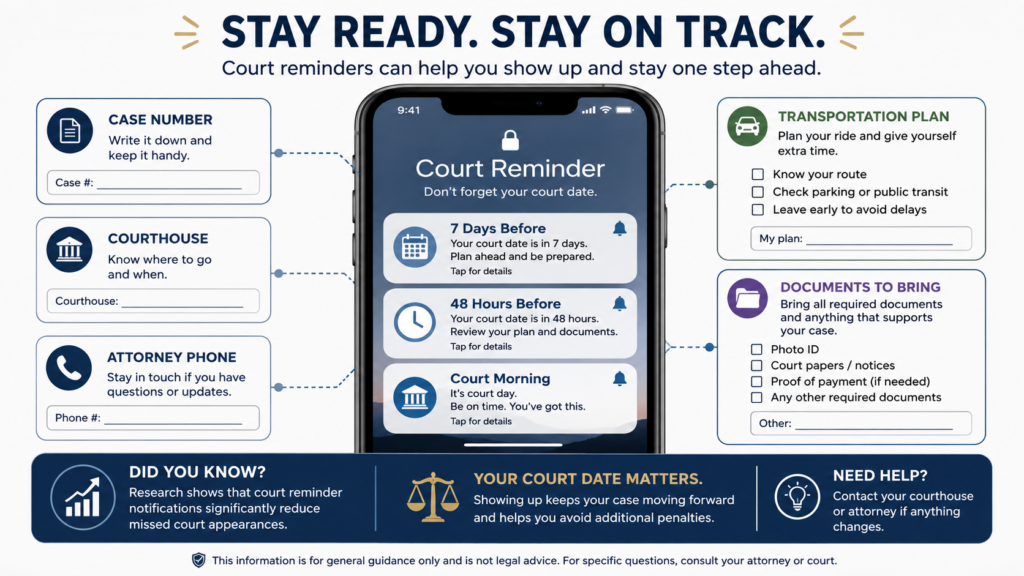
I also recommend setting several reminders instead of relying on one calendar notification. A randomized study involving 5,709 public-defender clients found that automated text reminders reduced the rate of warrants issued for missed court dates from 12.1% to 9.7% in the study group comparison, and incarceration following missed dates also declined. The results do not guarantee what will happen in your case, but they show how a very simple reminder system can prevent a serious problem from repeating. The full court-reminder study is available here.
My own practical recommendation would be simple: create one phone reminder a week before court, another 48 hours before, and a final reminder the morning of the hearing. Also save the court address and your case number inside the calendar event.
Expert Tips Before You Try to Lift a Bench Warrant
The first tip is to focus on the issuing court, not generic information about your state. Local court procedures can decide whether you need a motion, personal appearance, attorney appearance, payment, or a specific warrant calendar.
The second tip is to separate three different questions:
- How do I get the warrant recalled?
- What happens to my original case?
- What happens to my bail or release conditions?
Those questions may be decided at the same hearing, but they are not necessarily the same legal issue.
The third tip is to keep proof. If the judge quashes the warrant, save a copy of the order or docket entry showing what happened.
Finally, do not let embarrassment keep you from dealing with the problem. Courts regularly handle missed appearances. Waiting until an arrest happens removes many of the planning options you may have had earlier.
Frequently Asked Questions
1. How to clear a bench warrant without going to jail?
Start by confirming the warrant through the issuing court or an attorney. Then determine whether that court permits a motion to recall or quash, a remote hearing, attorney appearance, administrative recall, payment option, warrant calendar, or scheduled surrender.
Some courts officially allow defendants to file a motion and schedule a hearing specifically for warrant recall.
Avoiding jail cannot be guaranteed. The safest route depends on the warrant, underlying charge, judge, prior appearances, release conditions, and local procedure.
2. If you have a warrant can you just pay it?
Sometimes. Certain traffic, fine, and lower-level warrant procedures allow payment or an administrative fee to help clear an eligible warrant.
One local court rule, for example, allows qualifying warrants to be administratively quashed through a $50 procedure, while other warrant cases must go before a judge.
Always ask whether the payment itself cancels the warrant. Paying an underlying fine and having an arrest warrant officially recalled are not necessarily the same action.
3. If you have a bench warrant will they come to your house?
They may. A bench warrant authorizes arrest, and warrant units can actively seek people named in outstanding warrants.
An active warrant may also be discovered during other contact with law enforcement. Do not assume that police must wait until you leave home or get pulled over.
4. How much does it cost to lift a bench warrant?
There is no single price. Costs can include an administrative fee, outstanding fine, court costs, bond, private attorney fee, transportation, or other requirements connected with the original case.
Some courts charge a small administrative amount for specific eligible warrants, while others require a judge to decide what happens.
Contact the issuing court or a local attorney for the amount connected with your actual case.
5. How long will you be in jail for a bench warrant?
There is no universal jail period. A person whose warrant is recalled before arrest may spend no time in jail at all.
If you are arrested, the length of custody can depend on the issuing court, bond, court schedule, transportation, additional warrants, seriousness of the case, and whether the judge orders your release.
Do not rely on websites promising that every bench warrant arrest lasts only a few hours.
6. How long do you stay in jail for a bench warrant for missing court?
Missing court does not automatically create one fixed jail sentence. The judge may need to address the missed appearance, original case, release conditions, and any separate failure-to-appear consequence.
The safest way to reduce uncertainty is to deal with the warrant proactively and determine whether the court will consider a recall motion before an arrest.
7. Can a lawyer clear my bench warrant without me appearing?
Sometimes. Certain courts and certain types of cases may allow an attorney to request that the warrant be recalled without the defendant making the same type of personal appearance that would otherwise be required.
Other cases require the defendant to appear. Serious charges, probation matters, or specific court orders can make personal attendance necessary.
Ask a lawyer who regularly practices before the judge or court that issued the warrant rather than assuming a rule from another jurisdiction applies.
8. Will calling the court cause me to be arrested?
A phone call to a clerk is not the same thing as physically appearing for arrest, but you should still think carefully about what information you need and what you say. Court clerks can generally explain scheduling and procedural information, but they cannot give you legal advice.
Some courts specifically encourage defendants to contact the court or use an official case portal when resolving an outstanding warrant.
If the underlying case is serious or you are uncertain about the consequences of appearing, a lawyer can make the initial inquiry for you.
9. Can a bench warrant be removed because I never received notice?
Lack of notice can be an important fact, particularly if you can document that court papers were sent to the wrong address or you were never properly informed of the hearing. It does not automatically cancel the warrant by itself.
Ask the judge to review the circumstances through the court’s approved recall procedure. Bring address records, returned mail, previous court notices, or other evidence supporting your explanation.
10. Does clearing the bench warrant dismiss my original case?
Usually, no. Clearing the warrant generally removes the active court order connected with your failure to appear or comply.
The underlying ticket, criminal charge, probation matter, support dispute, or other proceeding can still continue. Make sure you know the next court date and what remains unresolved before treating the case as finished.
Final Thoughts
The safest answer to how to clear a bench warrant without going to jail is not to look for a trick that avoids the court. It is to use the court’s own procedure before an unexpected arrest takes away your ability to plan.
Confirm the warrant first. Identify the exact court and reason it was issued. Find out whether that court allows a recall motion, remote hearing, attorney appearance, payment procedure, administrative quash, warrant calendar, or arranged appearance.
Then prepare proof, deal with the underlying issue, and confirm in writing that the warrant was actually recalled.
If the warrant involves a serious criminal charge, probation, repeated missed appearances, significant bail, or another situation where custody is a realistic possibility, consider speaking with qualified local counsel before you appear. A few informed steps taken before the hearing can make the process far more predictable than waiting to find out what happens after an arrest.
