

How Much Does an Estate Have to Be Worth to Go to Probate?
If you are wondering how much does an estate have to be worth to go to probate, there is no single dollar amount that applies everywhere. Each state sets its own rules, and the decisive figure is usually the value of the deceased person’s probate assets, not everything they owned.
A valuable estate can avoid probate if its assets transfer through a trust, beneficiary designation, or survivorship rights. Meanwhile, a much smaller estate may still require a court filing when property was owned solely by the deceased and has no automatic transfer mechanism.
Legal disclaimer: This article provides general legal information and is not legal advice. Probate requirements change and differ by state, so confirm the current rules with the appropriate probate court or a licensed estate attorney.
Quick Answer: How Much Does an Estate Have to Be Worth to Go to Probate?
There is no nationwide minimum estate value that automatically triggers probate. Instead, state law determines whether the estate can use a small-estate affidavit, summary administration, voluntary administration, or another simplified procedure.
The first question is not “What was everything worth?” It is “Which assets actually belong to the probate estate?” After identifying those assets, you can compare their qualifying value with the applicable state threshold.
Estate Value Alone Does Not Decide Whether Probate Is Required
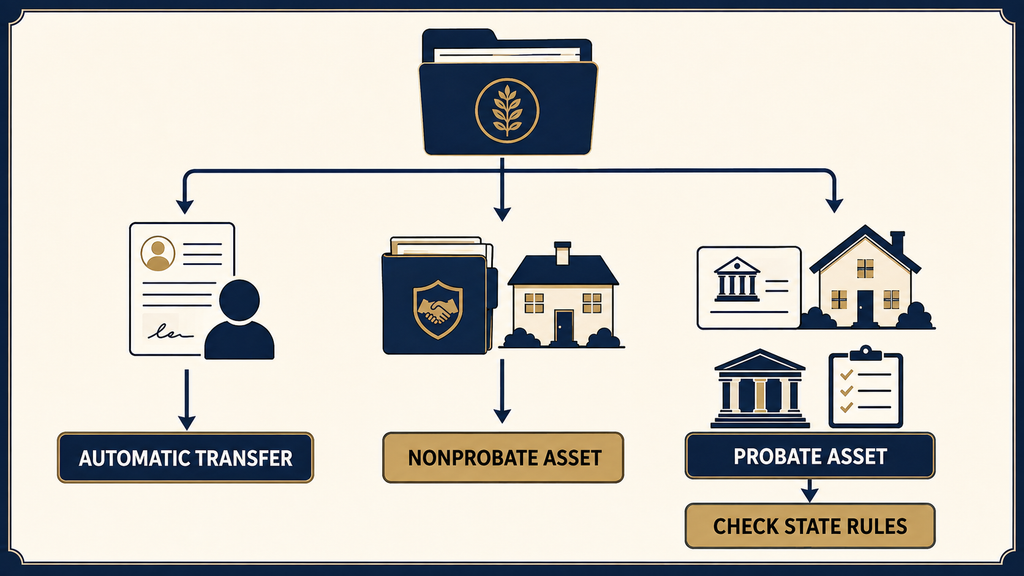
Probate is a court-supervised process used to validate a will, appoint an executor or administrator, address estate obligations, and transfer qualifying property. The probate estate generally consists of assets held in the deceased person’s name without a valid method for transferring them automatically.
That distinction matters because “estate” can mean several different things. A person’s gross estate, taxable estate, and probate estate are not necessarily worth the same amount.
Consider someone who owned a $600,000 home jointly with survivorship rights, a $200,000 retirement account with a valid beneficiary, and a $15,000 individual bank account without a beneficiary. Although the person controlled assets worth $815,000, the potential probate estate may consist only of the $15,000 bank account.
The opposite situation can also occur. Someone may leave only a modest parcel of land titled solely in their name, but transferring its title could still require a probate or other court proceeding because real estate often receives different treatment under small-estate rules.
Which Assets Count Toward the Probate Estate?
You should begin by reviewing how each asset was owned on the date of death. According to the Legal Information Institute’s explanation of probate assets, assets owned solely by the deceased without a survivorship feature are generally controlled through the probate process.
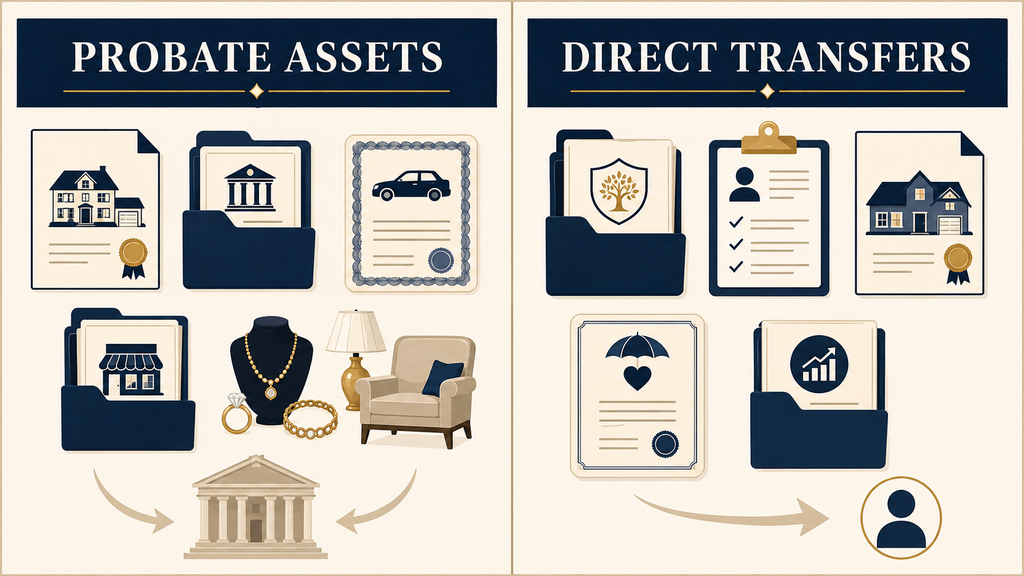
Common probate assets include:
- Bank or brokerage accounts held solely in the deceased person’s name without a payable-on-death or transfer-on-death beneficiary
- Real estate titled solely in the deceased person’s name
- A tenant-in-common interest in property
- Vehicles registered only to the deceased without an authorized transfer arrangement
- Business interests held personally by the deceased
- Household possessions, jewelry, collections, and other personal property
- Money owed to the deceased, including certain unresolved legal claims
- Life insurance or retirement benefits payable to the estate
Debts do not always reduce the value used for a state’s small-estate limit. Some states use gross probate property, while others exclude specific debts, exempt property, homesteads, or liens. I recommend following the exact valuation language in your state statute or court instructions rather than simply subtracting every bill from the estate’s assets.
What normally passes outside probate?
Many assets transfer under a contract, deed, trust, or ownership arrangement rather than through a will. The American Bar Association’s guidance on wills explains that a will does not ordinarily control property governed by a beneficiary designation or survivorship title.
Assets that commonly pass outside probate include:
- Property held in a properly funded living trust
- Jointly owned property with a valid right of survivorship
- Payable-on-death bank accounts
- Transfer-on-death securities accounts
- Life insurance with a living designated beneficiary
- Retirement accounts with valid beneficiaries
- Real estate covered by a valid transfer-on-death deed, where permitted
- Certain spousal property transferred through a special state procedure
These assets should not be assumed to avoid probate without checking the documents. An expired designation, a deceased beneficiary, an improperly funded trust, or a designation naming “the estate” may cause the property to become a probate asset.
Small-Estate Thresholds: Current State Examples
A small-estate threshold does not necessarily mean that estates below it need no legal process. It commonly means that an heir may use a shorter procedure instead of full or formal administration.
The following examples demonstrate why a single national answer would be misleading. These limits and qualifications apply to specific procedures and should not be treated as complete summaries of each state’s probate law.
| State example | Selected simplified procedure | Value rule and important limitation |
|---|---|---|
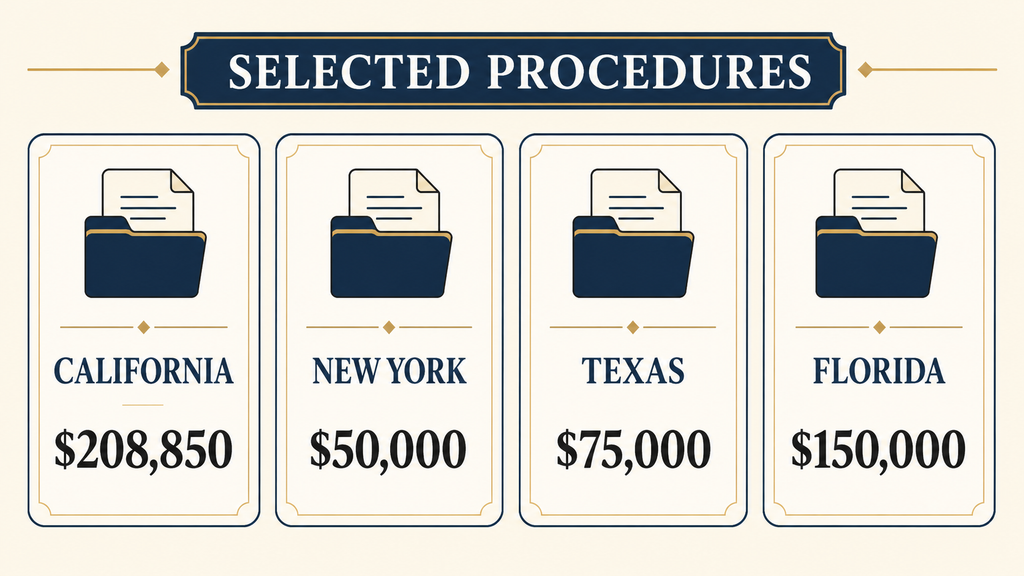
| California | Personal-property small-estate affidavit | For deaths on or after April 1, 2025, qualifying personal property may be collected when the statutory estate calculation does not exceed $208,850. Separate limits and procedures apply to real property. |
| New York | Voluntary administration | Generally available when the deceased left $50,000 or less in personal property. A house or land owned solely by the deceased prevents the estate from qualifying as a personal-property small estate. |
| Texas | Small-estate affidavit | Generally limited to estates of $75,000 or less after excluding qualifying homestead, exempt, and nonprobate property. The person must have died without a will, and several additional conditions apply. |
| Florida | Summary administration | Under the 2026 statute, the estate subject to administration, less exempt property, generally must not exceed $150,000, or the person must have been dead for more than two years. |
The California amount comes from an official small-estate declaration used for deaths on or after April 1, 2025. California also provides a separate procedure for real property of comparatively small value, demonstrating why personal and real property should not be combined casually.
Under New York’s voluntary-administration instructions, solely owned real estate changes the available procedure even when the personal property is below the limit. Jointly owned real estate may not have the same effect if it transfers to the surviving owner.
Texas permits a small-estate affidavit only when multiple requirements are satisfied. Its current small-estate guidance explains that the $75,000 calculation excludes specified property and that the procedure is intended for an intestate estate, meaning the deceased did not leave a valid will.
Florida deserves particular attention because older online articles may still display a $75,000 limit. The 2026 Florida summary-administration statute now states a $150,000 limit, after excluding property exempt from creditors’ claims, or allows summary administration when the deceased has been dead for more than two years.
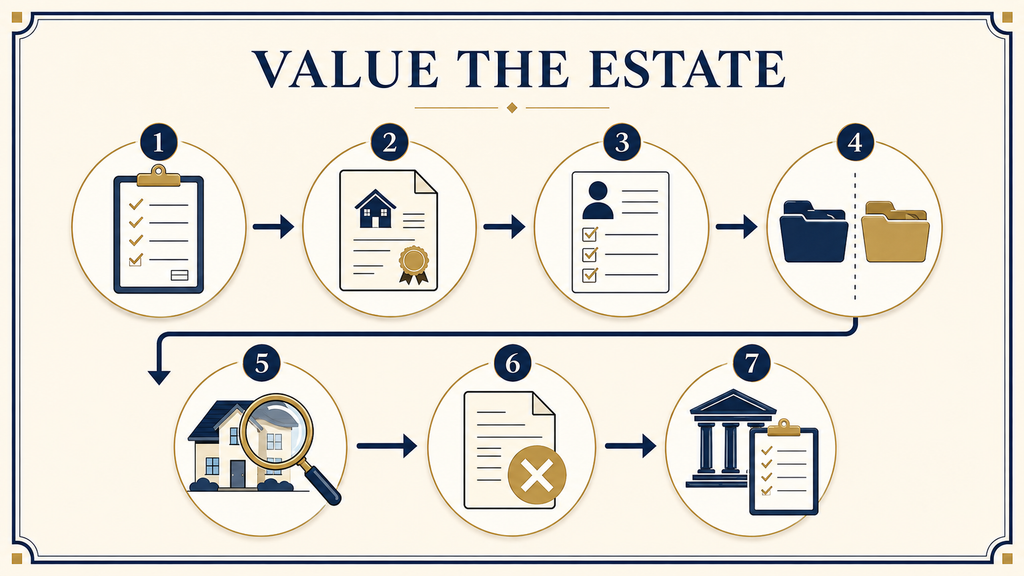
How to Calculate the Estate Value for Probate
Calculating an estate for probate requires more than adding the balances shown on recent statements. You must identify ownership, beneficiary arrangements, applicable exclusions, and the valuation date required by state law.
1. Create a complete asset inventory
List the deceased person’s real estate, accounts, vehicles, investments, business interests, valuables, and money owed to them. Include assets that may ultimately fall outside probate because you still need to confirm their ownership and transfer instructions.
2. Examine titles and account registrations
Check deeds, vehicle titles, bank records, brokerage registrations, and business documents. Words such as “joint tenants with right of survivorship” can produce a different result from “tenants in common.”
3. Verify every beneficiary designation
Contact the relevant financial institution or insurer to confirm whether a valid beneficiary is on file. Do not rely only on an old estate-planning folder because a later account form or contract may control the transfer.
4. Separate probate and nonprobate assets
Place solely owned assets without automatic transfer instructions in the potential probate column. Place trust property, valid beneficiary accounts, and survivorship property in a separate column, subject to verification.
5. Value the probate property correctly
Use the value required under applicable law, often the fair market value on the date of death. Real estate, business interests, jewelry, and collections may require a professional appraisal rather than an informal estimate.
6. Apply state-specific exclusions
Determine whether the relevant procedure excludes a homestead, exempt property, liens, vehicles, family allowances, or other designated assets. Because these rules are not uniform, copying another state’s calculation can produce the wrong answer.
7. Compare the result with the correct procedure
Compare the qualifying value with the small-estate rules in the state where the deceased lived. If the person owned real estate elsewhere, ask whether an additional proceeding may be required where that property is located.
Does Having a Will Prevent Probate?
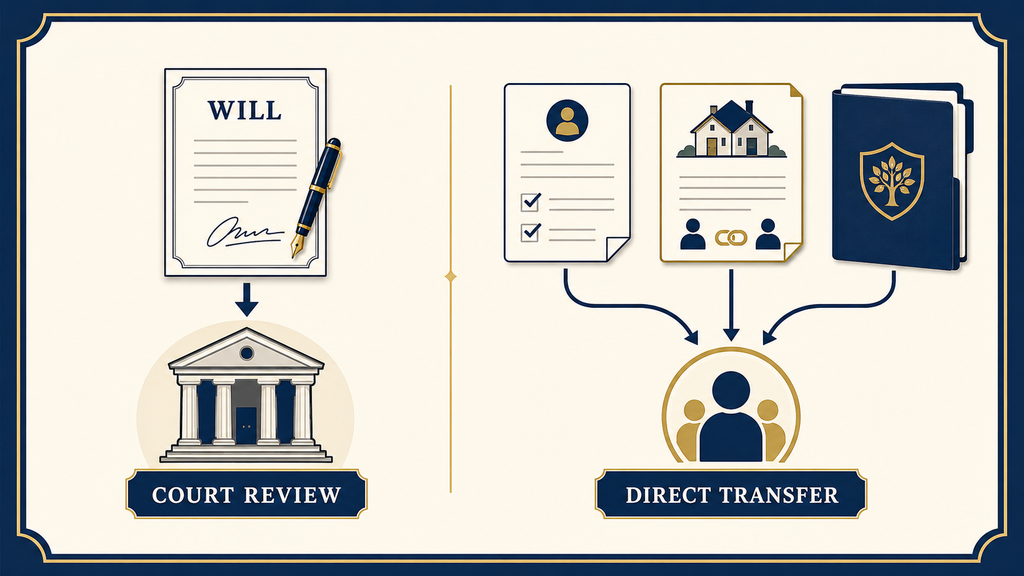
A will does not automatically avoid probate. In many situations, probate is the process through which the court recognizes the will and authorizes the executor to collect and distribute probate property.
A properly prepared will remains valuable because it identifies beneficiaries, nominates an executor, and can address guardianship and other estate matters. However, assets governed by beneficiary forms, survivorship rights, or trusts may transfer independently of the will.
If there is no will, the estate does not automatically avoid probate either. A court may appoint an administrator, and state intestacy law determines who inherits the probate property.
The absence of a will can also complicate a small-estate application. For example, Texas restricts its small-estate affidavit to qualifying intestate estates, while New York permits its voluntary-administration process in qualifying cases with or without a will.c
When a Small Estate May Still Need Court Involvement
“Small estate” does not always mean “no probate court.” Some simplified procedures require an affidavit to be filed with the court, a filing fee, judicial approval, notices to interested parties, or a waiting period before assets can be collected.
Court involvement may still be necessary when:
- Real estate was held solely by the deceased
- A financial institution refuses to release an account without court authority
- Beneficiaries disagree about distribution
- The original will cannot be found
- The will’s validity is questioned
- A creditor dispute needs resolution
- The estate has a pending lawsuit
- A minor or incapacitated beneficiary requires protection
- The identity or location of an heir is uncertain
- A personal representative needs formal authority to act
New York, for example, calls its simplified proceeding voluntary administration and appoints a voluntary administrator. Texas also requires the small-estate affidavit to be filed with a court, although whether a hearing occurs can depend on the county.
Formal Probate vs. a Simplified Estate Procedure
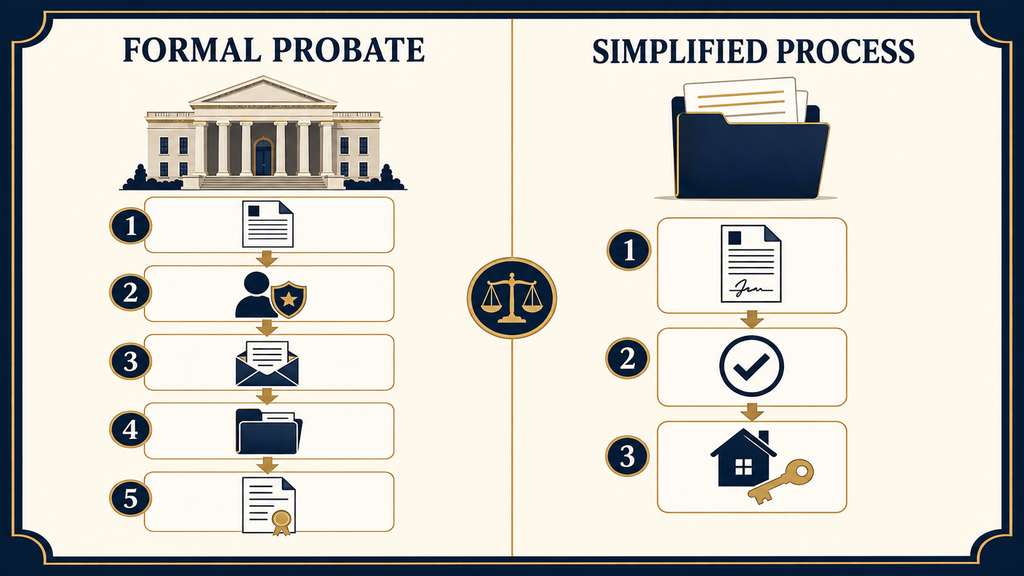
The distinction between formal probate and simplified administration is often more useful than asking whether there will be any legal process at all. Both routes can involve court documents, but their requirements and level of supervision differ.
| Issue | Formal probate or administration | Simplified estate procedure |
|---|---|---|
| Estate size | Often used when the estate exceeds the applicable simplified limit | Restricted by a state-specific value test |
| Real estate | Can generally provide authority to transfer solely owned real estate | May be excluded or governed by a separate procedure |
| Personal representative | Executor or administrator formally appointed | Affiant, successor, petitioner, or voluntary administrator |
| Court involvement | Usually more extensive | Often reduced, but not necessarily eliminated |
| Creditor process | Formal notice and claim rules commonly apply | Special or abbreviated rules may apply |
| Disputes | Better suited to contested or complicated matters | Usually intended for uncomplicated estates |
| Documents | Petition, notices, inventory, accounting, and closing papers may be required | Affidavit, petition, asset list, and supporting records may be enough |
A simplified procedure is not necessarily optional just because it appears easier. The estate must satisfy every statutory requirement, and using the wrong procedure can delay distribution or cause a filing to be rejected.
Probate Is Not the Same as Estate Tax
Probate and estate tax are separate legal issues. Probate concerns the authority to administer and transfer assets, while estate tax concerns whether a tax return and tax payment may be required based on a different legal calculation.
Probate inheritance is also separate from Social Security survivor benefits. Certain spouses, former spouses, children, and dependent parents may qualify through the deceased worker’s earnings record, as explained in our complete Social Security guide.
A small probate estate can be part of a much larger taxable estate because certain nonprobate assets may still count for tax purposes. Conversely, an estate may require probate while remaining far below the federal estate-tax filing threshold.
The IRS estate-tax filing table lists a $15 million filing threshold for deaths occurring in 2026, subject to the agency’s stated calculation rules. That figure does not determine whether an estate must go through probate, and state-level estate or inheritance taxes may have different rules.
Can Probate Be Avoided Legally?
Probate can often be reduced through careful estate planning, but avoiding it is not automatically the right objective for every family. Court supervision may provide useful structure when there are creditor issues, complicated assets, unclear instructions, or likely disputes.
Common planning methods include:
- Creating and properly funding a revocable living trust
- Maintaining current primary and contingent beneficiaries
- Using payable-on-death or transfer-on-death registrations where appropriate
- Holding selected property with valid survivorship rights
- Using a transfer-on-death deed where state law permits it
- Coordinating the will, trust, deeds, and beneficiary forms
- Reviewing the plan following deaths, divorces, marriages, moves, and major purchases
One detail I would not overlook is trust funding. Signing a trust document does not move property into the trust automatically, so an asset left in the owner’s individual name may still require probate.
You should also be careful when adding another person as a joint owner merely to avoid probate. Doing so can transfer present ownership rights, expose the property to the other owner’s creditors, create tax consequences, and interfere with the intended estate plan.
A Practical Checklist for Families and Executors
Before deciding that probate is or is not necessary, gather the documents and answer the following questions:
- Where did the deceased person maintain their legal residence?
- Did they leave an original signed will?
- What property was owned solely in their name?
- Did they own real estate, including property in another state?
- Which accounts have confirmed beneficiaries?
- Was any property held in a trust?
- Does jointly owned property include survivorship rights?
- What was each potential probate asset worth on the relevant date?
- Which state exclusions apply to the small-estate calculation?
- Is there a dispute, creditor issue, missing heir, or pending lawsuit?
I recommend confirming account and deed information directly rather than relying on family assumptions. A short consultation with a probate attorney or court self-help center may prevent an incorrect filing, particularly when real estate or competing heirs are involved.
Frequently Asked Questions
Does every estate have to go through probate?
No. An estate may avoid probate when all property transfers through valid beneficiary designations, survivorship rights, a funded trust, or another authorized process. A small-estate procedure may also replace formal probate, although it can still involve a court filing.
Is probate required if there is a will?
A will does not prevent probate. The court may need to recognize the will and authorize the executor before probate assets can be collected, debts addressed, and property distributed.
Is probate required if there is no will?
The lack of a will does not eliminate probate. If court administration is required, the court appoints an administrator and distributes the estate according to intestacy law rather than the deceased person’s written instructions.
Does a house automatically require probate?
A solely owned house frequently requires probate or another court-authorized transfer procedure. Probate may be avoided if the property was held in a properly funded trust, owned with valid survivorship rights, or covered by an effective transfer-on-death deed.
Do debts count when determining whether an estate is small?
The answer depends on the state and the specific procedure. Some calculations use gross property, while others exclude certain debts, liens, homesteads, or exempt assets, so you should follow the precise statutory formula.
Can a bank release money without probate?
A bank may release funds to a named payable-on-death beneficiary or accept an authorized small-estate affidavit. Its requirements will depend on the account registration, state law, elapsed waiting period, and supporting documents.
What happens when the estate exceeds the small-estate limit?
Exceeding the simplified-procedure limit may require formal probate or administration, but only for property belonging to the probate estate. Nonprobate assets ordinarily continue to transfer through their beneficiary, trust, or survivorship arrangements.
Can an executor distribute property before probate is completed?
An executor should not distribute property until they have proper authority and have addressed applicable debts, taxes, expenses, and creditor requirements. Premature distribution can create personal liability if insufficient assets remain to meet estate obligations.
Can beneficiaries avoid probate by agreeing among themselves?
An agreement does not give beneficiaries legal authority to transfer a solely owned account, vehicle, or real estate title. They must still use the procedure required by state law and the institution holding or registering the property.
Conclusion
There is no universal answer to how much does an estate have to be worth to go to probate. The correct answer depends on the value of the probate assets, how each asset is titled, whether beneficiaries were named, whether real estate is involved, and which state procedure applies.
I would start by creating a complete asset inventory and separating automatic transfers from solely owned property. Then check the current probate-court instructions where the deceased lived, and consult a qualified estate attorney when the estate includes real property, business interests, disputed beneficiaries, substantial debts, or unclear ownership.
