


What Does Insure Domestic Tranquility Mean?
If you are asking what does insure domestic tranquility mean, the simple answer is this: it means keeping peace, order, and stability within the country. The phrase appears in the Preamble to the Constitution, where it describes one of the broad purposes behind the creation of the new system of government.
Many quick answers stop there. That is true, but it omits the part that makes the phrase useful: “domestic tranquility” is not a promise that life will be free of crime, disagreement, protests, or difficult politics. It is an aim of constitutional government that public disputes should be handled through law, courts, elections, and lawful institutions rather than through violence or breakdown.
When I first looked closely at the Preamble, the word “insure” seemed confusing because it now makes many people think of insurance policies. In this sentence, it has its older, everyday sense of “ensure”: to help make something happen or to provide for it. So the phrase is not about insuring homes, cars, or people. It is about creating conditions in which people can live together with reasonable safety and civic order.
Quick answer: “Insure domestic tranquility” means to help maintain peace and order at home, within the nation, through a stable government and lawful ways of resolving conflict.

Where the phrase comes from
The phrase comes from the Preamble, the opening paragraph of the Constitution. You can read the official constitutional text, which begins by explaining that “We the People” established the Constitution to form a more perfect Union, establish justice, insure domestic tranquility, provide for the common defense, promote the general welfare, and secure liberty for future generations.
These are six connected goals, not six separate laws. The words explain why the document was created and what the people expected the new constitutional system to pursue. They are a helpful map for understanding the Constitution, but the specific powers, limits, rights, procedures, and remedies appear in the articles and amendments that follow.
That distinction matters more than many people realize. A person cannot normally point only to the words “domestic tranquility” and claim that the phrase itself creates a new legal right, a police power, a lawsuit, or a government benefit. The federal courts’ educational explanation of the Preamble makes the point clearly: the Preamble introduces the Constitution but does not itself define government powers or individual rights.
In other words, the phrase has real constitutional significance, but it also serves as a statement of purpose. It helps explain the document’s design. When a legal dispute arises, courts usually look to the actual provision that gives power or protects a right, such as a clause in Article I, Article IV, the Bill of Rights, or a later amendment.

The phrase in plain English, word by word
The easiest way to understand the phrase is to separate the two key words. “Domestic” here does not mean housework, interior design, or family life within a single home. It means internal or within the country, as opposed to a threat coming from another nation.
“Tranquility” means calm, peace, and freedom from serious disorder. It does not mean that everybody must agree or that society must become silent. A healthy constitutional system can include elections, criticism, rallies, court cases, labor disputes, public debate, and strong disagreement while still preserving domestic tranquility.
The word “insure” means to make provision for or help secure. Read together, the phrase means that the constitutional system should help prevent internal disorder from becoming so severe that ordinary life, democratic government, or the rule of law cannot function.
Here is a useful plain-language translation:
| Original phrase | Plain-English meaning | What it does not mean |
|---|---|---|
| Insure | Help make sure or provide for | Sell an insurance policy |
| Domestic | Inside the country | Only inside a private home |
| Tranquility | Public peace, stability, and orderly civic life | No disagreement, protest, or crime ever |
| The full phrase | Build a system that can keep internal peace through law | Give government unlimited power to demand silence |
This final point is the one I recommend remembering. The Constitution aims for order, but constitutional order is not the same as forced obedience. A government can claim to want “peace” while still violating protected rights, which is why the rest of the Constitution limits government power and protects individual liberty.
For example, peaceful speech can be unpopular, loud, emotional, or critical of public officials. That does not automatically make it a threat to domestic tranquility. The better constitutional question is whether the conduct is protected, whether there is an actual legal violation, and whether the government response is authorized and proportionate.
Insure versus ensure: why the wording looks unusual today
Modern writers often use “ensure” for making something certain and “insure” for financial coverage. In the Preamble, “insure” is an older spelling and usage that conveys the same basic idea as “ensure.” You do not need to read a hidden financial meaning into the word.
This older wording is why people sometimes search for “what does to insure domestic tranquility mean” or assume that the phrase has a technical insurance-law meaning. It does not. The question belongs to constitutional history and civic understanding, not to an insurance contract.
Does domestic tranquility mean safety from all danger?
No constitutional system can honestly guarantee that no crime, disaster, riot, or political crisis will ever happen. Domestic tranquility is a public goal, not a guarantee of a perfectly calm life.
The phrase is better understood as a commitment to lawful tools for responding to instability. Those tools include legislatures that can pass laws, courts that can resolve disputes, elections that allow peaceful changes of leadership, and constitutional limits that prevent officials from using public order as an excuse to ignore rights.

Why domestic tranquility mattered when the Constitution was written
The words in the Preamble were not chosen in a quiet or easy period. The country had recently won independence, but the government operating under the Articles of Confederation was weak in important ways. The central government could not reliably raise money through taxation, regulate commerce effectively, or respond quickly to national problems.
The Articles of Confederation described a “league of friendship” among the states, while leaving them with broad retained powers. That arrangement had helped keep the states connected during a difficult era, but it struggled when the new country needed coordinated action, stable finances, and a stronger means of managing serious internal tensions.
One event that shaped the conversation was Shays’ Rebellion in Massachusetts in 1786 and 1787. Farmers facing economic hardship, debt, and court actions resisted state authorities. The historical account of the rebellion and the road to the Constitutional Convention shows why the event alarmed many leaders, even though historians and citizens may disagree about its deeper causes and meaning.
The lesson was not simply “people must never protest.” The more useful lesson was that a country needs lawful and workable ways to deal with debt, economic distress, public conflict, and disputes between governments. If people believe the legal system cannot hear them, if states cannot cooperate, or if public institutions cannot respond to crises, anger can move away from courts and elections toward confrontation.
That historical background helps explain why “insure domestic tranquility” sits next to “establish justice.” The framers did not place peace and justice in opposite corners. They treated them as connected. Peace that ignores injustice is fragile, and justice that has no functioning system to enforce it can become only an idea on paper.
Domestic tranquility was not a call for a national police force
It is important not to place modern institutions back into the eighteenth century without care. The Preamble did not create a single national police force, nor did it give Congress general authority to regulate every local problem simply because a federal official calls it a matter of public order.
Instead, the Constitution created a structure in which powers were divided. National and state governments have different responsibilities, and courts examine whether a particular government action fits within a real constitutional or statutory authority. This balance matters because a government can pursue order only through lawful powers, not by inventing power whenever a crisis feels serious.

What domestic tranquility means in the constitutional system today
The Preamble gives the goal. The rest of the Constitution supplies the machinery. This is the missing piece in many short explanations, and it is what turns a vocabulary answer into a useful legal answer.
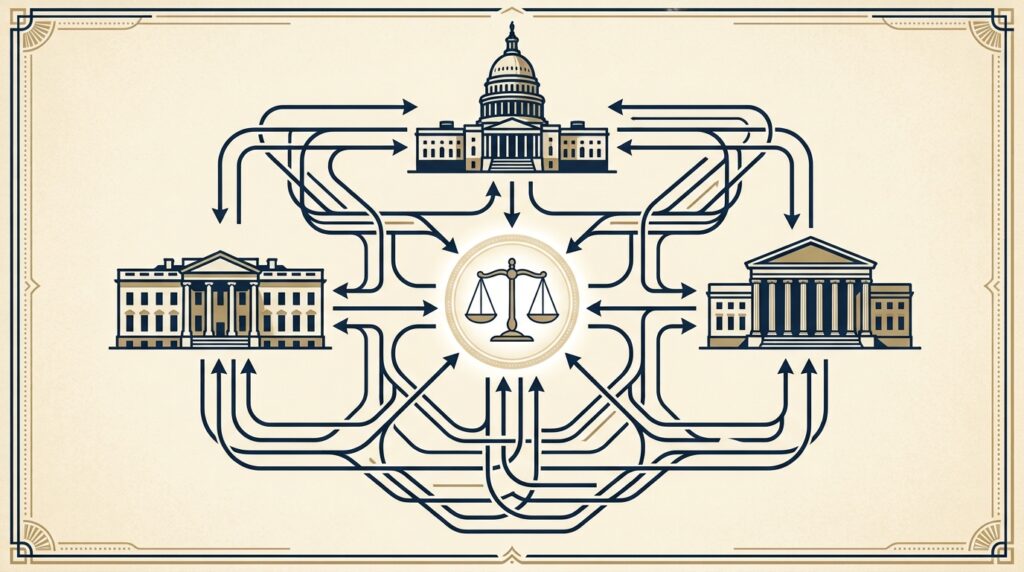
Domestic tranquility depends on several constitutional ideas working together. No one clause does all the work. Instead, the system relies on limited powers, separate branches, courts, elections, federalism, rights, and procedures that allow people to challenge government action without resorting to force.
Representative government gives conflict a peaceful outlet
People have strong views about taxes, schools, public safety, work, property, health, immigration, and many other subjects. A constitutional system does not remove these disagreements. It gives people lawful ways to influence the rules through voting, petitions, advocacy, public meetings, and elected representatives.
This is one reason the Preamble starts with “We the People.” The historical background of the Preamble explains that the opening identifies the people as the source of federal sovereignty. That idea helps domestic tranquility because government authority is not supposed to rest only on a ruler’s personal will or military force.
Courts provide a lawful place to settle disputes
Courts cannot solve every public problem, and lawsuits can be slow, expensive, or emotionally difficult. Still, courts provide a structured way to resolve disputes through evidence, rules, hearings, and review rather than retaliation.
Think of an ordinary disagreement about a contract, injury, property line, child support order, or criminal charge. The legal system gives people a process for filing claims, responding, presenting evidence, and appealing errors. That process can feel frustrating, but it is safer than allowing people to decide who is right through threats, intimidation, or private revenge.
For a related look at how constitutional authority is ranked, see the Constitution’s place as the supreme law of the land. It explains why federal, state, and local rules do not all carry the same legal weight and why a valid legal process matters when rules conflict.
Rights set limits on the pursuit of order
One of the most important points is that domestic tranquility cannot be used as a magic phrase to erase constitutional rights. Government officials may have legitimate public-safety duties, but they must exercise them within constitutional boundaries.
The Constitution protects many forms of individual liberty, including speech, religion, due process, protection against unreasonable searches, and equal treatment under law. These protections help create real stability because people are more likely to trust public institutions when rules are applied fairly and when they have a meaningful way to challenge unfair treatment.
This means that the phrase does not justify banning criticism merely because it is uncomfortable. It does not allow punishment without fair procedures. It does not erase the need for a warrant, a hearing, evidence, or legal authority when those safeguards apply.
Federalism distributes responsibility
Some issues are national. Others are mainly local or state matters. The Constitution divides and shares authority rather than placing every question in one set of hands.
That division can sometimes look messy, especially when different places have different laws. But it can also support domestic tranquility by allowing local problems to be handled close to the people affected while reserving certain national responsibilities for the national government.
For example, Article IV requires protection against invasion and, in certain circumstances, against “domestic Violence.” The text of Article IV, Section 4 uses “domestic violence” in an older sense that refers to internal insurrection or unlawful force, not the modern family-law meaning of abuse between intimate partners. It is a specific constitutional provision that shows how the document addressed severe internal disorder through defined legal rules rather than through the Preamble alone.
Separation of powers slows down dangerous decisions
A slower process can be frustrating when people want instant action. But requiring different branches to play distinct roles can reduce the risk that a single official or institution will respond to public fear with unlimited authority.
Legislatures write laws, executive officials carry them out, and courts decide legal disputes. The boundaries are not always simple, but the basic structure makes it harder for any one branch to control everything. That restraint is part of stable constitutional government.
What domestic tranquility does not mean
The phrase is easy to misuse because it sounds so broad and positive. A better article should make clear where the idea stops.
| Common misunderstanding | Better answer |
| “It means the government must stop every crime.” | Government can work to protect public safety, but the phrase itself does not guarantee a crime-free society or create a private right to damages. |
| “It means people cannot protest.” | Peaceful protest and criticism can be protected forms of civic participation. Disorder and violence are different legal questions. |
| “It lets officials do anything to keep order.” | No. Officials still need constitutional and legal authority, and rights and procedures continue to matter. |
| “It is a law that I can sue under by itself.” | Usually no. The Preamble states objectives; legal claims need an operative constitutional provision, statute, or other cause of action. |
| “Domestic means family life only.” | In this context, domestic means internal or within the country. |
| “Tranquility means everyone agrees.” | No. Democracy includes disagreement. The goal is to manage conflict lawfully and peacefully. |
There is a practical reason to understand these limits. Broad constitutional words can sound powerful in an argument, but legal accuracy comes from asking a more precise question: What exact law, constitutional provision, government action, or right is involved?
For example, if a city restricts a public gathering, the issue may involve speech, permits, public safety, time, place, and manner rules, or emergency authority. If a person is arrested, the issue may involve criminal procedure, probable cause, due process, bail, or a statute. Calling every difficult situation a domestic-tranquility issue can hide the real legal question.
My recommendation is simple: use the phrase to understand the Constitution’s purpose, but use the specific legal rule to analyze a real dispute. That approach is more accurate, more useful, and less likely to lead you to an outdated or misleading answer online.
Peaceful disagreement can support tranquility
This may sound surprising at first, but peaceful disagreement can actually strengthen public order. Voting, journalism, court challenges, public meetings, and lawful demonstrations give people ways to express conflict without turning it into violence.
Trying to suppress every disagreement can make a society less, not more, stable. When people have lawful channels to speak, organize, and challenge decisions, the constitutional system has a chance to correct mistakes before frustration turns into something more serious.
Tranquility and justice need each other
The Preamble places “establish Justice” immediately before “insure domestic Tranquility.” The order is meaningful even though the Preamble does not create a separate legal test.
People are more likely to accept difficult outcomes when they believe they received notice, a fair hearing, an impartial decision-maker, and a chance to be heard. That is why due process, equal protection, fair trials, and accessible courts are not merely technical ideas. They help build the public trust that makes peaceful civic life possible.

Real-life examples you can understand
The phrase becomes clearer when you compare ordinary situations. These examples are simplified, but they show how domestic tranquility differs from mere quietness.
Example 1: A peaceful protest near city hall
Residents gather outside city hall to criticize a new policy. They carry signs, chant, and ask elected officials to listen, but they do not threaten people or damage property.
That scene may be noisy and inconvenient, but it can still be part of a functioning constitutional system. Domestic tranquility does not mean public life has no conflict. It means there are lawful ways to express conflict and rules to protect safety without treating every disagreement as a threat.
Example 2: Neighbors in a serious property dispute
Two neighbors disagree over a fence line, and each believes the other is wrong. They may feel angry, but they can use surveys, mediation, local authorities, or court procedures instead of escalating the conflict themselves.
The constitutional phrase does not decide the property case. It illustrates the broader value of a system that provides people with peaceful methods to resolve disputes. Law is not only about punishment; it is also about preventing ordinary conflicts from becoming dangerous.
Example 3: A difficult criminal case
Police investigate a serious crime, and the community wants answers quickly. Domestic tranquility supports legitimate public-safety work, but it does not remove the accused person’s legal protections.
Officials still must follow the rules that apply to searches, evidence, hearings, and trials. A system that abandons fairness whenever people are frightened may look decisive in the moment, but it weakens trust and risks harming innocent people.
Example 4: A state asks for help during an internal crisis
In an extreme situation involving unlawful force or an insurrection, the Constitution contains more specific rules than the Preamble. Article IV, Section 4 addresses protection against invasion and, on proper application, domestic violence in its historical sense.
The wording shows why legal detail matters. The Preamble gives the goal of internal peace, while Article IV provides a defined constitutional framework for particular serious circumstances.
Example 5: A person receives a jury summons
Serving on a jury may not feel connected to domestic tranquility, but it is. Juries allow ordinary people to take part in resolving legal disputes through evidence and law rather than pressure or private power.
If you have received a summons and need to understand your options, how jury duty works in practice explains lawful reasons to seek an excuse or postponement. It is a useful reminder that court procedures matter because fair, accessible processes help disputes end with lawful decisions.

A practical way to use this phrase in school, research, or conversation
If you need a short answer for a class, you can write: “Insure domestic tranquility means keeping peace and order within the country by creating a stable government and lawful ways to settle disputes.” That answer is accurate, clear, and much better than saying only “it means peace.”
If you are writing a longer assignment, add the historical context. Explain that the phrase appeared after a period in which the Articles of Confederation had shown serious weaknesses, including limited national capacity to manage shared problems. Then explain that the Preamble expresses goals, while the operative parts of the Constitution create the actual powers and rights.
If you are discussing a current event, avoid using the phrase as a shortcut. Ask what legal rule is really involved. Is it a protest rule, a criminal statute, a due-process concern, an emergency order, a federalism question, or a court procedure? The more specific you are, the stronger your analysis will be.
A five-question checklist
Before using “domestic tranquility” in a legal or civic discussion, ask these questions:
- Am I using the phrase as a goal or as a legal rule? The Preamble states a goal. It does not normally operate as a stand-alone cause of action.
- What kind of conflict is involved? Is it peaceful political disagreement, ordinary crime, a civil dispute, or serious internal violence?
- Which specific constitutional or legal provision applies? Look beyond the Preamble for the actual authority or right.
- Are rights and due process involved? Public order does not cancel constitutional protections.
- Can the dispute be handled through a lawful process? Courts, elections, mediation, agencies, and legislatures are designed to prevent conflict from escalating into violence.
This checklist is especially helpful when online posts use constitutional phrases without context. Strong civic understanding is not about repeating impressive words. It is about connecting the words to the proper legal source and the real facts.
Expert tips for understanding the Preamble correctly
The first tip is to read the Preamble as a whole. The six purposes support one another. You will get a distorted result if you use “domestic tranquility” to justify order but ignore justice, liberty, general welfare, or the people’s role in creating government.
Second, separate a constitutional purpose from an enforceable legal command. The Preamble can guide historical understanding and provide context for other provisions, but it is not a substitute for the detailed articles and amendments.
Third, be careful with historical language. “Domestic violence” in Article IV has a different historical meaning from the modern phrase used in family-law and criminal-law contexts. Likewise, “insure” in the Preamble means ensure, not purchase coverage.
Fourth, check the source before repeating a fact. Short social-media answers often confuse the Preamble with Article IV, treat peaceful protest as unlawful disorder, or say that the Preamble itself grants unlimited power. Reading the Constitution’s Preamble and related constitutional analysis gives you a firmer foundation than a quick meme or quiz answer.
Finally, do not use this guide as personal legal advice. If a real issue involves a criminal charge, government order, protest restriction, immigration question, family-safety concern, or court deadline, speak with a qualified lawyer who can review the exact facts and current law.
Frequently asked questions
What does insure domestic tranquility mean in the Preamble?
In the Preamble, “insure domestic tranquility” means helping maintain peace, order, and stability within the country. It expresses the goal of creating a government that can handle internal conflict through law, courts, elections, and constitutional procedures rather than through violence or collapse.
The phrase is not a guarantee that no crime or disagreement will occur. It also does not, by itself, create a separate legal right or government power. The specific legal rules appear in the Constitution’s articles and amendments.
What does it mean to insure domestic tranquility?
Ensuring domestic tranquility means providing for internal peace and orderly civic life. In modern wording, “ensure domestic tranquility” would communicate the same basic idea.
It means that people should have lawful ways to resolve disputes and change government policy. It does not mean officials may silence criticism or ignore constitutional rights in the name of keeping things calm.
What do ” establish justice ” and ” insure domestic tranquility mean?
“Establish justice” and “insure domestic tranquility” are two connected purposes listed in the Preamble. Establishing justice means building a fair legal system, while insuring domestic tranquility means supporting peace and stability within the country.
The two goals work together. A society is more likely to remain peaceful when people can rely on fair procedures, courts, and representative government rather than believing that force is their only option.
Does domestic tranquility mean no crime or no protests?
No. Domestic tranquility does not mean that crime will disappear or that people cannot protest, criticize leaders, or disagree strongly about public policy. A constitutional democracy expects disagreement and protects many forms of peaceful expression.
The phrase is about maintaining a stable system that can respond to conflict lawfully. Violent conduct, threats, and serious disorder may raise different legal issues, but those issues must still be handled within constitutional limits.
Is “domestic tranquility” a legal term I can use in court?
Usually, no. The Preamble states the Constitution’s purposes, but it does not normally give someone a stand-alone legal claim. A court case needs a specific constitutional provision, statute, regulation, contract, or recognized legal cause of action.
For example, a person challenging a government restriction may need to rely on a speech, due process, equal protection, search and seizure, or statutory claim. The phrase “domestic tranquility” may provide helpful context, but it is not usually the legal rule that decides the case.
Final thoughts
The best answer to what does insure domestic tranquility mean is not only “peace and order.” It means building a constitutional system that can manage internal conflict through lawful institutions while still respecting justice, liberty, and individual rights.
Remember the balanced version: domestic tranquility does not mean silence, forced agreement, or unlimited government control. It means that even when people deeply disagree, the country has constitutional mechanisms to settle disputes, protect rights, and preserve public peace.
If you are studying the Preamble, start with the short definition and then remember the larger lesson. The Constitution was designed not merely to avoid disorder, but to give people fair and lawful ways to live through disagreement without losing the protections that make peace worth having.
