


If your permit test is coming up, one of the first things you may want to know is how many questions can you get wrong on the permit test and still pass. There is no single answer for the entire United States because each state sets its own knowledge-test format, passing score, and testing rules. In one state you might be able to miss 10 questions, while somewhere else even four wrong answers could be enough to fail.
I verified the current examples used in this guide against official California, Florida, New York, and Pennsylvania motor-vehicle sources before drafting it. Florida currently requires 40 correct answers out of 50, New York requires at least 14 correct answers out of 20 plus at least 2 of the 4 road-sign questions, and Pennsylvania requires 15 correct answers out of 18. California currently states that applicants must achieve an 80% passing score on the knowledge test, while the exact testing situation can vary by applicant.
Quick Answer: How Many Questions Can You Get Wrong on the Permit Test?
The number of questions you can get wrong depends on your state. In Florida, the Class E Knowledge Exam has 50 questions and requires 40 correct answers, so you can miss 10 questions and still pass. In Pennsylvania, you need 15 correct answers out of 18, which means you can miss only 3 questions. In New York, you need 14 correct answers out of 20, so you can miss up to 6 overall, but you must also answer at least 2 of the 4 road-sign questions correctly.
The safest approach is to check the current rules on your state’s official DMV, DPS, BMV, MVD, or equivalent licensing website before your test. Do not assume that a passing score or question count from another state applies where you live.
How Do You Calculate How Many Questions You Can Miss?
If your state publishes both the total number of questions and the number you need to answer correctly, the calculation is simple:
Maximum questions you can miss = Total test questions – Correct answers required
For example, a 50-question test requiring 40 correct answers allows 10 mistakes. A 20-question test requiring 16 correct answers would allow four mistakes, while an 18-question test requiring 15 correct answers allows only three.
Here are a few simple examples:
| Total Questions | Correct Answers Required | Maximum Wrong |
|---|---|---|
| 50 | 40 | 10 |
| 40 | 32 | 8 |
| 30 | 24 | 6 |
| 25 | 20 | 5 |
| 20 | 16 | 4 |
| 18 | 15 | 3 |
This calculation works only when the test uses a straightforward overall passing score. Some states have additional requirements for certain categories of questions, so you should always check the official rules rather than relying only on the arithmetic.
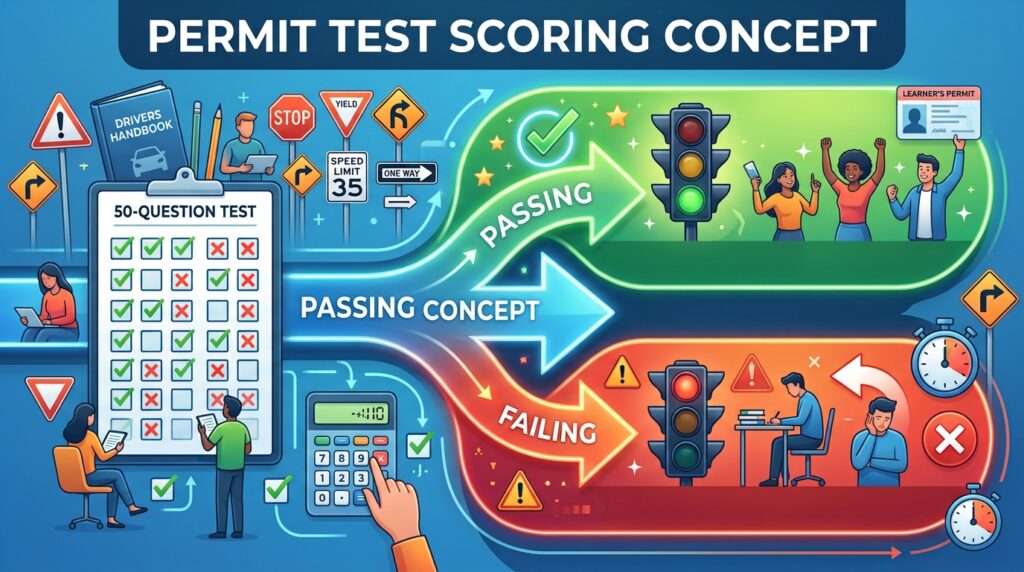
How Many Questions Can You Miss in Florida?
Florida has one of the clearest permit-test scoring systems. The Florida Department of Highway Safety and Motor Vehicles states that the Class E Knowledge Exam contains 50 multiple-choice questions covering traffic laws, safe-driving practices, and traffic controls. You must answer 40 of the 50 questions correctly, which equals an 80% score.
That means you can get 10 questions wrong and still pass the Florida Class E Knowledge Exam. Once you miss more than 10, you cannot reach the required 40 correct answers.
If you are preparing for a Florida permit, use the current Florida Highway Safety and Motor Vehicles Class E Knowledge Exam information rather than relying only on an unofficial practice-test website.
How Many Questions Can You Miss in New York?
The New York written permit test contains 20 questions, and you must answer at least 14 correctly. Based only on the overall score, this means you can miss as many as 6 questions.
However, New York has an important additional rule. Four questions relate to road signs, and you must correctly answer at least 2 of those 4 road-sign questions. Therefore, simply reaching 14 correct answers is not enough if you fail to meet the road-sign requirement.
This is a good example of why the question “how many can I get wrong?” does not always have a simple mathematical answer. You also need to understand how your state scores different parts of the test. The current requirement is explained in the New York State Driver’s Manual.
How Many Questions Can You Miss in Pennsylvania?
Pennsylvania uses a relatively short knowledge test. According to PennDOT, the test contains 18 multiple-choice questions, and you must answer 15 correctly to pass.
That means you can get only 3 questions wrong and still pass. Once you miss a fourth question, the highest score you could achieve would be 14 out of 18, which is below the passing requirement.
Pennsylvania’s current testing rules are available through the official PennDOT Driver’s Manual testing section.
What About the California Permit Test?
California is a good example of why you should be careful with old question-count tables found online. The California DMV currently states that the knowledge test uses multiple-choice questions based on the California Driver’s Handbook and requires a passing score of 80%.
Rather than relying on an old third-party article that gives one fixed question count for every California applicant, check the current requirements for your own application through the California DMV instruction permit information.
California DMV also states that applicants generally receive three attempts to pass the knowledge test before they must reapply. Minors who fail must wait seven days before retaking the test, not including the day of failure. These rules are another reason to prepare properly before using an attempt.
Permit Test Requirements Can Be Different Even When Passing Percentages Look Similar
It is tempting to search for a simple nationwide percentage, but that can be misleading. Florida requires 40 correct answers out of 50, which is exactly 80%. Pennsylvania requires 15 out of 18, which is approximately 83.3%. New York’s overall requirement of 14 out of 20 equals 70%, but the additional road-sign requirement means the total percentage alone does not tell the full story.
California currently publishes an 80% passing requirement, but applicants should still check their specific DMV instructions rather than assuming the test will look exactly like Florida’s. Two states can use the same percentage while having different numbers of questions, different retake rules, and different testing procedures.
Some States Have Special Scoring Rules
One of the most important things to understand is that the maximum number of wrong answers is not always the only rule that matters. New York is the clearest example among the states discussed here because you must both reach the overall passing score and correctly answer enough road-sign questions.
A permit test may also differ depending on factors such as your age, license class, whether you are applying for the first time, or whether you are taking a standard automobile test rather than a motorcycle or commercial-license exam. Before using any “maximum wrong answers” number, make sure it applies to the exact permit or license test you are taking.
Is the Permit Test the Same in Every State?
No. Ordinary driver licensing is handled at the state level, so there is no single national U.S. learner-permit test. Each state decides what applicants need to know, how the knowledge test is administered, what score is required, and what happens after a failed attempt.
Even the agency name changes from state to state. Depending on where you live, you may deal with a:
- Department of Motor Vehicles (DMV)
- Department of Public Safety (DPS)
- Bureau of Motor Vehicles (BMV)
- Motor Vehicle Division (MVD)
- Department of Transportation
- Department of Highway Safety and Motor Vehicles
This is why an article or practice test describing another state’s rules should never replace your own state’s official driver’s handbook.
What Topics Are Usually on a Permit Test?
The exact questions differ by state, but most learner-permit knowledge tests focus on the rules and safety information a new driver needs before getting behind the wheel. The questions are generally based on the state’s official driver’s manual or handbook.
You should expect to study topics such as:
- Traffic signs and traffic signals
- Lane markings
- Right-of-way rules
- Speed limits
- Safe following distances
- Parking rules
- Turning and passing
- Pedestrian and bicycle safety
- School buses
- Emergency vehicles
- Railroad crossings
- Seat belts
- Alcohol and drug laws
- Distracted driving
- Sharing the road with motorcycles and large trucks
California DMV, for example, specifically states that its knowledge-test questions are based on the California Driver’s Handbook. New York also directs applicants to study the relevant chapters of its official driver’s manual when preparing for the permit written test.

What Happens If You Get Too Many Questions Wrong?
If you exceed the maximum number of errors allowed, you fail the knowledge test. That normally does not mean you have lost your chance to obtain a learner permit permanently. Most states allow another attempt, but the rules for retesting are not the same everywhere.
Depending on your state, a failed test could mean you need to wait before trying again, schedule another appointment, pay another fee, or eventually submit a new application if you use all permitted attempts. California, for example, allows three attempts before an applicant must reapply, and minors must wait seven days before retaking a failed knowledge test.
Do not assume that another state uses California’s rule. Check the official licensing website for the exact retest requirements that apply to you.
Does the Permit Test Stop Once You Have Too Many Wrong Answers?
Some computerized testing systems may end the test once it is no longer mathematically possible for you to achieve a passing score, while others may operate differently. The licensing agency controls the exact testing software and procedure.
Instead of trying to count every possible mistake while testing, concentrate on each question. Constantly calculating whether you have “one mistake left” can increase anxiety and make you rush through questions you could otherwise answer correctly.
Can You Skip Questions on the Permit Test?
Whether you can skip a question and return to it later depends on the system used by your state. Some testing platforms may allow it, while others expect you to answer before moving on.
Do not build your test strategy around skipping difficult questions. Read each question carefully and look for words such as except, always, never, must, safest, and best. A single word can change what the question is asking, even when the driving rule itself is familiar.
How Hard Is the Permit Test?
The permit test is usually very manageable for someone who studies the official driver’s handbook and takes practice questions seriously. The difficulty often comes from assuming that years of watching other people drive are enough to know the law.
Many questions deal with specific rules rather than everyday driving habits. Right-of-way at intersections, parking on hills, school-bus laws, lane markings, safe following distances, railroad crossings, and alcohol-related restrictions can all produce questions where two answers initially look reasonable.
The best preparation is to study the current driver’s handbook first and use practice tests afterward to discover which subjects still cause problems.
What Practice-Test Score Should You Aim For?
If your state requires 80% to pass, do not stop studying as soon as you occasionally score exactly 80% on a practice test. Try to reach 90% or higher consistently before taking the real exam.
A higher practice score gives you room for unfamiliar wording, nerves, and a few questions covering material you may not remember perfectly. It also shows that you understand the rules rather than simply memorizing one set of online practice questions.
How to Improve Your Chances of Passing the Permit Test
You do not need complicated study techniques. A focused approach using official material and repeated practice is usually enough. Start with your state’s driver’s handbook, then concentrate extra study time on areas where your practice-test scores are weakest.
A few habits can make preparation much more effective:
- Read the official driver’s handbook rather than relying only on practice tests.
- Study road signs separately if you regularly confuse similar signs.
- Review right-of-way and intersection rules carefully.
- Practice questions about school buses, parking, lane markings, and speed rules.
- Take several different practice tests instead of memorizing one.
- Review every wrong practice answer and understand why it was wrong.
- Aim to score comfortably above the minimum before booking or taking the official test.
On the real test, read the complete question before looking for an answer. Many mistakes happen because applicants recognize a familiar topic and choose an option before noticing an important word such as “except” or “unless.”
What Happens After You Pass?
Passing the knowledge test is usually one step in the learner-permit process rather than the end of it. Depending on your age and state, you may still need to complete a vision test, provide identification and residency documents, pay permit fees, obtain parental consent, complete driver education, or meet supervised-driving requirements.
Once you begin driving, understanding traffic-law consequences also becomes important. Our guide explaining how long a speeding ticket stays on your record covers how driving records, points, and insurance consequences can differ after a traffic violation. You can also browse our Driving Laws guides for more plain-language explanations of driving rules and legal issues.
Frequently Asked Questions
How many questions can you get wrong on the permit test?
It depends on your state. Florida currently allows up to 10 wrong answers on its 50-question Class E Knowledge Exam because 40 correct answers are required. Pennsylvania allows only 3 wrong answers because you need 15 correct out of 18. New York allows up to 6 wrong overall, but you must also correctly answer at least 2 of the 4 road-sign questions.
How many questions can you miss on a 50-question permit test?
If the test requires 40 correct answers out of 50, you can miss 10 questions. This is Florida’s current Class E Knowledge Exam requirement. A different 50-question test could theoretically use a different passing score, so always check your state’s official rule.
How many questions can you miss on a 20-question permit test?
That depends on the passing requirement. New York currently requires at least 14 correct answers out of 20, meaning you can miss up to 6 overall. However, New York also requires at least 2 correct answers from its 4 road-sign questions.
What happens if you get 11 wrong on a 50-question test?
If the test requires 40 correct answers out of 50, getting 11 wrong would leave you with only 39 correct answers, so you would fail. This is how the current Florida Class E Knowledge Exam works.
What percentage do you need to pass the permit test?
There is no single national percentage. Florida currently requires 80%, Pennsylvania requires 15 out of 18, New York requires at least 14 out of 20 plus its road-sign requirement, and California currently states that applicants need an 80% passing score.
Can you fail because of road-sign questions?
Yes, in a state with a special road-sign requirement. New York requires you to answer at least 2 of its 4 road-sign questions correctly even if your overall number of correct answers is otherwise high enough.
Is the permit test multiple choice?
The permit knowledge test is commonly multiple choice. Florida, Pennsylvania, and California all describe their current knowledge tests as using multiple-choice questions. Check your own state’s current handbook for the exact format.
What happens if you fail the permit test?
Most applicants can test again, but waiting periods and limits vary by state. California currently permits three attempts before you must reapply, and minors must wait seven days before another attempt after a failure.
Are online permit practice tests the same as the real test?
No. Practice tests are useful for preparation, but you should not expect the official exam to contain the same questions. Use your state’s current driver’s handbook as the main source and practice tests as a way to check your knowledge.
How many times should I take practice tests before the real permit test?
There is no required number. A better measure is your score. Keep practicing until you consistently score well above your state’s minimum passing requirement and understand why each answer is correct.
Final Answer
So, how many questions can you get wrong on the permit test? There is no single U.S.-wide number. Florida currently lets you miss up to 10 of 50 questions, Pennsylvania lets you miss 3 of 18, and New York lets you miss up to 6 of 20 overall while also requiring at least 2 correct road-sign answers out of 4. California currently requires an 80% passing score, but applicants should use the current DMV instructions for their particular knowledge test rather than relying on an old fixed question count.
The most reliable way to prepare is to check your state’s official licensing website, find the current number of questions and passing requirement, and study the latest driver’s handbook. Once you know those figures, you can calculate how many mistakes are allowed and aim to score comfortably above that minimum during practice.
