

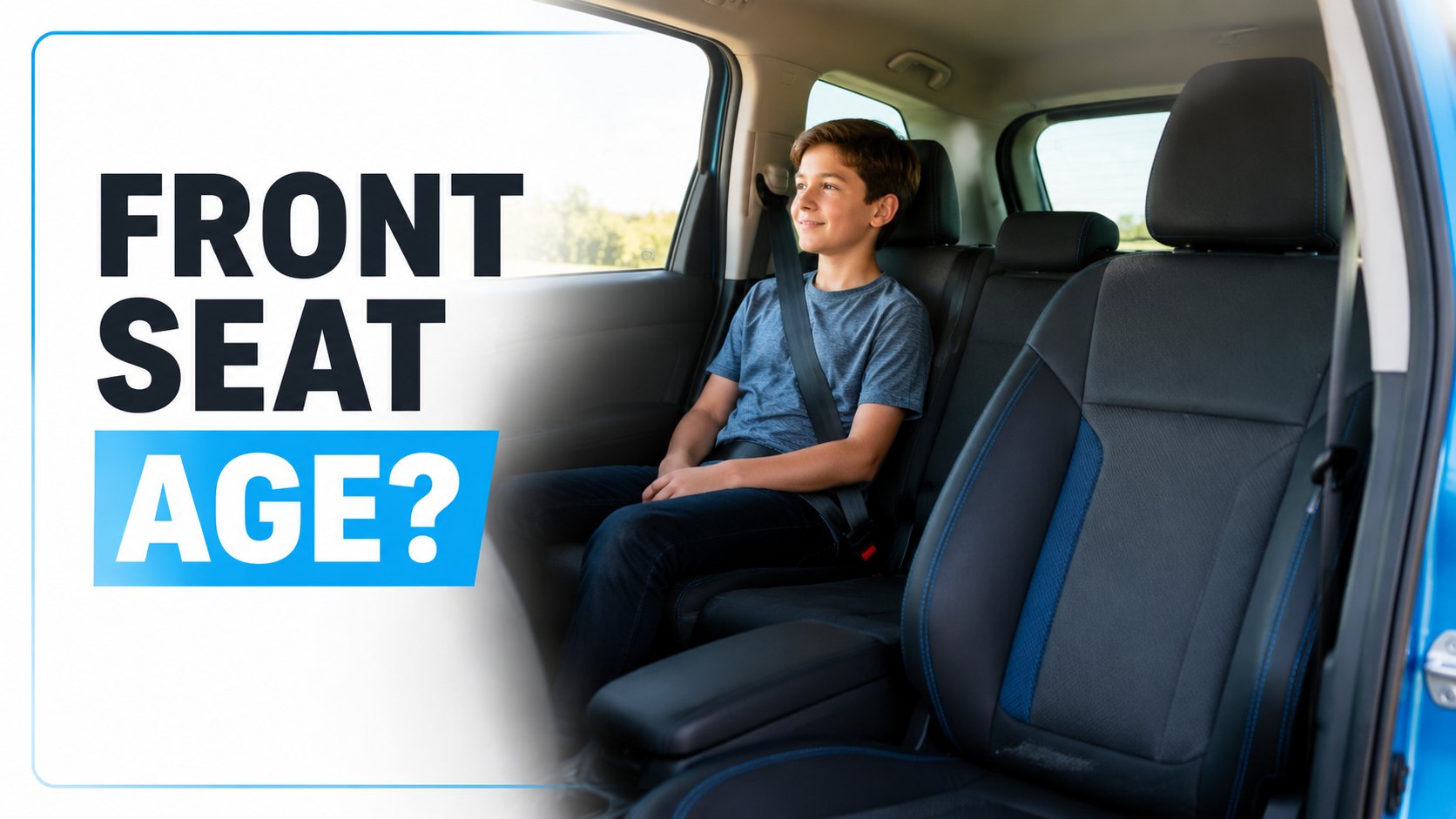
If you are wondering how old do you have to be to sit in the front seat, the safest general answer is 13 years old. Both federal safety guidance and pediatric experts recommend keeping children properly restrained in the back seat until they turn 13.
That does not mean every state has a law saying “age 13.” The legal answer depends on your state’s child-restraint and rear-seat requirements. A child may technically be allowed in front at a younger age in some places, but legal does not always mean safest.
This guide explains the difference between the law and safety recommendations. It also covers airbags, height, weight, booster seats, seat-belt fit, pickup trucks, and what to do when a front seat must be used.
Children younger than 13 should normally ride in the back seat. After turning 13, a child should use the front seat only if the vehicle’s lap-and-shoulder belt fits correctly and the child can remain properly seated for the entire journey.
Important: Child passenger laws vary by state and can change. This article provides general legal and safety information, not advice for a specific case.
How Old Do You Have to Be to Sit in the Front Seat Legally?
There is no single federal law establishing one minimum front-seat age for every child. States create their own rules covering car seats, booster seats, seat belts, and where younger passengers must sit.
Some states require certain children to use the rear seat when one is available. Others regulate the type of restraint but do not establish a separate front-seat age. The IIHS state seat-belt and child-restraint law table shows how significantly these rules can differ.
| Question | General answer |
|---|---|
| Safest age to begin using the front seat | 13 or older |
| Universal legal minimum age | None |
| Who determines most child-restraint rules? | Individual states |
| Does turning 8 automatically make the front seat safe? | No |
| Does reaching 4 feet 9 inches automatically make it safe? | No |
| Can a rear-facing seat go in front of an active airbag? | Never |
| Should the vehicle manual be checked? | Yes |
The Governors Highway Safety Association’s child-passenger guidance recommends that state laws require children younger than 13 to ride properly restrained in the rear whenever rear seats are available. However, not every state has adopted that complete recommendation.
This creates an important distinction:
- Legal minimum: The lowest standard allowed under your state’s current law.
- Safety recommendation: The practice most likely to protect the child.
- Manufacturer requirement: Instructions for the car seat, booster, airbag, and vehicle.
- Seat-belt readiness: Whether the vehicle belt fits the child’s body correctly.
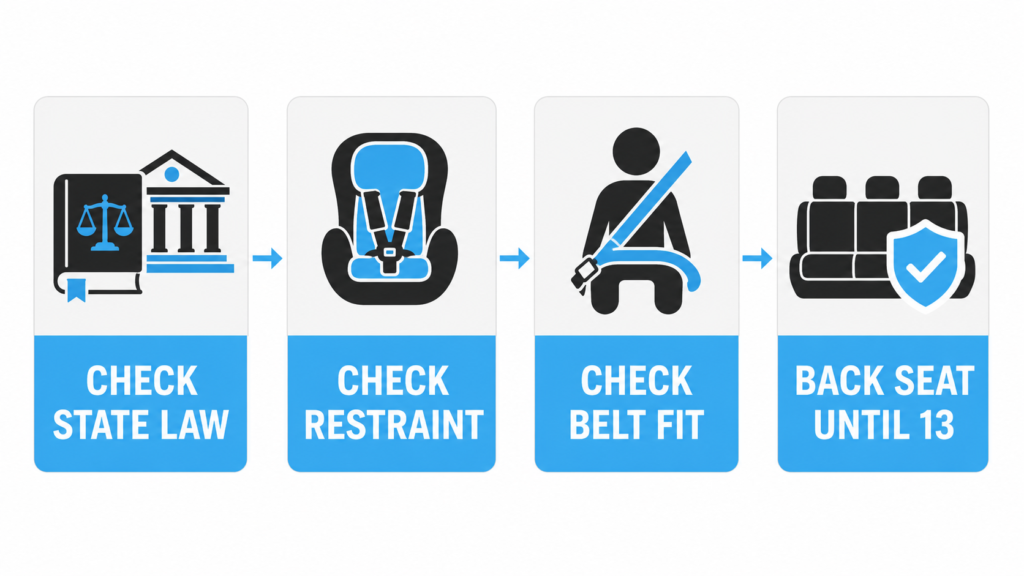
You should satisfy all four standards. Following only the least restrictive rule may leave a child poorly protected.
Why Age 13 Is the Main Safety Recommendation
The National Highway Traffic Safety Administration’s car-seat guidance says children should remain in the back seat at least through age 12. The American Academy of Pediatrics similarly recommends rear seating for every child younger than 13.
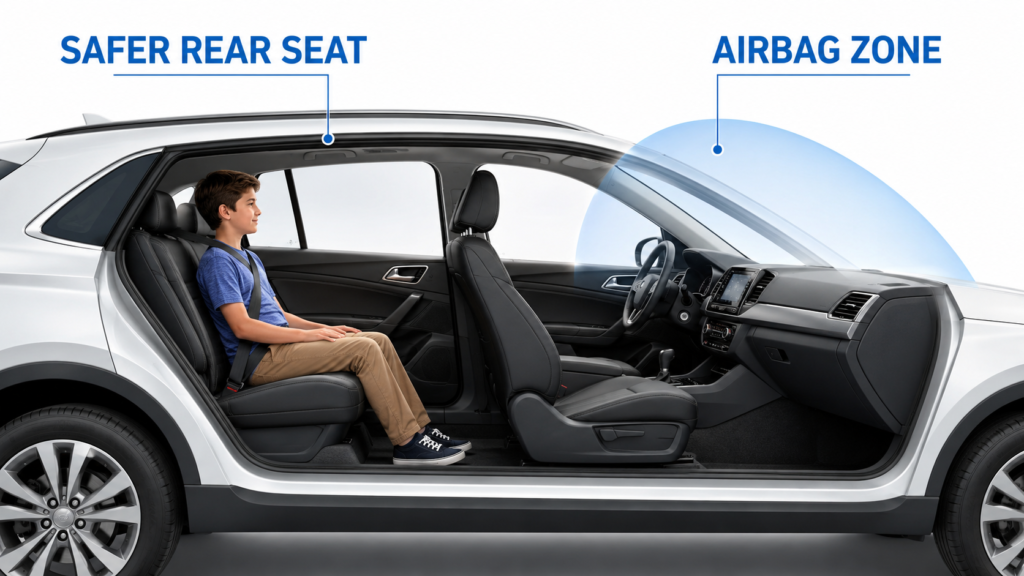
Age matters because vehicle safety systems are primarily designed around adult bodies. A younger child’s bones, torso, and seating position can make the force from a crash or inflating airbag more dangerous.
The front passenger seat also places the child closer to common frontal crash forces. The back seat provides greater separation from the dashboard, windshield, and front passenger airbag.
Reaching age 13 does not create an instant guarantee of safety. A small 13-year-old may still need additional consideration if the belt crosses the neck or abdomen, while a tall 11-year-old should remain in the rear because height alone does not remove the age-related concern.
Age, Height, and Weight Are Not the Same Test
Parents often hear that a child can move to the front after reaching a particular height or weight. Those measurements usually relate to car-seat or booster-seat requirements, not necessarily front-seat safety.
A height of 4 feet 9 inches, or 57 inches, is commonly associated with fitting an adult seat belt. Many children do not achieve a proper belt fit until they are between 9 and 12 years old. That does not cancel the recommendation to stay in the back until age 13.
Weight is also not a reliable front-seat test by itself. A heavier child may still have a short torso, poor belt fit, or insufficient distance from the dashboard.
| Factor | What it helps determine | What it does not prove |
|---|---|---|
| Age | Development and recommended seating location | Proper belt fit |
| Height | Whether an adult belt may fit | Front-seat readiness by itself |
| Weight | Car-seat or booster limits | Safe distance from an airbag |
| Maturity | Ability to remain correctly seated | Compliance with state law |
| Vehicle design | Belt geometry and airbag position | That every child fits equally well |
I recommend treating age 13 as the starting point for considering the front seat, not as the only test. You should then assess the belt fit, seating posture, vehicle instructions, and your child’s ability to sit correctly.
Does Your Child Still Need a Booster Seat?
A booster seat raises the child so the vehicle’s lap-and-shoulder belt rests on stronger parts of the body. It should normally be used in the back seat until the adult belt fits correctly without it.
According to current CDC child passenger safety guidance, proper belt fit usually occurs between ages 9 and 12. Children develop at different rates, so a birthday alone should not decide when the booster is removed.
If you are caring for a younger child, first confirm that the child has reached the correct stage for leaving a harnessed seat. Our guide to when a baby can safely move to a forward-facing car seat explains why the manufacturer’s limits matter more than reaching one convenient age or weight.
Use This Seat-Belt Fit Test
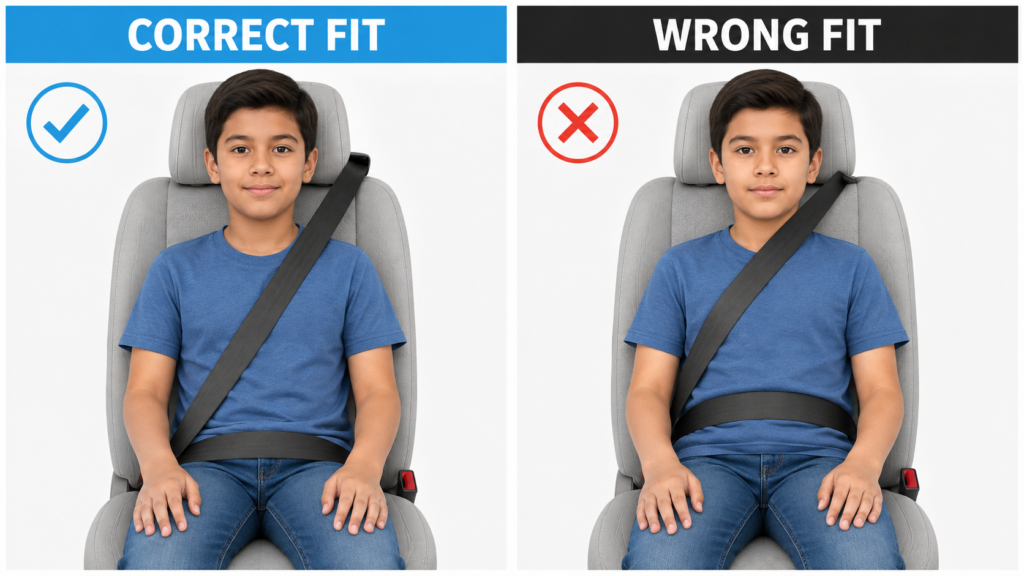
Have your child sit directly on the vehicle seat without a booster. Check all of the following:
- The child’s back rests flat against the seatback.
- Their knees bend naturally at the edge of the seat.
- Their feet have stable support rather than dangling uncomfortably.
- The lap belt lies low across the upper thighs or hips, not the stomach.
- The shoulder belt crosses the center of the chest and shoulder.
- The belt does not touch the neck or face.
- The child can maintain this position for the entire trip.
If any part of this test fails, the child is not ready for that vehicle’s seat belt alone. A child can pass in one vehicle and fail in another because seat depth and belt geometry differ.
Do not allow a child to place the shoulder belt behind their back or under an arm. That may feel more comfortable, but it removes essential upper-body protection.
Why Front Passenger Airbags Can Be Dangerous for Children
Front airbags inflate extremely quickly during certain crashes. They are designed to protect a properly positioned adult sitting far enough from the dashboard, not a small child leaning forward or sitting close to the airbag cover.
The NHTSA airbag safety guidance provides limited circumstances in which an airbag on-off switch may be appropriate. These exceptions do not mean routinely disabling airbags is a safe way to let younger children ride in front.
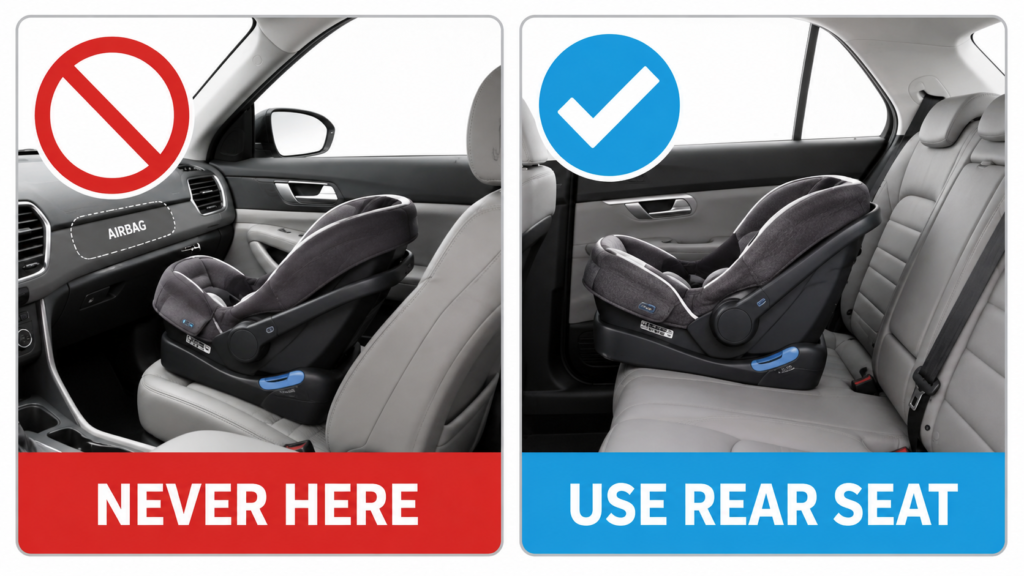
Never Put a Rear-Facing Car Seat in Front of an Active Airbag
A rear-facing child seat places the back of the seat close to the dashboard. If the airbag deploys, it can strike the child restraint with enormous force.
The CDC specifically warns never to put a rear-facing car seat in the front seat. This is one detail I would not overlook, even for a very short journey.
An automatic passenger-sensing system is not permission to ignore the vehicle manual. Sensors, indicators, permitted restraint types, and seating restrictions differ between vehicles.
What If a Child Must Sit in the Front?
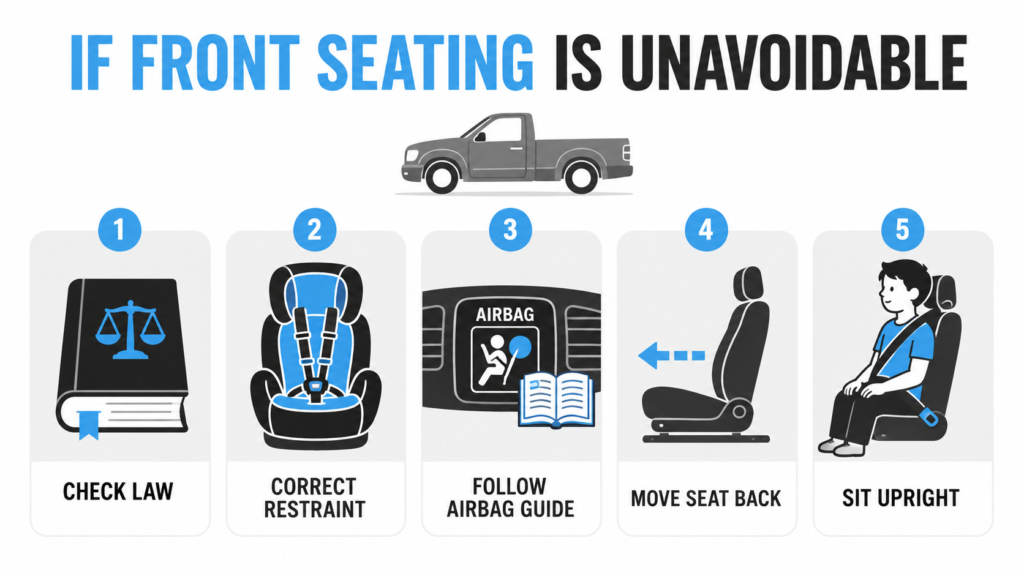
Occasionally, a vehicle has no rear seat, all usable rear positions are occupied by younger children, or a medical situation affects seating arrangements. State law may contain an exception, but the exact exception must be verified before the trip.
If front seating cannot reasonably be avoided, follow these precautions:
- Check the law. Review the current rule for the state where the vehicle is being operated.
- Read both manuals. Follow the vehicle manual and the restraint manufacturer’s instructions.
- Never place a rear-facing restraint before an active airbag.
- Use the correct restraint. A child who needs a car seat or booster does not become ready for an adult belt merely because only the front seat is available.
- Move the passenger seat back. Create as much distance from the dashboard as the vehicle and restraint instructions permit.
- Keep the child upright. The child must not lean toward the dashboard, lie across the seat, or play with the belt.
- Use a lap-and-shoulder belt. A lap-only belt does not provide the same upper-body restraint.
- Ask for professional help. Unusual vehicle layouts deserve individual assessment.
If you regularly transport more children than can be safely seated in the rear, I would start by changing the transport arrangement. Convenience should not become the default reason for putting a younger child in the highest-risk position.
What About a Single-Cab Pickup Truck?
A single-cab pickup requires special care because there is no rear seating position. The correct answer depends on state law, the child’s restraint stage, the truck’s airbag system, and instructions in the owner’s manual.
Never assume that a manual airbag switch makes every child restraint acceptable. If the child is young enough to require a car seat or booster, consult a certified child passenger safety technician before making the front position a regular arrangement.
Common Mistakes Parents Should Avoid
One common mistake is treating the booster-seat cutoff as permission to use the front. Booster readiness and front-seat readiness answer two different questions.
Another mistake is allowing a child to move forward because friends of the same age already do it. Children of the same age can differ in height, proportions, maturity, and belt fit.
Avoid these problems:
- Moving a child forward immediately after their eighth, tenth, or twelfth birthday
- Using height or weight as the only test
- Removing a booster before the belt fits in that particular vehicle
- Letting the shoulder belt sit behind the back or under the arm
- Assuming a short journey carries no crash risk
- Allowing a child to lean forward, turn around, or recline excessively
- Putting the youngest child in front while an older passenger occupies the rear
- Disabling an airbag without following manufacturer instructions
- Relying on an online summary without checking current state law
When several children are traveling, the youngest or least protected child should not automatically be placed in front. Arrange passengers according to their restraint needs, applicable law, and the instructions for every seating position.
A Practical Front-Seat Readiness Checklist
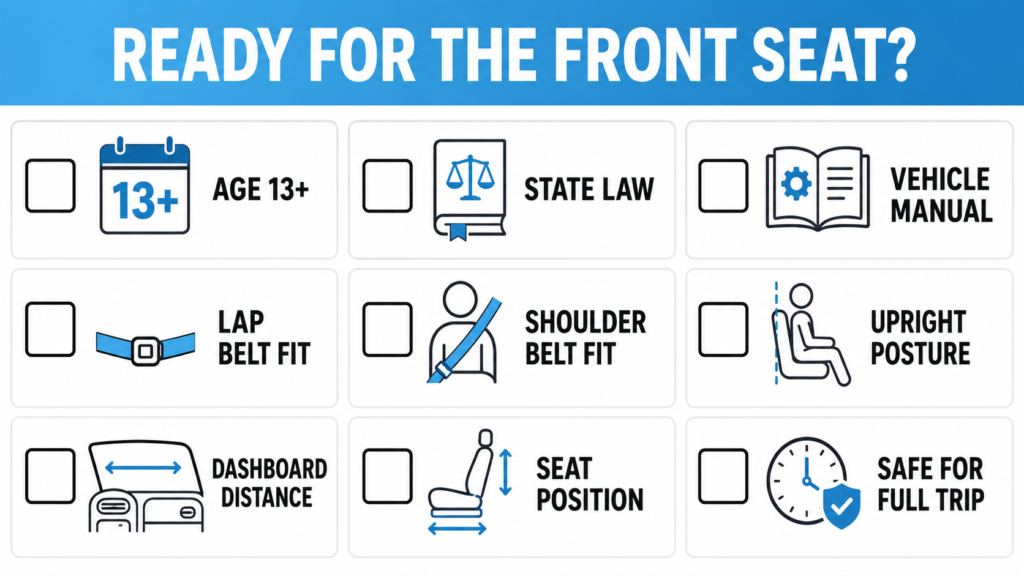
Once a child is at least 13, use a complete readiness check rather than relying only on the birthday.
| Readiness question | Required answer |
|---|---|
| Is the child at least 13? | Yes |
| Does state law allow the seating arrangement? | Yes |
| Does the vehicle manual permit it? | Yes |
| Does the lap belt sit across the hips or upper thighs? | Yes |
| Does the shoulder belt cross the chest and shoulder? | Yes |
| Can the child sit with their back against the seat? | Yes |
| Can they avoid leaning toward the dashboard? | Yes |
| Can the passenger seat be positioned safely? | Yes |
| Can they remain correctly seated for the full journey? | Yes |
If you answer no to any question, keep the child in the back. There is no disadvantage to waiting longer when a safe rear seating position remains available.
How to Check the Rule Where You Live
Do not rely on another parent’s understanding or an old social-media post. Laws change, and neighboring states may impose different requirements.
Use this process:
- Open your state legislature, motor-vehicle department, highway-safety office, or state police website.
- Search for “child passenger restraint law” and “rear seat requirement.”
- Confirm the page’s update date and effective date.
- Check age, height, weight, seating position, and airbag provisions separately.
- Review exceptions for pickups, vehicles without rear seats, medical needs, taxis, or fully occupied rear seats.
- Compare the legal requirement with the safer age-13 recommendation.
- Recheck the law before interstate travel or after moving to another state.
A child passenger safety technician can also examine the restraint and your specific vehicle. NHTSA provides a car-seat inspection station locator for finding trained assistance.
Frequently Asked Questions
Can a 10-year-old sit in the front seat?
It may be legal in some states, depending on the restraint and rear-seat rules. However, safety authorities recommend that a 10-year-old remain properly buckled in the back seat until age 13.
Can an 11-year-old sit in the front seat?
An 11-year-old should normally ride in the rear, even if the child is tall or no longer needs a booster. State law may permit front seating in certain circumstances, but the back remains the recommended position.
Can a 12-year-old sit in the front seat?
A 12-year-old may be legally permitted to sit in front in some states. NHTSA guidance says children should remain in the back at least through age 12, so waiting until the thirteenth birthday is the safer approach.
Can a 13-year-old sit in the front seat?
Generally, yes, provided state law permits it and the seat belt fits correctly. The child must also sit upright, keep the belt properly positioned, and remain an appropriate distance from the dashboard.
How tall should a child be to sit in the front seat?
There is no universal height that independently makes the front seat safe. A height of about 4 feet 9 inches is commonly associated with adult seat-belt fit, but children younger than 13 should still normally sit in the rear.
How much should a child weigh before sitting in the front?
There is no single universally accepted front-seat weight. Weight limits are more useful for choosing and outgrowing child restraints, while front-seat readiness also depends on age, belt fit, posture, vehicle design, and state law.
Can a child use a booster seat in the front?
State law and vehicle instructions may allow it in limited situations, but a booster should generally be used in the rear. Never use a booster with a lap-only belt because booster seats require both lap and shoulder portions.
What is the safest seat for a child?
The back seat is generally safest for a properly restrained child. The center rear position may offer added separation from side impacts, but only when the correct restraint can be securely installed there and an appropriate belt system is available.
Can a child sit in front if the airbag is turned off?
Turning off the airbag does not automatically make the front seat as safe as the rear. You must still follow state law, the vehicle manual, restraint instructions, and the age-13 recommendation.
Who gets the ticket if a child is seated illegally?
Responsibility usually falls on the driver, but the exact rule and penalty depend on state law. Some states impose fines, points, education requirements, or proof that an appropriate restraint has been obtained.
Conclusion
So, how old do you have to be to sit in the front seat? The clearest safety answer is 13, but you must also check state law, seat-belt fit, restraint requirements, and the vehicle manual.
Keep younger children properly restrained in the back whenever possible. When your child reaches 13, use the readiness checklist before allowing the move rather than relying on age alone.
If your older child is beginning to learn about road safety and driving rules, our learner’s permit test guide can help them understand what to expect. For a child who still uses a car seat or booster, arrange a professional seat check and confirm the current law before your next journey.
