

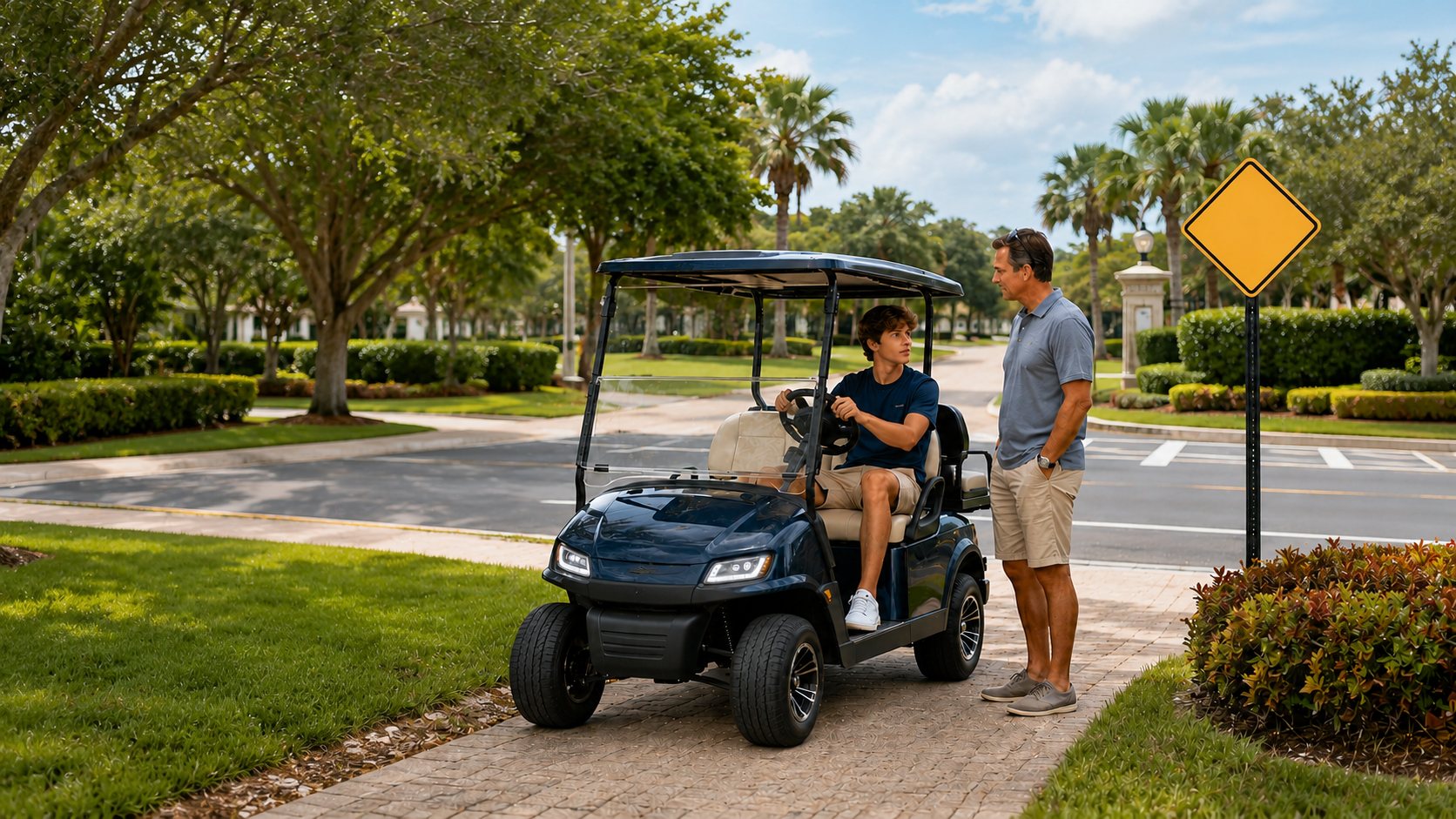
If you are wondering how old do you have to be to drive a golf cart, the honest answer is that there is no single minimum age that applies everywhere. On permitted public roads, drivers commonly need to be at least 15 or 16 and may need a learner’s permit or full driver’s license.
Private property, golf courses, resorts, gated communities, and homeowners’ associations can establish different requirements. This guide explains how age, location, licensing, vehicle classification, and local ordinances work together so you can check the correct rule before handing over the keys.
Important: This article provides general legal and safety information. Golf-cart laws can change and may differ between states, counties, cities, communities, and individual properties.
Quick Answer: How Old Do You Have to Be to Drive a Golf Cart?
There is no universal golf-cart driving age. A driver on a public street often needs to be 16 and hold a valid driver’s license, although some places allow a 15-year-old with a learner’s permit.
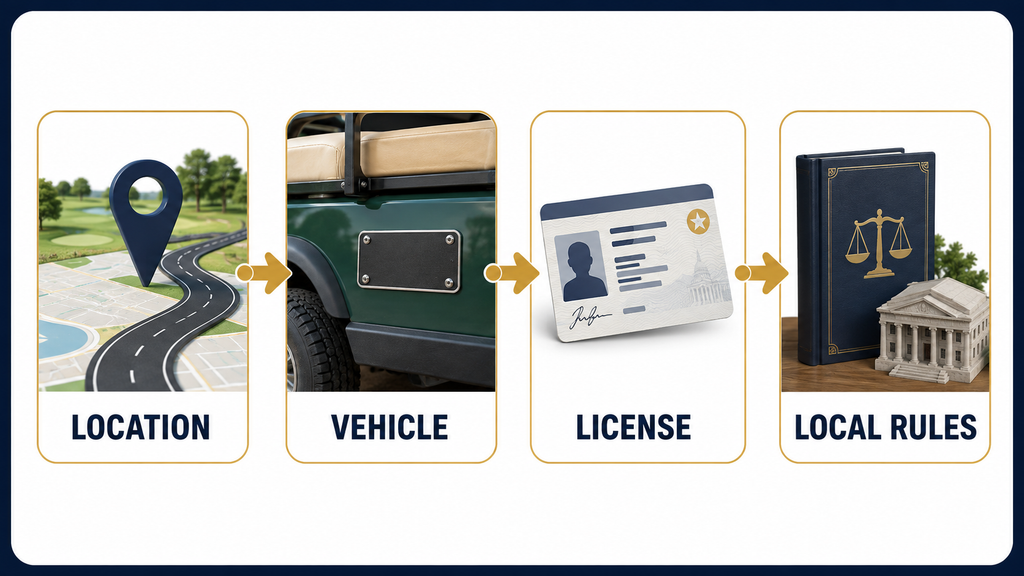
Private-property rules may allow younger operators, but the property owner, golf course, resort, campground, or HOA can impose a higher age limit. Before allowing a minor to drive, check all four of these points:
- Is the road public or private?
- Is the vehicle legally a golf cart or a low-speed vehicle?
- Does the driver need a license or learner’s permit?
- Has the city, county, HOA, or property owner adopted a stricter rule?
Why There Is No Single Golf-Cart Driving Age
Golf-cart operation can be controlled by several layers of rules. A state may establish basic requirements, but a county or city may decide whether golf carts are allowed on particular streets at all.
A gated community may then create additional rules for its privately maintained roads. A golf course or resort can also impose contractual rules that are stricter than the minimum established by law.
This means that asking only for the state minimum may not give you a complete answer. You must also identify the precise road, property, and vehicle involved.
Legal Permission Is Not the Same as Property Permission
A state law might not prohibit a younger person from operating a cart on genuinely private land. That does not force a golf course, campground, rental company, school, or HOA to let that person drive.
The property owner can require adult supervision, a valid license, an internal permit, or a higher minimum age. Violating those rules could result in removal from the property, loss of rental privileges, HOA consequences, or personal liability after an accident.
A Private Community Road Is Not Automatically Private
A road inside a gated or residential community may be privately maintained, publicly maintained, or governed by a special local ordinance. The presence of a gate does not provide a reliable answer by itself.
I recommend asking the HOA or property manager for the written golf-cart policy. You should also check the city or county road map rather than relying on what neighbors commonly do.
Public Roads, Private Property, and Golf Courses
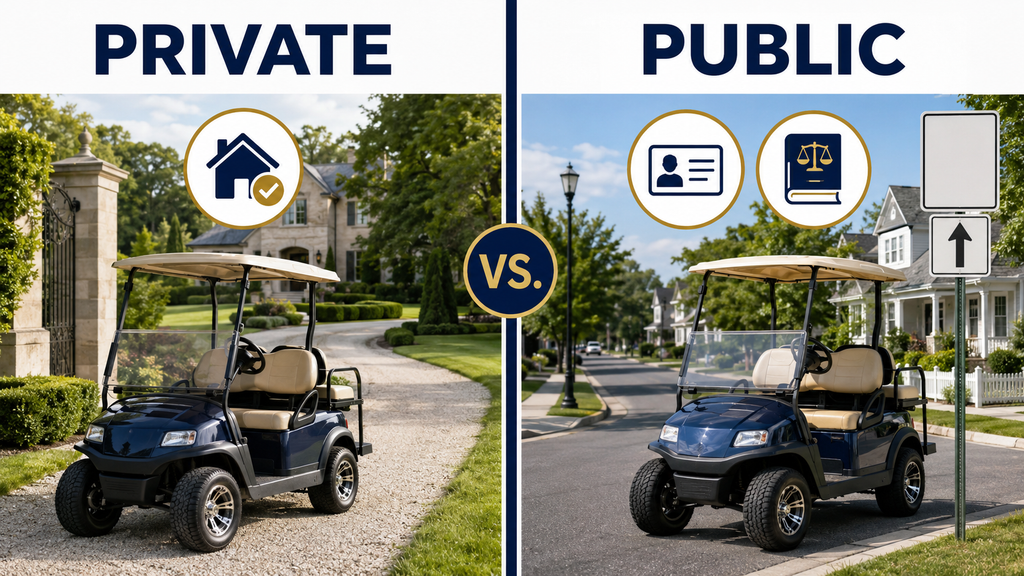
The place where the cart is driven often matters more than the cart’s appearance. The legal difference between a private yard and a public neighborhood street can completely change the age, licensing, insurance, and equipment requirements.
| Location | Typical legal position | What to verify |
|---|---|---|
| Private residential land | State road-licensing rules may not apply in the same way | Owner permission, insurance exclusions, supervision and public-access rules |
| Golf course | Course policy usually controls ordinary course use | Rental age, staff permission and designated paths |
| Gated community | Rules depend on whether the roads are public or private | HOA policy, local ordinance, licensing and insurance |
| Public neighborhood street | State and local traffic rules apply | Authorized roads, minimum age, license, equipment and registration |
| Sidewalk or shared path | Frequently prohibited unless specifically authorized | Local code and posted signs |
| Highway crossing | Often allowed only at designated locations | Crossing rules, driver age and road-speed limits |
A golf cart being legal somewhere nearby does not mean it is legal on every connecting road. The route to a golf course, store, beach, park, or school may include a prohibited street even when the starting neighborhood permits carts.
Golf Cart vs. Low-Speed Vehicle: Why Classification Matters
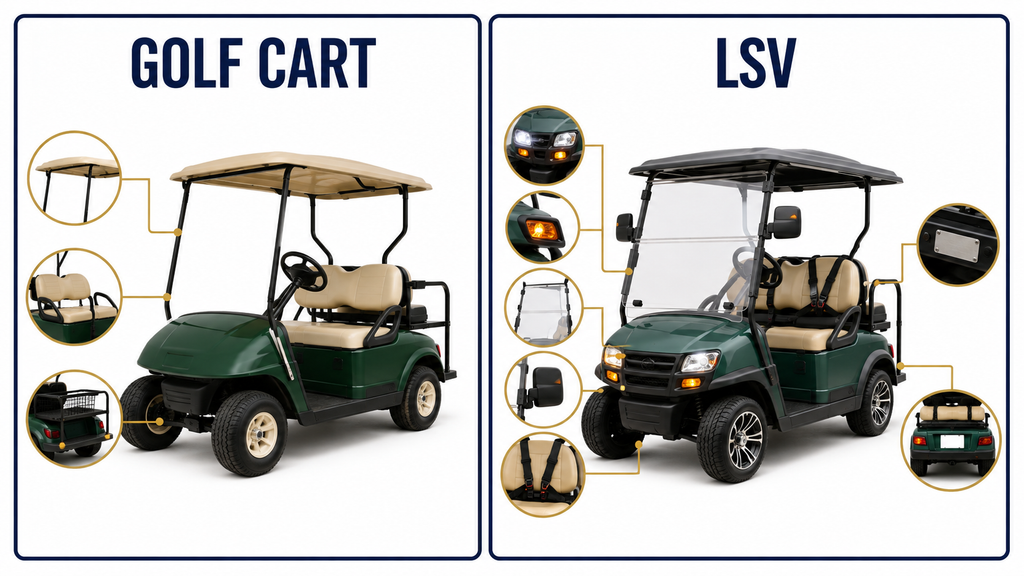
A standard golf cart and a low-speed vehicle can look almost identical. Legally, however, they may be treated very differently.
The National Highway Traffic Safety Administration defines a low-speed vehicle as a four-wheeled motor vehicle with an attainable speed of more than 20 mph but not more than 25 mph. The federal low-speed-vehicle definition places these vehicles within a specific motor-vehicle safety framework.
| Feature | Standard golf cart | Low-speed vehicle |
|---|---|---|
| Typical designed speed | Usually 20 mph or below | More than 20 mph but not more than 25 mph |
| Primary intended use | Golf course or limited local use | Public-road transportation in permitted areas |
| VIN | May not have a road-use VIN | Normally required |
| Registration | Depends on local law and use | Commonly required |
| Insurance | Depends on location and law | Commonly required |
| Driver’s license | Depends on location | Normally required |
| Safety equipment | Limited unless upgraded | Federal and state equipment requirements apply |
Adding lights, mirrors, or seat belts to a golf cart does not automatically make it a legal low-speed vehicle. A lawful conversion may require certification, inspection, a VIN, registration, title documents, and insurance.
One detail I would not overlook is speed modification. Increasing a cart’s maximum speed can change its legal classification without automatically making it compliant with all requirements for road use.
Current Golf-Cart Age Rules: Official Examples
The following examples demonstrate why a single online age chart can be misleading. They are not a substitute for checking the rule that applies to your exact location.
| State example | Driver requirement on authorized public roads | Important limitation |
|---|---|---|
| Florida | A driver under 18 must have a valid learner’s license or driver’s license. Because the minimum learner’s-license age is 15, the practical minimum is generally 15. | Drivers 18 or older need government-issued photo identification, and local governments may impose stricter rules. |
| South Carolina | At least 16 with a valid driver’s license | The cart must be permitted, registered and insured, and local restrictions may apply. |
| Michigan | At least 16 and licensed to operate a motor vehicle | A qualifying village, city or township must first authorize golf-cart operation. |
| Virginia | A valid driver’s license is required | Operation is limited to designated highways and specified speed conditions. |
| Ohio state parks | A valid driver’s license or qualifying permit is required | The cart needs specified safety equipment, insurance and an authorized park roadway. |
Florida’s current statute states that a person under 18 may not operate a golf cart on a public road without a valid learner’s license or driver’s license. It also allows local governments to adopt more restrictive rules, as shown in the current Florida golf-cart statute.
This is particularly important because some older online charts still describe Florida’s previous minimum as 14. The state’s highway-safety agency confirms that the newer permit requirement took effect in October 2023 in its official golf-cart and low-speed-vehicle guidance.
South Carolina requires a public-highway golf-cart driver to be at least 16 and carry a valid license. Its official golf-cart checklist also covers registration, insurance, operating distance, road-speed limits and local authority.
Michigan law provides another clear example. Under Michigan’s golf-cart statute, the operator must be at least 16 and licensed, but golf-cart operation depends on local authorization.
Virginia does not simply publish a low stand-alone golf-cart age. Instead, its designated-highway golf-cart law requires the operator to possess a valid driver’s license and limits where the vehicle can be driven.
Do You Need a Driver’s License to Drive a Golf Cart?
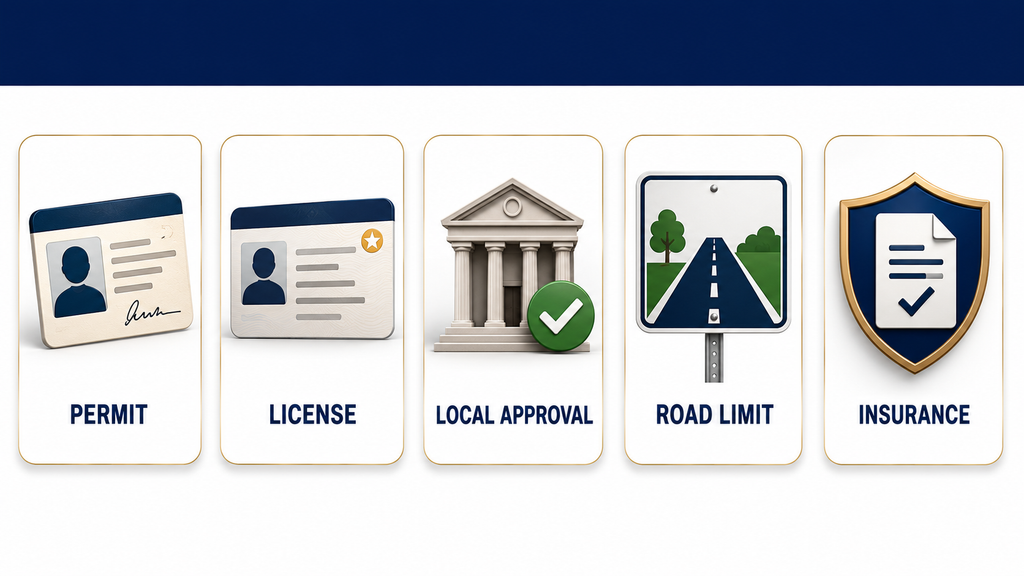
A license is commonly required when a golf cart enters an authorized public street. Some laws accept a learner’s permit under specified conditions, while others require a full driver’s license.
On a golf course or private property, a regular license may not be legally required. The owner can still require one as a condition of entry, rental, employment, insurance coverage, or community access.
A learner’s permit does not automatically authorize unsupervised golf-cart operation. You must determine whether the applicable law expressly accepts the permit and whether the permit’s supervision restrictions still apply.
If a young driver is preparing for a permit, our guide to permit-test questions and passing requirements explains why licensing rules must be checked state by state.
Can an Out-of-State License Be Used?
A valid out-of-state license may be accepted in many places, but local ordinances and rental agreements can impose additional conditions. Do not assume that license reciprocity also makes the cart or chosen road legal.
A suspended, revoked, expired, or restricted license may not satisfy the rule. If the driver has any licensing restriction, I recommend checking with the issuing motor-vehicle agency and the local authority before driving.
How to Check the Exact Rule Where You Live
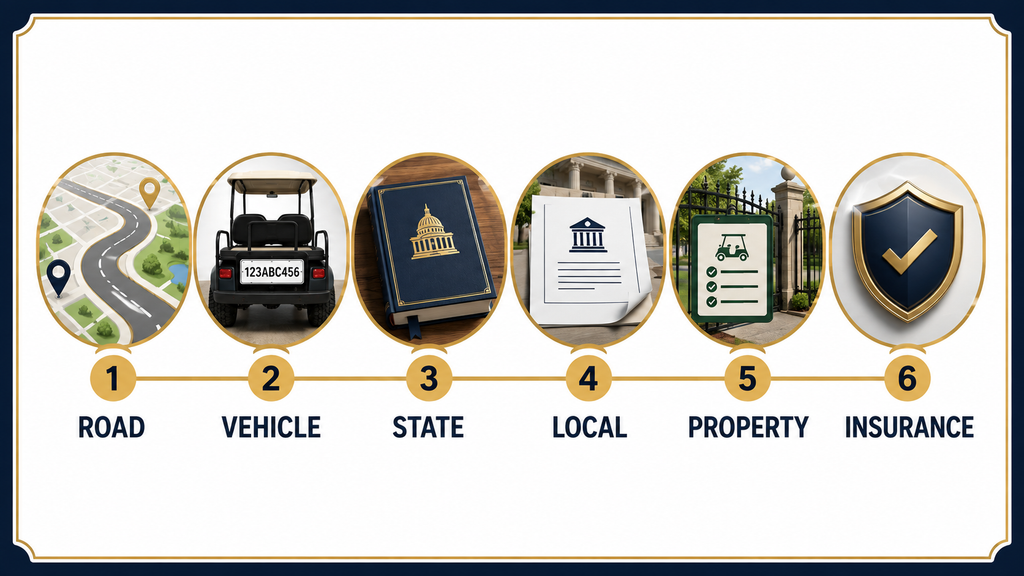
The safest approach is to verify the law from the road upward. Start with the exact location rather than searching only for a general statewide minimum age.
Step 1: Identify the Road or Property
Determine whether every part of the planned route is privately or publicly maintained. Pay particular attention to intersections, highway crossings, sidewalks, bridges, parking lots and roads outside the community gate.
Step 2: Identify the Vehicle Classification
Check the manufacturer’s label, maximum designed speed, VIN status, title and registration. Do not classify the vehicle solely by its appearance or by what the seller called it.
Step 3: Read the State Rule
Use the official legislature, DMV, highway-safety or public-safety website. Confirm the definition of a golf cart, minimum operator qualification, permitted roads, equipment rules and nighttime restrictions.
Step 4: Find the Local Ordinance
Search the city or county code for “golf cart,” “golf car,” “low-speed vehicle,” “personal transportation vehicle” and “neighborhood electric vehicle.” A local ordinance may prohibit carts entirely or authorize them only on a published list of streets.
Step 5: Check the Property Policy
Ask the golf course, resort, campground, HOA or property manager for its written rules. If the cart is rented, read the age, supervision, insurance and authorized-driver clauses before signing.
Step 6: Confirm Insurance
Ask the insurer whether the policy covers the cart, the named driver, the intended road and the planned use. Homeowners or automobile coverage should not be assumed to cover every golf-cart accident.
Safety Considerations for Young Golf-Cart Drivers
A golf cart’s low speed can create a false sense of security. Open sides, a high center of gravity, limited occupant protection and abrupt turning can make ejection and rollover serious risks.
A trauma-center study covering 2012 through 2022 reviewed 235 golf-cart injury patients, 105 of whom were children. Among the children, only 10% were restrained and 41% were ejected, while ejection was associated with more severe injury, according to the peer-reviewed golf-cart trauma study.
The findings came from one coastal community, so they should not be treated as a universal injury rate. They still illustrate why adult supervision and restraints matter even when the trip is short.
I recommend the following minimum precautions:
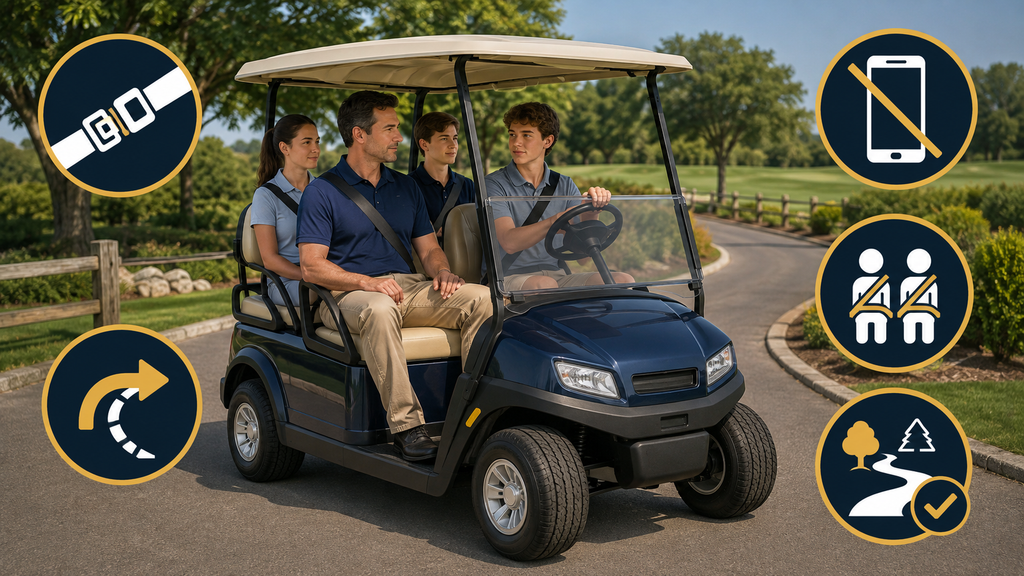
- Use only manufacturer-designated seats.
- Never allow a passenger to sit on another person’s lap.
- Keep hands, arms, legs and feet inside the cart.
- Use installed seat belts correctly.
- Slow down before every turn.
- Do not allow standing or riding on the rear platform.
- Avoid steep slopes, wet grass and uneven shoulders.
- Never drive while distracted or impaired.
- Follow the manufacturer’s passenger and weight limits.
- Do not let a child practice near traffic, pedestrians or water.
Passenger safety also matters when the family transfers from a cart to a regular vehicle. Our guide explaining when a child is ready to sit in the front seat separates legal minimums from safer recommendations.
Common Mistakes Parents and Owners Should Avoid
Assuming Adult Supervision Makes Everything Legal
An adult sitting beside a child does not automatically satisfy an age or licensing rule. Supervision only helps when the applicable law or property policy specifically allows a younger operator under supervision.
Relying on an Old State-by-State Chart
Golf-cart laws change, and local ordinances may change faster than statewide summaries. Florida’s newer permit requirement shows why an undated age chart can produce an incorrect answer.
Treating an HOA Road as Private Without Checking
Some community streets are dedicated public roads even though they look private. Ask who maintains the road and which police agency has jurisdiction.
Assuming Safety Equipment Makes the Cart Street Legal
Lights, mirrors and seat belts can improve safety, but equipment alone does not create legal authorization. The driver, road, registration, title, insurance and vehicle classification must also comply.
Allowing a Child to Steer From an Adult’s Lap
This does not make the adult the driver in any meaningful safety sense. It can interfere with steering and braking while leaving the child unrestrained and exposed.
Ignoring Insurance Until After a Crash
A policy may exclude an underage operator, public-road use, rentals, modified carts or vehicles kept away from the insured residence. Ask for written confirmation instead of relying on an informal assumption.
Frequently Asked Questions
Can a 12-year-old drive a golf cart?
A 12-year-old should not be assumed legally eligible to drive on a public street. Private-property operation depends on local law, the nature of the property, owner permission and the property’s written rules.
Can a 13-year-old drive a golf cart?
A 13-year-old may be allowed to operate a cart in limited private settings if the owner permits it. That does not normally provide permission to enter a public street, sidewalk or public parking area.
Can a 14-year-old drive a golf cart?
It depends on the location, but many public-road rules require a license or learner’s permit that a 14-year-old cannot yet obtain. Be cautious with websites that still list 14 as Florida’s general minimum because the current public-road rule requires qualifying identification or licensing.
Can a 15-year-old drive a golf cart?
A 15-year-old may qualify in a place that expressly accepts a valid learner’s permit, such as under Florida’s current public-road rule. The road must still be authorized, and local restrictions or permit supervision conditions may apply.
Can a 16-year-old drive a golf cart?
A licensed 16-year-old can satisfy the operator requirement in several states, including South Carolina and Michigan. That does not make every street legal, so the cart, road, equipment and local ordinance must also comply.
Can kids drive golf carts on private property?
They may be allowed in some genuinely private settings, but there is no automatic right for a child to drive. Property-owner rules, insurance conditions, public-access laws and safety concerns can still restrict operation.
Do you need a license to drive a golf cart in a neighborhood?
You commonly need a valid license or qualifying permit when the neighborhood streets are public. Private communities may establish separate rules, but you must confirm whether the roads are actually private.
Is a learner’s permit enough to drive a golf cart?
Only when the applicable law accepts a learner’s permit and all permit restrictions are followed. A permit that requires adult supervision does not become an unrestricted license simply because the vehicle is a golf cart.
Can you drive a golf cart on the sidewalk?
Generally, you should not drive on a sidewalk unless a specific law or marked route authorizes it. Michigan, for example, expressly prohibits golf carts on sidewalks constructed for pedestrians.
Can you receive a DUI while driving a golf cart?
Yes, impaired operation of a golf cart can result in a DUI or similar charge under many state laws. Private property is not always an exception, particularly when the property or parking area is accessible to the public.
Conclusion
The clearest answer to how old do you have to be to drive a golf cart is that public-road drivers commonly need to be at least 15 or 16 and possess a qualifying permit or full driver’s license. However, no age alone makes the trip legal because the road, local ordinance, vehicle classification, equipment, registration and insurance also matter.
I recommend checking the current state law, local municipal code and written property policy before allowing any minor to drive. Review the exact route, confirm insurance coverage, and keep a copy of any required license, identification, registration or permit in the cart.
