


How to get out of a car lease early without penalty
If you searched for how to get out of a car lease early without penalty, you are probably hoping for a single form, a phone call, or a loophole that makes the contract disappear. In most ordinary situations, there is not, and simply returning the keys can create a far larger bill than expected.
You are not trapped, but you need the right comparison. A lease transfer, buyout and sale, written pull-ahead offer, or genuine legal right can avoid an early-termination penalty, although you may still pay a transfer fee, tax, mileage charge, or payoff balance.
Most articles stop at a list of options. I will show you how to compare the two numbers that matter, get answers in writing, and spot a dealer solution that moves old debt into your next payment. This is general education, so let your signed lease, local law, and written payoff quote control your decision.
The honest meaning of “without penalty”
There are two very different outcomes people call a penalty-free lease exit. The first is genuinely favorable: the leasing company releases you after a qualified transfer, purchase payoff, promotional waiver, or statutory termination right. The second only looks favorable at first because the old lease balance has been rolled into a new loan or lease, in which you pay it off slowly with interest.
A direct early termination is usually the expensive path. The official leasing guidance warns that it can bring a substantial charge, while the current consumer-lease disclosure rules require the contract to explain the conditions and calculation method. The warning is useful, but it is not a waiver.
Treat a lease exit as a settlement, not a car return. When I research an exit problem, I begin with the signed contract, exact payoff quote, and independent value offers, not a dealer sales pitch. That prevents the common mistake of treating monthly payment times months left as the true exit cost.
Get the facts before you ask anyone to “take over” the car
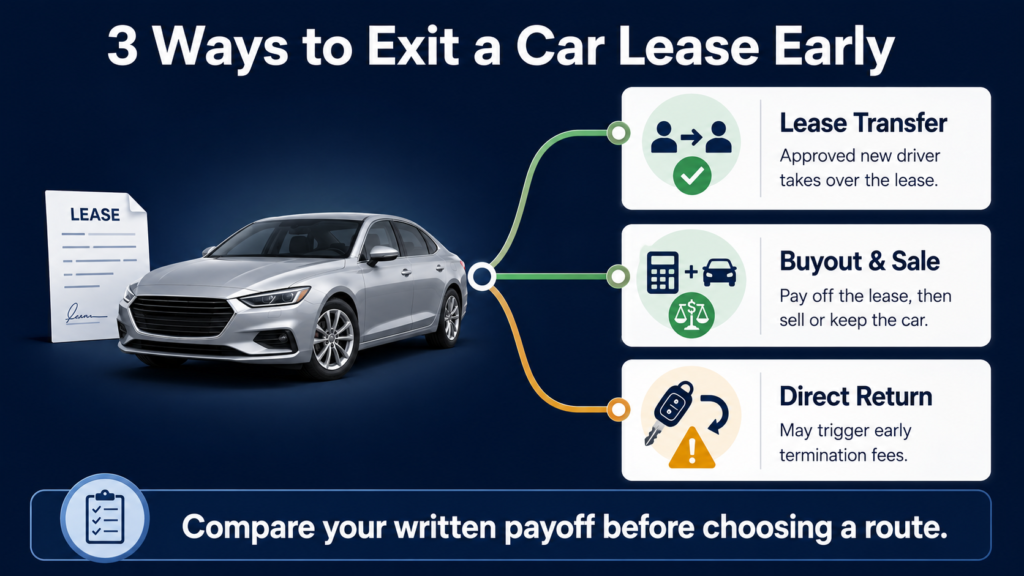
Call the leasing company, not only the dealership, and ask for information in writing. The lessor usually owns the contract and decides whether transfer, early purchase, extension, or pull-ahead is allowed, so an email is more useful than a vague phone conversation.
Request two figures that can differ: your customer purchase payoff for a specified date, and the third-party or dealer payoff, if another buyer is allowed. Include every fee, tax, and expiry date in both requests.
Do not confuse either figure with residual value. Residual value is mainly an end-of-term estimate, while an early buyout may use a different formula or be restricted to the named customer.
Gather the rest of your file before negotiating. It lets you compare every route on the same basis.
- Lease facts: Record current mileage, total allowance, payment, term, maturity date, disposition fee, and all transfer fees. Read the “Early Termination,” “Purchase Option,” and “Assignment” clauses because they decide what the company will consider.
- Vehicle evidence: Photograph all sides, wheels, interior, odometer, keys, and service records in good light. This records condition before a buyer or inspector sees the vehicle.
- Value evidence: Obtain at least three dated offers from unrelated potential buyers. The best number is one the buyer will honor after inspecting the car.
- Exit evidence: Ask whether you remain liable after a transfer and whether incentives or an early buyout are permitted. Get the answer in writing before paying for advertising or repairs.
Option 1: Transfer the lease, but only if you receive the right release
A lease transfer, often called an assignment or assumption, is usually the closest thing to a routine low-cost exit. Another approved person takes over the remaining payments, so you avoid ending the agreement early, but only if the lease permits it.
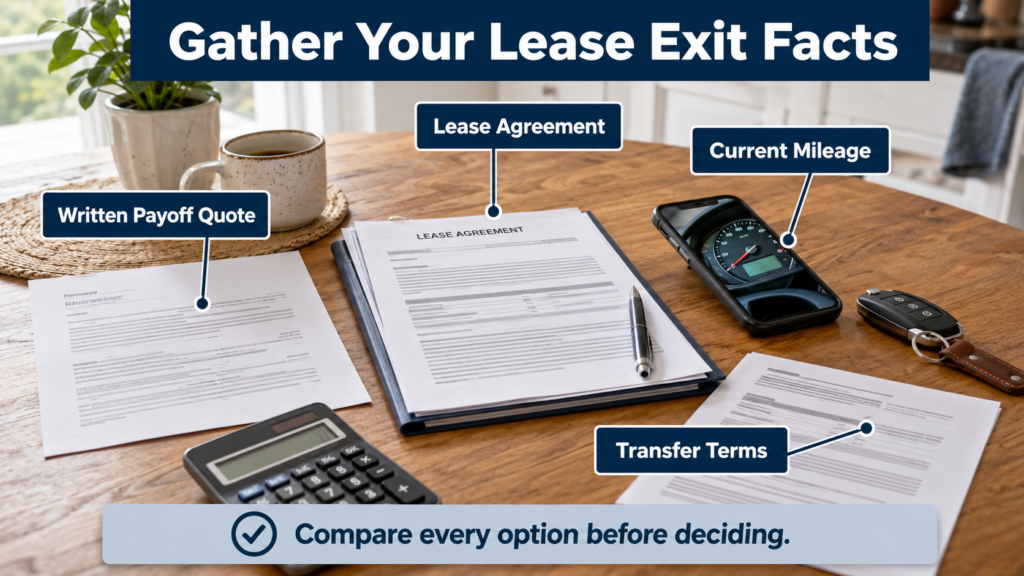
Ask four questions: Is transfer allowed? Does the new person need credit approval? What are all fees? Does the original lessee receive a complete release? Some leases leave the first lessee liable if the new driver misses payments or damages the vehicle.
If the lessor will not issue a clear release, you are not fully out of the lease. I would not hand over keys or access to the vehicle until the company confirms every approval and transfer document is complete.
Make the listing factual: payment, months, current and allowed mileage, location, condition, transfer fee, and permitted incentive. A documented incentive may be cheaper than early termination, but it is still an expense, not a free exit.
The practical transfer sequence is straightforward but should not be rushed:
- Ask the lessor for its current transfer packet, permitted matching process, and deadlines. The transfer is not real until its formal approval process is complete.
- Explain that the lessor, not you, makes the credit decision. Keep personal data private and do not promise approval to an interested person.
- Keep the signed assumption, release, delivery record, and receipts. Check the next account statement and correct any lingering liability promptly in writing.
Option 2: Buy out the lease, then sell or keep the vehicle
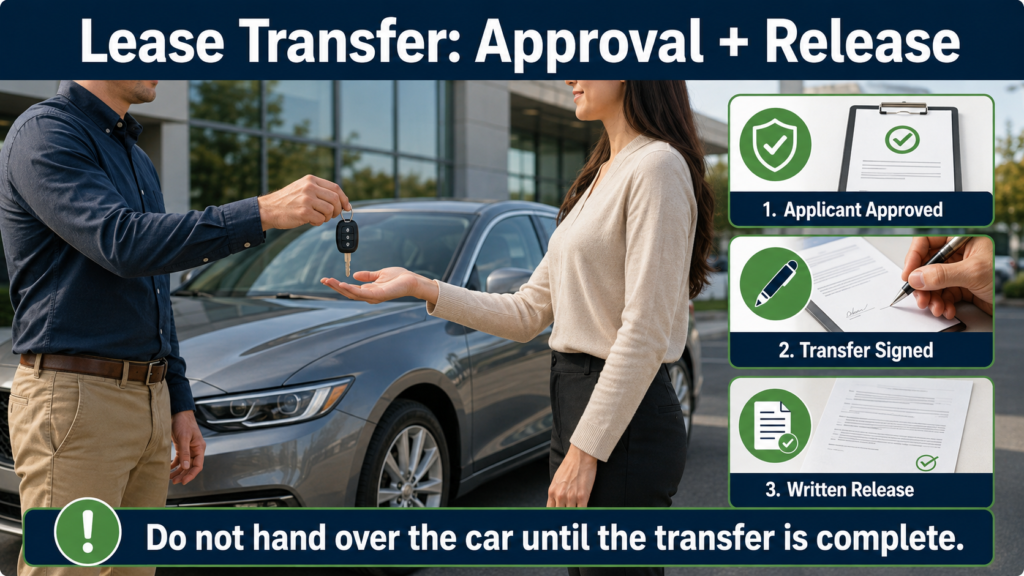
An early buyout can be the cleanest route when the vehicle is worth at least as much as the all-in payoff. You purchase the vehicle from the lessor, ending the lease through payment rather than early termination, then keep, refinance, or sell it.
Start with the written all-in customer payoff, then subtract the best firm sale offer after tax, title, inspection, repair, and transaction costs. A positive result may produce equity, zero can be a break-even exit, and a negative result means cash or a cheaper strategy is needed.
Use written figures: net equity = best real sale price minus all-in payoff minus unavoidable transaction costs. Do not use a residual value, an optimistic asking price, or a verbal promise that a dealer will make it work.
Check two restrictions. A third-party buyer may face a higher payoff or be prohibited from buying during the term, which can mean buying the vehicle yourself first. If you finance that buyout, compare total loan cost, not only the lower-looking monthly payment.
One overlooked step is to ask about optional add-on products. Review whether prepaid protection products, service contracts, or similar extras can be cancelled and whether any unused portion is refundable under their terms. Official enforcement action has highlighted refund problems involving unused vehicle add-ons, so request a written answer rather than assuming a refund will appear automatically.
Option 3: Use a written pull-ahead offer or trade-in, without burying the loss
Sometimes a leasing company offers a pull-ahead program near maturity, waiving one or more remaining payments if you qualify for a replacement vehicle. It can help, but it is a conditional offer, not a general right.
Get it in writing and check models, deadline, mileage, wear, loyalty, and finance requirements. A waived payment does not necessarily erase damage, disposition, taxes, or a prior balance.
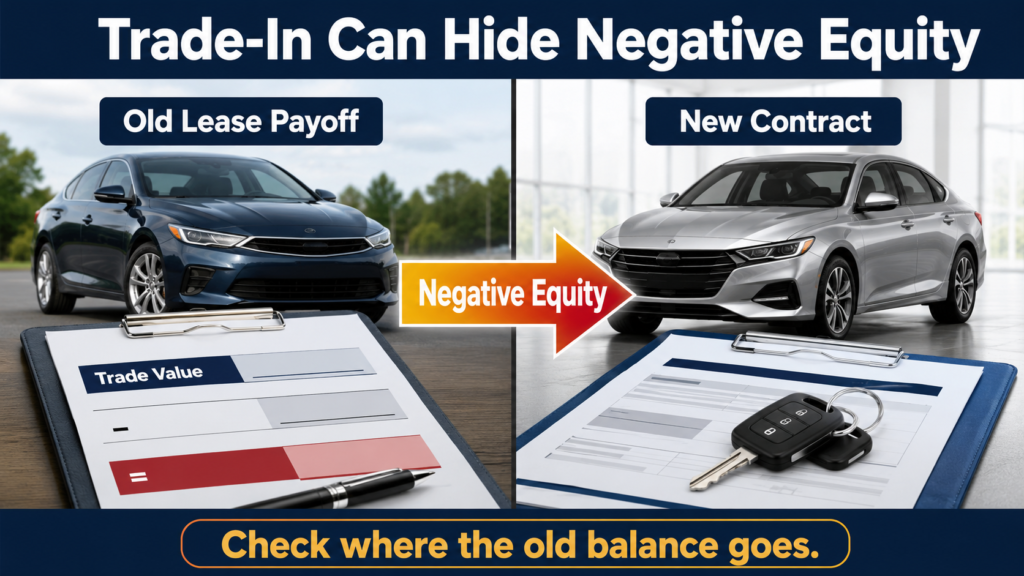
A dealer trade-in can close the old lease, but when the offer is lower than the payoff, the difference is negative equity. You may pay it now, use your down payment, or roll it into the new contract, which means you keep paying for the old vehicle.
Ask for an itemized worksheet separating old payoff, trade value, equity, new-vehicle price, fees, cash down, and total of payments. I treat “we will take care of your lease” as the start of analysis, because line items reveal whether it is a real buyout, waiver, or a costlier replacement contract.
Option 4: Know the limited situations that can truly remove the penalty
There is no universal hardship rule that lets any driver cancel because money is tight, a job changes, or the car no longer fits. Call early, because the guidance on payment difficulties says a company may offer a plan, due-date change, or temporary forbearance; get any arrangement in writing because it usually postpones rather than cancels the obligation.
Limited legal or contractual routes may change the outcome. A materially faulty vehicle, serious misrepresentation, undisclosed term, or breach of service obligation can create remedies unlike buyer’s remorse, so preserve advertisements, repair orders, messages, photos, and a dated timeline.
The federal consumer-lease framework requires an understandable early-termination calculation and a reasonable penalty or other charge. Read the current early-termination calculation requirement before querying a bill, then ask for the contractual formula, inputs, dates, credits, realized value, and each fee.
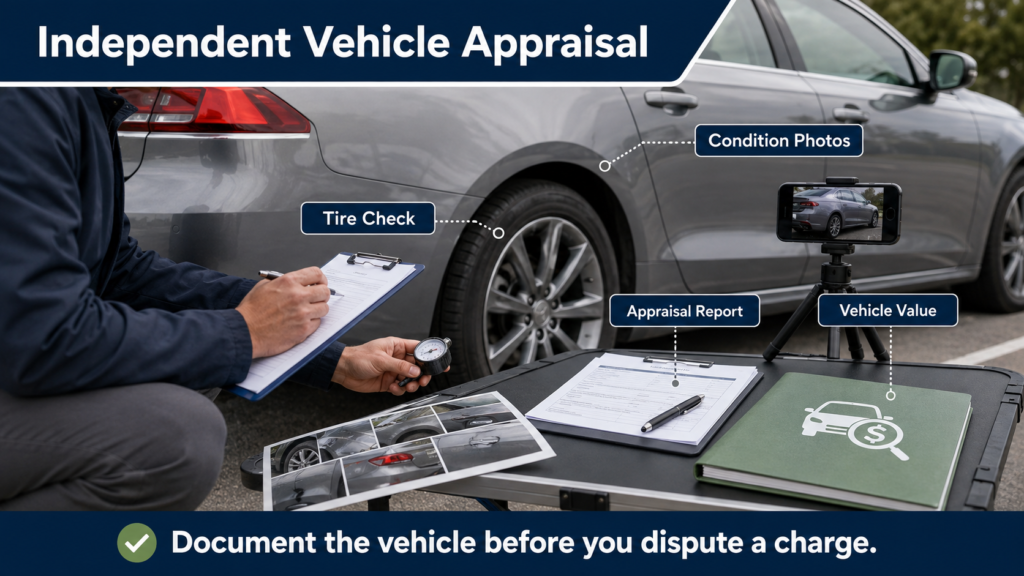
If liability depends on residual value versus realized sale value, check for an independent appraisal right. It is narrow, but the appraisal disclosure rule can make a mutually agreed independent appraisal, paid for by the lessee, final and binding.
A special military termination right
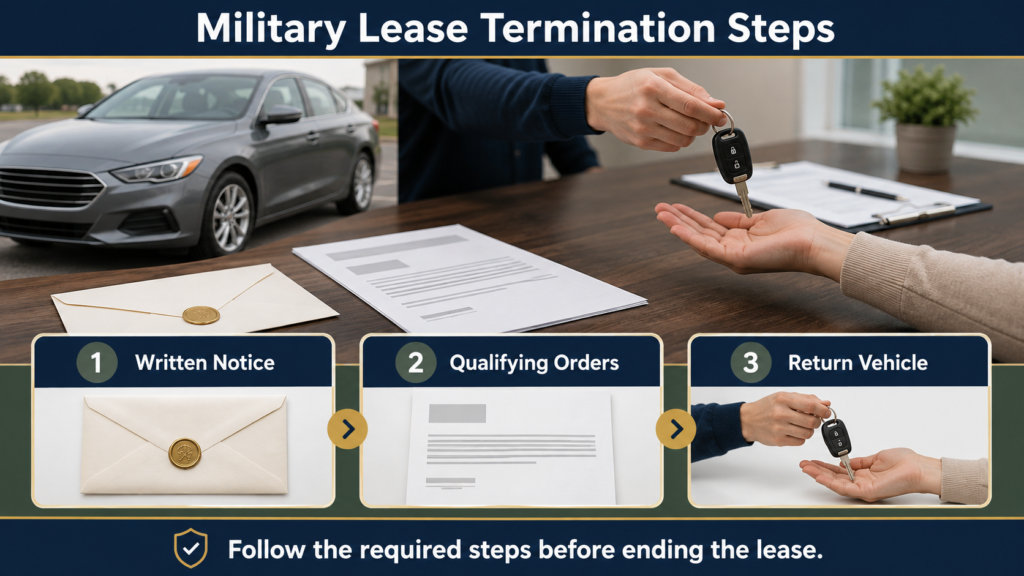
Active-duty service members may have a genuine no-early-termination-charge route under the Servicemembers Civil Relief Act. The official vehicle-lease termination guidance covers a pre-service lease after a call to active duty for at least 180 days, or qualifying overseas permanent-change-of-station orders or deployments of at least 180 days.
Written notice, qualifying orders, an approved delivery method, and timely vehicle return still matter. This removes early cancellation charges when it applies, but not amounts already due or reasonable excess wear and mileage.
When the lease calculation, not the whole contract, is the problem
If you believe a charge is wrong, make a written request that identifies the account, disputed amount, calculation, and supporting documents. Include your photos or appraisal evidence, but do not agree to a number just to end an uncomfortable call.
Keep paying undisputed amounts unless qualified advice says otherwise. If the company will not resolve a documented servicing issue, the official consumer complaint process can route it to the company for a response.
Use a five-column exit worksheet before you decide
The most useful document you can make is a one-page comparison of every available route. It keeps a low monthly payment or an attractive verbal offer from distracting you from total cost. Use dates beside every quote because a payoff, vehicle offer, and promotion can expire at different times.
| Exit route | What may clear the lease | Costs to enter | Costs people often miss | Best fit |
|---|---|---|---|---|
| Lease transfer | Approved new lessee and written release | Transfer fee, possible incentive | Original-lessee liability if no release, excess mileage | The lease is transferable and attractive to a new driver |
| Buyout then sale | All-in purchase payoff | Tax, title, financing or transaction costs | Lower post-inspection offer, third-party buyout restriction | Firm sale value is near or above payoff |
| Pull-ahead offer | Written waiver for specified remaining payments | New-vehicle transaction costs | Wear, mileage, deadline and eligibility conditions | Only a short term remains and the replacement is already suitable |
| Trade-in | Dealer pays the lessor’s payoff | Negative equity or new-contract costs | Old balance hidden in the replacement payment | The worksheet shows a genuine net benefit |
| Direct early termination | Payment of the lessor’s final calculated bill | Early-termination liability | Disposition, mileage, wear, collection risk | Last resort after written comparison |
Here is a simple illustration. Imagine your all-in customer payoff is $21,300 and an actual buyer offers $22,100 after inspection. If title, tax, and transaction costs total $300, your estimated net result is $500 in your favor, subject to the exact closing terms. That may be a no-penalty exit because the lease is paid off, not terminated early.
Now change only the buyer’s offer to $20,000. Your gap is $1,300 plus the $300 costs, or about $1,600 out of pocket. If an approved transfer costs a $300 fee and a $750 incentive, the transfer could be roughly $550 cheaper, even though it is not literally free.
Add a sixth option whenever you are close to maturity: keep the lease until the scheduled end. Multiply the remaining required payments, then add any likely end-of-lease mileage, wear, and disposition charges. Waiting is often the least dramatic option, and in some cases it is financially better than paying a large exit amount to escape only a few remaining months.
Do not use voluntary repossession as an “option” in your worksheet. The public explanation of vehicle repossession makes clear that returning a vehicle after default can still leave you responsible for a deficiency and related fees, and it can harm your credit record. It is damage control, not a penalty-free exit plan.
A practical script for your call and a safer decision order
Use a plain request rather than trying to negotiate before you know the facts. You can say: “I am considering a transfer, customer buyout, dealer buyout, or an early return. Please send me the current written payoff for each available route, your transfer rules and fees, whether I receive a release after transfer, and the full method used to calculate an early termination charge.” This wording avoids agreeing to an early return while making the company give you useful information.
Then work through the choices in this order. First, check for a documented statutory right or a real defect, misrepresentation, or contractual breach. Second, ask whether a transfer with a full release is allowed. Third, compare your all-in payoff with firm buyer offers. Fourth, inspect any pull-ahead or trade-in proposal line by line. Only after those checks should you price a direct early termination.
Keep a file with the lease, payoff quotes, offer screenshots, agent names, dates, messages, inspection reports, transfer paperwork, and photos. If an account later shows an unexplained balance or credit-report error, this file is more useful than memory. After a completed exit, check the official free credit-report portal and dispute any incorrect reporting directly with the relevant reporting company.
State and federal rules can overlap, so your contract may not be the only source of rights. If you would like a quick plain-language background before researching your local remedies, read how federal and state rules can work together. That distinction matters when a contract provision looks broad but a local consumer-protection rule may still apply.
Five shortcuts that can make an expensive situation worse
Stopping automatic payments or canceling insurance is not the same as ending a lease. The contract remains in force until the lessor confirms a transfer, payoff, termination, or other release. A lapse in required insurance can itself be a breach and may lead to force-placed coverage or other charges under the contract.
Do not give a buyer the car and hope that they will make your payments. A private arrangement may be convenient for a week, but you remain contractually responsible if the person disappears, crashes the car, or stops paying. Use the lessor’s formal transfer process, including its insurance and approval requirements.
Avoid repairing every small mark without first reading the return standards and getting a sensible repair quote. Some work is normal use; some is chargeable damage; and poor cosmetic work can reduce a buyer’s offer. Get a pre-return inspection if available, save before-and-after photos, and compare the repair cost with the lessor’s written charge standard.
Do not take a dealer’s appraisal as the market value. It is one offer in a negotiation that may also involve your next car. Obtain independent offers on the same day where possible, and compare the whole transaction rather than the trade-in number alone.
Finally, do not rely on a forum post that says a particular lease brand “always” allows transfers or outside buyouts. Policies change, trim and model restrictions vary, and the lease you signed controls. A written answer for your account is worth more than a thousand general anecdotes.
How early-exit protections compare in other countries
Rules differ because the product called a “lease” may really be a long-term rental, a hire-purchase agreement, a conditional sale, or a finance arrangement with a balloon payment. That is why a comparison can be helpful, but it should never be copied blindly into your own contract. The table below compares the structure of protections rather than promising that a driver can cancel free of charge.
| Jurisdiction or framework | Main early-exit protection | Important limit | Practical verdict |
|---|---|---|---|
| Federal and state framework used in this guide | Consumer leases must disclose early-termination conditions and a reasonable calculation method. | It does not create a general right to walk away because circumstances changed. | Strong on disclosure, but the contract and local law still drive the price. |
| United Kingdom | A debtor can use the statutory right to terminate many regulated hire-purchase or conditional-sale agreements, with liability governed by the half-total-price rule. | This is not a blanket solution for every genuine hire or personal-contract-hire lease, and damage can still matter. | The clearest statutory early-exit route for the specific finance agreements it covers. |
| Ontario, Canada | Consumer-lease rules require detailed disclosures and use a prescribed approach to early-termination compensation. | It is not the same as a free cancellation right, and provincial rules matter. | More formula-focused than a simple “hand back the keys” approach. |
| Australia | Standard-form consumer contracts can be challenged if terms are unfair, and the contract protections list one-sided termination penalties as a potential issue. | A court decides unfairness, and this is not an automatic exit from a vehicle lease. | Helpful protection against unfair terms, not a routine no-cost lease exit. |
If “good” means the clearest predictable statutory exit, the United Kingdom is strongest in this narrow comparison for qualifying hire-purchase and conditional-sale contracts. If “good” means a true lease can always be returned early free of charge, no country in this comparison offers that broad promise. The product type, the amount already paid, the vehicle condition, and the exact contract still matter.
Expert tips that protect your money and your credit
- Compare exit cost, not monthly payment. A lower new payment can hide a longer term, higher rate, rolled-in negative equity, or a larger total of payments. Ask for the total payable and compare it with your best standalone exit route.
- Get a payoff and an offer on the same day. Vehicle values, inspection results, and payoff figures move. A same-day comparison gives you a more honest picture than using an old online estimate against a new payoff.
- Use the word “release.” A transfer is not enough if the original lessee remains liable. Ask whether the company will issue a complete written release and keep it with your final account statement.
- Treat mileage as a real liability. Calculate projected total miles at the date you expect to exit, then compare it with the contract’s total allowed miles and per-mile charge. If you are already over the allowance, do not wait until a buyer or inspector discovers it.
- Ask about both payoff paths. The customer purchase payoff and a third-party payoff can be different, and the difference can change whether a sale is possible. Never assume a dealer can buy out your vehicle at the price you were quoted.
- Do not sign a replacement deal under pressure. Take the complete itemized figures home, sleep on them, and compare the total cost. A genuine good offer should still be understandable when you are not sitting at a sales desk.
For more plain-English explanations of everyday rights and obligations, browse our legal-information guides before you sign a settlement, transfer, or replacement finance agreement.
Frequently asked questions
Can I return a leased car early without a penalty?
You can physically return it, but that does not usually end the financial obligation without cost. An ordinary early return can trigger the contract’s early-termination calculation, plus unpaid amounts, wear, mileage, and other permitted charges. A transfer, buyout, written promotion, qualifying military right, or a valid remedy for a serious contractual problem is more likely to avoid an early-termination penalty.
The first step is not to drop off the vehicle. Request the written calculation and compare it against a transfer and all-in buyout path. If only a few payments remain, also compare the cost of keeping the lease until its scheduled end.
Is a lease transfer truly penalty-free?
A successful transfer can avoid early termination because the lease continues, but it is not automatically free. You may pay an assignment fee, advertising fee, or incentive to attract a new lessee. More importantly, some contracts keep the original lessee liable if the new person defaults.
Ask whether the transfer creates a complete written release. If the answer is no, describe the deal accurately as a transfer of use and payment responsibility, not as a clean exit. Only the lessor’s final paperwork can settle that question.
Can I sell a leased car to get out early?
Usually, you must first satisfy the leasing company’s purchase payoff, either yourself or through an allowed buyer. The vehicle can be sold only if the buyer and lessor can complete the title and payoff process under the contract. Some lessors limit third-party buyouts during the lease, so check this before listing the vehicle.
Compare firm offers with your all-in payoff, not just the residual value. If the sale price is higher after costs, the route may work well. If it is lower, calculate the gap and compare it with the cost of a transfer or waiting until maturity.
Will ending a car lease early hurt my credit?
Paying off a lease, completing an approved transfer, or using a documented legal termination should not be treated the same way as a default. Your credit profile can change whenever an account closes, but the key issue is whether payments were made as agreed and whether the account is reported accurately. Do not let someone tell you that a proper payoff automatically “destroys” your credit.
Late payments, default, and repossession are much more serious risks. Once the exit is complete, review your reports through the official portal and challenge any error directly. Keep the release and paid-in-full evidence in case the reporting takes time to update.
What should I do if the early termination charge looks wrong?
Ask for the contract clause, full formula, every input, vehicle-value credit, dates used, and each fee in writing. Compare the answer with your signed disclosure, condition photos, mileage record, and any pre-return inspection. If realized value affects the charge, check whether the independent appraisal disclosure applies to your lease.
Do not ignore the invoice or withhold payment solely because you are upset with it. Make a documented dispute, escalate through the company’s complaint channel, and seek local legal or consumer assistance if the figures remain unsupported. A clear paper trail is much stronger than an angry phone call.
Final takeaway: choose the exit that actually closes the obligation
The safest answer to how to get out of a car lease early without penalty is not a trick. It is a disciplined comparison: obtain written payoff figures, confirm transfer and buyout rules, collect real vehicle offers, price any negative equity openly, and secure a written release. If a promotion or legal right applies, make sure its conditions are met before returning the car.
Start with the leasing company, not a hurried dealership visit. Then choose the route with the lowest verified total cost and the clearest release of liability. That approach protects your budget, your credit record, and your ability to make a better vehicle decision next time.
