

How Long Is Maternity Leave in California?
If you are trying to work out how long is maternity leave in california, the first thing to understand is that there is no single program officially called “California maternity leave.” Your total time away from work can come from several different laws and benefit programs, and they do not all do the same job.
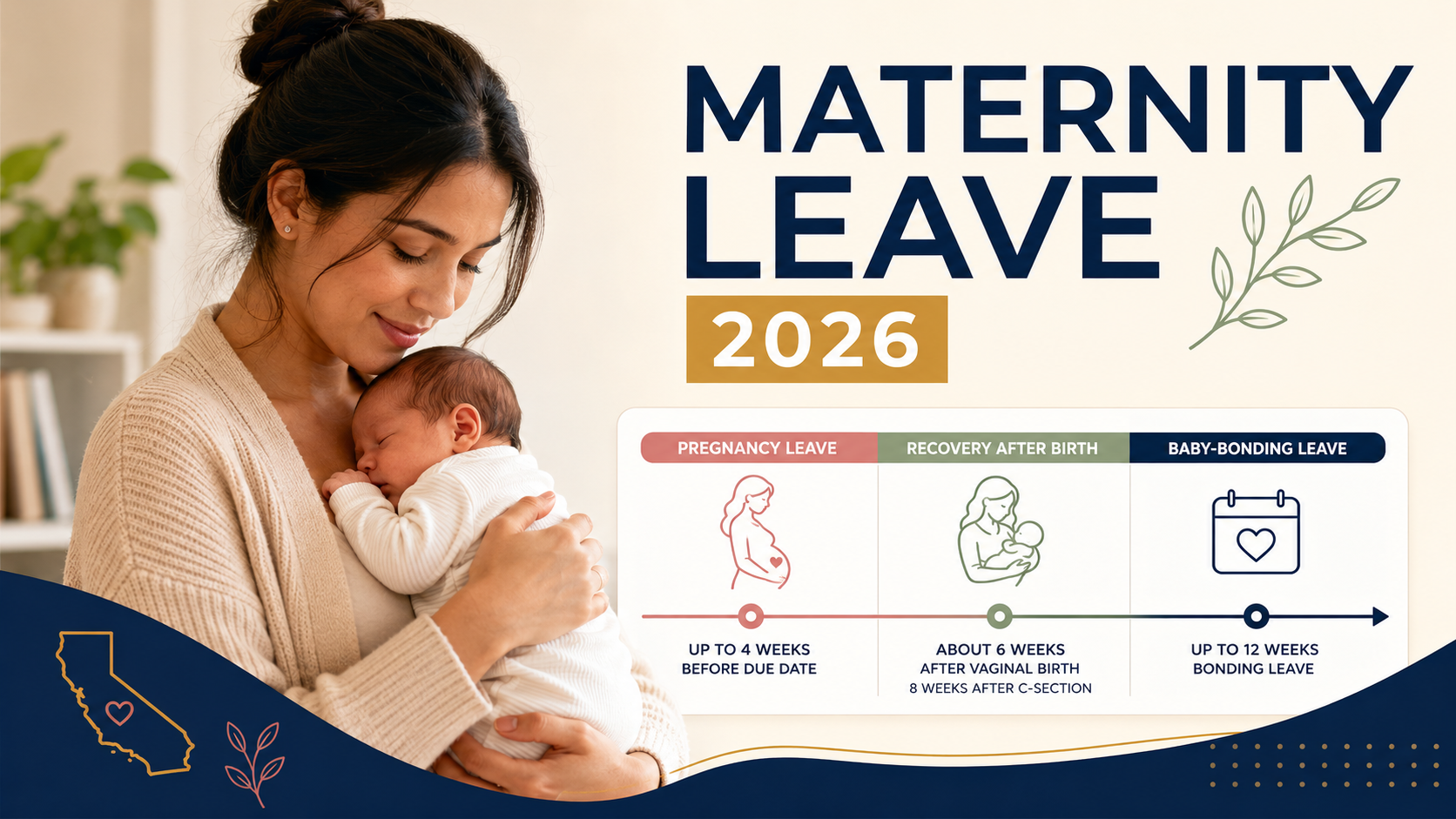
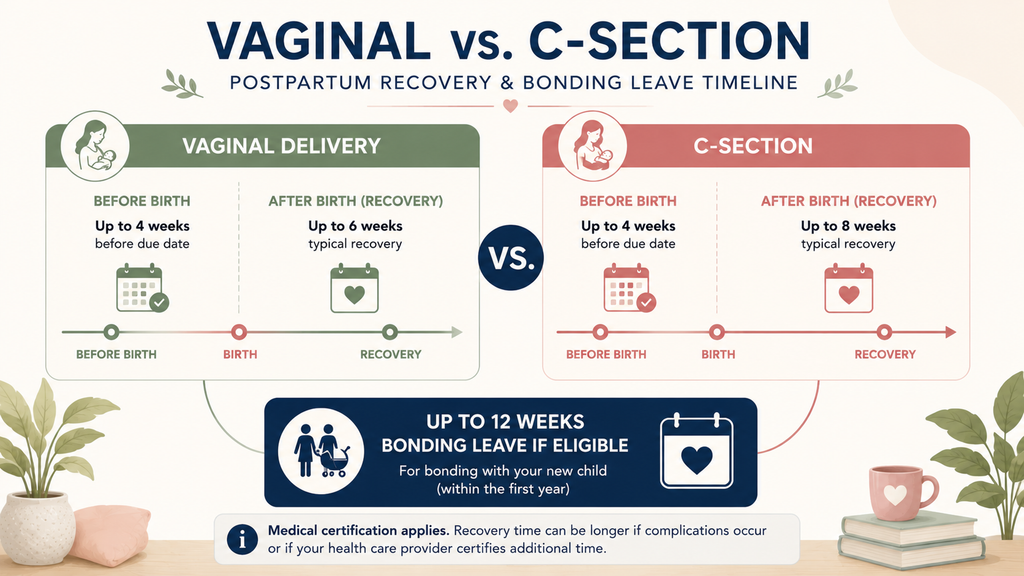
For an eligible employee who gives birth, a common uncomplicated timeline is up to four weeks before delivery, approximately six weeks after a vaginal birth or eight weeks after a C-section for pregnancy-related disability, followed by as much as 12 weeks of baby-bonding leave if the employee qualifies under the California Family Rights Act. A medically complicated pregnancy or recovery can result in a longer disability period.
Quick Answer: How Long Is Maternity Leave in California?
California Pregnancy Disability Leave can provide up to four months of job-protected leave while an employee is actually disabled by pregnancy, childbirth, or a related condition. An eligible employee can then potentially take up to 12 additional weeks of CFRA leave to bond with the child. State Disability Insurance and Paid Family Leave may replace part of the employee’s wages during portions of that time, but pay benefits and job protection are separate questions.
Important: This article provides general legal information, not individual legal advice. Eligibility can depend on employer size, time worked, hours of service, medical certification, payroll coverage, collective bargaining agreements, and other facts.
How California Maternity Leave Fits Together
California maternity leave becomes much easier to understand when you separate job-protected leave from money paid while you are away from work.
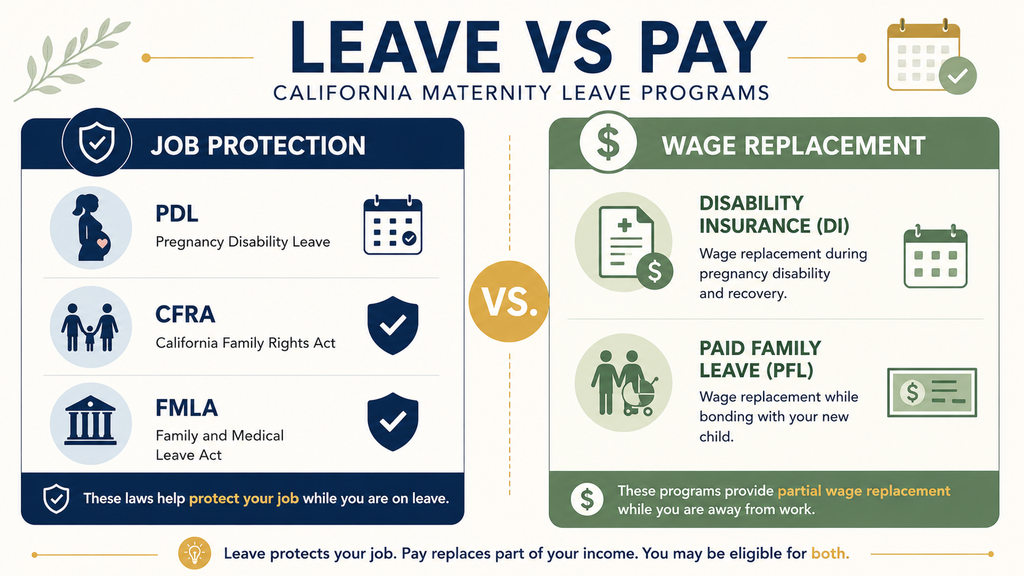
Pregnancy Disability Leave, or PDL, protects qualifying time away because of your own pregnancy-related disability. CFRA protects eligible baby-bonding leave. Disability Insurance and Paid Family Leave, on the other hand, are primarily wage-replacement programs administered through the Employment Development Department.
| Program | Main purpose | Potential time | Job protection? | Pays benefits? |
|---|---|---|---|---|
| PDL | Pregnancy or childbirth disability | Up to 4 months | Yes | Not by itself |
| Disability Insurance | Wage replacement during medical disability | Depends on certified disability | No by itself | Yes |
| CFRA | Bonding with a new child | Up to 12 weeks | Yes | No by itself |
| Paid Family Leave | Wage replacement while bonding | Up to 8 weeks | No by itself | Yes |
| FMLA | Medical/bonding leave | Up to 12 weeks | Yes | Generally unpaid |
California’s Civil Rights Department explains that employees working for employers with at least five employees may receive up to four months of Pregnancy Disability Leave when a health care provider determines that pregnancy, childbirth, or a related condition makes them disabled.
One detail I would not overlook is the difference between leave and pay. The EDD expressly treats Disability Insurance and Paid Family Leave as wage-replacement benefits, while job protection may come from laws such as PDL, CFRA, or FMLA.
The same legal distinction between time away from work and whether an employer must continue paying wages appears in other kinds of protected absences. The Law Learner’s guide to employer obligations during jury service provides another example of why “Can I take leave?” and “Will my employer pay me?” are separate questions.
Pregnancy Disability Leave: Up to Four Months
California Pregnancy Disability Leave applies when a worker is actually disabled because of pregnancy, childbirth, or a related physical or mental condition.
If your employer has at least five employees, there is no minimum number of months or hours you must have worked before becoming eligible for PDL. Your health care provider determines whether you have a pregnancy-related disability and how much leave is medically necessary, subject to the statutory maximum.
California defines the four-month PDL entitlement based on your normal work schedule. For someone working a standard schedule, the state’s PDL calculation guidance explains that four months works out to approximately 17⅓ weeks.
You do not automatically receive all 17⅓ weeks simply because you are pregnant. PDL covers the period during which your provider certifies that you cannot perform your regular job or cannot do so safely because of the pregnancy-related condition.
Pregnancy disability can potentially include conditions such as severe morning sickness, medically required bed rest, gestational diabetes, pregnancy-induced hypertension, preeclampsia, postpartum depression, prenatal or postnatal care, and recovery from pregnancy loss.
How Long Is the Typical Pregnancy Disability Period?
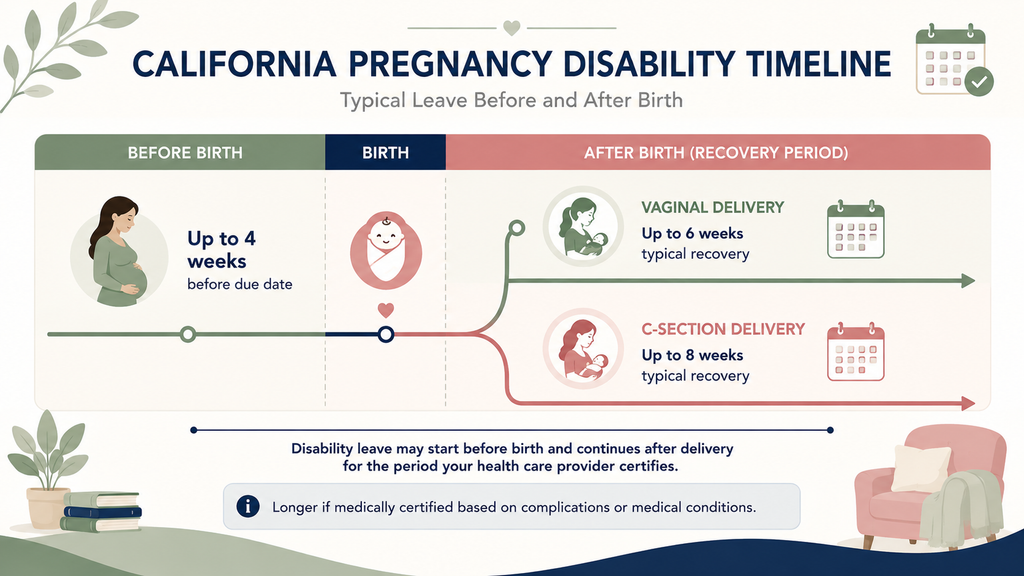
For a pregnancy without medical complications, the EDD’s pregnancy Disability Insurance guidance generally provides benefits for:
- Up to 4 weeks before the estimated delivery date
- Up to 6 weeks after a vaginal delivery
- Up to 8 weeks after a cesarean delivery
A licensed health professional can certify a longer disability period when complications or the employee’s work limitations justify it.
That distinction matters. The typical 10- or 12-week DI pregnancy period is not the same thing as the maximum PDL entitlement.
How Long Is Maternity Leave in California After Birth?
Once a birthing employee is no longer disabled by pregnancy or childbirth, the reason for leave changes. The employee may then qualify for baby-bonding leave under the California Family Rights Act.
CFRA can provide up to 12 workweeks of job-protected bonding leave for the birth of a child or placement of a child through adoption or foster care. The state’s PDL and child-bonding guide explains that an employee generally needs at least 12 months of service, 1,250 hours worked during the previous 12 months, and an employer with at least five employees.
This bonding period is important because pregnancy disability and CFRA baby bonding are different entitlements. For a qualifying birth mother, CFRA bonding can generally begin after pregnancy disability ends.
Example: Vaginal Delivery
Suppose your provider certifies you as disabled for four weeks before your expected delivery and six weeks afterward. If you then qualify for and use the full 12 weeks of CFRA bonding leave, your total leave could be approximately 22 weeks.
That example assumes an uncomplicated delivery and separate eligibility for CFRA. A shorter or longer pregnancy-disability period changes the total.
Example: C-Section
Suppose your provider certifies four weeks before delivery and eight weeks after a routine C-section. Adding 12 weeks of CFRA bonding leave could create a total absence of approximately 24 weeks.
Again, this is an illustration rather than an automatic entitlement. Your provider controls the medical-disability portion, while CFRA eligibility controls the bonding portion.
How Long Is Maternity Leave in California With Pay?
This secondary question requires a different answer because paid benefits do not necessarily cover every week of job-protected leave.
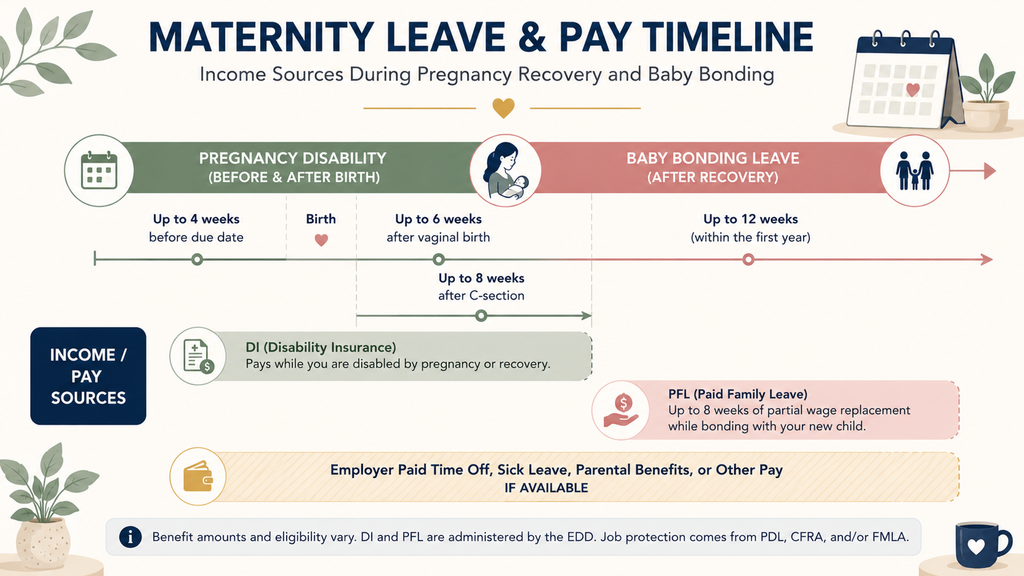
Eligible workers may receive Disability Insurance while unable to work because of pregnancy or recovery from childbirth. After the medical disability ends, eligible parents may receive Paid Family Leave benefits while bonding with the new child.
The EDD’s current Paid Family Leave benefit rules provide up to eight weeks of partial wage replacement within a 12-month period for qualifying bonding, caregiving, or military-assist claims.
For 2026 claims, the EDD’s benefit-payment calculation rules generally replace about 70% to 90% of wages, depending on earnings. The current maximum weekly DI/PFL benefit is $1,765.
Does Your Employer Have to Pay Your Full Salary?
Usually, PDL and CFRA themselves do not require an employer to pay your normal salary simply because you are on leave. Employer-paid parental leave, sick leave, vacation, PTO, a collective bargaining agreement, or an employer’s voluntary disability plan may provide additional income.
This is why I recommend making two separate timelines before your leave begins:
- Job-protection timeline: PDL, CFRA, and possibly FMLA.
- Income timeline: DI, PFL, PTO, sick leave, employer parental pay, or another benefit.
That simple exercise often exposes a gap where your job may remain protected but state wage-replacement benefits have ended.
How FMLA Fits Into California Maternity Leave
The federal Family and Medical Leave Act can also protect qualifying maternity and parental leave, but it does not simply add 12 extra weeks to every California employee’s total.
The Department of Labor’s FMLA birth and bonding rules provide eligible employees up to 12 workweeks of job-protected leave for birth, bonding, adoption, foster placement, and qualifying serious health conditions.
For most private-sector employees, FMLA eligibility generally requires 12 months of employment, at least 1,250 hours of service during the previous 12 months, and a worksite where the employer has at least 50 employees within 75 miles.
FMLA commonly runs at the same time as another qualifying leave rather than creating a fresh block afterward. For example, FMLA may overlap with PDL during pregnancy-related incapacity, while CFRA can provide separate bonding leave after pregnancy disability ends.
The Department of Labor also makes clear that FMLA itself is generally unpaid. Accrued paid leave or other benefits may run at the same time, but federal FMLA protection does not itself create salary continuation.
How Long Is Maternity Leave in California for Mothers and Women?
For a woman who gives birth, the potentially available leave can be longer than the leave available to a non-birthing parent because pregnancy-related disability comes first.
A qualifying mother may receive medically necessary PDL for as much as four months, followed by up to 12 weeks of CFRA bonding leave if she independently qualifies for CFRA. In a maximum medically supported scenario, that combination can approach 29⅓ weeks of job-protected leave.
Most uncomplicated pregnancies do not require the full four months of PDL. A more typical timeline might involve four weeks before birth, six or eight weeks after delivery, and then up to 12 weeks of bonding leave.
Mothers adopting a child or receiving a foster placement do not require pregnancy-disability leave for that event. However, eligible employees can still qualify for CFRA bonding leave and potentially PFL benefits.
How Long Is Maternity Leave in California for a C-Section?
A C-section most directly affects the medical-disability portion of maternity leave.
The EDD normally recognizes up to eight weeks of postpartum Disability Insurance benefits following a cesarean delivery, compared with up to six weeks after an uncomplicated vaginal delivery. The same EDD guidance allows up to four weeks before the estimated due date in an uncomplicated pregnancy.
After a provider determines that the employee is no longer disabled, a CFRA-eligible mother can potentially move into up to 12 weeks of bonding leave. A routine C-section therefore does not automatically increase the bonding entitlement itself.
If complications continue beyond the ordinary eight-week recovery period, the provider may certify additional disability when medically justified.
How Long Is Maternity Leave in California for Fathers and Men?
For fathers and other non-birthing parents, pregnancy-disability leave generally does not apply because PDL protects an employee from their own pregnancy-related disability.
An eligible father can instead receive up to 12 weeks of CFRA bonding leave during the first year after the child’s birth, adoption, or foster placement. The Department of Labor similarly confirms that mothers and fathers have equal FMLA bonding rights when they meet federal eligibility rules.
California’s Paid Family Leave program can also provide eligible fathers with up to eight weeks of partial wage replacement for bonding.
So if you search how long is maternity leave in California for men, “maternity leave” is not technically the best description. The practical issue is parental or baby-bonding leave, and the key state job-protection figure for a CFRA-eligible non-birthing parent is up to 12 weeks.
How Long Is Maternity Leave in California for Teachers?
Teachers have an extra complication: job-protected leave rights and state wage-replacement coverage do not always line up.
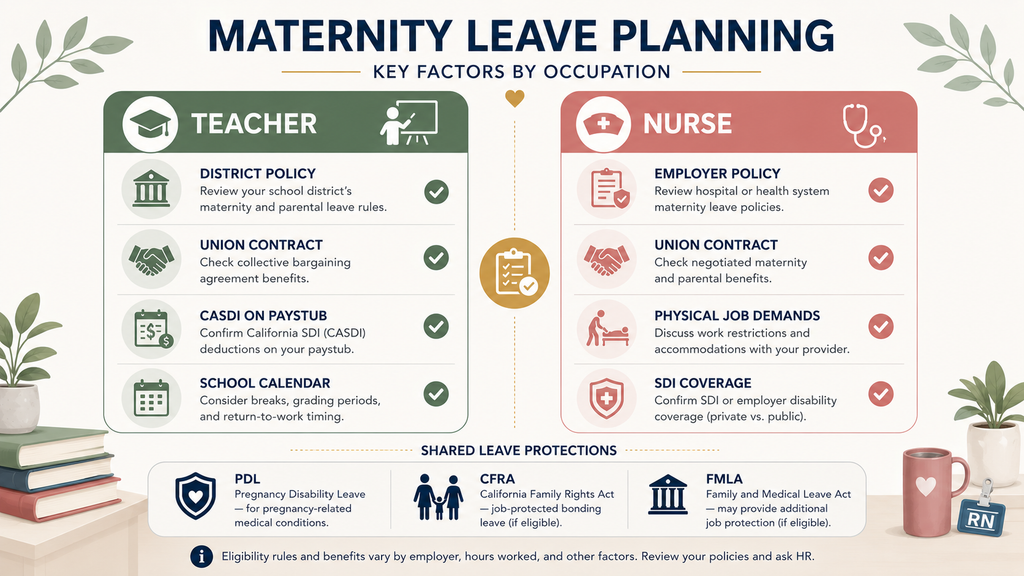
Public and private school employees may have FMLA rights when they meet the applicable eligibility conditions, and California PDL and CFRA may also apply. However, a public school employee should not automatically assume that State Disability Insurance deductions are being taken from their paycheck.
The EDD explains that public school employers may elect SDI coverage for eligible employee groups, but they are not universally required to participate in the same way as ordinary covered private employers. Individual school employees cannot simply elect group SDI coverage on their own.
Teachers should therefore check:
- Whether CASDI appears on the paystub
- PDL eligibility
- CFRA and FMLA eligibility
- District maternity or parental-leave policies
- Available sick leave
- Differential-pay provisions
- Collective bargaining agreement benefits
Do not assume a colleague’s leave package will be identical to yours. District policy and union agreements can materially affect how much of a teacher’s absence is paid even when the underlying job-protected leave laws are the same.
How Long Is Maternity Leave in California for Nurses?
Nurses employed by private hospitals and health systems generally use the same PDL, CFRA, DI, PFL, and FMLA framework as other covered employees. Union contracts and hospital parental-leave policies can provide more generous benefits than the legal minimum.
Pregnancy disability can be especially fact-specific in physically demanding clinical roles. The EDD’s pregnancy guidance recognizes that factors such as continuous standing, lifting, regular chemical exposure, job limitations, and the employee’s current medical condition may affect whether a provider certifies the worker as unable to perform regular duties.
That does not mean every pregnant nurse automatically qualifies for earlier disability leave. Your health professional determines the medical limitation, while the employer must separately address applicable accommodation and leave requirements.
Public-sector nurses should also confirm whether they participate in SDI or another employer disability program. State and public-entity benefit arrangements can differ from those of private hospitals.
Who Qualifies for CFRA Baby-Bonding Leave?
For most employees, CFRA eligibility for child bonding turns on three core requirements. You generally need:
- At least 12 months of service with the employer
- At least 1,250 hours worked during the previous 12 months
- An employer with at least five employees
The bonding leave must relate to the birth, adoption, or foster placement of a child and generally be used within the first year.
This is different from PDL. A newly hired pregnant employee working for an employer with five or more employees may potentially qualify for medically necessary PDL even though she has not worked long enough to qualify for CFRA bonding leave.
That difference is one reason a generic statement such as “everyone gets seven months of maternity leave” is inaccurate.
A Practical California Maternity Leave Timeline
I recommend planning the leave in stages rather than asking HR only, “How many weeks do I get?”
Before the Due Date
Review your paystub for CASDI deductions, employee handbook, union agreement if applicable, PTO balance, and parental-leave policy. Ask HR which job-protection laws they believe apply to you and what certification they require.
When Pregnancy Disability Starts
Provide the medical certification required for PDL and apply for Disability Insurance if you are covered and eligible. The disability date is determined by your actual medical circumstances rather than simply by your preference to stop working.
After the Baby Is Born
Continue DI during the provider-certified postpartum disability period. Without complications, this is commonly up to six weeks following vaginal delivery or eight weeks following C-section.
When Your Medical Disability Ends
If eligible, transition into CFRA bonding leave and apply for PFL benefits. EDD specifically explains that mothers with an active pregnancy DI claim can transition from Disability Insurance to Paid Family Leave after their final DI pregnancy payment.
Before Returning
Confirm your scheduled return date, reinstatement rights, insurance coverage, any remaining bonding leave, and whether you need a medically supported workplace accommodation.
Common California Maternity Leave Mistakes
One of the biggest mistakes is treating the words maternity leave, paid leave, disability leave, and bonding leave as interchangeable. Each one can answer a different legal or financial question.
Other common problems include:
- Assuming 12 weeks is the entire maternity entitlement. Pregnancy disability may come before bonding leave.
- Assuming PFL protects your job. PFL primarily provides benefits, not standalone job protection.
- Assuming CFRA pays for 12 weeks. CFRA protects eligible leave, while PFL currently pays for up to eight weeks.
- Assuming every pregnancy receives 17⅓ weeks of PDL. The maximum is available when medically necessary; typical uncomplicated claims are shorter.
- Assuming C-section means 20 weeks automatically. Eight weeks is a typical postpartum medical-recovery period, not a fixed total maternity-leave entitlement.
- Ignoring employer or union benefits. A workplace may offer better paid leave than the statutory minimum.
- Waiting too long to plan. HR documentation, medical certification, payroll coverage, and benefit applications can involve different systems.
When possible, ask HR to give you a written timeline showing which law protects each period and which benefit pays during each period. That is usually more useful than a simple statement that you have “maternity leave.”
Frequently Asked Questions
How long is maternity leave in California for women?
Women who give birth may qualify for up to four months of medically necessary PDL and, if separately CFRA-eligible, up to 12 additional weeks of baby-bonding leave. The maximum combined protected period can approach 29⅓ weeks, but uncomplicated pregnancies generally require less pregnancy-disability leave.
How long is maternity leave in California for mothers?
A common uncomplicated timeline is up to four weeks before delivery, six weeks after vaginal birth or eight weeks after C-section, followed by up to 12 weeks of CFRA bonding leave for an eligible mother. Medical complications, employer coverage, and CFRA eligibility can change the total.
How long is maternity leave in California for fathers?
An eligible father can generally receive up to 12 weeks of CFRA job-protected bonding leave during the child’s first year. Eligible fathers may also receive up to eight weeks of partial wage replacement through Paid Family Leave.
How long is maternity leave in California for men?
Men and other non-birthing parents generally do not receive Pregnancy Disability Leave because PDL covers the employee’s own pregnancy-related disability. Their principal entitlement is usually parental bonding leave, potentially up to 12 weeks under CFRA if eligibility requirements are satisfied.
How long is maternity leave in California for C-section?
For an uncomplicated C-section, EDD normally recognizes up to four weeks of pregnancy disability before the estimated delivery date and up to eight weeks afterward. A CFRA-eligible employee may then take up to 12 weeks of separate bonding leave after the medical disability ends.
How long is maternity leave in California for teachers?
Teachers may have PDL, CFRA, and FMLA rights, but pay varies substantially by district, SDI participation, sick-leave balances, and collective bargaining agreements. Public school employees should verify whether their bargaining unit participates in SDI rather than assuming state wage-replacement coverage applies automatically.
How long is maternity leave in California for nurses?
Nurses generally follow the same PDL and CFRA rules as other covered workers, but physical job demands, employer policies, public-sector status, and union benefits can affect the practical leave and pay arrangement. A health professional can consider duties such as lifting and continuous standing when determining whether pregnancy prevents a nurse from performing regular work.
Conclusion
The answer to how long is maternity leave in california depends on whether you are talking about pregnancy disability, baby bonding, job protection, or wage replacement. A qualifying birth mother can potentially combine up to four months of medically necessary PDL with up to 12 weeks of CFRA bonding leave, while Disability Insurance and Paid Family Leave may provide partial income during qualifying portions of the absence.
For many uncomplicated pregnancies, the practical timeline is shorter: commonly up to four weeks before delivery, six weeks after a vaginal birth or eight weeks after a C-section, followed by up to 12 weeks of bonding leave if CFRA eligibility is satisfied.
Before setting your return-to-work date, check your paystub, handbook, employer size, length of service, hours worked, health care certification, and any union or employer parental benefits. If your employer refuses leave you believe is protected, retaliates because you requested pregnancy or bonding leave, or disputes your reinstatement rights, review the California Civil Rights Department’s official pregnancy and family-leave protections and consider obtaining advice from a qualified employment lawyer based on your specific circumstances.
