

Is Jaywalking Illegal? What the Law Actually Says
If you are asking is jaywalking is illegal, the honest answer is: sometimes. No single rule applies to every street. A crossing may violate the law when a pedestrian ignores a signal, crosses between adjacent signal-controlled intersections outside a permitted crosswalk, crosses diagonally without authorization, or fails to yield where the law requires it.
However, crossing outside painted lines is not automatically illegal everywhere. Some laws allow midblock crossing if the pedestrian yields, while recent reforms in places such as California and New York City have narrowed enforcement or removed certain local prohibitions. This guide explains what jaywalking means, when a ticket is possible, how fines work, and when pedestrians have the right of way.
Legal disclaimer: This article provides general legal information, not advice for a particular citation, collision, or location. Pedestrian rules can change by state, municipality, roadway, and exact circumstances, so confirm the current statute and local code that apply where the crossing occurred.
About the publisher: The Law Learner creates plain-language educational guides that help readers understand legal concepts and locate the rules that may apply. Its articles are informational and do not create an attorney-client relationship or replace advice from a qualified local lawyer.
The Short Answer: When Is Jaywalking Illegal?
The word “jaywalking” can hide several different acts. Legally, what matters is not the label but the specific rule the person allegedly broke.
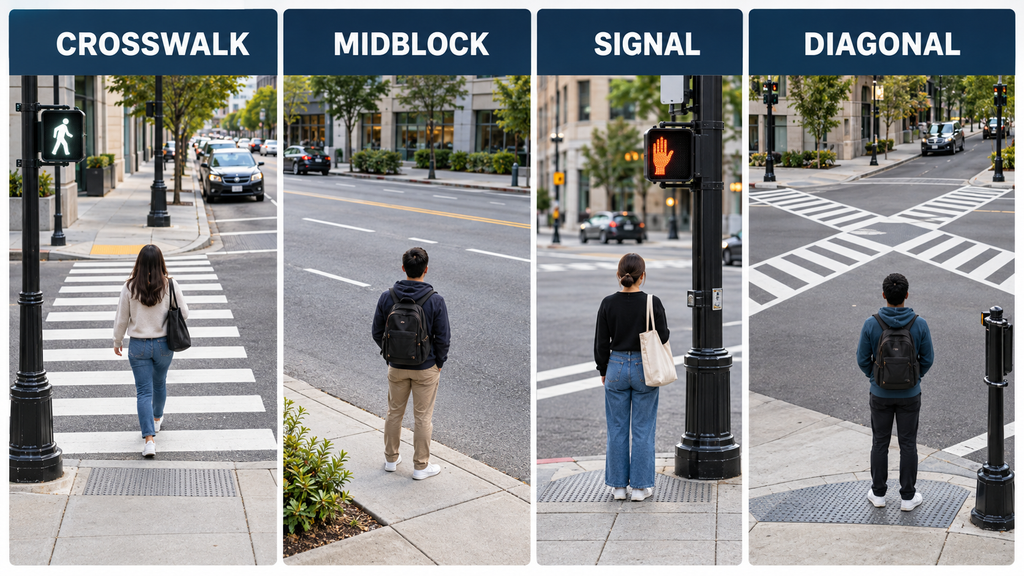
| Crossing situation | Typical legal treatment | Detail that can change the answer |
|---|---|---|
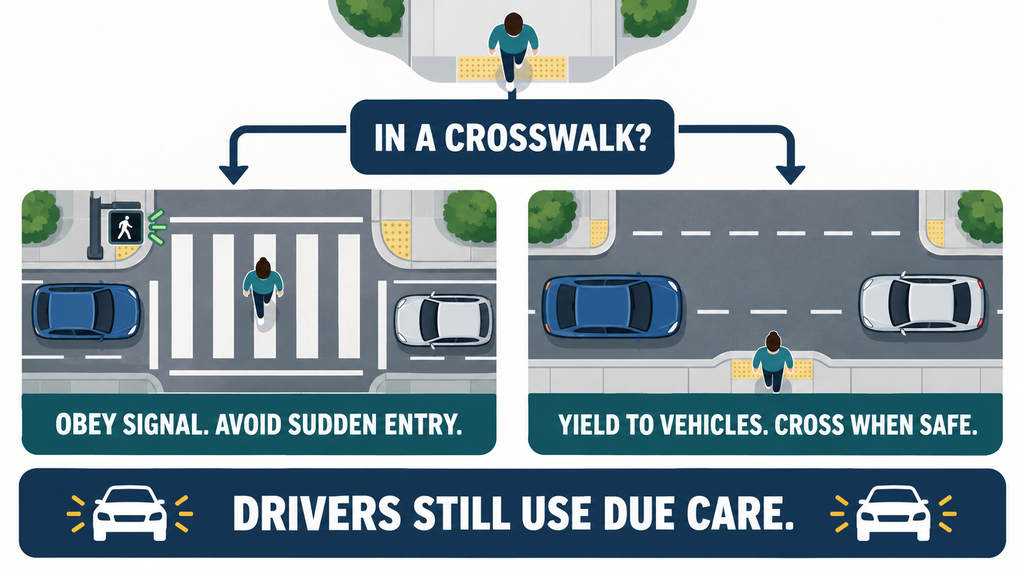
| Crossing in a marked crosswalk with a WALK signal | Usually permitted | A pedestrian still cannot enter so suddenly that a nearby driver cannot yield |
| Crossing at an unmarked crosswalk at an intersection | Often permitted | State definitions and traffic controls determine whether an unmarked crosswalk exists |
| Crossing midblock where no signalized intersections are adjacent | Sometimes permitted after yielding | Local ordinances, restricted roads, and visibility rules may impose additional limits |
| Crossing between adjacent signal-controlled intersections | Often restricted to a marked crosswalk | The wording and exceptions differ by jurisdiction |
| Crossing against a DON’T WALK signal | Commonly prohibited | A traffic officer’s direction or a local reform may affect the rule |
| Crossing diagonally | Usually prohibited unless authorized | Signs or markings may expressly permit it |
| Walking on a freeway or controlled-access road | Commonly restricted | Emergencies and designated access points may be exceptions |
The quickest reliable answer therefore requires four facts: the exact location, the type of road, the nearest traffic controls, and what the pedestrian did. The broader explanation of how state and local law interact is useful here because a statewide traffic code may coexist with a city ordinance and posted controls.
What Is Jaywalking?
“Jaywalking” is an informal term for crossing or using a roadway in violation of pedestrian traffic rules. A statute may never use that word. Instead, it may regulate obedience to pedestrian signals, crossing outside a crosswalk, yielding to vehicles, diagonal crossing, walking along the roadway, or access to a highway.
That distinction explains why a question such as “Is crossing outside a painted crosswalk illegal?” cannot be answered from the paint alone. Many intersections include unmarked crosswalks, which are legally recognized extensions of the sidewalk even though no stripes appear on the road. Conversely, a person can violate a signal while standing inside a beautifully marked crosswalk.
Marked and unmarked crosswalks are not the same thing
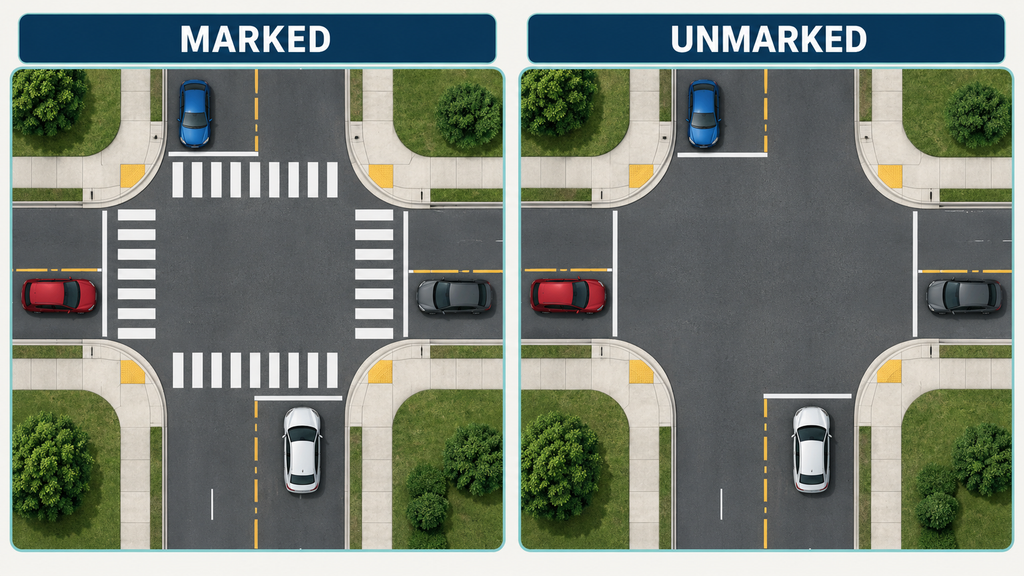
A marked crosswalk is identified by pavement lines or other markings. An unmarked crosswalk may exist at an intersection because the law treats the sidewalk path across the roadway as a crosswalk, but the precise definition varies.
One detail I would not overlook is the intersection itself. Before assuming that no paint means no crosswalk, check the controlling traffic code’s definition section and look for signals, signs, curb ramps, stop lines, and the continuation of sidewalks.
Is Jaywalking Illegal Under Every Local Law?
No. The laws are not uniform, and recent reforms make broad online claims especially unreliable. Even where a particular midblock crossing is permitted, pedestrians may still have to yield to vehicles, obey signals, avoid prohibited roads, and use reasonable care.
The following examples show why “legal” and “illegal” are too simple without context. They are illustrations, not a complete survey of all 50 jurisdictions.
| Location | Current rule illustrated | What it does not mean |
|---|---|---|
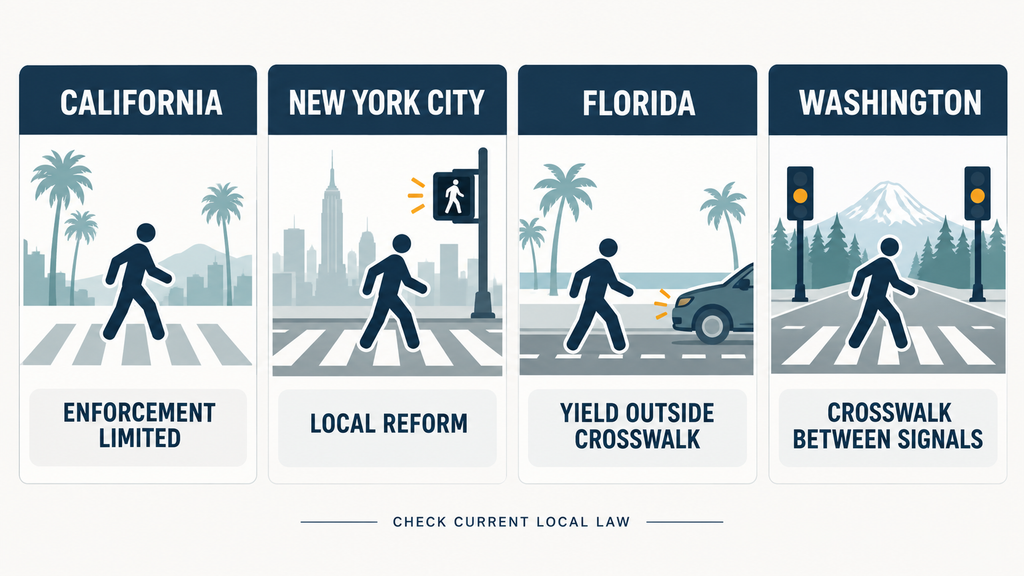
| California | Vehicle Code section 21955 requires use of a crosswalk between adjacent intersections controlled by signals or officers. Still, it permits a stop only when a reasonably careful person would see an immediate danger of collision. | It does not give pedestrians permission to ignore danger, signals, or the duty of due care |
| New York City | The enacted pedestrian crossing and right-of-way legislation permits crossing at points other than crosswalks and crossing contrary to signals, subject to yielding duties | It does not give a pedestrian outside a crosswalk priority over vehicles that have the right of way |
| Florida | Section 316.130 requires pedestrians outside a marked or unmarked crosswalk to yield and requires marked-crosswalk use between adjacent signalized intersections | It does not remove a driver’s continuing duty to use due care |
| Washington | RCW 46.61.240 requires a pedestrian crossing outside a marked or unmarked crosswalk to yield and generally requires a marked crosswalk between adjacent signal-controlled intersections | It does not prohibit every midblock crossing on every ordinary road |
California is a good example of why “jaywalking was legalized” can be an inaccurate shortcut. The statute still contains a crosswalk rule for a specific setting, but it limits when an officer may stop someone for that violation. A change in enforcement authority is not necessarily the same as deleting every pedestrian-crossing rule.
New York City illustrates a different reform. Its local measure permits conduct that older summaries may still describe as prohibited. Still, it preserves the principle that a pedestrian crossing outside a crosswalk must yield to priority traffic. The practical lesson is to check the date and exact text of any article or map claiming to show where is jaywalking legal.
How Much Is a Ticket for Jaywalking?
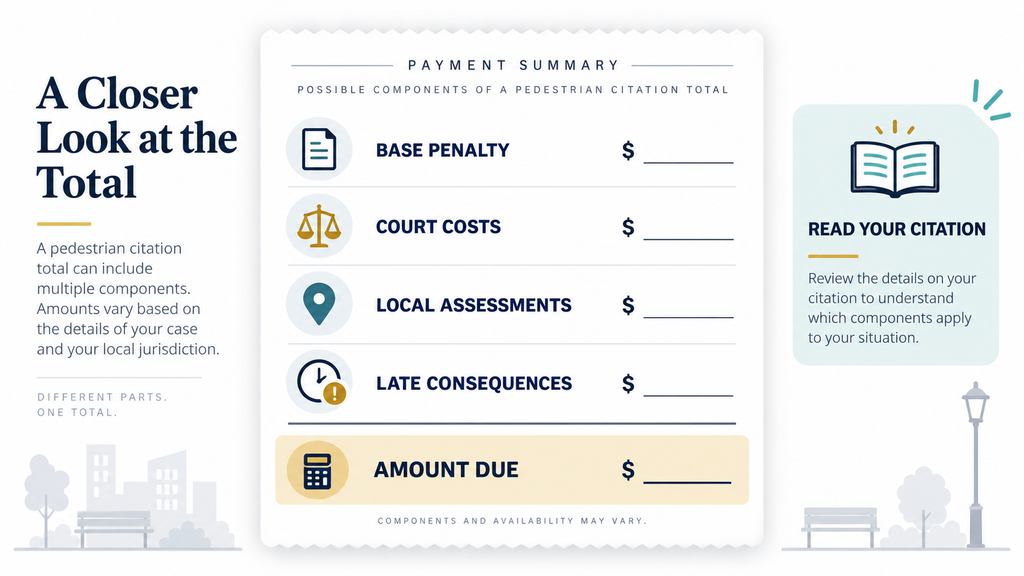
There is no standard ticket price. The amount may depend on the cited section, city code, court schedule, prior violations, and added assessments or administrative costs. In some places, the conduct is a civil or noncriminal traffic infraction; in others, the applicable rule and classification may differ.
Florida offers a useful example of why you should distinguish the base penalty from the amount due. Its traffic-infraction penalty schedule lists a $15 penalty for pedestrian infractions, while the same statute authorizes court costs and other assessments. It would therefore be misleading to promise that every Florida pedestrian ticket costs only $15, and more misleading to apply that figure elsewhere.
To determine how much a jaywalking ticket costs, read the actual citation. Look for the statute or ordinance number, deadline, court or agency, base amount, mandatory costs, and whether you must appear. Do not assume the rules for an ordinary driving citation automatically apply to a pedestrian matter; our guide to how long a speeding ticket stays on your record shows how strongly traffic consequences can depend on the violation and jurisdiction.
What to do if you receive a pedestrian citation
Start by photographing both sides of the ticket and the location while conditions are still similar. Missing a response date can create a larger problem than the original fine, so confirm the deadline and permitted response methods with the court or agency named on the citation.
Then take these steps:
- Identify the exact charge. Search the official state or municipal code for the cited section, not simply the word “jaywalking.”
- Compare the facts with each element. Note the intersection, signals, markings, sight distance, traffic, officer location, and whether the cited rule contains an exception.
- Preserve useful evidence. Save photographs, video, witness contact information, maps, and any receipt or time-stamped record that confirms where you were.
- Check the response options. Depending on the jurisdiction, the ticket may allow payment, a written challenge, an administrative process, or a court hearing.
- Get local advice when the stakes justify it. Consider a qualified attorney or legal-aid provider if the citation is tied to an injury, repeated charges, immigration concerns, an arrest, or a missed court date.
Paying a ticket can sometimes be treated as admitting or resolving the violation, so understand the listed options before choosing one. Whether a challenge is worthwhile depends on the evidence, potential costs, and local procedure, not the size of the base fine alone.
Do Pedestrians Have the Right of Way?
Yes, in some situations, but not everywhere or at every moment. A pedestrian commonly receives priority in a crosswalk when lawfully crossing, while a pedestrian outside a crosswalk commonly must yield to vehicles. Signals, sudden entry, emergency vehicles, road design, and local rules can change the analysis.
Florida’s pedestrian statute captures several principles that appear in many traffic codes. It requires drivers to yield to pedestrians in crosswalks under specified conditions, prohibits a pedestrian from suddenly leaving a curb into the path of a vehicle that is too close to yield, and still requires every driver to exercise due care to avoid colliding with a pedestrian.
This means right of way is not a force field. A pedestrian should not step into an immediate hazard merely because a crosswalk exists, and a driver should not continue toward a visible person merely because that person crossed improperly. Drivers turning at red lights must be especially careful because their attention may be directed toward vehicle traffic; this guide to right turns on red and pedestrian yielding explains that conflict in a common intersection setting.
What If a Pedestrian Is Hit While Crossing Improperly?
An unlawful crossing does not automatically make a driver blameless, and having the right of way does not automatically settle a damages claim. Investigators and insurers may examine speed, visibility, signals, lighting, distraction, braking, the pedestrian’s path, and whether each person used reasonable care.
Civil-fault rules also vary. A pedestrian’s conduct may reduce recovery in a comparative-fault system, while another jurisdiction may apply a stricter rule or recognize exceptions. The traffic citation and the injury claim are related evidence, but they are not always the same legal question.
After a collision, prioritize safety and medical care. Call emergency services when appropriate, remain at the scene if able, identify witnesses, photograph the roadway and signals, preserve clothing and device data, and avoid guessing about fault in statements or online posts. A local injury attorney can evaluate the applicable traffic rule, fault standard, insurance issues, and filing deadline.
How to Check the Exact Rule Where You Are
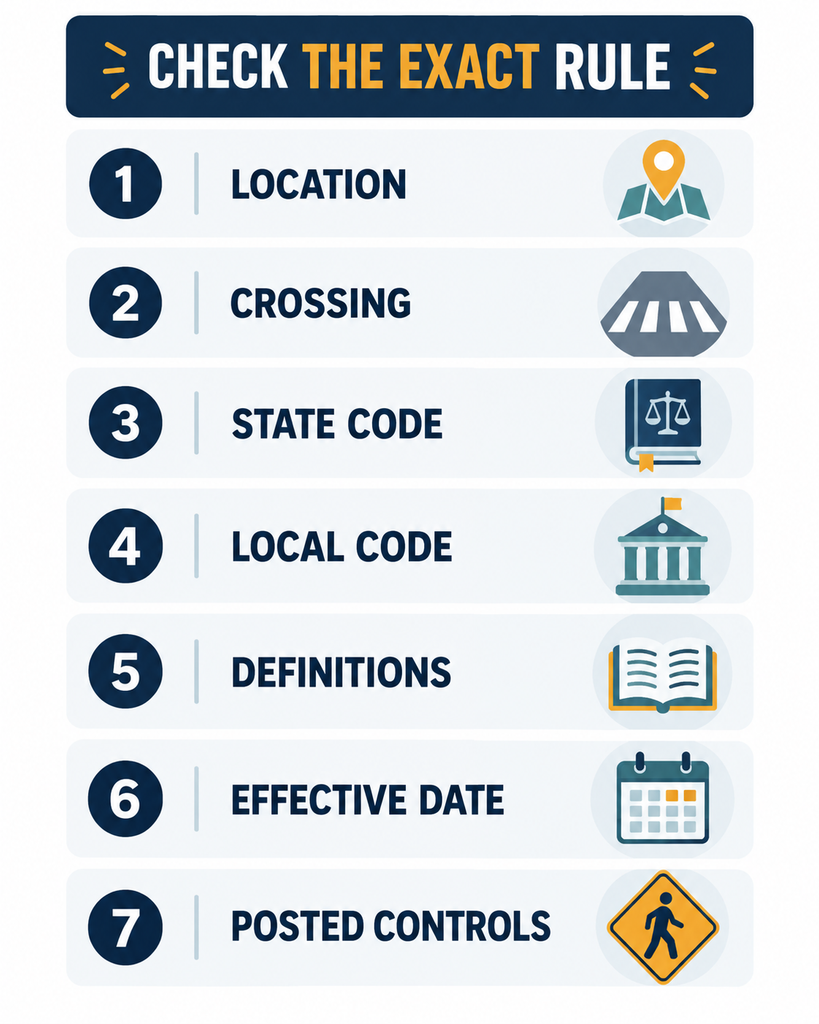
I recommend starting with official sources rather than a search snippet or an outdated chart. A reliable check takes a few extra minutes but prevents you from confusing a state restriction with a city exception or a posted instruction.
- Pinpoint the location. Record the city, street, nearest intersection, direction of travel, and whether the crossing was at or between intersections.
- Describe the conduct precisely. Note the signal phase, crosswalk markings, diagonal or straight path, and whether vehicles had to change speed or direction.
- Find the current state traffic code. Search the legislature’s official site for pedestrian, crosswalk, traffic-control signal, and roadway provisions.
- Check the municipal code. A city may add rules, repeal an older prohibition, set a fine, or regulate a particular road.
- Read definitions and exceptions. Terms such as “crosswalk,” “intersection,” “controlled-access highway,” and “immediate hazard” can decide the result.
- Confirm the effective date. A newly enacted reform may not apply to an older ticket, article, or collision.
- Follow posted controls. A sign, signal, officer, barrier, or temporary traffic plan may govern the precise location.
The NHTSA pedestrian safety guidance recommends following signs and signals, using sidewalks where available, and crossing at a crosswalk or intersection when possible. Where neither is available, it advises choosing a well-lit place with a clear view and waiting for a safe gap.
Common Mistakes That Create Legal or Safety Problems
The first mistake is assuming that an empty road makes every crossing lawful. A statute may require a marked crosswalk between adjacent signalized intersections even when no vehicle is near. The opposite assumption is also wrong: crossing outside painted lines is not necessarily prohibited if the law permits it and the pedestrian yields.
Other avoidable mistakes include:
- Treating a flashing countdown as permission to begin crossing without checking the local signal rule.
- Assuming a driver sees you because you can see the vehicle.
- Stepping from between parked cars where sight lines are short.
- Relying on an old article after a law has changed.
- Confusing legality with right of way.
- Ignoring a citation because the base fine appears small.
- Believing that a driver’s duty of care disappears when a pedestrian makes a mistake.
The safest practical rule is simple: use a crosswalk or intersection when one is reasonably available, obey the signal, remain visible, and cross only when you can confirm that drivers are yielding. Legal permission does not remove the physical risk created by speed, darkness, weather, or poor visibility.
Frequently Asked Questions
1. What is jaywalking in simple terms?
Jaywalking is an informal name for crossing or using a roadway in a way that may violate pedestrian traffic rules. The actual citation normally identifies a specific act, such as disobeying a signal, failing to yield outside a crosswalk, or crossing diagonally without permission.
2. Is jaywalking a crime?
It is often handled as a civil, municipal, or noncriminal traffic violation rather than a crime, but the classification depends on the governing law and circumstances. Conduct connected with obstruction, refusal to follow a lawful order, or another offense may raise separate issues, so read the exact charge.
3. Where is jaywalking legal?
No dependable one-line list exists because state statutes, city ordinances, road types, and crossing circumstances differ. California limits stops for a particular crossing violation to immediate-danger situations, while New York City permits certain crossings that were previously prohibited; both still preserve safety or yielding duties.
4. How much is a ticket for jaywalking?
The total varies by jurisdiction and may include a base fine, court costs, and local assessments. For example, Florida lists a $15 statutory penalty for pedestrian infractions, but applicable costs and assessments can raise the amount due.
5. Do pedestrians have the right of way in a crosswalk?
Pedestrians commonly have priority when lawfully using a crosswalk, but they must obey applicable signals and should not enter so suddenly that a nearby driver cannot yield. Drivers generally retain a duty to use due care even when a pedestrian violates a rule.
6. Can I cross the street if there is no crosswalk?
Sometimes, as long as the road is not restricted and you yield as required. A marked crossing may be mandatory between adjacent signal-controlled intersections, and an unmarked legal crosswalk may already exist at an intersection, so local definitions matter.
7. Can jaywalking affect an injury claim?
Yes. An improper crossing may be evidence of fault and can reduce or, under some rules, prevent recovery, but it does not automatically excuse a careless driver. The outcome depends on local civil-fault law and evidence such as visibility, speed, signals, and each party’s opportunity to avoid the collision.
Conclusion
So, is jaywalking illegal? Sometimes, but the answer depends on the specific crossing, the traffic controls, and current state and local rules. Crossing outside painted lines is not universally forbidden, and legal permission never guarantees right of way or safety.
Before acting on a ticket or making assumptions after a collision, identify the cited section and verify it on an official government site. For more plain-language explanations of traffic rules and legal consequences, explore The Law Learner’s driving-law guides and consult a qualified local lawyer when your facts require individual advice.
