

When Did Drunk Driving Become Illegal?
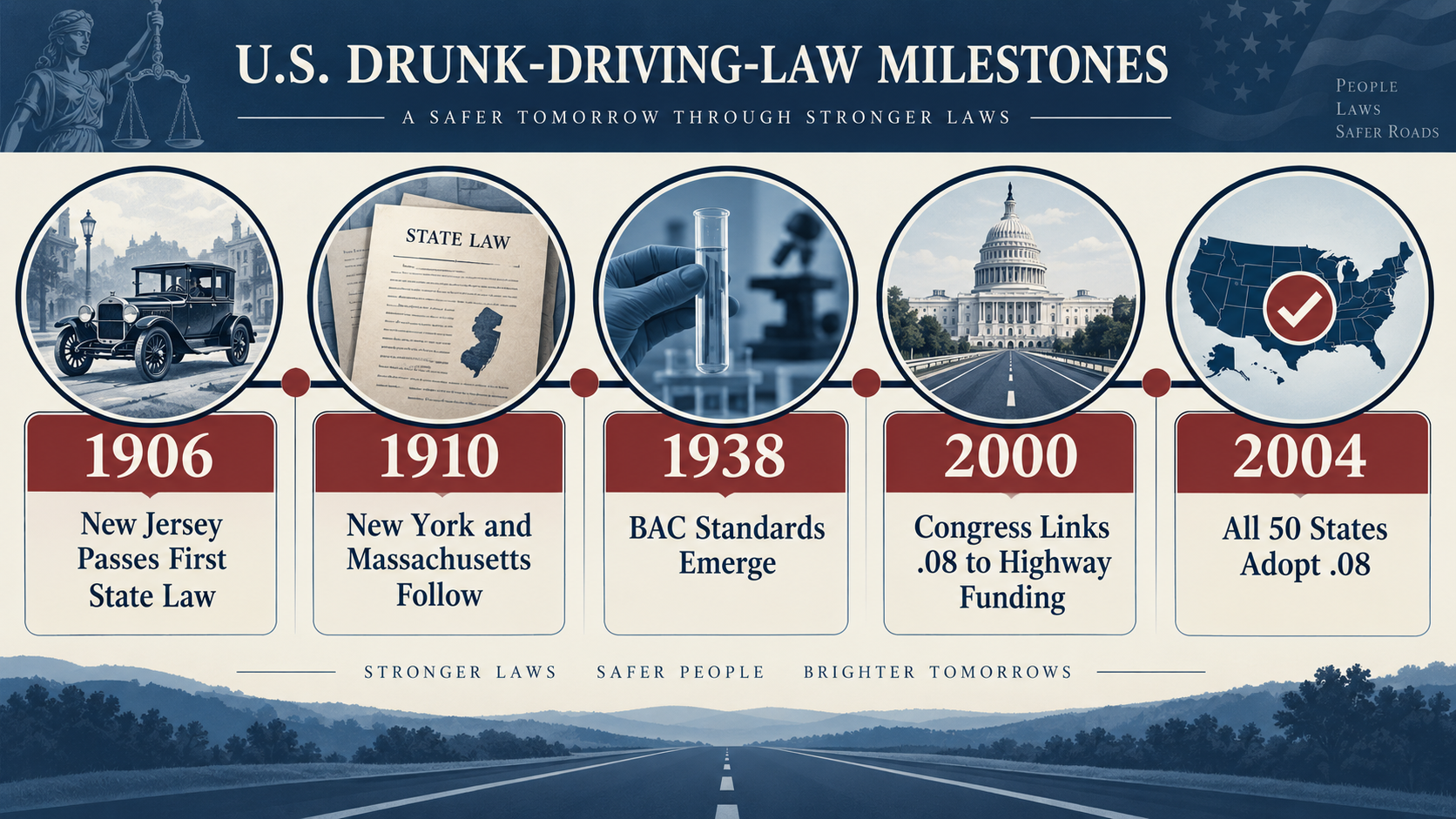
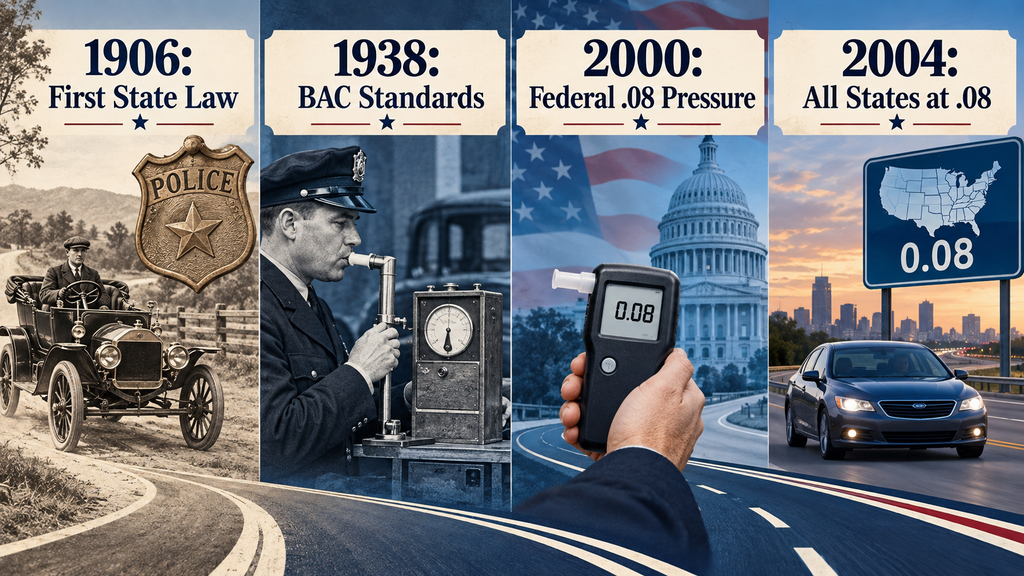
Drunk driving first became illegal in the United States in 1906, when New Jersey enacted the country’s earliest known state law prohibiting an intoxicated person from driving a motor vehicle. New York and Massachusetts adopted similar laws in 1910.
There was no single federal law that later made drunk driving illegal everywhere. States created and enforced their own DUI laws. The federal government eventually used highway funding to encourage consistent standards, most importantly the nationwide adoption of a .08 blood alcohol concentration (BAC) limit. All 50 states had enacted that limit by July 2004.
Short answer:
First state prohibition: New Jersey, 1906
Early followers: New York and Massachusetts, 1910
Federal push for a uniform .08 BAC limit: 2000
All 50 states using .08: July 2004
The First Drunk-Driving Law: New Jersey, 1906
New Jersey’s 1906 law stated that no intoxicated person could drive a motor vehicle. It is generally recognized as the first state law specifically criminalizing drunk driving.
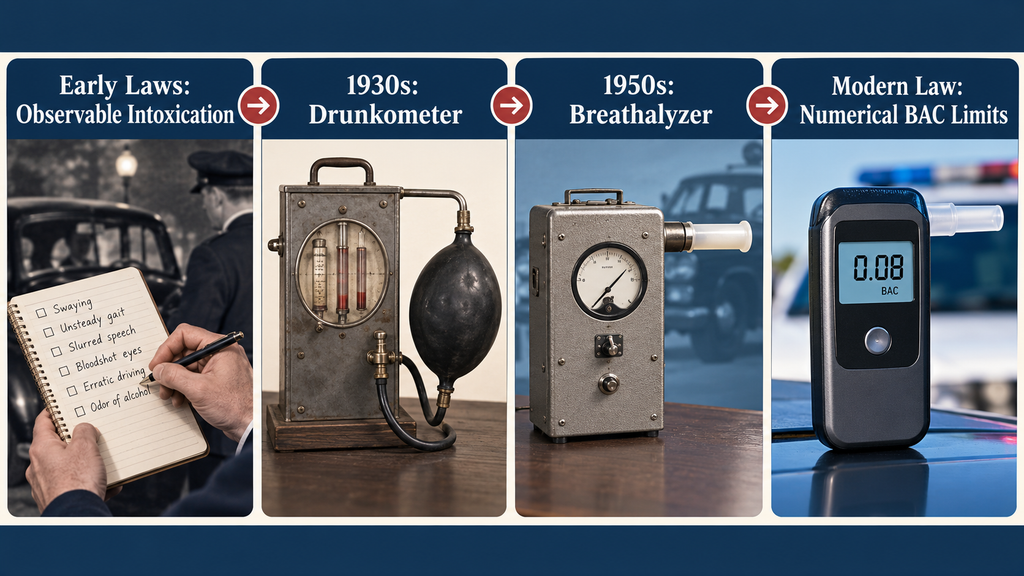
The law identified prohibited conduct but did not establish a measurable alcohol limit. Police and courts had to judge intoxication using observable evidence such as erratic driving, slurred speech, poor balance, or the smell of alcohol.
New York and Massachusetts followed in 1910. Other states gradually enacted similar restrictions as automobiles became more common and alcohol-related crashes became a growing public-safety concern.
Some sources identify New York’s 1910 law as the first DUI law. That description overlooks New Jersey’s earlier statute. New York was an important early adopter, but the strongest historical answer to “when did driving drunk become illegal?” is New Jersey in 1906.
Why There Is No Single “All 50 States” Date
The question “when did drunk driving become illegal in all 50 states?” can refer to two different developments:
- When every state prohibited driving while intoxicated.
- When every state adopted the same numerical BAC limit.
States enacted their original intoxicated-driving laws separately, and historical sources do not consistently identify a single documented date when the final state adopted a basic prohibition. By the mid-1930s, most states had some form of drunk-driving law.
The clearer nationwide milestone came much later. In July 2004, Delaware became the final state to adopt a .08 per se BAC law, bringing all 50 states under the same standard for ordinary adult drivers.
A per se law means the BAC reading itself establishes the offense. Prosecutors do not also have to prove that the driver was visibly unable to control the vehicle.
How BAC Changed DUI Enforcement
Early laws prohibited “intoxication” without defining it numerically. That made cases dependent on police observations and witness testimony.
Scientific testing gradually made the standard more objective. In the 1930s, researchers developed practical breath-testing equipment, including the Drunkometer. In 1938, the American Medical Association and National Safety Council proposed a framework for interpreting blood alcohol levels. A BAC of .15 was then treated as strong evidence of intoxication.
The Breathalyzer, developed by Robert Borkenstein in the 1950s, made roadside alcohol testing more practical. States later moved toward lower per se limits, commonly .10 before the national shift to .08.
Did Drunk Driving Become Illegal Federally?
Not in the way the question is usually understood.
Congress did not create one general federal DUI statute governing every public road. Ordinary DUI cases remain primarily matters of state law and are prosecuted in state courts.
The major federal action occurred in 2000, when Congress tied part of federal highway funding to states adopting a .08 per se limit. Under the legislation, states that failed to comply beginning in fiscal year 2004 risked losing an increasing percentage of specified highway funds. The federal rule implementing the funding condition required a state law making it an offense to operate a vehicle with a BAC of .08 or higher.
This was federal pressure, not Congress directly rewriting every state’s criminal code. Each state still had to enact and enforce its own law.
DUI on federal property
Federal DUI rules can apply in places under federal jurisdiction. For example, 36 C.F.R. § 4.23 prohibits operating a vehicle in a National Park Service area while:
- impaired to the point of being incapable of safe operation; or
- having a blood or breath alcohol concentration of .08 or higher.
If the surrounding state uses a stricter BAC limit, that lower limit applies under the regulation. Other federal-property cases may use state DUI law through the Assimilative Crimes Act when no applicable federal rule covers the conduct.
The Road to a Nationwide .08 Limit
Congress initially encouraged states to adopt .08 laws through federal incentive programs. The stronger turning point came with legislation enacted in 2000.
The progression was:
| Year | Legal development |
|---|---|
| 1906 | New Jersey enacted the first recognized state drunk-driving prohibition |
| 1910 | New York and Massachusetts adopted early DUI laws |
| 1938 | Medical and safety organizations promoted numerical BAC standards |
| 1980s–1990s | States strengthened DUI enforcement and lowered BAC limits |
| 2000 | Congress attached highway-funding consequences to failure to adopt .08 |
| 2004 | Delaware became the final state to enact the .08 standard |
By 2004, every state and the District of Columbia had made it a per se offense to drive with a BAC of at least .08. The National Highway Traffic Safety Administration confirms that nationwide status as of 2004.
What Is the Legal BAC Limit Today?
For most adult noncommercial drivers, the per se limit is .08, except in Utah, where it is .05. NHTSA’s current impaired-driving guidance explains the nationwide .08 framework and Utah’s lower limit.
Different standards apply to certain drivers:
- Commercial drivers: Federal regulations use a .04 BAC threshold while operating a commercial motor vehicle.
- Drivers under 21: Every state uses a zero-tolerance limit of .02 or lower.
- Drivers subject to special restrictions: Some states impose lower limits on people with previous DUI convictions.
The exact charge may be called DUI, DWI, OUI, or OWI depending on the jurisdiction.
Is driving below .08 legal?
A BAC below the per se limit is not an automatic defense. A driver may still be charged when alcohol or another substance has impaired the ability to drive safely.
The .08 standard establishes a level at which the BAC reading alone can support a per se offense. It does not guarantee that driving after drinking is lawful below that number.
State definitions, penalties, and evidentiary rules differ. This is similar to other driving laws, where the governing jurisdiction matters. The Law Learner’s explanation of whether jaywalking is illegal illustrates why a nationwide yes-or-no statement can miss important state and local differences.
Why the 1980s Were a Turning Point
Drunk driving had been illegal for decades before the 1980s, but enforcement and public attitudes changed sharply during that period.
Organizations such as Mothers Against Drunk Driving brought national attention to alcohol-related deaths and repeat offenders. States increased penalties, strengthened license-suspension rules, and expanded chemical testing.
Congress also used highway funding to encourage nationwide traffic-safety policies. These included:
- a minimum drinking age of 21;
- zero-tolerance BAC laws for drivers under 21;
- stronger penalties for repeat offenders;
- the eventual .08 BAC standard.
These measures did not first criminalize drunk driving. They made state laws more consistent, measurable, and enforceable.
DUI Laws Continue to Differ by State
The shared .08 benchmark does not make every state’s DUI law identical. States still differ on:
- whether the offense requires driving or only physical control of a vehicle;
- license suspension periods;
- mandatory jail sentences;
- ignition-interlock requirements;
- test-refusal consequences;
- treatment and education programs;
- enhanced penalties for high BAC levels;
- felony treatment of repeat offenses or injury crashes.
NHTSA maintains a digest of state impaired-driving laws. Still, anyone facing a current charge should review the applicable state statute and seek advice from a licensed attorney in that jurisdiction.
A conviction may also remain on a motor-vehicle record longer than an ordinary traffic violation. For comparison, see how state rules determine how long a speeding ticket stays on a driving record.
Conclusion
Drunk driving first became illegal in New Jersey in 1906, followed by New York and Massachusetts in 1910. The offense developed state by state rather than through one nationwide federal ban.
The modern national milestone arrived in 2004, when every state had adopted a .08 per se BAC limit after Congress connected compliance to federal highway funding. Today, state law still controls most DUI cases, while specific federal rules apply on federal property and to commercial drivers.
