

What to Do After a Car Accident Legally in Kansas
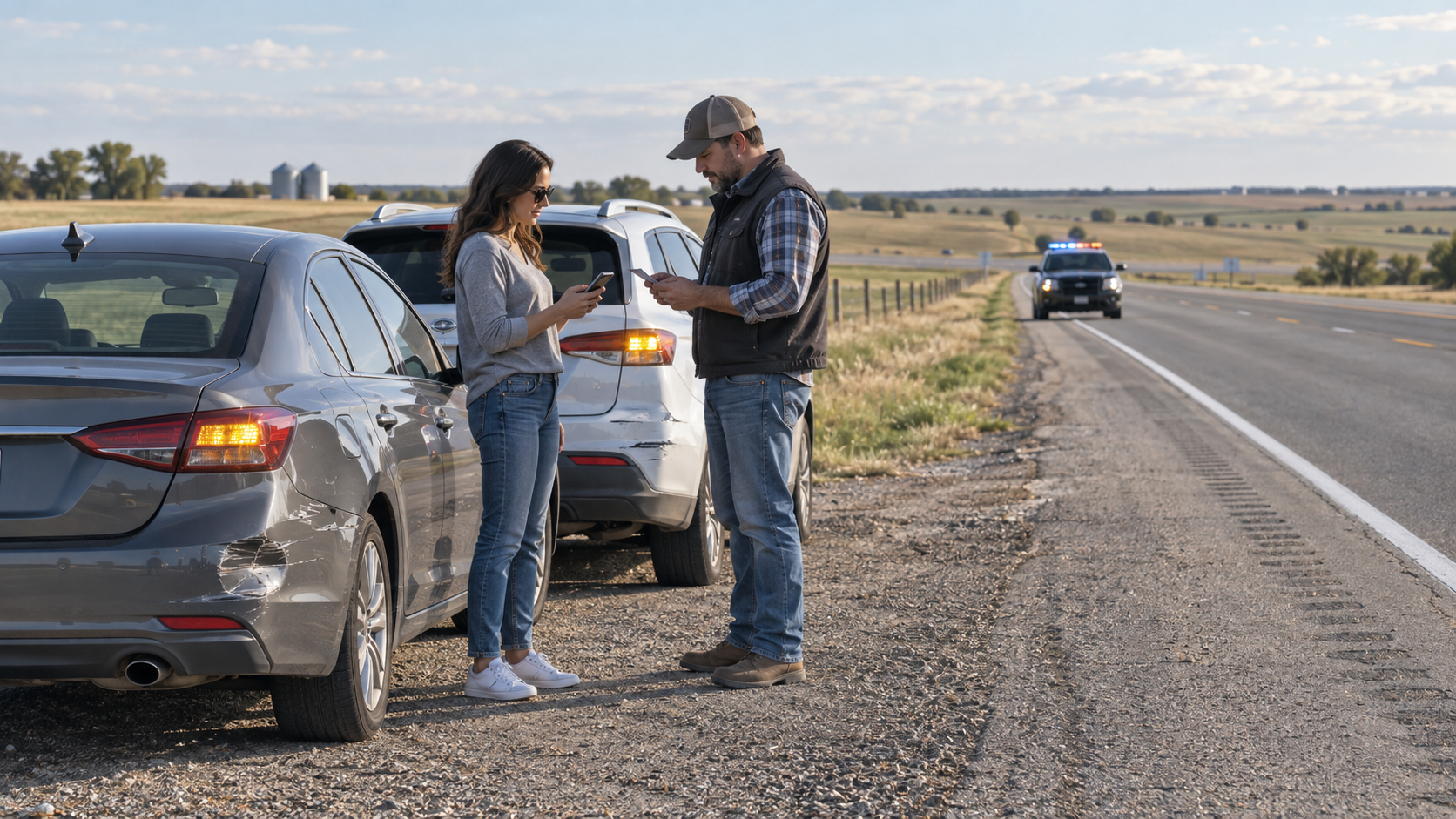
Knowing what to do after a car accident legally in Kansas can protect you from a leaving-the-scene charge and prevent avoidable problems with an insurance claim. You generally must stop, remain at or near the scene, assist injured people, provide required information, and notify law enforcement when the collision causes an injury or death.
Even in a property-damage-only accident, documenting the scene and obtaining a police report can prevent disputes about what happened.
Quick answer: Stop as close to the accident scene as safely possible, check for injuries, call 911 when anyone is injured, exchange identification and insurance information, photograph the scene and notify your insurer promptly. Do not leave before completing your legal duties.
First, stop and address immediate safety.
A driver involved in a Kansas accident must stop. If remaining in the traffic lane creates another danger, move to the nearest safe position when the vehicle can be moved. Do not drive away or relocate farther than necessary before exchanging information.
Turn on your hazard lights and check yourself, your passengers, and people in the other vehicle for injuries. Call 911 immediately if someone is injured, unconscious, trapped, or complaining of significant pain.
Under Kansas Statute 8-1602, a driver involved in an accident causing injury or death must stop and immediately report the accident to the nearest authorized police authority. The driver must remain at the scene until completing the information and assistance duties imposed by state law.
Do not move a seriously injured person unless leaving the person in place presents an immediate threat, such as fire or approaching traffic. Tell the emergency dispatcher what happened and follow the instructions provided.
Exchange the information Kansas law requires
Kansas law requires more than exchanging telephone numbers. Under Kansas Statute 8-1604, the driver must provide:
- Their name and address
- The vehicle’s registration number
- Their driver’s license when requested
- Proof of liability insurance or other financial security
Provide the information to the other driver, an injured person, or the person attending the damaged vehicle. Record the other driver’s license plate, insurer, policy information, and contact details as well.
The same statute requires a driver to provide reasonable assistance to an injured person. That may include arranging transportation for medical treatment when treatment appears necessary, or the injured person requests it.
Refusing to provide the required information or leaving before completing these duties can turn an ordinary accident into a criminal matter.

Know when to contact the police.
You must immediately notify law enforcement when the accident causes injury or death. Calling the police is also sensible when:
- A driver appears impaired or attempts to leave
- The vehicles cannot be driven safely
- A commercial vehicle is involved
- Traffic is obstructed
- Public property has been damaged
- The drivers disagree about what happened
- The other driver cannot provide insurance information
Many online articles state that Kansas requires a police report whenever property damage reaches $1,000. That claim relies on an outdated version of K.S.A. 8-1606, which the current Kansas statutes list as repealed. Do not treat that old threshold as the current statewide rule.
For a property-damage-only accident, local reporting practices or ordinances may still apply. When the damage is substantial, or fault is disputed, contacting local police or the county sheriff is usually the safer choice. A responding officer may document the drivers, vehicles, visible damage, road conditions, and witness information.
A police report does not automatically determine civil fault, but it can provide an important independent record.
What if you hit an unattended vehicle?
Do not leave after hitting an empty parked car, fence, mailbox, or other unattended property.
Under Kansas Statute 8-1605, a driver must attempt to locate and notify the owner. If the owner cannot be found, leave a written notice in a conspicuous location containing your name, address, and vehicle registration number. You must also report the accident to the nearest police authority.
Photograph the damage, the notice, and where you placed it. Merely leaving a telephone number may not satisfy every part of the statutory requirement.
Document the accident before the scene changes.
Once urgent safety needs are addressed, preserve evidence without blocking emergency personnel.
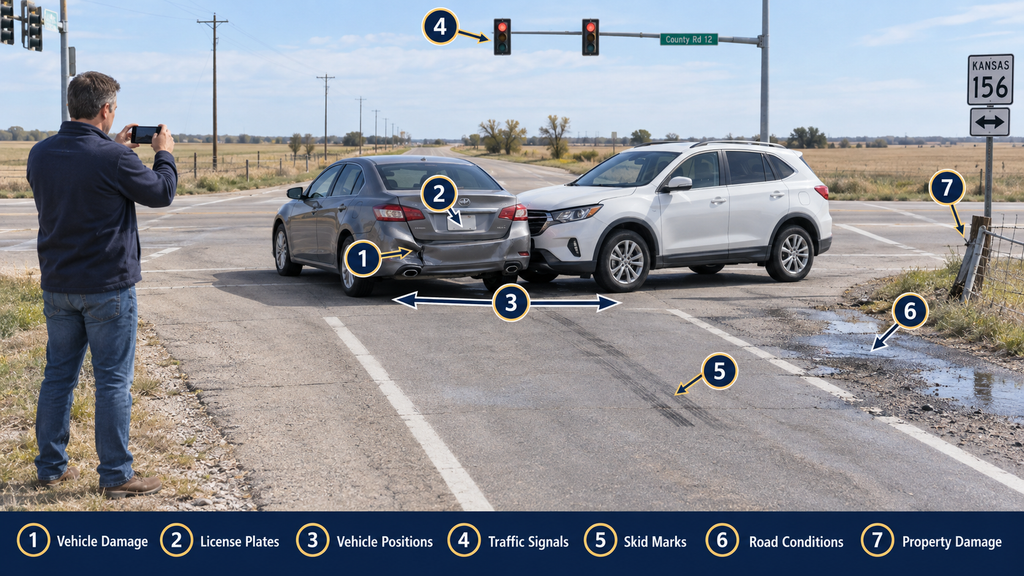
Photograph:
- All vehicles and visible damage
- License plates
- The vehicles’ positions
- Intersections, lanes, and traffic signals
- Skid marks or debris
- Weather and road conditions
- Nearby property damage
Ask witnesses for their names and contact information. Save dashcam footage quickly because some systems automatically overwrite older recordings.
Write down what happened while the details are fresh. Include the time, location, direction of travel, and anything you observed immediately before the collision. Keep this account factual. Avoid guessing about speeds, distances, or causes you did not directly observe.
If the accident involved a pedestrian, responsibility may depend on signals, crossing location and each party’s conduct. Our explanation of pedestrian right-of-way and jaywalking laws provides useful background, although Kansas law and the facts of the particular collision control.
Obtain medical care and preserve your records.
Some injuries are obvious immediately. Others, including soft-tissue injuries and certain concussion symptoms, may become noticeable later.
Seek emergency treatment for severe pain, breathing problems, confusion, weakness, loss of consciousness, or other concerning symptoms. For less urgent symptoms, arrange an appropriate medical evaluation and explain that they began after the collision.
Keep copies of medical records, bills, prescriptions, travel expenses, and proof of missed work. These records help connect claimed losses to the accident.
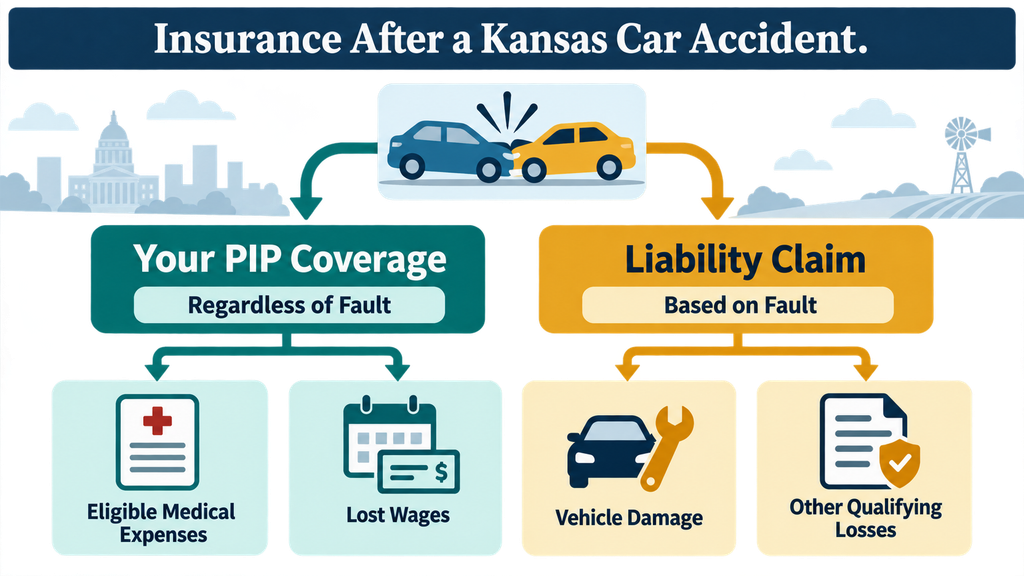
Do not delay medically necessary care merely because you are worried about fault. Kansas auto policies include personal injury protection, commonly called PIP, which can provide specified benefits regardless of who caused the accident.
Notify your insurance company promptly
Report the collision to your insurer within the period required by your policy. Many policies require “prompt” or “reasonable” notice instead of specifying one universal number of days.
Give accurate basic information, but do not speculate. You may not yet know the full extent of your injuries or all circumstances contributing to the collision.
Kansas requires certain auto-insurance coverages. The Kansas Department of Insurance’s automobile insurance guidance explains that PIP can cover specified medical expenses and lost wages for insured occupants regardless of fault. Liability coverage addresses losses the insured legally causes to someone else.
PIP does not mean fault is irrelevant. The responsible driver may still face a liability claim for vehicle damage, qualifying injuries, and other losses.
How fault affects compensation in Kansas
Kansas follows modified comparative negligence under K.S.A. 60-258a. A claimant’s compensation can be reduced according to the claimant’s percentage of fault.
For example, if someone has $20,000 in recoverable damages and is found 20% responsible, the recovery may be reduced to $16,000. A claimant whose fault is equal to or greater than the fault attributed to the party or parties being pursued may be unable to recover from them.
Kansas also limits when an injured person can recover noneconomic damages such as pain and suffering from another motorist. Under K.S.A. 40-3117, the injury generally must satisfy a statutory threshold. Qualifying circumstances include at least $2,000 in reasonably valued medical treatment or certain serious outcomes, such as specified fractures, permanent injury, permanent disfigurement, loss of bodily function, or death.
Avoid actions that can damage your position
After a collision:
- Do not leave before fulfilling your legal duties.
- Do not argue with or threaten another driver.
- Do not admit legal fault based on an incomplete understanding.
- Do not post accident details or injury activities publicly.
- Do not repair or dispose of important evidence before documenting it.
- Do not sign a broad release without understanding what it resolves.
You can be polite and cooperative without accepting blame. Explain what you observed to law enforcement and your insurer, but avoid unsupported conclusions.
How long do you have to file a Kansas accident claim?
Kansas generally applies a two-year limitations period to personal-injury actions and claims for injury to personal property under K.S.A. 60-513. Missing the applicable deadline can prevent a lawsuit even when the underlying claim was otherwise valid.
Exceptions and shorter procedural deadlines may apply, particularly when a government vehicle or public entity is involved. Insurance-notice requirements may also arise much earlier than the lawsuit deadline. Do not wait until the end of the two years to investigate a serious collision.
Frequently asked questions
Do I legally have to call the police after a minor Kansas accident?
Kansas requires immediate police notification when an accident causes injury or death. The previous statewide $1,000 property-damage reporting provision has been repealed. Local rules may still apply, and reporting is advisable when damage is significant, fault is disputed, or a driver lacks insurance information.
Should I admit fault at the accident scene?
No. Provide the required information and answer officers truthfully, but do not guess or accept legal responsibility before all evidence is known. Fault may involve multiple drivers, road conditions, or other factors.
Can I leave if the other driver says no report is necessary?
Not until you have stopped and completed all legally required duties. Exchange the required information, assist anyone injured, and notify police when the law requires it.
How soon should I notify my insurer?
Notify your insurer as soon as reasonably possible and follow the notice language in your policy. A two-year lawsuit deadline does not give you two years to report the accident to your insurance company.
Conclusion
The safest legal response after a Kansas car accident is to stop, address injuries, contact police when required, exchange complete information, and preserve evidence. Report the claim promptly and pay attention to Kansas-specific insurance, fault, and filing rules.
This article provides general legal information, not advice for a particular accident. Serious injuries, disputed fault, uninsured drivers, commercial vehicles, and government claims may justify prompt guidance from a Kansas-licensed attorney.
