


Quick answer: How much is it to adopt a child in NC? Adoption from the North Carolina foster-care system can be free or nearly free when a county department of social services or a state-contracted agency provides training, a preplacement assessment, and placement services. A private domestic agency adoption may cost approximately $25,000 to $50,000 or more, an independent adoption may cost $15,000 to $40,000 or more, and an international adoption may cost $30,000 to $60,000 or more.
The court filing charge is much smaller than the total private-adoption price. As of January 1, 2026, the standard North Carolina cost for a non-foreclosure special proceeding, the category used for an adoption petition, is $120. You can add sheriff service, the preplacement assessment, the report to court, attorney work, agency services, and other case expenses.
North Carolina also reimburses up to $2,000 per child per adoption in qualifying nonrecurring costs for most adoptions finalized in the state, excluding stepparent and foreign adoptions. That provision can benefit some private and independent cases as well as foster-care adoptions, but eligibility should be confirmed with the family’s county DSS.
Planning note: The private, independent, stepparent, relative, and international figures below are working budget ranges, not government-set prices or guaranteed averages. Obtain current written quotes for your particular adoption.
North Carolina Adoption Cost Comparison
| Adoption route | Practical 2026 planning range | North Carolina-specific point |
|---|---|---|
| Foster-care adoption through county DSS or contracted agency | Often $0 to $2,000 before reimbursement | Training, assessment, and placement services may be free |
| Private domestic agency adoption | About $25,000 to $50,000+ | Agency may use a sliding fee scale; lawful birth-parent expenses can vary |
| Independent or direct-placement adoption | About $15,000 to $40,000+ | Attorney, preplacement assessment, report to court, and lawful placement expenses apply |
| Stepparent adoption | About $1,000 to $5,000 in many uncontested cases | Excluded from the state’s $2,000 nonrecurring-cost reimbursement |
| Relative adoption | About $1,500 to $8,000+ in many uncontested cases | North Carolina defines which family relationships qualify as a relative adoption |
| International adoption | About $30,000 to $60,000+ | Foreign adoptions are excluded from the $2,000 state reimbursement |
The final number is driven less by the $120 filing charge and more by the route, professional services, consent issues, travel, and whether a public or private provider prepares the required assessments.
What North Carolina Charges at the Court and Vital-Records Stages
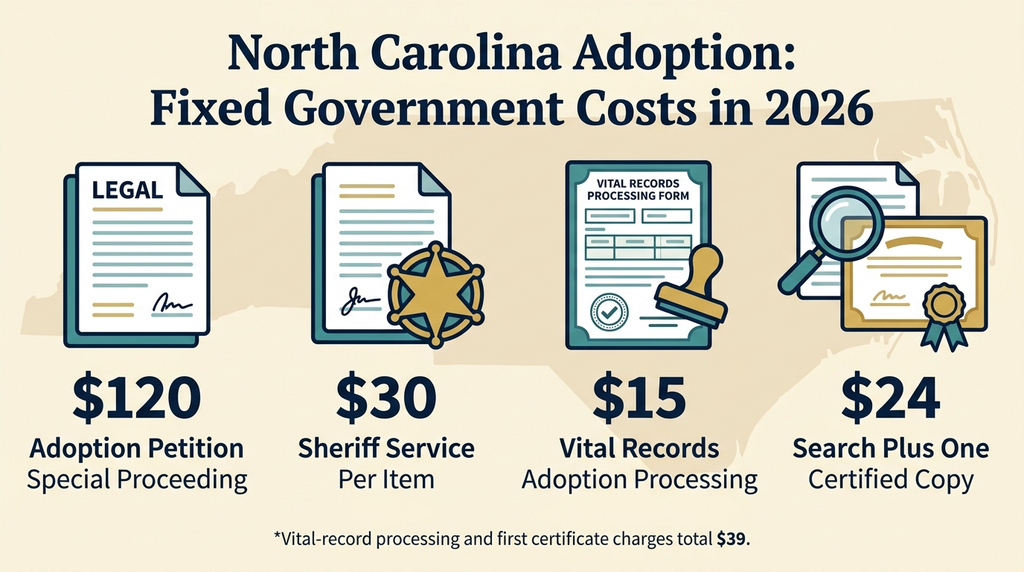
North Carolina adoption petitions are filed as special proceedings with the clerk of superior court. The state’s 2026 Special Proceedings Costs Chart lists:
| Government charge | 2026 amount |
|---|---|
| General Court of Justice fee | $106 |
| Facilities fee | $10 |
| Telecommunications and data connectivity fee | $4 |
| Standard non-foreclosure special-proceeding total | $120 |
| Sheriff service of civil process | $30 for each item served |
The clerk assesses the amount due in the individual case. Additional charges may arise for service, publication, certified copies, amendments, or other filings. A person unable to afford the filing fee may ask the clerk to waive court costs using the appropriate indigency form.
After an adoption, North Carolina Vital Records currently charges:
- $15 to process the adoption
- $24 for a routine file search, including one certified copy of the modified birth certificate or applicable record
- $39 total for those two charges
The $15 and $24 fees are nonrefundable. For a new in-state adoption, parents should wait for the required notice and use the specific Adoption Processing Form rather than placing the first order through VitalChek.
These fixed charges are useful budgeting anchors, but they do not include professional services.
Is Foster-Care Adoption Free in North Carolina?
It can be. North Carolina families may work with a county DSS or a licensed private agency under contract with the state to foster or adopt without paying program fees. Agencies outside the state contract system may charge for their work.
NCDHHS states that the cost of adopting a child with special needs from foster care is covered by the child’s agency. In these cases, most county departments complete the required Pre-Placement Assessment, North Carolina’s term for the adoption home study, at no charge. A county may sometimes refer the family to a private provider, which may or may not charge a fee.
A careful foster-adoption budget should still reserve money for possible:
- Medical forms or examinations
- Certified personal and family records
- Fingerprints or background-related costs not absorbed by the agency
- Home safety updates
- Travel for visits, placement, or finalization
- Attorney consultation or representation
- Court and vital-record charges
Families can confirm whether a private agency has a state contract by contacting NC Kids or their county DSS. A statement that an agency “works with foster care” does not necessarily mean every service is free.
For national context about subsidies and foster-to-adopt expenses, read How Much Does It Cost to Adopt From Foster Care?
How long the North Carolina public process may take
NCDHHS says the home-study process and agency training may take approximately three to six months. There is no guaranteed matching period because the process focuses on the child. After placement, finalization typically takes six months or longer.
A longer process does not always increase agency fees, but it can increase travel, document-renewal, childcare, and time-off-work costs. Ask how long the assessment remains current and what the provider charges for an update.
North Carolina’s $2,000 Adoption-Cost Reimbursement
NCDHHS states that adoptions finalized in North Carolina, except stepparent and foreign adoptions, are eligible for reimbursement of qualifying nonrecurring expenses up to $2,000 per child per adoption.
Reasonable adoption-related costs can include items such as:
- Attorney fees
- Court filing fees
- Preplacement assessment expenses
- Fingerprints and required background checks
- Other reasonable costs directly connected with completing the adoption
After finalization, the family submits receipts, fingerprint-clearance documentation, and Responsible Individuals List background checks for each applicant to the adoption or eligibility worker at the local county DSS.
Private-agency and attorney-arranged adoptions may also qualify. NCDHHS specifically directs those families to contact the DSS office in the North Carolina county where they live to determine whether the child and expenses meet the rules.
Do not wait until after finalization to ask about eligibility
Although the reimbursement claim uses receipts after the decree, discuss the program with county DSS before finalization. Ask:
- Whether the adoption is expected to qualify
- Which expenses the county will recognize
- Which forms, agreements, and clearances must be completed
- When receipts must be submitted
- Whether any expense paid by an agency, grant, employer, or tax benefit must be excluded
Do not assume that every dollar up to $2,000 will be reimbursed. The expense must qualify, documentation must be complete, and the adoption cannot fall within an excluded category.
Adoption Assistance for an Eligible Child
North Carolina adoption assistance primarily helps children with qualifying special needs achieve permanency. Eligibility can arise through agency custody, previous North Carolina foster-care placement, SSI-related disability eligibility, or certain prior adoption or guardianship circumstances. Citizenship or qualified-alien requirements also apply.
The Adoption Assistance Agreement must generally be completed and signed by the adoptive parents and agency before finalization. Families should not rely on a verbal expectation that a payment or Medicaid coverage can be arranged afterward.
For the 2026 to 2027 fiscal year, North Carolina’s standard board rates used in foster and adoption services are:
| Child’s age | Current monthly standard board rate |
|---|---|
| Birth through age 5 | $702 |
| Ages 6 through 12 | $742 |
| Age 13 and older | $810 |
An individual adoption-assistance payment depends on the child’s eligibility, needs, funding rules, and agreement. Do not read the table as an automatic payment promise to every adoptive family. Ask the responsible county agency to explain the proposed cash benefit, Medicaid eligibility, duration, review rules, and any special-services support in writing.
North Carolina also offers no-cost post-permanency Success Coach services across all 100 counties. These voluntary services can support parenting strategies, crisis prevention, advocacy, school needs, and service coordination for up to two years at a time. They do not reduce the original adoption invoice, but they may reduce later out-of-pocket support costs.
How Much Does a North Carolina Preplacement Assessment Cost?
The preplacement assessment evaluates whether the prospective parent or parents are suitable to adopt. It is prepared by a county DSS or a licensed child-placing agency and may review:
- Household interviews
- Criminal and child-abuse or neglect checks
- Health, financial, and employment information
- References and family history
- Home safety
- Parenting preparation and adoption expectations
Private-provider pricing commonly falls around $1,500 to $3,000, with possible additional charges for travel, expedited completion, updates, international requirements, and post-placement reports.
North Carolina law requires a written fee agreement before an agency begins a charged preplacement assessment. The fee cannot depend on whether the assessment is favorable or an adoption occurs.
County DSS fee ceilings
For fee-based work performed by a county department of social services, North Carolina’s administrative rule sets these maximums:
| County DSS service | Maximum charge |
|---|---|
| Preplacement assessment plus report to court | $1,500 |
| Report to court only | $200 |
No county DSS fee is charged in specified circumstances, including when the family continues pursuing the adoption of an identified child in DSS custody and placement responsibility. Fees may also be reduced or waived when the record documents that the family cannot pay.
These ceilings govern county DSS fees, not every private agency’s program charge. Ask a private provider to separate the assessment price from matching, placement, counseling, and supervision fees.

Private Domestic Agency Adoption Costs
A North Carolina private domestic adoption typically costs $25,000 to $50,000 or more. The range varies because an agency may provide a complete program or charge separately for each stage.
Common categories include:
| Cost category | Possible services |
|---|---|
| Application and education | File opening, orientation, and adoptive-parent preparation |
| Preplacement assessment | Home visits, interviews, records, checks, and written assessment |
| Outreach and matching | Family profile, advertising or outreach, and match coordination |
| Birth-parent services | Counseling, legal advice, medical expenses, travel, and lawful living expenses |
| Placement services | Interstate compliance, documents, and temporary-care coordination |
| Post-placement work | Visits, report to court, and case supervision |
| Legal and court work | Consents, filings, notices, hearings, and decree |
North Carolina law allows an agency to consider adoptive-parent income and use a sliding fee scale. Ask whether the quoted price is income-based and which proof of income the agency uses.
Before enrolling, obtain written answers to the following:
- Is the quoted amount a minimum, average estimate, or maximum?
- Is the preplacement assessment included?
- How many post-placement reports are included?
- Are the child’s and birth parent’s legal fees included?
- What happens to each payment if a match does not result in placement?
- Are unused expense funds returned or credited?
- Is a new program or matching fee due for another opportunity?
- Does the agency help the family seek North Carolina’s $2,000 reimbursement?
Independent or Direct-Placement Adoption Costs
In a direct-placement adoption, a parent or guardian places the child directly with the prospective adoptive parent rather than relinquishing the child to an agency for placement. The family still needs lawful professional support, a preplacement assessment when required, post-placement reporting, and a court case.
A practical budget is approximately $15,000 to $40,000 or more, including:
- Adoptive-parent attorney fees
- Separate birth-parent legal services
- Preplacement assessment and updates
- Report to court
- Counseling
- Medical or hospital expenses
- Lawful ordinary living expenses
- Travel and administrative expenses
- Filing, service, publication, and vital-record charges
The lower end may apply when the parties are already connected, consent is clear, insurance covers medical care, and support expenses are limited. The upper end can rise with extensive living support, uncovered medical bills, interstate compliance, travel, or litigation.
North Carolina Rules for Birth-Parent Expenses
North Carolina General Statute section 48-10-103 permits adoptive parents to pay reasonable and actual expenses in defined categories. These include:
- Agency services
- Medical, hospital, nursing, pharmaceutical, travel, and similar pregnancy, birth, or child-illness expenses
- Licensed adoption-related counseling
- Ordinary living expenses during pregnancy and for no more than six weeks after birth
- Costs of obtaining required background information about the child and biological family
- Legal services, court costs, travel, and other adoption administration
- The preplacement assessment and report to court
Unlike Ohio’s fixed $6,000 living-expense ceiling, the cited North Carolina statute does not set a single-dollar maximum. That does not create an unlimited budget. Expenses must be reasonable and actual, disclosed to the court, and connected to a permitted category.
Payments cannot be contingent on placement, relinquishment, consent, or cooperation in completing the adoption. In most cases, you cannot recover lawful payments simply because the adoption is not completed. Recovery may be pursued when money was accepted with fraudulent intent to prevent the adoption.
This makes careful controls essential:
- Send payments through the responsible licensed agency or adoption attorney.
- Use a written budget tied to documented needs.
- Pay providers directly where practical.
- Keep leases, utility bills, medical invoices, receipts, and payment records.
- Ask who bears a planned expense if the adoption does not proceed.
- Never characterize support as payment for the child or for consent.
At least ten days before an adoption hearing, each petitioner generally files an affidavit accounting for money or value paid or promised in connection with the adoption. The court may request more detail and review whether fees or payments are reasonable.

Stepparent Adoption Costs in North Carolina
An uncomplicated stepparent adoption often costs approximately $1,000 to $5,000. The basic $120 filing fee is only one part of the budget.
Other possible costs include:
- Attorney or document-preparation services
- Sheriff service or publication
- Criminal and child-welfare checks
- A report to court or other clerk-required assessment
- Certified marriage, birth, divorce, custody, or support records
- A contested hearing over consent
- The $39 vital-record processing and certificate charges
The biggest financial question is usually whether the other legal parent’s consent is available or whether the petitioner must prove that consent is unnecessary under North Carolina law. A contested consent issue can push the case beyond the typical range.
Stepparent adoptions are excluded from North Carolina’s up-to-$2,000 nonrecurring-cost reimbursement. Do not subtract that benefit from a stepparent budget.
Relative and Kinship Adoption Costs
North Carolina classifies an adoption as a relative adoption when the petitioner has one of the relationships listed in the adoption statute, such as a grandparent, full or half sibling, first cousin, aunt, uncle, great-aunt, great-uncle, or great-grandparent. A placement with someone outside the statutory list may be treated as an independent adoption even if the family informally considers that person a relative.
Many uncontested relative cases cost approximately $1,500 to $8,000 or more. Costs depend on:
- Whether parental consent is given
- Whether notice can be completed easily
- The child’s existing custody or guardianship orders
- Whether a preplacement assessment is required
- Which agency prepares the report to court
- Whether interstate or tribal law applies
- Attorney time and number of hearings
A relative adoption finalized in North Carolina is not automatically excluded from the $2,000 nonrecurring-cost reimbursement. Confirm eligibility with the county DSS rather than assuming either approval or denial.
International Adoption Costs for North Carolina Families
International adoption usually costs approximately $30,000 to $60,000 or more, depending on the child’s country and the number and length of required trips.
Budget categories include:
- Accredited or approved adoption service provider
- International preplacement assessment
- U.S. immigration applications and biometrics
- Foreign government and legal expenses
- Dossier preparation, notarization, apostilles, and translation
- Medical review and examinations
- Airfare, lodging, local transport, and required stays
- Post-adoption or post-placement reports
- North Carolina readoption or recognition work where appropriate
North Carolina courts distinguish between readoption after a completed foreign adoption and adoption when the foreign country did not finalize the case. A North Carolina decree does not itself decide federal immigration status.
Foreign adoptions are excluded from the state’s $2,000 nonrecurring-cost reimbursement. For the complete international budget, see How Much Does International Adoption Cost?
Four Sample North Carolina Adoption Budgets
These examples illustrate how charges accumulate. They are not provider quotes.
Example 1: Adoption through county DSS
| Item | Illustrative amount |
|---|---|
| Training, preplacement assessment, and placement | $0 |
| Attorney consultation and finalization help | $1,000 |
| Court filing | $120 |
| Records, travel, and checks | $500 |
| Vital Records | $39 |
| Gross cost | $1,659 |
| Possible nonrecurring-cost reimbursement | Up to $1,659 if every expense qualifies |
Example 2: Private domestic agency adoption
| Item | Illustrative amount |
|---|---|
| Agency, education, outreach, and matching | $25,000 |
| Preplacement assessment and reports | $3,000 |
| Legal and court services | $6,000 |
| Counseling, medical, travel, and lawful living expenses | $8,000 |
| Documents and final records | $500 |
| Gross cost | $42,500 |
| Possible North Carolina reimbursement | Up to $2,000 if the adoption and expenses qualify |
Example 3: Uncontested stepparent adoption
| Item | Illustrative amount |
|---|---|
| Court filing | $120 |
| Attorney services | $2,250 |
| Service, records, and checks | $300 |
| Vital Records | $39 |
| Gross cost | $2,709 |
| North Carolina nonrecurring-cost reimbursement | Not available for a stepparent adoption |
Example 4: Independent adoption
| Item | Illustrative amount |
|---|---|
| Preplacement assessment and report | $2,500 |
| Attorneys and court expenses | $11,000 |
| Medical, counseling, and legal support | $10,000 |
| Travel and documents | $1,500 |
| Gross cost | $25,000 |
Add a contingency reserve when medical, travel, or living expenses remain uncertain. A tax credit or reimbursement may reduce net cost later but does not necessarily solve the upfront cash requirement.
Federal Adoption Tax Credit for 2026
North Carolina does not currently provide a general state adoption-expense tax credit. Families may, however, qualify for federal adoption tax benefits.
For federal tax year 2026, the maximum adoption credit is $17,670 per eligible child, including up to $5,120 that may be refundable. The credit begins to phase out at modified adjusted gross income of $265,080 and is fully phased out at $305,080.
Rules differ for domestic and foreign adoptions. A taxpayer adopting a spouse’s child cannot claim the federal adoption credit for that adoption. Coordinate employer-provided adoption assistance, government reimbursement, grants, and the credit so you don’t use the same expense twice.
Keep:
- Agency and attorney invoices
- Proof of payment
- Travel records and mileage details
- Court orders
- Reimbursement determinations
- Adoption-assistance agreements
- Employer-benefit statements
- Records identifying expenses paid by another source
Ask a qualified tax professional when to claim expenses and how a special-needs adoption affects the calculation.
How to Reduce Adoption Costs in North Carolina
- Start with county DSS or a state-contracted agency for foster adoption. These routes can provide assessment and placement services at no cost.
- Ask about the $2,000 reimbursement before finalization. Confirm the forms, clearances, eligible costs, and submission process early.
- Obtain the adoption-assistance agreement before the decree. Do not rely on an oral promise of later benefits.
- Use the county DSS fee ceilings when applicable. The combined assessment and report charge cannot exceed $1,500 for fee-based county DSS work.
- Request a written private-agency fee schedule. Separate matching, assessment, reports, legal work, and third-party expenses.
- Document all birth-parent support. North Carolina requires reasonable, actual, non-contingent payments in lawful categories.
- Check whether you qualify for a court-fee waiver. Ask the clerk for the proper form if the $120 filing charge is unaffordable.
- Plan for cash flow separately from tax savings. You generally claim the federal credit through a tax return, not when the agency invoice arrives.
For a nationwide comparison of adoption routes, read How Much Does It Cost to Adopt a Child in 2026? You can also compare the different state systems in Texas, Florida, California, and Ohio
Questions to Ask Before Paying a North Carolina Provider
- Is the agency licensed, and is it under contract with the state for foster adoption?
- Does the program fee include the preplacement assessment?
- Who prepares the report to the court, and what does it cost?
- Which post-placement visits are included?
- Which payments are refundable after a failed match?
- How are lawful birth-parent expenses approved and documented?
- Who prepares the affidavit accounting for adoption-related payments?
- Does the adoption appear eligible for the $2,000 reimbursement?
- Does the child appear eligible for adoption assistance and Medicaid?
- Which court, service, publication, and vital-record fees are excluded?
Frequently Asked Questions
How much money is it to adopt a child in NC?
It may cost little or nothing to adopt through county DSS or a state-contracted foster-adoption agency. Private domestic adoption often costs about $25,000 to $50,000 or more, independent adoption about $15,000 to $40,000 or more, and international adoption about $30,000 to $60,000 or more.
How much is it to adopt a child in North Carolina through foster care?
Training, the preplacement assessment, and placement services may be free through a county or contracted agency. A family may still pay for court costs, records, travel, medical forms, or optional legal help. Qualifying nonrecurring costs can be reimbursed up to $2,000 per child.
What is the North Carolina adoption filing fee in 2026?
The standard non-foreclosure special-proceeding cost is $120. Sheriff service is $30 for each item of civil process served. The clerk calculates the amount due in the individual case, and a fee waiver may be available based on inability to pay.
How much does a North Carolina adoption home study cost?
Private preplacement assessments commonly cost around $1,500 to $3,000. For county DSS fee-based work, the maximum is $1,500 for the preplacement assessment and report to court together, or $200 for the report only. Foster-adoption assessments may be free.
Can adoptive parents pay a birth mother’s living expenses in North Carolina?
Yes. North Carolina permits reasonable and actual ordinary living expenses during pregnancy and for no more than six weeks after birth. Payments cannot depend on placement or consent and must be disclosed appropriately. The cited statute does not impose one fixed dollar cap, but the court can review reasonableness.
Are birth-parent expenses refunded if the adoption does not happen?
Generally, you cannot recover lawful payments solely because the adoption is not completed. No further payment is required unless a signed agreement provides otherwise. North Carolina law allows a recovery claim when the recipient accepted payment with fraudulent intent to prevent the adoption.
Does every North Carolina adoption qualify for the $2,000 reimbursement?
No. NCDHHS excludes stepparent and foreign adoptions. Expenses must also qualify and be documented. Private and independent families should ask their county DSS whether the child and planned expenses are eligible.
How long does foster adoption take in North Carolina?
NCDHHS estimates three to six months for the home study and agency training. Matching has no fixed timeline. Finalization commonly takes six months or longer after a child is placed with the family.
Do I need an attorney to adopt in North Carolina?
An attorney is not legally required to start or finalize every adoption, but the Judicial Branch cautions that adoption proceedings can be complicated and self-represented petitioners are held to the same standard as attorneys. Professional advice is especially important in direct placement, contested consent, interstate, tribal, and international cases.
Bottom Line
So, how much is it to adopt a child in NC? Foster-care adoption through a county or state-contracted agency can be free or nearly free. A private domestic adoption may cost $25,000 to $50,000 or more, an independent adoption may cost $15,000 to $40,000 or more, and an international adoption may cost $30,000 to $60,000 or more.
North Carolina’s most useful fixed numbers are the $120 court filing cost, $30 sheriff service charge per item, $1,500 county DSS ceiling for an assessment plus report, $200 county DSS ceiling for a report only, $2,000 potential nonrecurring-cost reimbursement, and $39 vital-records cost. Verify these amounts and the family’s eligibility before paying or publishing a final budget.
Sources
This article was researched for 2026 using current official and primary materials, including:
- North Carolina Department of Health and Human Services: Adoption and Foster Care FAQs
- NCDHHS: Post-Permanency Support and Adoption Assistance
- North Carolina Judicial Branch: Adoption
- North Carolina Judicial Branch: 2026 Special Proceedings Costs Chart
- North Carolina General Statute 48-10-103: Lawful Adoption Payments
- North Carolina General Statute 48-3-304: Preplacement Assessment Fees
- 10A NCAC 70H .0113: County DSS Assessment and Report Fees
- North Carolina Vital Records: Adoption Process and Fees
- NCDHHS: Foster and Adoption Service Rates Effective July 1, 2026
- IRS: Adoption Credit
- IRS: Tax Year 2026 Inflation Adjustments
Private, independent, stepparent, relative, home-study, and international cost ranges are editorial planning estimates based on current provider pricing, published legal guidance, and typical expense categories. They are not statutory statewide averages or guaranteed quotes. Verify current fees, reimbursement rules, assistance, and tax provisions before publication and before making a financial decision.
Legal Disclaimer
This article provides general educational information, not legal, tax, or financial advice. Adoption costs and requirements depend on the child’s circumstances, adoption route, agency, county, court, and current law. Consult a licensed North Carolina adoption attorney, the responsible agency, the clerk of superior court, and a qualified tax professional for advice about a specific case.
