

If you are wondering How long can you stay in a storage unit, the practical answer is that there is no universal number of minutes or hours. You may normally remain inside during the facility’s access hours for legitimate storage activities, but you cannot use the unit as a residence or stay overnight.
Your rental agreement may also prohibit loitering or remaining inside for an unusually long period. Even a facility offering 24-hour access is giving you permission to reach your belongings, not permission to sleep, cook, work, or live inside the unit.
Quick answer: You may generally stay long enough to organize, load, unload, or inspect your belongings during authorized access hours. Staying overnight, sleeping, or treating the unit as a residence can violate the rental agreement, state law, zoning rules, and building or fire codes.
This article provides general legal information and not advice for a specific dispute. Your signed agreement, state law, local ordinances, and facility rules determine what applies to your situation.
How long can you stay in a storage unit during the day?
Most storage facilities do not publish a strict rule such as “customers may remain for only two hours.” Instead, they limit when you may enter and what you may do while you are there.
A tenant who spends several hours sorting boxes during authorized access hours may not be breaking any rule. However, repeated all-day visits, staying after closing, bringing bedding, cooking, or using the unit as a workplace may cause the facility manager to investigate.
The safest approach is to remain only as long as reasonably necessary for storage-related tasks. If you need an extended period to organize a large unit, tell the manager beforehand and confirm that your plan complies with the lease.
Understand office hours, access hours, and 24-hour access
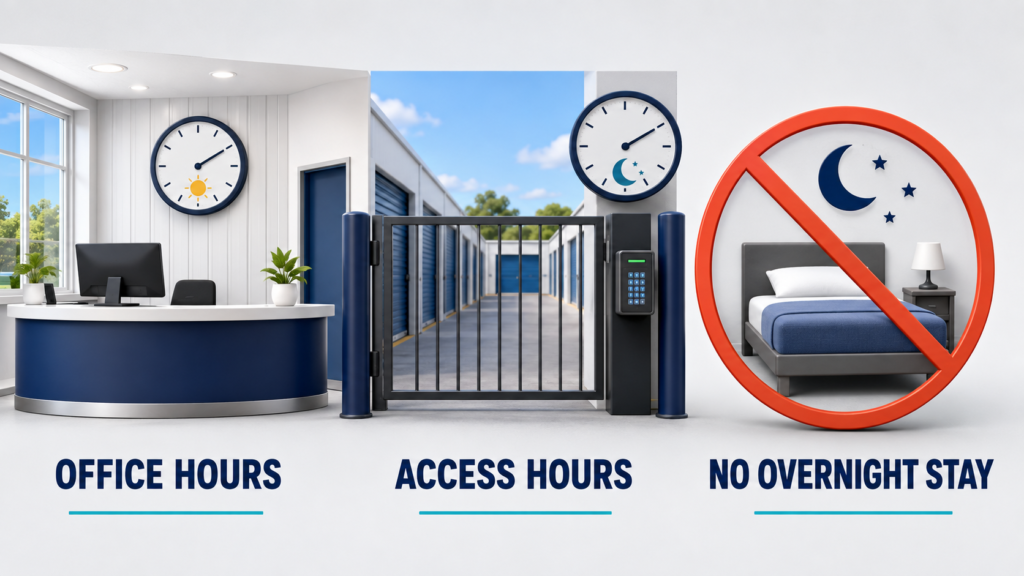
Storage facilities often advertise office hours and access hours separately. Confusing the two can leave you locked outside the gate or inside the property after customer access has ended.
| Type of hours | What it normally means | What it does not permit |
|---|---|---|
| Office hours | Times when employees are available to assist customers | Access to your unit after the office closes |
| Access hours | Times when your gate code or key permits entry | Sleeping or remaining after the access period |
| 24-hour access | Permission to enter the facility at any time | Residential use, overnight occupancy, or unrestricted activity |
| Appointment access | Entry arranged directly with management | Ignoring supervision or time restrictions |
One detail I would not overlook is that 24-hour access is not the same as a 24-hour right to occupy the space. A major storage operator’s overnight-use policy expressly distinguishes convenient access from permission to stay overnight.
What does the storage rental agreement allow?
A storage rental agreement gives you a limited contractual right to use a defined space for storing personal property. It is generally not a residential lease and does not grant the same rights as renting an apartment or house.
Industry guidance on self-storage rental-agreement provisions recommends that agreements clearly prohibit living, sleeping, unauthorized business activity, and dangerous stored materials. Your agreement may also regulate visitors, gate codes, electricity, food, animals, repairs, smoking, and vehicle parking.
Before signing or spending an extended period at the facility, check these clauses:
- Permitted use of the unit
- Daily gate and building access hours
- Prohibition on sleeping or residential use
- Rules covering guests and shared access codes
- Restrictions on electrical devices and extension cords
- Prohibited items and hazardous materials
- Management’s inspection and emergency-access rights
- Default, termination, and property-removal procedures
- Charges for damage, cleaning, or unauthorized use
Do not assume that paying monthly rent gives you unrestricted control over the unit. Your possession remains subject to the contract and the facility’s lawful operating rules.
Can you stay inside a storage unit for extended periods?
You may be allowed to spend several hours arranging furniture, creating an inventory, or moving belongings. Whether a long visit is acceptable depends on the agreement, access schedule, activity, and facility manager.
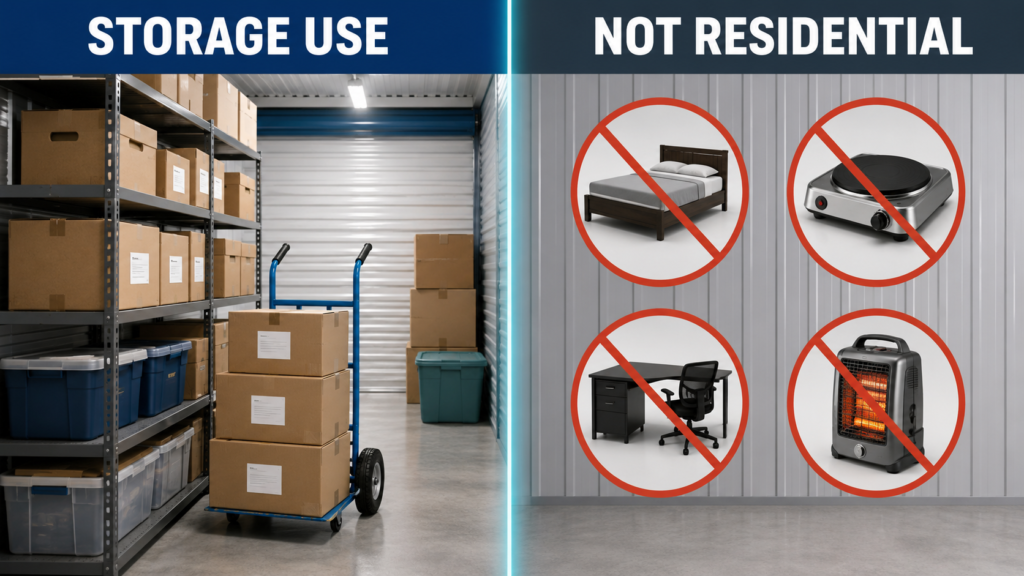
A long visit becomes more concerning when your conduct looks residential or creates a safety problem. Warning signs may include arriving late at night, remaining after the gate closes, bringing a mattress, preparing food, connecting unauthorized appliances, receiving mail, or regularly using bathroom facilities as though the property were your home.
| Usually storage-related | Likely prohibited or suspicious |
|---|---|
| Loading or unloading boxes | Sleeping or staying overnight |
| Organizing stored belongings | Cooking or using heating equipment |
| Photographing items for an inventory | Using the unit as a permanent office |
| Assembling approved shelving | Connecting unauthorized electrical wiring |
| Waiting briefly for a moving vehicle | Bringing bedding and household living supplies |
| Meeting an approved mover | Allowing another person to live in the unit |
If you expect a major sorting project to take all day, I recommend speaking with management first. Written permission for a long daytime visit can prevent an ordinary storage task from being mistaken for unauthorized occupancy.
Can you sleep in a storage unit?
Sleeping in a storage unit is generally prohibited, even if you intend to stay for only one night. It can violate the rental agreement and laws that restrict self-storage spaces to the storage and removal of personal property.
There is not usually an exception because you have 24-hour access, pay rent on time, or leave before employees arrive. Sleeping changes the character of your use from storage access to human occupancy, which creates contractual, zoning, insurance, and safety issues.
A brief accidental nap while sorting boxes is factually different from deliberately arriving with bedding and planning to spend the night. However, management may still require you to leave because the facility cannot safely permit overnight occupancy.
Why is living in a storage unit prohibited?
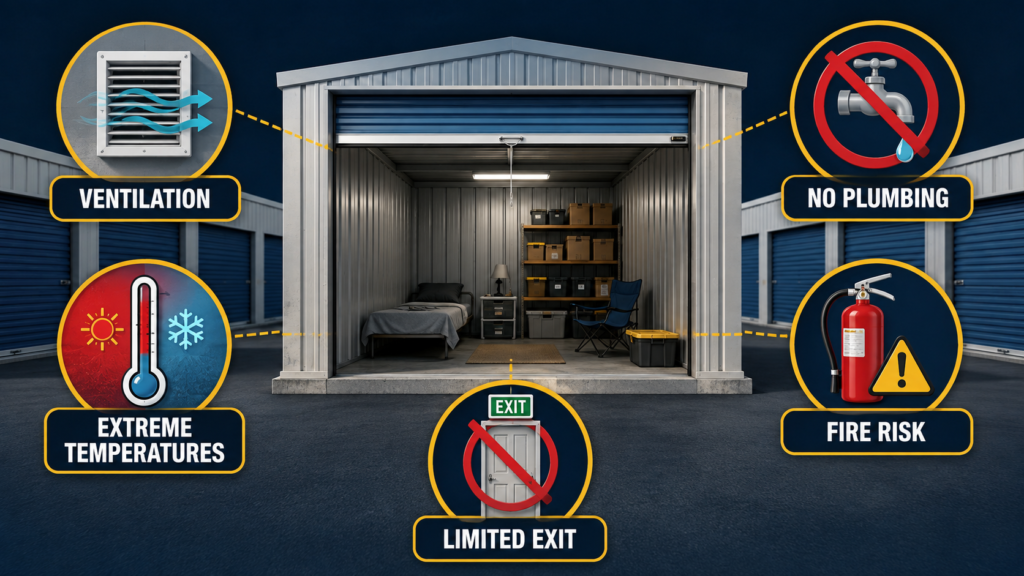
Storage units are built and approved for property, not people. They commonly lack the combination of sanitation, ventilation, emergency escape, plumbing, electrical capacity, natural light, and temperature control expected in lawful residential spaces.
Zoning and permitted land use
Local zoning rules determine where residential, commercial, and industrial uses may occur. A self-storage property is normally approved for commercial or storage use, so allowing people to live there could place the operator in violation of its permit or zoning classification.
A tenant cannot normally convert a commercial storage space into a residence simply by adding furniture. A lawful conversion could require planning approval, inspections, construction work, and a residential certificate of occupancy.
Building and fire-code classifications
Building codes separate storage occupancies from residential occupancies containing dwelling or sleeping units. The International Building Code occupancy classifications demonstrate why a space approved for storage is not automatically suitable for sleeping.
Storage-unit partitions, exterior locks, narrow aisles, and limited exits can create serious risks during a fire or medical emergency. Cooking appliances, improvised wiring, candles, fuel-burning heaters, and blocked passageways can make those risks worse.
Health and personal safety
A standard unit may become dangerously hot or cold, especially when it is not climate-controlled. Poor ventilation, chemical vapors, pests, and the absence of water or sanitation can also make extended occupancy unsafe.
Some units are designed to lock from the outside. A person sleeping inside could be trapped by another customer, a facility employee, a gate schedule, or an emergency.
How storage-unit rules vary by state
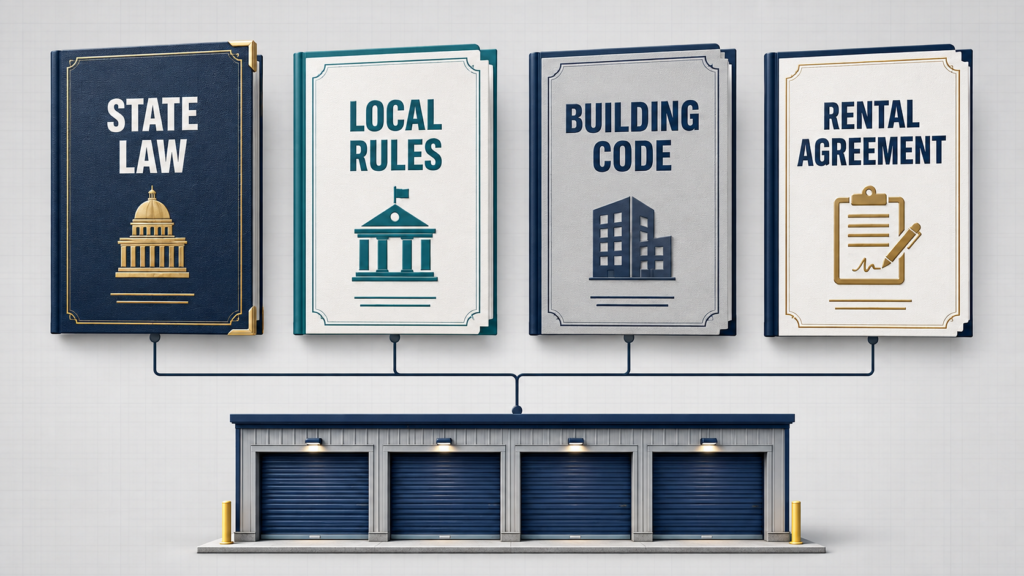
The basic result is similar in many places, but the legal route can vary. Some states directly prohibit residential use in their self-storage statutes, while others rely more heavily on rental contracts, zoning ordinances, property-maintenance rules, and local building or fire codes.
For example, Texas Property Code Section 59.009 states that a tenant may not use or allow a self-service storage facility to be used as a residence. Florida’s statutory definition of a self-service storage facility likewise states that individual storage spaces may not be used for residential purposes.
Even when state legislation does not contain an identical sentence, local rules may still prohibit sleeping or residential occupancy. The rental agreement may be stricter than the minimum legal rule, provided its terms are enforceable.
Before relying on a general answer, check:
- Your signed rental agreement
- The state self-storage statute
- Local zoning and property-use ordinances
- Applicable building and fire codes
- Written facility policies
- Any warning or notice issued by management
What happens if you are caught living in a storage unit?
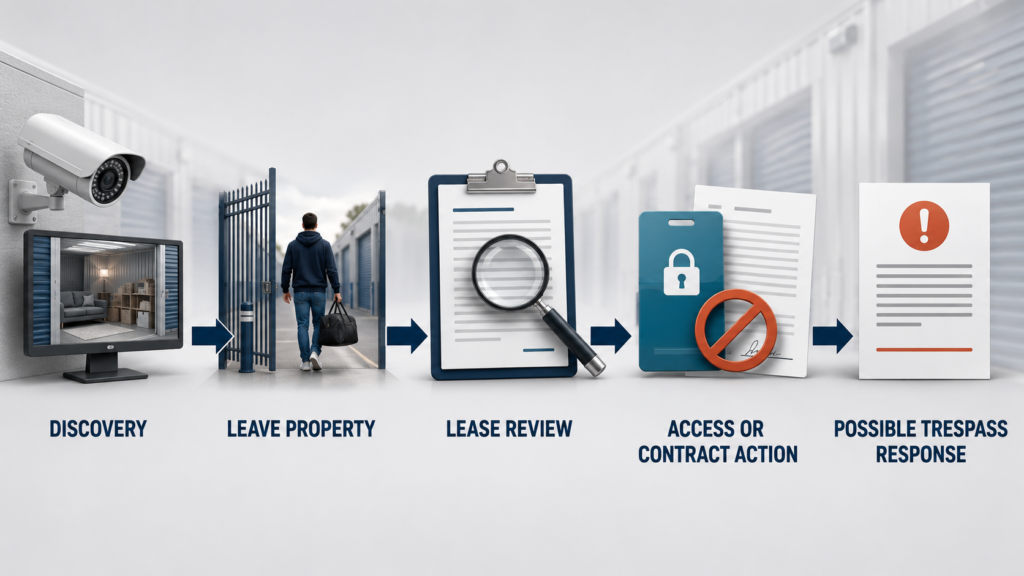
The facility manager may first require you to leave immediately. Depending on the agreement and circumstances, management may also issue a written warning, suspend gate access, terminate the rental agreement, or demand that you remove your belongings.
If you refuse to leave after permission has been withdrawn, the issue can develop into trespassing. Law enforcement involvement is possible, especially when someone remains after closing, forces entry, damages property, creates a fire risk, or returns after receiving a formal exclusion notice.
Possible consequences include:
- Immediate removal from the property
- Suspension of your gate code
- Termination of the rental agreement
- Charges for cleaning or property damage
- Loss of access except for an arranged move-out
- A trespass warning
- Police involvement if you refuse to leave
- Code-enforcement action against the facility or occupant
Contract termination does not usually allow the operator to discard your belongings instantly. State self-storage lien laws and the rental agreement generally provide procedures covering unpaid rent, notices, access restrictions, and the eventual sale or disposal of stored property.
What should you do if you need somewhere to stay?
Do not use a storage unit as emergency accommodation. If you are at risk of sleeping there because you lack safe housing, contact local shelter, outreach, or housing-assistance services before the facility closes.
The HUD Find Shelter tool can locate nearby shelter, health-care, clothing, and food resources. You can also contact local housing assistance through 211 for information about shelters, rent assistance, utility help, and other services.
If management has already discovered you, remain calm and cooperate with instructions to leave. Ask for the move-out requirements in writing, collect essential identification and medication, and arrange a lawful time to remove the rest of your property.
Frequently Asked Questions
Can I stay in my storage unit all day?
Possibly, if you remain within access hours and are genuinely organizing, loading, or inspecting property. Management may still restrict unusually long or repeated visits, so ask permission before planning an all-day project.
Does 24-hour access mean I can sleep there?
No. Twenty-four-hour access normally means you can enter to store or retrieve belongings at any time, not that you can occupy the unit as residential accommodation.
Can I use a storage unit as an office?
Many facilities prohibit operating a business from inside a unit, even when business inventory may be stored there. Ask whether the facility offers approved workshop, office, or commercial-flex space instead.
Is sleeping in a storage unit trespassing?
Sleeping there initially may be a lease violation or prohibited use rather than trespassing by itself. Trespass concerns become stronger if you remain after access hours, refuse an instruction to leave, enter a restricted area, or return after permission has been withdrawn.
Can a storage facility lock me out for staying overnight?
The agreement and state law determine the available remedy. Management may suspend access or terminate the contract, but separate statutory procedures can apply to stored property, notices, unpaid charges, and lien enforcement.
Can children or pets stay in a storage unit?
A brief supervised visit may be governed by facility policy, but children and animals should never be left unattended in a unit. Using the space to house people or animals is generally prohibited and creates significant safety concerns.
Can I receive mail at a storage unit?
Some facilities allow business deliveries or packages under controlled conditions, while others prohibit them. Receiving ordinary residential mail may also suggest unauthorized occupancy, so obtain written approval before using the address.
Conclusion
The answer to How long can you stay in a storage unit is not based on one nationwide time limit. You may generally remain during authorized hours for legitimate storage tasks, but extended loitering, sleeping, working, or residential use can violate the lease and applicable law.
Read the agreement before entering, follow the posted access schedule, and contact management if a large organizing project will take several hours. For more straightforward explanations of everyday legal questions, explore The Law Learner’s practical legal guides.
