

Do You Have to Go to Law School to Take the Bar?
In most states, you must complete an approved legal education before you can take the bar exam. The traditional way to meet this requirement is by earning a Juris Doctor, or J.D., from an eligible law school.
However, law school is not the only route available everywhere.
California, Vermont, Virginia, and Washington have structured programs that may allow you to qualify for the bar exam by studying under an experienced attorney or judge. This route is commonly called “reading the law,” legal apprenticeship, law-office study, or a law clerk program.
These programs are not simple shortcuts. Participants usually spend three or four years completing supervised legal study, written examinations, progress reports, and practical work. They must then meet the jurisdiction’s remaining licensing requirements.Why Most States Require Law School
State courts and bar-admission authorities regulate who may practice law. Their rules protect clients and determine whether applicants have sufficient legal knowledge, professional judgment, and ethical fitness.
In the traditional pathway, an aspiring lawyer generally:
- Completes the required undergraduate education.
- Earns a J.D. from an accepted law school.
- Applies to a state bar-admission authority.
- Passes the required bar examination or licensing assessment.
- Completes professional-responsibility requirements.
- Passes a character-and-fitness review.
- Takes the attorney’s oath and is admitted to practice.
Completing law school does not automatically make someone a lawyer. It normally establishes the applicant’s educational eligibility for the next stages of admission.
Likewise, passing the bar exam is not enough on its own. An applicant cannot legally practice until they complete every requirement and the relevant authority formally admits them.
The National Conference of Bar Examiners maintains jurisdiction information covering admission rules, examinations, score transfers, and character-and-fitness requirements. Because these rules change, applicants should also consult the state authority responsible for the jurisdiction where they plan to practice.
Can You Take the Bar Without Going to Law School?
Yes, but only in a small number of states and only after completing an approved alternative legal-education program.
You generally cannot read legal books at home, pay the examination fee, and take the bar as an independent candidate. A jurisdiction that recognizes law-office study will normally require you to:
- Apply or register before beginning
- Meet prior education requirements
- Find an eligible supervising attorney or judge
- Follow a prescribed legal curriculum
- Complete a minimum period of study
- Work or study for a required number of hours
- Take regular examinations
- Submit progress reports
- Receive credit for your completed study
The state must recognize your legal education before you become eligible for its bar examination.
Which States Allow You to Take the Bar Without Law School?
California, Vermont, Virginia, and Washington offer recognized routes that may allow a person to qualify without earning a traditional J.D.
Maine and New York should not be grouped with the four full apprenticeship states without explanation. They may recognize a combination of formal law-school education and supervised law-office study, but they generally do not offer the same completely law-school-free path.
California Law Office Study Program
California allows eligible participants to study law in a law office or judge’s chambers instead of completing a conventional law-school program.
According to the State Bar, the program involves four years of recognized legal study. Participants generally study for at least 18 hours each week over 48 weeks of the year. A portion of that time must involve direct supervision, and the supervising attorney or judge must examine the participant’s progress.
Common requirements include:
- Registering with the State Bar
- Studying under an eligible attorney or judge
- Completing the required weekly and annual study time
- Taking monthly written examinations
- Submitting semiannual reports
- Paying applicable fees
- Meeting California’s pre-legal education requirement
Participants may also need to pass the First-Year Law Students’ Examination, commonly called the Baby Bar. Delaying or failing that examination can limit the amount of legal-study credit the applicant receives.
Check the official California Law Office Study Program information before entering an arrangement with a supervisor.
What California applicants often overlook
Completing the four-year study period does not guarantee eligibility if reports, examinations, hours, or supervisor requirements were not properly documented.
California participants should keep their own copies of:
- Registration approval
- Monthly examinations
- Study schedules
- Supervisor evaluations
- Progress reports
- Attendance and study-hour records
- Fee receipts
- Correspondence with the State Bar

Vermont Law Office Study Program
Vermont also provides a law-office-study route for applicants who do not earn a traditional J.D.
The program generally requires four years of supervised legal study. The applicant must arrange an approved course of study with an eligible attorney or judge and comply with the state’s reporting and evaluation requirements.
The program is regulated. Finding an attorney who is willing to help does not automatically enroll the applicant or make the study eligible for credit.
Before starting, a prospective participant should confirm:
- Preliminary education requirements
- Supervisor qualifications
- Required application documents
- Minimum study expectations
- Subjects that must be covered
- Reporting deadlines
- Evaluation and examination requirements
- What happens if the supervisor changes
Current rules and forms are available through the Vermont Judiciary.
Virginia Law Reader Program
Virginia’s alternative pathway is called the Law Reader Program. It is one of the most structured versions of reading the law.
The program generally requires three years of study. Law readers ordinarily complete at least 25 hours of study each week for at least 40 weeks per year. The rules include a prescribed curriculum, direct instructional requirements, examinations and formal reporting.
The supervising attorney generally needs substantial active-practice experience and must personally direct the reader’s legal education.
Virginia also limits the arrangement. The program should not be treated as a correspondence course or a casual remote mentorship. Applicants must follow the official requirements concerning the place of study, supervision, curriculum and permissible employment.
Prospective participants should read the current Virginia Law Reader Program regulations and application instructions before beginning.
Washington APR 6 Law Clerk Program
Washington’s APR 6 Law Clerk Program combines academic study with practical employment.
It is a four-year program supervised by an eligible tutor. Participants generally work in a law office or qualifying legal department while completing a structured legal curriculum.
The program typically includes:
- Regular employment in a qualifying legal setting
- Approximately 32 hours of work and study each week
- Direct instruction from the tutor
- A prescribed course of study
- Monthly written examinations
- Annual requirements and progress reports
- Program fees and administrative deadlines
Washington’s program can provide meaningful practical experience because participants work inside a legal organization while studying. However, holding a legal-support job does not automatically make someone an APR 6 law clerk. The applicant and tutor must meet the program’s conditions and receive approval.
The Washington State Bar Association admissions portal provides current Law Clerk Program information.
What About New York and Maine?
New York and Maine are often included in articles about taking the bar without law school. That description can be misleading.
These states may allow eligible applicants to combine law-school education with supervised law-office study. However, the applicant generally cannot avoid formal law school entirely.
New York
New York’s combination route normally requires an applicant to complete qualifying study at an approved law school before completing the remaining legal-education period through a clerkship or law-office program.
Someone with no qualifying law-school education should not assume that reading under a New York attorney will establish eligibility.
Maine
Maine also has rules under which a combination of law-school education and supervised legal study may satisfy the educational requirement in certain circumstances.
Because both routes depend on specific prior education, describe them as partial alternatives rather than full law-school replacements.
How to Become a Lawyer Without Going to Law School
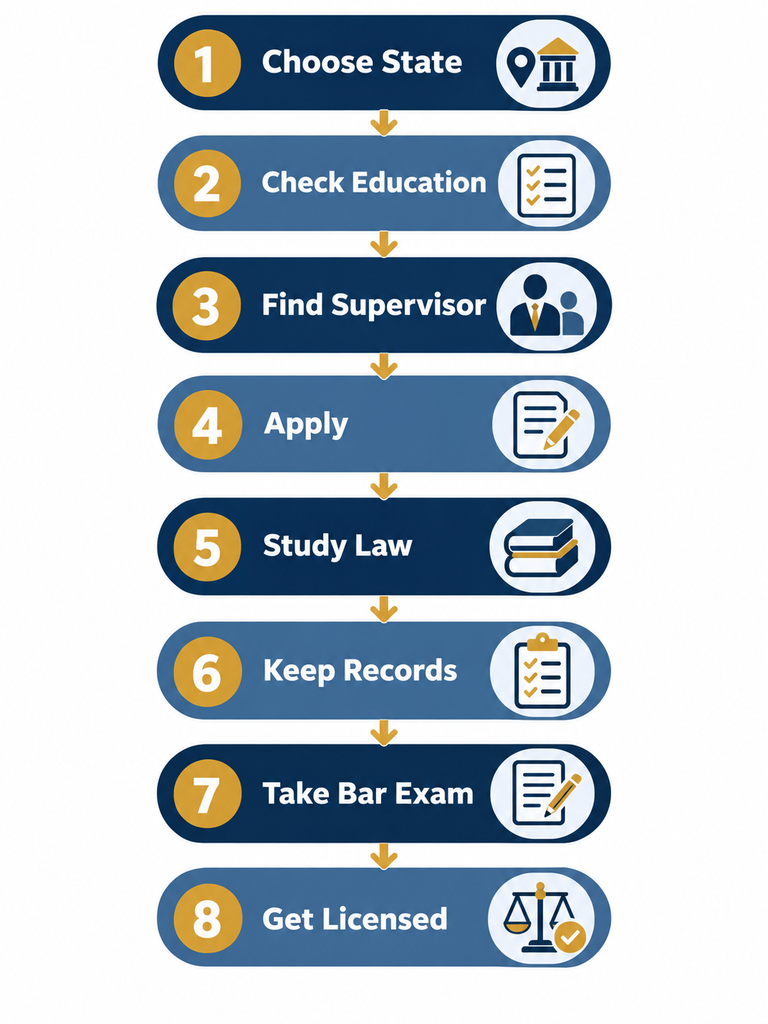
Step 1: Choose the state before choosing a supervisor
Alternative legal education is jurisdiction-specific. A four-year apprenticeship completed in one state may not qualify you to take another state’s bar examination.
Your first decision should therefore be where you intend to seek your initial license.
Step 2: Check your previous education
States may require a bachelor’s degree, a certain number of college credits, or proof that your education is equivalent to the stated requirement.
Do not assume that practical work experience will replace an unmet college requirement.
Step 3: Find a qualified supervising attorney or judge
Depending on the jurisdiction, the supervisor may need:
- A minimum number of years in active practice
- A license in good standing
- A principal office in the state
- Experience in a qualifying legal environment
- Time to provide regular personal instruction
- Willingness to create and grade examinations
- Approval from the admission authority
A supervisor is taking on a multi-year teaching and administrative responsibility. This is one reason finding a suitable placement can be difficult.
Step 4: Obtain official approval
Do not begin accumulating study hours based only on a private agreement. The state may refuse to recognize work completed before your official registration date.
Read all instructions, submit the required documents, and wait for confirmation if the program requires prior approval.
Step 5: Complete the academic curriculum
Legal apprentices generally study many of the same foundational subjects taught in law school, including:
- Civil procedure
- Constitutional law
- Contracts
- Criminal law and procedure
- Evidence
- Property
- Torts
- Professional responsibility
- Legal research
- Legal writing
Practical experience in one field does not replace subjects required by the program or tested on the bar examination.
Step 6: Keep complete records
Maintain more documentation than you believe you will need. If an attorney retires, becomes unavailable, moves, or ends the arrangement, your own records may become important.
Record:
- Dates and hours of study
- Subjects completed
- Books and materials used
- Instructional meetings
- Written assignments
- Examination questions and answers
- Grades and feedback
- Reports submitted to the regulator
Step 7: Complete the remaining admission process
Once your legal education is recognized, you may still need to:
- Pass the jurisdiction’s bar examination
- Pass the MPRE or another ethics assessment
- Complete a character-and-fitness investigation
- Provide fingerprints or background information
- Meet filing deadlines
- Pay examination and investigation fees
- Complete a state-law component
- Take the attorney’s oath
Is Reading the Law Easier Than Attending Law School?
Usually not.
An apprenticeship may reduce tuition costs, but the educational and scheduling demands can be substantial. Participants often balance employment, legal reading, written assignments, examinations, and bar preparation.
A traditional law school normally provides:
- A planned curriculum
- Full-time instructors
- Legal research resources
- Academic support
- Classmates and study groups
- Clinics and student organizations
- Career services
- Organized bar-preparation support
- On-campus recruitment
An apprentice may need to find or build many of these resources on their own.
Daily law-office work can teach valuable practical skills, but the work performed in one office may not cover every subject tested on the bar. For example, an apprentice working in an estate-planning office may receive little daily exposure to criminal procedure or constitutional law.
The apprentice therefore needs both practical training and a separate academic plan.
Is Reading the Law Cheaper?
It can be significantly less expensive than paying conventional law-school tuition, but “cheaper” does not mean free.
Possible expenses include:
- Program registration fees
- Monthly or annual administrative fees
- Casebooks and study materials
- Online legal-research access
- Bar-review courses
- First-year examinations
- Bar-exam application fees
- Character-and-fitness fees
- Travel and testing expenses
- Lost income caused by study commitments
Applicants should also consider how much they will earn during the program and whether the work arrangement provides benefits.
Avoid relying on promotional claims about the exact amount you will save. The total cost depends on the state, study materials, employment arrangement, program length, examination attempts, and whether you pay for commercial bar preparation.
Advantages and Disadvantages
Can You Practice Law Immediately After Passing the Bar?
No. Passing the bar examination is not the same as receiving a law license.
An applicant may still need to complete:
- Character-and-fitness approval
- An ethics examination
- A state-law course
- Administrative paperwork
- Fee payments
- The attorney’s oath
- Formal admission by a court or licensing authority
Until formal admission is complete, the applicant generally cannot advertise as an attorney or independently perform work reserved for licensed lawyers.
The correct sequence is:
Education eligibility → bar application → examination → remaining requirements → formal admission
Can an Apprentice-Trained Lawyer Practice in Another State?
Possibly, but interstate mobility can be more complicated without a J.D.
Another state may examine:
- Whether you graduated from an accepted law school
- How you qualified for your original license
- Whether your bar score can be transferred
- How long you have actively practiced
- Whether the state offers admission by motion
- Whether the two jurisdictions have reciprocal rules
- Your disciplinary and good-standing history
Score portability and educational eligibility are also different issues. A transferable bar score does not necessarily override a state’s legal-education requirement.
Will Law Firms Hire Someone Who Did Not Attend Law School?
Some will, but opportunities may differ.
A small firm that supervised the apprentice may value the person’s practical experience and familiarity with its clients. Government offices, nonprofit organizations, and other employers may also focus heavily on licensing, skills, and experience.
However, some employers use law-school attendance, grades, class rank, journal participation, or on-campus recruitment as part of their hiring process. An apprentice will not have these conventional credentials.
This does not mean employment is impossible. It means applicants should investigate their intended career area before committing to the route.
Ask potential employers whether they require:
- A J.D.
- Graduation from an accredited law school
- Eligibility in multiple jurisdictions
- Specific academic credentials
- Participation in law-school recruitment
- Particular clinical or internship experience
Who Should Consider a Legal Apprenticeship?
This route may suit someone who:
- Lives in a state that recognizes it
- Meets the preliminary education requirements
- Has access to a qualified supervisor
- Can maintain a multi-year work-and-study schedule
- Learns effectively without a traditional classroom
- Plans to remain in the licensing state
- Has researched the relevant employment market
- Understands that lower tuition does not mean less work
It may be less suitable if you:
- Expect to move between states
- Want large-firm or law-school-based recruitment
- Need extensive classroom support
- Cannot maintain consistent weekly study hours
- Are unsure where you want to practice
- Do not have a stable supervising arrangement
- Want the fastest or simplest licensing route

Get important answers from the regulator, not only from a proposed supervisor, private course provider, online forum, or social-media post.
Common Myths About Taking the Bar Without Law School
Myth: Anyone can challenge the bar exam
Fact: Most jurisdictions require applicants to prove that they meet legal-education requirements before being allowed to take the exam.
Myth: Reading the law means studying alone
Fact: Modern programs involve qualified supervision, a curriculum, examinations, documented hours, evaluations, and regulatory oversight.
Myth: An apprenticeship is faster than law school
Fact: Full apprenticeship programs generally take three or four years. A full-time J.D. commonly takes three academic years.
Myth: Passing the bar automatically makes you a lawyer
Fact: The applicant must complete all licensing requirements and receive formal admission.
Myth: An apprenticeship license works in every state
Fact: Each jurisdiction decides whether it will recognize the applicant’s education, examination record, and experience.
Myth: The apprenticeship route is free
Fact: Although tuition may be much lower, books, program fees, examinations, bar preparation, applications, and lost work opportunities can still create meaningful costs.
Conclusion
Do you have to go to law school to take the bar? In most states, the answer is yes. A qualifying law degree remains the standard way to establish eligibility.
California, Vermont, Virginia, and Washington provide regulated alternatives through supervised study in a law office, judge’s chambers, or qualifying legal workplace. New York and Maine may recognize combination routes, but they generally still require some formal law-school education.
An apprenticeship can reduce tuition and provide valuable practical experience. It also demands several years of disciplined study, detailed recordkeeping, qualified supervision, and careful career planning. It may limit your ability to qualify or find work in another state.
Before deciding, check the latest official rules, confirm your eligibility in writing, and review the requirements of any state where you may eventually practice.
CTA: Explore more straightforward explanations of legal education, licensing rules, and everyday laws on The Law Learner.
