


How Much Does International Adoption Cost in 2026?
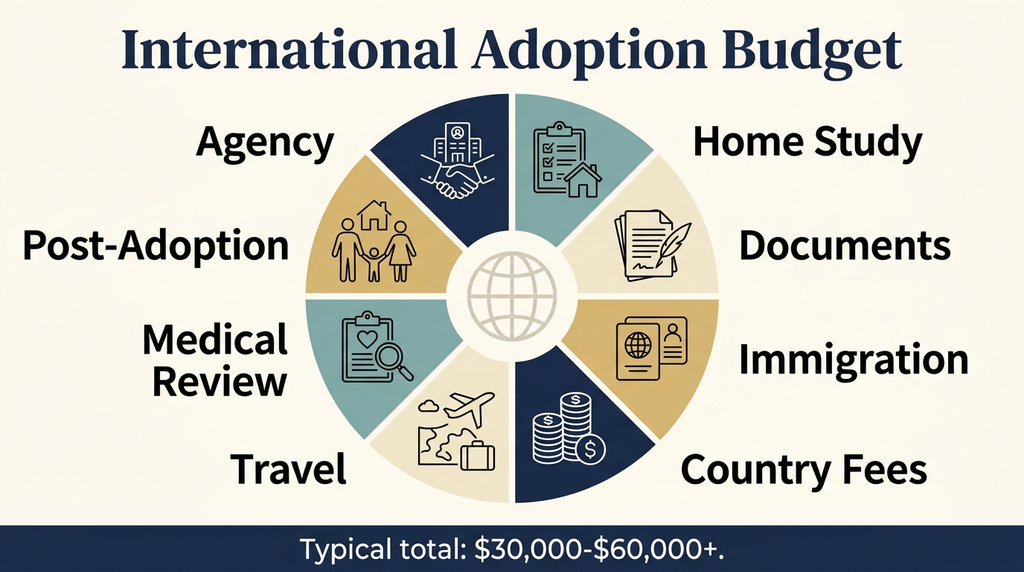
International adoption commonly costs $30,000 to $60,000 or more for a family in the United States. Some cases fall below that range, while complex programs, repeated travel, long stays or unexpected legal work can push the total above it.
Recent National Council for Adoption analysis citing federal fiscal year 2024 reporting identified a broad total-cost range of approximately $17,500 to $62,263 for adoptions from Hague Convention countries. This is a useful reference point, but it is not a guaranteed price for any country or family.
The most accurate budget combines fees from the U.S. adoption service provider, home-study provider, U.S. immigration agencies, the child’s country of origin, travel companies, and post-adoption professionals. It must also leave room for delays and changes that no initial fee sheet can predict.
Quick answer: A realistic international adoption budget is often $30,000 to $60,000 or more. Major expenses include agency services, home study, immigration filings, dossier preparation, foreign-country fees, legal work, medical review, airfare, lodging and post-adoption reports. Request a country-specific written fee schedule and ask which charges are fixed, estimated, refundable or outside the agency’s control.
International Adoption Cost Breakdown
| Cost category | What it may include | Why the amount changes |
|---|---|---|
| U.S. agency and program services | Case management, coordination, education, referral support and post-placement work | Provider structure, country program and services bundled into the fee |
| Home study | Interviews, background checks, home visits, education and written report | State rules, provider rates, household complexity and required updates |
| Dossier and documents | Certified records, apostilles, authentication, translation, courier and copying | Number of documents and country-specific formalities |
| U.S. immigration processing | Suitability application, child petition, biometrics, visa and related submissions | Hague or non-Hague route, household members and later changes |
| Foreign-country expenses | Central authority, court, legal, guardian, medical, passport or administrative charges | The country’s law and approved fee structure |
| Travel | Airfare, accommodation, local transport, meals and escorts | Number of travelers, trips, season, destination and required stay |
| Child medical review | Record translation, specialist consultation and testing | Available records and the child’s health needs |
| Post-adoption requirements | Social-worker visits, reports, translation, filing and delivery | Country schedule and number of years reports remain due |
| U.S. state proceedings | Recognition, finalization, readoption, certificates and attorney fees | Visa type, state law and whether the foreign order is already final |
| Contingency reserve | Renewals, repeat travel, delays and unexpected professional work | Program stability and duration |
Some agencies bundle several categories into one program fee, while others quote them separately. Adding estimates from different providers without checking for overlap can accidentally double-count costs.
What Does an International Adoption Fee Actually Pay For?
Families are not paying for a child. Legitimate fees compensate agencies, social workers, courts, governments, attorneys, translators and other professionals for lawful services needed to protect the child and complete the adoption.
Article 32 of the Hague Adoption Convention states that no one should derive improper financial gain from an intercountry adoption and that only costs, expenses and reasonable professional fees may be charged or paid.
A higher fee does not automatically indicate wrongdoing because international cases can require extensive professional coordination. However, unclear payments, unofficial cash requests, and fees inconsistent with the written agreement deserve careful scrutiny.
Before paying, families should know:
- Who receives the money
- Which service the payment purchases
- Whether the amount is fixed or estimated
- Whether a government or court set the fee
- Whether a receipt will be provided
- What portion is refundable
- What happens if the program pauses or the referral does not proceed
Hague Convention Versus Non-Hague Adoption
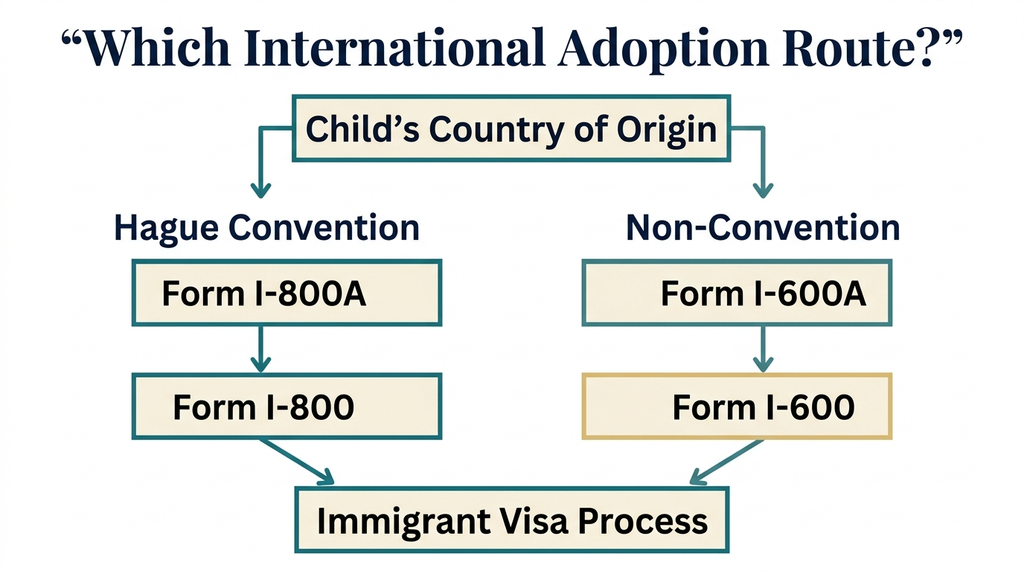
The country of origin determines which principal U.S. immigration route applies.
Adoption from a Hague Convention country
The Hague Convention process establishes cooperation and safeguards between participating countries. Prospective adoptive parents generally begin by filing Form I-800A with U.S. Citizenship and Immigration Services to establish suitability and eligibility. After receiving an eligible child referral through the proper process, families use Form I-800 to seek classification of the child as a Convention adoptee.
Families must follow the required sequence. The U.S. Department of State warns prospective parents not to accept a placement or improperly contact responsible parties before Form I-800A approval. In a Convention case, the adoption or custody process must also respect the required Article 5/17 steps.
Adoption from a non-Convention country
The non-Convention orphan process generally uses Form I-600A to establish the prospective parent’s suitability in advance and Form I-600 to ask USCIS to classify a specific child as an orphan under U.S. immigration law.
The legal meaning of “orphan” is narrower than its everyday use. The child must satisfy the federal statutory definition and other requirements. A foreign adoption order alone does not guarantee that the child qualifies to immigrate to the United States.
Why this distinction affects cost
The route changes:
- Required forms and supporting evidence
- Provider and accreditation requirements
- Sequence of approvals
- Foreign and U.S. government coordination
- Document and translation demands
- Risk of repeating work after an error or country change
How Much Is It to Adopt a Child From an Orphanage?
People frequently search for the cost of adopting a child from an orphanage, but “orphanage adoption” is not a separate legal pathway. In most situations, the question refers to international adoption from a country where children may live in residential care.
Not every child in an orphanage or children’s home is an orphan under U.S. immigration law. The Department of State explains that some parents place children in institutional care temporarily because of poverty, illness or another hardship and intend for them to return home. Those parents may not have relinquished their rights or consented to adoption.
Before a U.S. family can complete an intercountry adoption, the child must be legally eligible under the country of origin’s law and qualify under the applicable U.S. immigration category. Ethical family-preservation efforts and domestic placement options in the child’s country may also need consideration.
Families should be cautious if anyone:
- Offers a child directly through an institution
- Suggests bypassing a central authority or accredited provider
- Guarantees that a particular child is adoptable before legal review
- Requests undocumented cash or a personal transfer
- Encourages the family to enter on a tourist arrangement and “fix the paperwork later”
- Claims that a foreign adoption automatically guarantees a U.S. immigrant visa
The Major Expenses, Step by Step
1. Adoption service provider fees
The U.S. adoption service provider often represents the largest planned expense. Fees may cover program administration, case management, coordination with a foreign supervised provider, parent preparation, referral review and reporting.
Unless a limited exception applies, prospective parents pursuing either a Convention or orphan adoption generally need an accredited or approved provider to act as the primary provider. Verify the provider’s current status rather than relying on an old brochure or directory entry.
Ask whether the program fee includes:
- Home study
- Foreign-supervised provider charges
- Translation and dossier review
- Referral support
- In-country legal services
- Escort services
- Post-placement reports
- Travel assistance
2. Home study and updates
USCIS requires a compliant home study to determine whether prospective parents are suitable and eligible to adopt abroad. It examines the household, health, finances, background, relationships, preparation and proposed country program.
International home studies must meet federal requirements as well as the family’s state requirements. They generally identify the country and the characteristics of the child the family is approved to adopt. A study prepared by a nonaccredited provider may require review and approval by an accredited agency.
Delays can lead to paid updates, renewed clearances, new medical letters and repeated visits. Moving, marriage, divorce, a new household member, job loss, or a significant health change may also require an amendment.
3. Dossier preparation
A dossier is the collection of documents submitted to the foreign authority. It may include:
- Birth and marriage records
- Divorce or death certificates where relevant
- Medical reports
- Employment and income verification
- Police clearances
- Home-study approval
- Reference letters
- Photographs
- Powers of attorney
- USCIS approvals
Documents may need notarization, certification, apostilles or consular authentication. Translation, international couriers and repeated issuance can add hundreds or thousands of dollars over a long case.
4. U.S. immigration and visa expenses
Possible charges include USCIS applications, child petitions, biometrics, immigrant visa processing and medical examinations required for immigration. Fees can change, and the correct amount depends on the form, filing method, household members and case structure.
Use the current USCIS fee schedule or fee calculator immediately before filing. Do not rely on a figure copied from an older blog post, even if the article itself remains online.
5. Foreign government, court and legal expenses
The country of origin may charge for central-authority processing, court proceedings, guardianship, civil documents, passports, medical reviews or legal representation. The State Department publishes country information pages that identify known procedures and fee information.
Only pay lawful charges through the approved process. Ask the provider to explain any difference between its contract and the government’s published information.
6. Travel and accommodation
Travel is one of the largest unpredictable categories. A program may require one trip, several trips or an extended residence period. Costs depend on:
- Number of travelers
- Number and timing of trips
- Airfare season
- Required length of stay
- Location of the court and child’s residence
- Local transportation
- Translation or guide support
- Passport and visa delays
- Medical or weather disruptions
Build the travel budget using refundable or changeable bookings where practical. Include emergency rebooking, travel insurance and additional lodging rather than estimating only the minimum scheduled stay.
7. Medical record review and care
Prospective parents often ask a physician experienced in international adoption medicine to review the child’s available medical and developmental records. Further testing may be required after arrival.
This review cannot eliminate uncertainty. Records may be incomplete, translated imperfectly or based on limited testing. Families should prepare emotionally and financially for needs that become clearer after placement.
8. Post-adoption and post-placement reporting
Many countries require reports after the child joins the family. Reports may continue for months or years and can involve social-worker visits, photographs, translation, notarization and international delivery.
These obligations remain important after the excitement and expense of travel. Failure to submit reports can affect cooperation between countries and future families’ ability to adopt.
9. State recognition, finalization or readoption
Depending on the foreign order, visa category and state law, parents may need or choose to complete a U.S. finalization, recognition or readoption proceeding. This can help establish a state-issued adoption decree or birth record and may be important where the adoption was not considered final before entry.
Citizenship and documentation consequences depend on the individual facts. Parents should confirm the child’s status and obtain the appropriate Certificate of Citizenship or other evidence rather than assuming every visa category produces identical results.
A Sample $50,000 International Adoption Budget
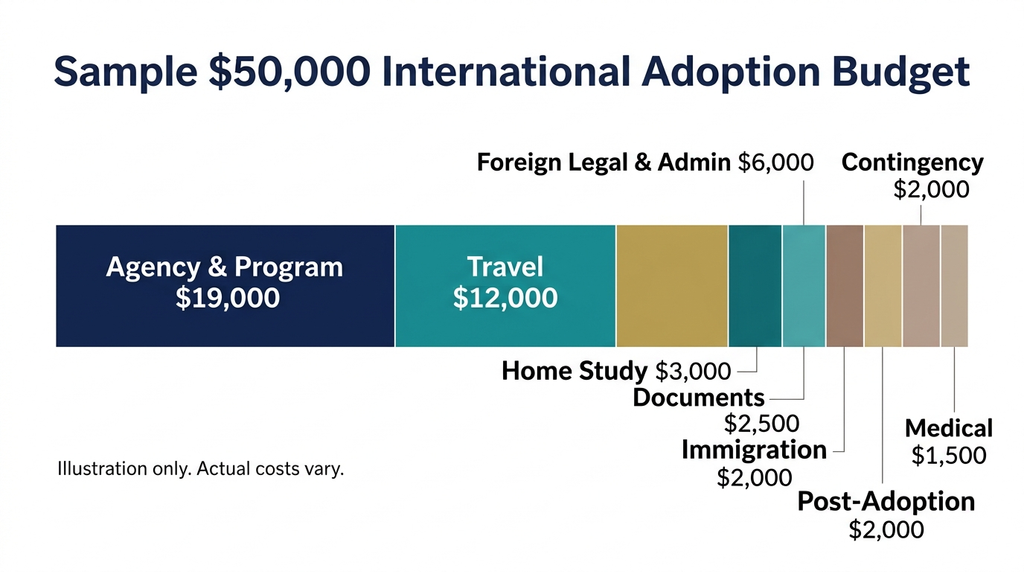
The following example shows how a total can accumulate. It is an illustration only and is not a quote for any provider or country.
| Example category | Illustrative amount |
|---|---|
| Agency and program services | $19,000 |
| Home study, clearances and updates | $3,000 |
| Dossier, translation and authentication | $2,500 |
| U.S. immigration and visa processing | $2,000 |
| Foreign legal and administrative expenses | $6,000 |
| Travel and accommodation | $12,000 |
| Medical review and examination | $1,500 |
| Post-adoption and state documentation | $2,000 |
| Contingency reserve | $2,000 |
| Illustrative total | $50,000 |
A real fee schedule may categorize or bundle these costs differently. Never add this example to an agency’s inclusive quote without checking which services have already been counted.
When and How Are International Adoption Fees Paid?
Most families do not pay the complete amount on one day. Payments are commonly tied to stages such as:
- Agency application
- Program enrollment
- Home-study approval
- Dossier submission
- Child referral
- Foreign proceeding
- Travel and visa processing
- Post-adoption reporting
A staged schedule creates time to plan, but it does not reduce the final cost. Some payments become nonrefundable once work begins. Others may be transferable to a later referral or country program only under specific contract terms.
Hidden Costs That Can Change the Final Total
Currency movements
A foreign fee quoted in local currency can become more expensive if the U.S. dollar weakens before payment.
Document expiration
Medical reports, police clearances, home studies and immigration approvals may expire. Program delays can require new documents and fees.
Repeat travel
A court postponement, medical issue or visa delay can extend the stay or create an additional trip.
Country or program changes
Countries can change eligibility rules, pause processing or close a program. Families may lose some fees and need a new home study, dossier or immigration submission.
Child-specific needs
Additional medical review, accessible travel, specialized equipment or immediate treatment may be necessary.
Post-adoption care
Legal adoption costs are only part of financial preparation. Health care, therapy, language support, education and travel connected with family or cultural relationships may continue long after finalization.
What Happens to the Money if the Adoption Does Not Proceed?
There is no universal refund rule. The contract should separate:
- Nonrefundable application charges
- Fees earned when a service is completed
- Funds held for future expenses
- Foreign payments already transmitted
- Travel purchases governed by airline or hotel policies
- Amounts transferable to a new referral or program
- Refunds available after suspension or closure
Ask the provider to explain several scenarios in writing: a family withdrawal, government denial, a child referral ending, country suspension, and agency loss of accreditation.
No ethical provider can guarantee that a specific referral, timeline, foreign approval or immigrant visa will succeed.
The 2026 Federal Adoption Tax Credit for International Adoption
For tax year 2026, the maximum federal adoption credit is $17,670 per eligible child, and up to $5,120 may be refundable, subject to the applicable rules. The credit begins to phase out when modified adjusted gross income exceeds $265,080 and is eliminated at $305,080 or more.
Qualified expenses may include reasonable and necessary:
- Adoption fees
- Attorney fees
- Court costs
- Adoption-related travel, meals and lodging
- Other expenses directly related to the legal adoption
Foreign adoptions have an important timing rule. Qualified expenses are generally claimed only when the adoption becomes final for U.S. federal tax purposes. Unlike an eligible domestic adoption, an unsuccessful foreign adoption generally does not produce an adoption credit.
The special rule that can allow the maximum credit without matching expenses for a state-determined special-needs adoption applies to eligible U.S. children, not foreign adoptions. Families should not label an international adoption “special needs” for tax purposes merely because the child has a disability or medical condition.
Use IRS Form 8839 and current instructions. Expenses reimbursed by an employer or another source cannot simply be claimed again as unreimbursed expenses.
Grants, Employer Benefits and Other Financial Help
Possible funding sources include:
- Employer adoption reimbursement
- Paid adoption leave
- Nonprofit adoption grants
- Military reimbursement for eligible service members
- Agency sliding scales
- Family savings and fundraising
- Loans or home-equity borrowing
Grants are competitive and should not be treated as guaranteed income. Debt also changes the long-term cost through interest. Build a workable plan that does not depend entirely on receiving a grant or tax refund.
For comparison, families considering a lower-cost domestic public route can read how much it costs to adopt from foster care. Our complete U.S. adoption cost guide compares all major pathways.
How to Compare Two International Adoption Fee Schedules
Do not compare only the largest number printed on each document. Create one spreadsheet with matching categories and ask both providers to identify:
- Services included in the agency fee
- Foreign partner or supervised-provider charges
- Home study and update fees
- Immigration, visa and medical charges
- Expected number of trips and travelers
- Required length of stay
- Translation and authentication
- Post-adoption reports
- Estimated third-party expenses
- Refund and transfer rules
- Contingency recommendations
An apparently cheaper program can become more expensive when it excludes travel, translations, foreign legal work or post-adoption services.
Questions to Ask Before Choosing a Country Program
- Is the country currently processing adoptions with the United States?
- Is it a Hague Convention country?
- Is the provider currently accredited or approved for the required services?
- What age, health, marital, residency or family-size requirements apply?
- What profiles of children genuinely need intercountry adoption?
- What is the complete estimated fee schedule?
- Which expenses are outside the provider’s control?
- How many trips and how many days in-country are normally required?
- What happens financially if the program pauses?
- Which post-adoption reports are mandatory, and for how long?
- Will a U.S. state proceeding be required after entry?
- What medical and trauma-informed preparation is provided?
Check the State Department’s country information and recent adoption notices before enrolling and again before each major payment or trip.
Does Your State Affect an International Adoption?
Yes. Although immigration is federal, the home study, provider licensing and recognition or readoption process can depend on the family’s state. Our developing state series includes:
- Texas adoption costs
- Florida adoption costs
- California adoption costs
- Ohio adoption costs
- North Carolina adoption costs
Unpublished links will become active when the corresponding guide is published at the stated URL.
Frequently Asked Questions
What is the average cost of international adoption?
Many U.S. families should plan for approximately $30,000 to $60,000 or more. Recent reported totals for Hague Convention programs covered a wider range, showing why a country-specific fee schedule is more useful than one national average.
Which country is cheapest to adopt from?
No country is reliably the “cheapest.” Program availability, applicant eligibility, the needs of children, travel and legal requirements change. Selecting a country solely because of an advertised low fee can lead to poor financial and ethical decisions.
Can I adopt directly from an orphanage without an agency?
Usually not through an informal direct arrangement. U.S. families generally must follow the country’s authorized process and U.S. immigration requirements, with an accredited or approved primary provider unless an exception applies.
Does a child in an orphanage automatically qualify for adoption?
No. The child may have living parents who retain rights, may be in temporary care or may not satisfy the applicable U.S. immigration definition. Competent authorities must establish legal eligibility.
Are international adoption fees paid all at once?
Usually they are divided into stages, but payment structures vary. Read the refund and transfer provisions for every stage before enrolling.
Can international adoption expenses be refunded if the case fails?
Some unearned or unspent funds may be refundable, while application fees, completed services, foreign payments and travel purchases may not be. The written contract controls many of these questions.
Can I claim the adoption tax credit before a foreign adoption is final?
Generally no. Foreign adoption expenses are normally claimed when the adoption becomes final for U.S. tax purposes. Families should verify the correct tax year with Form 8839 instructions or a tax professional.
Does the adopted child automatically become a U.S. citizen?
Some internationally adopted children acquire citizenship automatically after satisfying statutory conditions, while other cases require finalization or additional documentation. The visa category and facts matter. Confirm status through USCIS and obtain formal evidence of citizenship.
Do relatives adopted from abroad use the same process?
A family relationship does not automatically remove immigration or adoption requirements. A relative may still need to qualify as a Convention adoptee or orphan, or satisfy a different immigration route with its own custody and residence requirements.
How long does international adoption take?
It can take months or several years depending on the country, referral, family eligibility, documents, courts, immigration and program stability. A quoted timeline is an estimate, not a promise.
The Bottom Line
International adoption usually requires a budget of $30,000 to $60,000 or more, but the headline total is only the beginning of responsible planning. Families need to understand what each fee covers, when payments become nonrefundable, how program changes affect the budget and which obligations continue after the child arrives.
The safest approach is to verify the country’s current status, use properly accredited professionals, obtain an itemized written fee schedule, calculate realistic travel costs and maintain a contingency reserve. Most importantly, financial planning should support a lawful, ethical and child-centered process rather than a search for the fastest or cheapest placement.
This article provides general educational information and is not legal, immigration, tax or financial advice. Intercountry adoption programs, fees, immigration requirements and country rules can change. Confirm current information with the U.S. Department of State, USCIS, the relevant foreign authority and qualified professionals.
Sources for Editorial Verification
- U.S. Department of State: Intercountry Adoption
- U.S. Department of State: Eligibility to Adopt
- U.S. Department of State: Who Can Be Adopted
- U.S. Department of State: Home Study Requirements
- U.S. Department of State: Adoption Statistics and Annual Reports
- USCIS: Form I-800A
- USCIS: Form I-800
- USCIS: Form I-600A
- USCIS: Form I-600
- USCIS: Fee Calculator
- IRS: Adoption Credit
- IRS: 2026 tax inflation adjustments
- HCCH: Hague Convention on Intercountry Adoption
- National Council For Adoption: Reported international adoption cost range
