

That little envelope shows up, and your stomach drops. You open it, and there it is in bold letters: you’ve been summoned for jury duty. Your first thought is probably not “how exciting.” It’s probably “how do I get out of jury duty?”
I get it. Between work deadlines, childcare, and everything else on your plate, jury duty can feel like it landed on your calendar at the worst possible time. The good news is that how to get out of jury duty is not some secret trick lawyers keep to themselves. There are real, legal, and well-documented ways to be excused, postponed, or exempted, and I’m going to walk you through every one of them in plain language.
I’ve spent time researching how courts across different states actually handle these requests, from small county courthouses to federal district courts, and one thing became clear fast: most people fail at this not because they don’t qualify, but because they ask the wrong way, at the wrong time, or with the wrong paperwork. That’s the part most blog posts skip over. So let’s fix that.
Before we go further, it helps to understand a basic legal idea. If you ever want a refresher on how courts and legal procedures work in general, my civil services section has more plain-English breakdowns like this one.
Why Jury Duty Exists (And Why Courts Don’t Just Let Anyone Skip It)
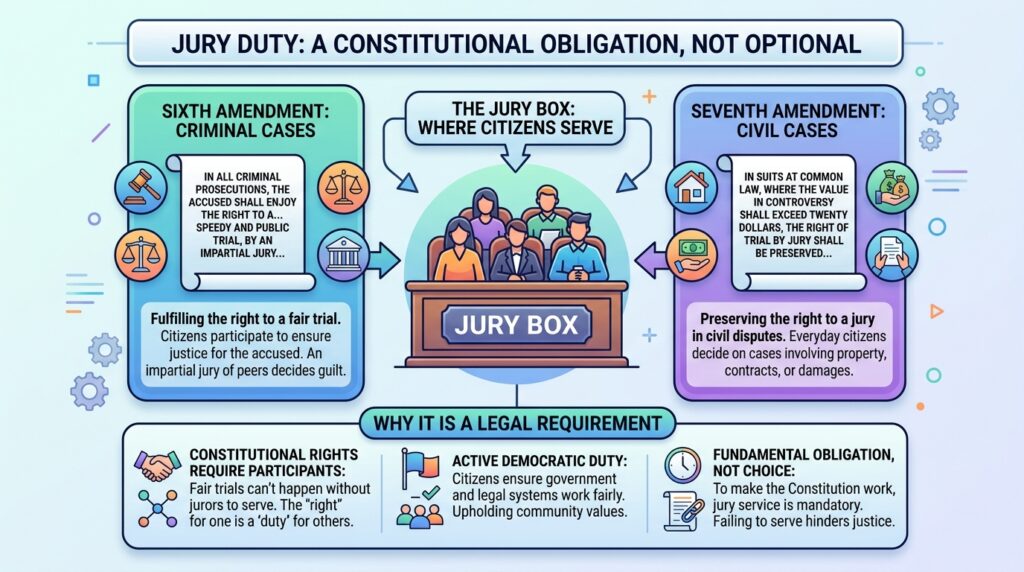
Jury duty isn’t a random inconvenience. It’s baked into the structure of the American justice system. The right to a trial by an impartial jury of your peers is guaranteed by the Sixth and Seventh Amendments, and juries only work if regular citizens actually show up.
Because of that, courts don’t treat “I don’t feel like it” as a valid excuse, and they never will. What they do accept are documented, specific circumstances that make service genuinely difficult or impossible. The Jury Selection and Service Act allows courts to grant temporary deferrals or excusals on the grounds of undue hardship or extreme inconvenience, and that single phrase is the backbone of almost every excuse strategy you’ll read about below.
Excuse, Exemption, or Postponement: They’re Not the Same Thing
This is where a lot of people trip up. Before you request anything, you need to know which one actually applies to you.
| Term | What It Means | Example |
|---|---|---|
| Exemption | You’re automatically not eligible to serve; no request needed in most cases | Active-duty military, certain law enforcement |
| Excuse | The court agrees you have a valid reason not to serve, permanently or for this summons | Financial hardship, medical condition |
| Postponement | You still have to serve, just not right now | Vacation already booked, work deadline this week |
Most people who search for how to get out of jury duty are actually looking for a postponement, not a full excuse, because courts hand those out far more easily. If a permanent excuse doesn’t apply to you, asking to reschedule is almost always your fastest, most reliable option.
Legal Reasons Courts Commonly Accept
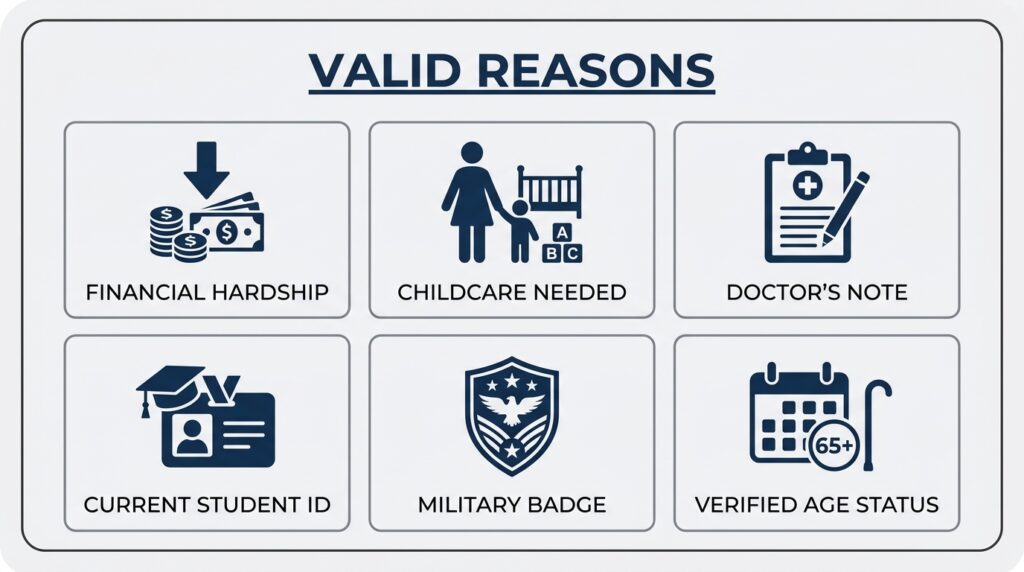
While every state has its own rulebook, certain reasons recur across the country. Courts generally recognize:
- Financial hardship you can document, such as being self-employed with no paid time off
- Being the primary caregiver for a child, elderly parent, or someone with a disability
- A medical condition, physical or mental, backed by a doctor’s note
- Full-time student status, especially during exams or a fixed academic schedule
- Recent jury service, usually within the past one to two years
- Active military duty
- Age, in states that allow older citizens to opt out, typically 70 and above
- No means of transportation or an unreasonable distance to the courthouse
None of these work automatically just because you check a box. You’ll typically need to submit your request in writing, along with documentation that backs up your reason, before the deadline printed on your summons. Courts across the country repeat the same warning: wanting to get out of jury duty isn’t a reason on its own; you need a documented circumstance behind it.
How to Get Out of Federal Jury Duty
Federal jury duty tends to be stricter than state court, and honestly, this surprised me when I first looked into it. Occupation-based excuses that were once common, such as being a teacher or a doctor, have largely disappeared from federal courts.
Under federal law, only a few groups are automatically exempt: active-duty members of the armed forces and National Guard, members of professional (not volunteer) fire and police departments, and full-time public officers of federal, state, or local government. Everyone else has to request an excuse for hardship, and it’s granted on a case-by-case basis.
A few federal-specific details worth knowing:
- Some districts also allow excusals for people over age 70, recent federal jurors, and volunteer firefighters or rescue squad members.
- Requests almost always need to come from you directly, not your employer. Federal courts have made clear that employer-submitted requests won’t be considered, since jury service is treated as a personal obligation.
- Medical excuses usually require a signed letter from a licensed physician stating that service would pose a real risk to your health; a general note asking to be excused generally isn’t enough.
You can read the official rules directly from the U.S. Courts’ jury service page, which every federal district follows in some form.
How to Get Out of Grand Jury Duty vs. Petit Jury Duty
These two terms confuse almost everyone, so let’s clear it up quickly.
A petit jury is the standard trial jury you picture, twelve people deciding a criminal or civil case. A grand jury is different: it doesn’t decide guilt; it decides whether there’s enough evidence for a case to go to trial at all, and it can meet for weeks or months at a time.
If you’re wondering how to get out of grand jury duty specifically, the same hardship and exemption rules apply, but the stakes are higher because the time commitment is longer. Courts tend to look closely at requests involving multi-week grand jury terms, since finding replacement jurors mid-term is more logistically challenging. Your best move here is to document a longer-term conflict, such as an ongoing medical treatment schedule or a semester of classes, rather than a single day’s inconvenience.
For petit jury service, the process is usually shorter, and the hardship threshold can be met more easily since trials often wrap up within days.
State-by-State: How to Get Out of Jury Duty Where You Live
Jury duty rules genuinely differ depending on where you’re summoned. Here’s a breakdown covering the states people ask about most.
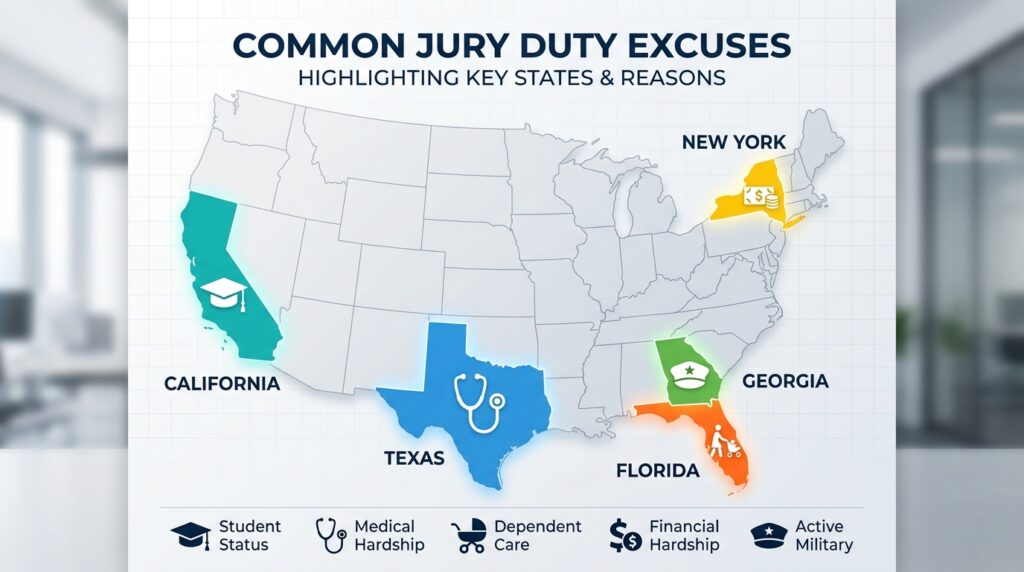
How to Get Out of Jury Duty in Texas?
Texas courts allow you to request an excuse if you’re actively caring for a child under ten with no other supervision available, over 70, caring for an elderly or infirm person, a full-time student, or a licensed, practicing physician. You can also be excused for a religious holiday conflict. For federal court in Texas, you can request an excuse if you’re over 70, serve as an uncompensated firefighter or rescue squad member, or served on a federal jury within the past two years.
How to Get Out of Jury Duty in Florida?
Anyone 70 or older can request excusal in writing, and it applies to any future summons as well. Florida also excuses expecting mothers and parents who aren’t working full-time and have custody of a child under six. Beyond that, hardship, extreme inconvenience, or public necessity are all valid grounds, and postponements can run up to six months from your original date.
How to Get Out of Jury Duty in California?
California doesn’t use a long list of automatic exemptions. Instead, the court excuses a person from jury service when it finds that serving would cause undue hardship. That covers no transportation or excessive commute, a physical or mental impairment, or caring for a dependent with no one else to cover. Most counties also let you request a straightforward postponement, and in Sacramento County, for example, service can be pushed back up to 90 days from your original summons date.
How to Get Out of Jury Duty in Georgia?
Georgia courts recognize hardship excuses for financial strain, medical conditions, and caregiving responsibilities, similar to most states, and jurors over 70 can typically request to be excused. Check your specific county clerk’s office for the exact form, since Georgia’s process is handled at the county level rather than statewide.
How to Get Out of Jury Duty in Oregon?
Oregon allows postponements for scheduling conflicts and excuses for documented hardship, medical issues, and caregiving duties. Oregon also has a “one strike” rule in many counties: if you already postponed once, you’ll usually need to serve on the next date unless you have a new, serious reason.
How to Get Out of Jury Duty in PA?
Pennsylvania counties generally follow the same undue hardship standard, and military service or student status are commonly accepted reasons.
How to Get Out of Jury Duty Philadelphia?
For jury duty in Philadelphia specifically, requests go through the First Judicial District, and documentation like a doctor’s note, pay stub, or class schedule is usually required before a request is even reviewed.
How to Get Out of Jury Duty in NY?
New York courts accept medical excuses when you provide a signed physician’s statement describing your condition and how long it’s expected to last. For federal jury duty in New York specifically, financial hardship claims need solid documentation. If you’re a freelancer who doesn’t get paid when you’re not working, that lost income needs to be documented and submitted with your exemption request.
How to Get Out of Jury Duty NYC?
Jury duty in NYC follows the same statewide rules but is administered borough by borough, so the exact form and contact office depend on which court sent your summons.
How to Get Out of Jury Duty in Illinois?
Illinois handles excusals at the county level. You can request an excuse for undue hardship, but whether it’s granted is up to your local county board, jury commission, or jury administrator, and sometimes the circuit chief judge must approve it first. If you’re only temporarily unable to serve, a deferment to a later month is usually the easier path.
More State Rules at a Glance?
Several other states people search for follow a similar hardship-based framework, with small local differences worth knowing before you file a request:
How to get out of jury duty Colorado?
Automatic exemptions for active military and certain public safety roles, plus discretionary hardship, medical, and caregiving excuses handled at the county level.
How to get out of jury duty Ohio?
Hardship and medical excuses are common, and a first postponement is usually granted with little pushback if requested early.
How to get out of jury duty NC?
Financial hardship, medical conditions, and full-time student status are standard accepted reasons, submitted through the local clerk of court.
How to get out of jury duty in Indiana?
Similar hardship standard, with county courts handling most requests directly.
How to get out of jury duty MN?
Hardship, medical, and caregiving excuses are accepted, and Minnesota courts generally allow one postponement without extensive proof.
How to get out of jury duty in Alabama?
Age, medical, and financial hardship excuses apply, processed through the circuit clerk’s office.
How to get out of jury duty in Kentucky?
Standard hardship and medical excuses, with paperwork submitted before the reporting date on your summons.
How to get out of jury duty in Tennessee?
Hardship, medical, and caregiving excuses are accepted, with most requests handled at the county level.
How to get out of jury duty Washington State?
Courts here are known for being fairly flexible with one-time postponements under the same undue hardship standard.
How to get out of jury duty Louisiana?
Financial hardship claims require documentation, as in most states, and are submitted through the parish court.
How to get out of jury duty Nevada?
Nevada courts, particularly in Clark County, tend to process excusal requests online through their juror portal.
How to Get Out of Jury Duty in Oklahoma?
Oklahoma allows excuses for age (typically 72 and older), medical hardship, and financial hardship, along with the standard exemptions for active military and certain public officials. Postponement requests are usually handled directly through the district court clerk listed on your summons.
How to Get Out of Jury Duty as a College Student
If you’re in school full-time, you’re in a stronger position than most people realize. Many states, including Texas and Pennsylvania, list full-time student status as an accepted reason for excusal or postponement. The key is proof: a current class schedule, a letter from your registrar, or a student ID showing full-time enrollment usually does the job.
One thing I’d genuinely recommend: don’t wait until the week of your summons to request this. Registrar offices can take a few days to issue an official letter, and missing the deadline on your summons can turn an easy student excusal into a much harder conversation with the court.
What Happens If You Just Ignore a Jury Summons
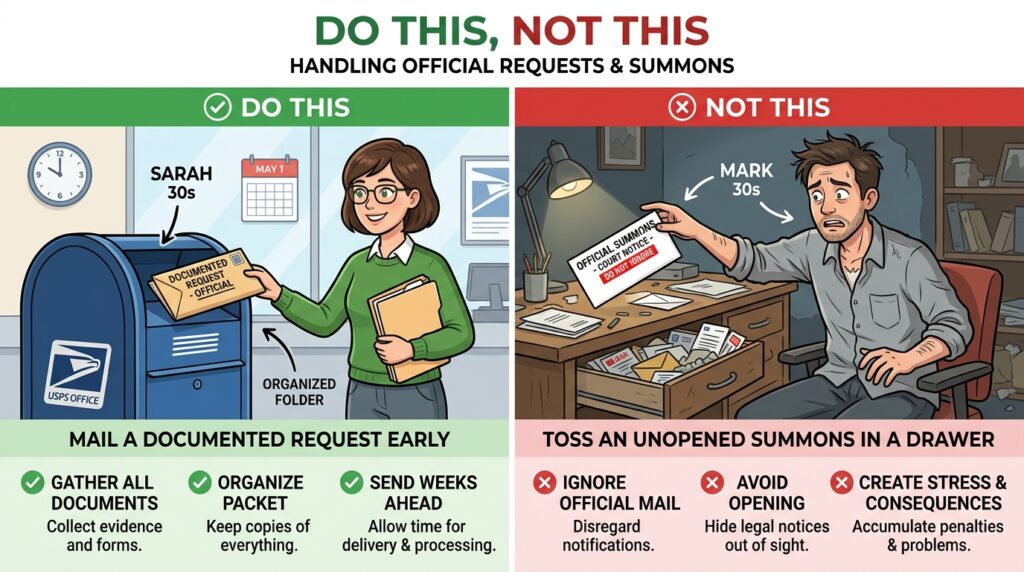
I want to be straightforward about this part because many articles gloss over it. Skipping your summons without requesting anything is genuinely one of the worst moves you can make. Failing to appear can lead to fines or other legal penalties, and in some counties, a judge can issue a contempt citation that follows you well beyond a simple missed day.
If a date genuinely doesn’t work, request a postponement instead of ignoring the letter entirely. Courts generally respond far better to clear, honest communication than to silence, and a postponement is almost always easier to get than forgiveness after the fact.
Smart, Ethical Approaches During Jury Selection
Some people search for ways to get out of jury duty, hoping there’s a way to be dismissed during voir dire, the jury selection process. I want to be clear here: lying to a judge to avoid service isn’t a strategy; it’s a legal risk, and courts take it seriously.
That said, honesty during voir dire naturally filters people out. If you genuinely have strong opinions that would make impartiality difficult, or a real conflict of interest with the case, attorneys and judges are trained to notice and typically excuse those jurors. The right approach is to answer questions truthfully, not to perform a role to get dismissed.
Can You Postpone Jury Duty More Than Once?
Sometimes one postponement isn’t enough; life doesn’t always cooperate with a single rescheduled date. The honest answer here is that it depends heavily on your court, and it’s worth knowing before you ask.
Most counties allow one postponement fairly easily, often without much explanation required. A second request usually needs a real, documented reason, not just general inconvenience. Some courts, particularly in Oregon and parts of Texas, apply what’s sometimes called a soft “one strike” approach, where a second postponement is only granted for a genuinely new circumstance that didn’t exist when you made your first request.
If you know you’ll need more flexibility, it helps to be upfront about that in your very first request rather than asking again later. For example, if you’re a full-time student with finals in one term and a health procedure scheduled the next, mentioning both circumstances at once, with documentation for each, is more effective than two separate last-minute requests.
Federal courts tend to be stricter about repeated postponements than state courts. If you’re dealing with federal jury duty and you’ve already used a postponement, your next request usually needs to shift toward a formal excusal request, with stronger documentation to back it up.
Pros and Cons of Trying to Get Excused
| Pros | Cons |
|---|---|
| Avoids lost income for hourly or self-employed workers | Courts may deny weak or undocumented requests |
| Reduces childcare or caregiving stress | Repeated postponement requests can look uncooperative |
| Legitimate hardship cases are usually approved quickly | Missing the request deadline can eliminate your options entirely |
| Keeps you compliant with the law, unlike ignoring the summons | Some excusals only apply to that specific summons, not future ones |
Expert Tips Before You Submit Your Request
- Read your actual summons first. Every court prints its specific process and deadline right on the form, and generic advice online won’t override your local court’s exact instructions.
- Request early. Courts process excusal and postponement requests in the order they arrive, and last-minute requests are far more likely to get rejected simply due to timing.
- Keep copies of everything. Whatever you submit, whether it’s a doctor’s note or a hardship letter, keep a dated copy for your own records.
- Call the clerk’s office if you’re unsure. A five-minute phone call can save you from submitting the wrong form entirely.
- Don’t confuse a summons for jury selection with an actual trial assignment. Receiving a summons only means you might be picked; most people who show up are never actually seated on a jury.
If your situation involves a more complex family circumstance, such as being a single parent seeking to document caregiving hardship, my family law section covers related topics that might help you craft a stronger, clearer request.
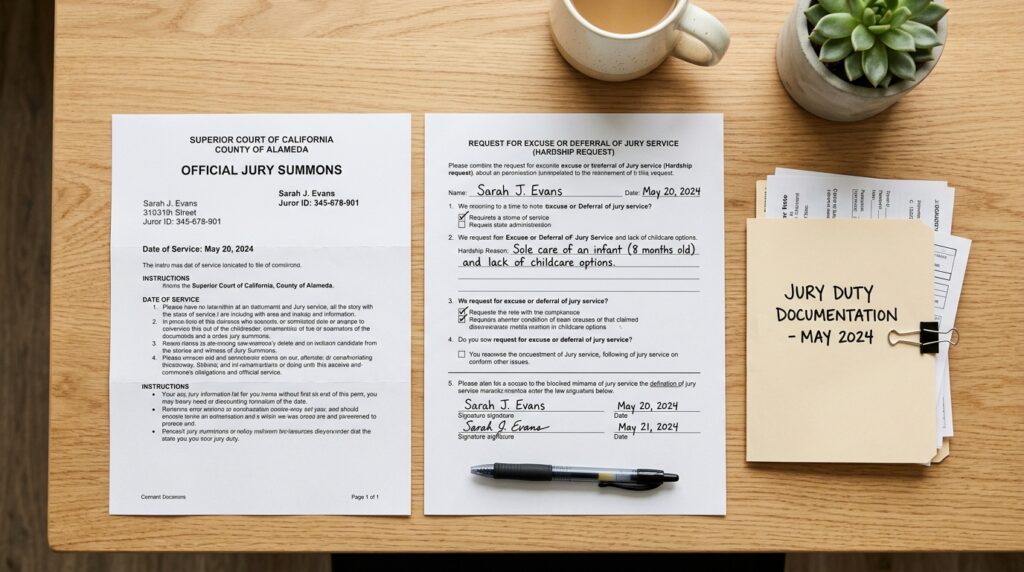
How to Write a Hardship Letter That Actually Works
A weak hardship letter is one of the biggest reasons requests get denied, and I’ve noticed most guides never actually show you what a strong one looks like. Courts read hundreds of these, so vague language like “I really can’t make it” rarely gets a second look. Specific, documented, and calm always beats emotional and general.
Here’s a simple structure that works across most states:
- State your summons details first. Include your juror ID number, reporting date, and county or district, right at the top.
- Name your reason clearly in one sentence. Say exactly which category you’re requesting under: financial hardship, medical condition, caregiving, or student status.
- Explain the specific impact. Instead of “it’s hard for me,” explain what actually happens. For example, a self-employed contractor might explain that missing work means missing an unpaid day with no substitute income, not just general inconvenience.
- Attach your documentation. A pay stub, doctor’s note, class schedule, or care recipient’s medical letter should be referenced directly in the letter, not just implied.
- Ask for a specific outcome. Say plainly whether you’re requesting a full excusal or a postponement, and if it’s a postponement, suggest a realistic future date.
- Sign and date it. Courts generally won’t consider unsigned or undated requests.
A short example of the tone that tends to work well:
“I am requesting a postponement of my jury service scheduled for [date] under Juror ID [number]. I am a self-employed [occupation] and do not receive paid leave. Serving on the original date would result in a complete loss of income for that period, as documented in the attached pay records. I am requesting a new date within the next 90 days that works with the court’s schedule.”
Notice that letter doesn’t ramble, doesn’t apologize excessively, and gets straight to the point with proof attached. That’s exactly what jury clerks are trained to look for.
Do Employers Have to Pay You for Jury Duty?
This question comes up constantly, and the honest answer is: it depends on where you live and who you work for. Employers aren’t required by federal law to pay employees during jury service, though many choose to as a matter of company policy. A handful of states do require some level of compensation for at least the first few days, so it’s worth checking your specific state’s labor rules or asking your HR department directly before assuming you’ll lose income entirely.
What every employer in the country does have to do, regardless of pay, is protect your job. Federal law makes it illegal for an employer to fire, threaten, or intimidate a permanent employee because of jury service, and real financial penalties can follow, including liability for lost wages and a civil penalty of up to $5,000 per violation. If you’re worried about your job security because of a summons, that protection is exactly why panicking and ignoring the letter is the wrong move; the law is already on your side.
Many state courts also pay a small daily juror fee, though it’s usually modest, often somewhere between fifteen and fifty dollars a day depending on the jurisdiction. It’s rarely enough to replace a full day’s wages, which is exactly why financial hardship remains one of the most commonly accepted excuses nationwide.
Common Mistakes People Make When Trying to Get Excused
After going through dozens of court procedures for this guide, a few patterns kept recurring. Avoiding these mistakes alone puts you ahead of most people who get denied.
- Waiting until the last minute. Courts process requests in order, and a request submitted the day before your reporting date is far more likely to be rejected simply due to timing, regardless of how valid your reason is.
- Submitting a vague reason with no documentation. “I’m busy” or “I have a lot going on” won’t get approved anywhere. Specificity and proof matter far more than how urgently something is worded.
- Assuming your employer can request on your behalf. In federal court especially, requests from an employer instead of the employee generally won’t even be considered.
- Confusing a one-time excusal with a permanent exemption. Some people assume being excused once means they’re off the list forever. Unless your reason falls under a permanent category, such as age or a lasting medical condition, you’ll likely be summoned again in a year or two.
- Ignoring the summons entirely because “no one will notice.” Court systems track responses, and a no-show is treated very differently from a documented request, even if both result in you not showing up that day.
Frequently Asked Questions
Can I get out of jury duty just because I don’t want to serve?
No. Courts need a documented reason, such as hardship, a medical condition, caregiving duties, or a recognized exemption. Simply not wanting to go isn’t accepted anywhere in the country.
What’s the easiest way to get out of jury duty?
For most people, requesting a one-time postponement is far easier than requesting a full excusal, since it doesn’t require proving long-term hardship, just a scheduling conflict.
Will I get in trouble if I ignore my jury summons?
Yes, potentially. Courts can issue fines or contempt penalties for a no-show. Always respond to your summons, even if you’re requesting to be excused.
Do I need a lawyer to request an excuse from jury duty?
No. Most excusal and postponement requests are handled directly with the court clerk or online juror portal, with no attorney required.
How long does a jury duty excuse typically last?
It depends on the reason and your state. Some excuses, like certain age exemptions, apply to every future summons. Others, like a one-time scheduling conflict, only cover that specific date.
Final Thoughts
Jury duty isn’t going away, and honestly, it shouldn’t, since the whole system depends on regular people showing up. But if your situation is genuinely difficult right now, you have real, legal paths available, and now you know exactly what they are. My honest recommendation: read your summons carefully, decide whether you need a postponement or a true excusal, gather your documentation early, and submit your request well before the deadline. That one step alone solves most of the problems people run into.
If you found this useful, take a look through more of the practical legal guides on The Law Learner, where I break down everyday legal questions like this one in plain, simple language.
Also Read: How Much Does It Cost to Change Your Name in 2026?
