


What is one way a command economy affects the lives of private citizens?
If you are asking what is one way a command economy affects the lives of private citizens, the clearest answer is that it limits how much people can make their own economic decisions. Instead of families, workers, and business owners deciding what to buy, sell, produce, or invest in, a central authority makes many of these decisions through its planning system.
That answer is accurate, but it can feel too short to be useful. A real command economy affects more than a classroom definition because it can shape what is on the shelf, which jobs are available, how much a product costs, whether someone can expand a private business, and how scarce goods are shared.
The most useful way to understand the topic is to follow one ordinary decision from beginning to end. Ask who decides what gets made, who receives it, what it costs, and whether a private citizen can choose a different option; that simple method turns an abstract economics question into everyday life.
Quick answer: One way a command economy affects private citizens is by limiting personal economic choice. The government or central planning body can decide major matters such as production, prices, employment priorities, resource allocation, and the scope for private business.
The direct answer: personal economic choice becomes limited
A command economy is an economic system in which major economic choices are made through central direction rather than mainly through voluntary exchange in open markets. A widely used economic definition describes it as a system in which economic decisions are made by government authority and productive resources are publicly controlled.
For private citizens, the key word is not simply government. Every modern society has laws, taxes, public schools, safety rules, and government services, but those facts alone do not create a command economy. The defining difference is how far central planners control the core questions of production and distribution: what will be produced, how much, by whom, for whom, and at what official price.
In a strongly planned system, a family may still choose small things, such as how to prepare a meal or which day to visit relatives. However, their range of meaningful economic choices can narrow because the larger menu of possibilities has already been shaped by a plan rather than by competing suppliers responding to individual demand.

Follow the decision, not the slogan
The phrase “command economy” is often used as a political shorthand, making it easy to overlook the actual mechanism. My recommendation is to set the labels aside for a moment and trace the decisions that reach a household, because that reveals the practical effect much more clearly.
Historically, detailed centrally planned systems often involved official production targets, controlled inputs, administered prices, closely regulated wage structures, and state direction of trade. A concise explanation of this model shows how central control over production, prices, and distribution changes the main feedback loop: suppliers answer to a plan rather than mostly to separate consumer choices.
| Economic decision | Who mainly decides in a command economy? | Everyday effect on a private citizen |
|---|---|---|
| What factories and farms produce | Central planners set priorities and output targets. | The person may find fewer versions of a product, or none at all, when the plan prioritizes elsewhere. |
| How scarce inputs are used | Public authorities allocate labor, materials, energy, and finance. | A local repair shop, builder, or small producer may be unable to obtain the inputs needed to respond to demand. |
| Prices of key goods and services | Authorities may set or tightly control official prices. | A low price can help affordability, but it does not guarantee that the product is available when the person needs it. |
| Jobs and pay structures | State bodies or state-owned employers set many employment priorities and wage rules. | Career options, pay differences, and the ability to move into another line of work may be narrower. |
| Distribution of goods | Administrative rules, priority groups, waiting lists, or rationing may guide access. | Time, connections, paperwork, or eligibility can matter alongside money. |
| Private enterprise | The state can restrict ownership, scale, licensing, credit, or permitted sectors. | It may be harder to open, grow, or freely price a private business. |
This framework explains why people can experience the same formal price in very different ways. One person may receive an item because their workplace is prioritized, while another may need to wait, travel, use a coupon, or go without it.
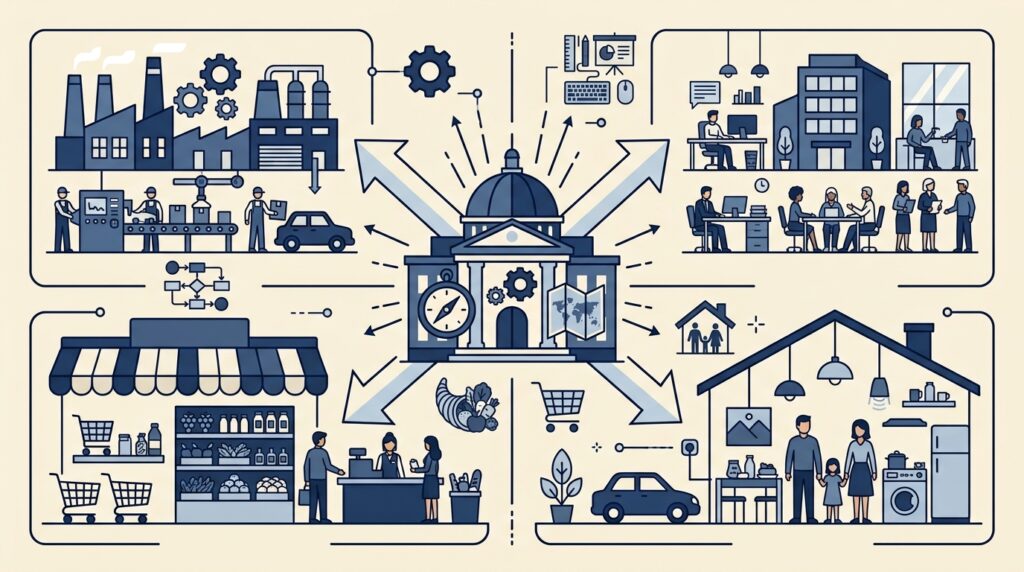
How a command economy changes an ordinary day
Imagine an ordinary weekday without attaching it to a particular place or period. A household needs breakfast food, transportation, work, an appliance repair, and perhaps a plan to save for a future goal; in a market-led setting, many suppliers compete for those needs, whereas in a command system, those options can be shaped much earlier by official decisions.
That does not mean every day is chaotic or every planned system produces the same outcome. It means that a citizen’s choices depend more heavily on administrative priorities, published quotas, workplace allocation, and public distribution rules than on a large field of independent sellers responding to demand.
Shopping: availability can matter more than the price tag
In a market, a higher price often signals that something is scarce, and suppliers may see an incentive to produce more, or new sellers may enter. In a command economy, an official price can remain low even when demand exceeds supply, which may make an item appear affordable on paper while it remains difficult to obtain in practice.
This is why economists distinguish between a price and access. A person does not truly benefit from a low official price if the product is unavailable, restricted to a priority group, or requires hours of waiting that the household cannot spare.
The hidden cost can become time. A queue, repeated trips to a shop, forms, registration, or informal swapping can become part of the effort needed to obtain a basic item, even though none of those costs appear on the official receipt.

Work: the plan can influence a career path
Employment can be one of the most personal effects of economic planning because work determines income, routine, skills, and future opportunities. If the central plan favors heavy industry, public construction, agriculture, defense, energy, or a particular service, education places and job openings may follow those priorities rather than the changing preferences of individual workers and consumers.
This can create predictable employment in sectors the state considers essential. At the same time, a person who wants to change careers, negotiate a new wage, or work for a competing employer may have fewer options available in states where major employers and resource decisions are state-controlled.

Saving, repairing, and starting something small
Economic freedom also involves a person’s ability to obtain credit, rent space, buy materials, hire help, and set a sustainable price. In a command economy, these steps may require official approval or be limited to permitted sectors, so talent alone may not be enough to turn a local idea into income.
Limited choice has four different meanings
Many short articles stop at the phrase “limited consumer choice.” That is true, but it leaves out the four different ways choice can shrink, and separating them makes the explanation far more accurate.
The first is availability: is the product or service physically there? The second is variety: if it is there, can the person choose among quality levels, designs, sizes, suppliers, or alternatives; the third is permission: is the person legally allowed to buy, sell, own, import, or provide it; and the fourth is voice: can a buyer’s preferences encourage a supplier to change future production?
| Type of choice | The practical question | What can change under central planning |
| Availability | “Can I get it at all?” | Supply can depend on quotas, distribution rules, and priority sectors. |
| Variety | “Can I choose the version that fits my needs?” | A plan may provide a single standard option rather than many competing ones. |
| Permission | “Am I allowed to buy, sell, own, or offer this?” | Rules can limit private trade, private ownership, imports, prices, or business activity. |
| Voice | “Will my preference change what is produced next?” | Individual demand may carry less direct weight than plan targets and official priorities. |
A household might have access to a basic product and still lack meaningful choice if the only version is unreliable, poorly suited to a disability, unavailable at the time needed, or distributed only through an employer or an official category. Economic choice is not merely about luxury brands; it can be about whether a parent can find the right medicine container or a repair worker can obtain a spare part.
Jobs, wages, and the promise of security
A balanced explanation should recognize why central planning has appealed to some policymakers and citizens. A government that controls major firms and investment can direct resources toward public infrastructure, universal services, strategic industries, or employment stability without waiting for private investors to see a profit opportunity.
For a private citizen, that can mean a more predictable job path or lower-cost access to a service the state chooses to prioritize. Historically planned systems were often associated with stable staple prices, housing support, relatively equal wage structures, full employment, and job security, although the real experience varied widely by time and place.
The trade-off is that a guarantee can come with less personal control. If wage bands, hiring, promotion, training places, housing assignments, or work locations are governed by an administrative plan, a citizen may gain certainty in one area but lose flexibility to negotiate, move, or pursue an opportunity outside the plan.
Potential benefits when a plan works as intended
- A central authority can direct scarce resources toward essentials, emergency rebuilding, public transport, education, housing, or health services. This can help when rapid coordination is needed, and private incentives alone are not meeting a basic need.
- State employment policies can reduce the fear of sudden unemployment in chosen sectors. For a family on a tight budget, predictability may matter as much as the chance of earning more.
- Controlled prices and subsidies can make selected goods appear affordable. The key question is whether supply, quality, and access keep pace with that promise.
Risks that private citizens may feel directly
- A person’s wage may be tied more closely to an official category than to demand for their skills. This can weaken the incentive to improve a product or service.
- The most attractive jobs, homes, or goods can become linked to priority status, an employer, an application process, or personal connections. When money cannot clear a shortage, another method decides who receives the limited item.
- A citizen may have less ability to switch from an ineffective supplier to a better one. Without competitors, complaints may have less influence on quality, service, and innovation.

Private business, property, and innovation
Private ownership is central to this discussion because ownership gives people the right to decide how a resource is used, within the law. When a state owns or directs most factories, land, banks, wholesalers, and large retailers, a private citizen has less room to decide what to produce, where to invest, which supplier to use, or how to respond to a customer’s idea.
That does not mean every planned economy bans every private activity. Real systems can be mixed, transitional, or inconsistent, and small informal or permitted private activity may exist even when the government controls the commanding heights of the economy; this is why it is more accurate to describe the degree of command rather than treating every country as a pure textbook model.
The practical test is simple: can someone notice a local need, gather resources, set a reasonable price, hire people, and expand if customers value the service? The more each step depends on central approval, allocation, or a state monopoly, the more the person’s economic life is being shaped by command rather than voluntary exchange.
Innovation also changes under this structure. A planner can mobilize resources for a shared goal, but independent experimentation can be slower when creators cannot easily raise funds, test a new idea, choose suppliers, or secure a clear share of the benefits of improvement.
Prices, rationing, queues, and informal markets
Prices do more than tell a customer what to pay. They also send information about scarcity and demand, and they create an incentive for producers to make more of something when people value it enough to buy it; when central planners replace many market prices with official ones, they must gather and process that information in another way.
That task is extremely difficult at the level of millions of products, parts, skills, locations, and changing household needs. A basic supply-and-demand explanation of shortages shows why a fixed price can create excess demand when people want more than is available.
An official price can protect a household from a sudden increase, which is a real benefit when supply is reliable. Yet if authorities set the price below the level at which demand and supply would meet, people may compete through waiting, eligibility, repeat visits, relationships, or informal exchange rather than through a higher posted price.
This is sometimes described as a non-money price. A parent may pay the same official amount as everyone else, but the parent who can leave work for three hours, travel to several shops, or use a workplace network has a different chance of success than someone who cannot.
Economic history also shows why price control alone is not a complete consumer policy. When fixed prices and output targets lead to shortages or surpluses, a fair assessment must consider availability, quality, distribution, and timing, as well as the label on the shelf.

A fair view of advantages, costs, and trade-offs
It is tempting to describe command economies as either fair systems that guarantee essentials or systems that remove all freedom. Neither shortcut is good economics because every system must solve scarcity and every system involves trade-offs.
Central planning can help with a narrow, urgent task, such as coordinating an emergency response or building a network that private firms would underprovide. Problems deepen when a single institution tries to make day-to-day choices for millions of households without the flexible feedback from prices, competition, and private initiative.
| Potential strength | Possible cost for private citizens | The question a careful reader should ask |
| Coordinated investment in a chosen priority | Other needs may receive too little investment. | Who decides the priority, and can citizens signal a different need? |
| Stable official prices for selected essentials | Low prices can coexist with low availability or poor quality. | Is the good reliably accessible, not merely cheap on paper? |
| Greater equality in some wages or benefits | Individual effort, skill scarcity, and new ideas may be rewarded less directly. | Does the system still encourage learning, effort, and useful improvement? |
| Employment security in public sectors | Job choices and geographic mobility can be more limited. | Can someone realistically move into work that fits their skills and goals? |
| Faster execution of a central project | Errors can be widespread when the same plan is wrong. | Is there independent feedback, correction, and accountability? |
The most honest conclusion is not that one system makes every citizen happy or unhappy. It is that a command economy shifts power over major economic decisions away from private citizens and toward central planners, which can provide coordination and security in selected areas while reducing consumer choice, entrepreneurial freedom, and responsiveness to individual preferences.
Command, market, and mixed systems: the fastest comparison
Most real economies are mixed rather than purely command-based or purely market-based. A mixed system may use private ownership and supply-and-demand pricing in many areas while also funding public services, regulating safety, subsidizing key goods, or setting rules for environmental and labor protection.
The key is the degree of control over the central economic decisions. A useful reference point is whether a citizen can make a choice, whether a competing supplier can respond, and whether prices and investment are mostly set through voluntary exchange or through an official plan.
| Feature | Command economy | Market economy | Mixed economy |
| Major production decisions | Mostly directed by a central authority. | Mostly shaped by private firms and consumer demand. | Shared between markets and public policy. |
| Prices | Often administered or controlled for key goods. | Mostly shaped by supply and demand. | Some prices are market-based while others are regulated or subsidized. |
| Private business | Restricted, limited, or subordinated to the plan. | Broadly permitted within laws and competition rules. | Permitted, but subject to public rules and public-sector activity. |
| Consumer choice | Can be limited by supply plans, rationing, and restrictions. | Usually broader, though income limits what a person can afford. | Varies by sector, income, and regulation. |
| Main feedback system | Reports, targets, administrative decisions, and allocations. | Prices, profit and loss, consumer demand, and competition. | A mixture of market feedback and policy goals. |
This comparison also keeps legal questions separate from economic-system questions. Government power can be broad or narrow depending on the legal structure, and how legal authority limits government power is a helpful next read if you want to understand why an official action still needs a lawful source of authority.
Likewise, an economic system is not the same thing as every civic obligation a person has. A topic such as when and how to respond to jury duty is governed by court procedure and legal rules, while this article is about who makes core economic decisions and how those decisions shape private life.
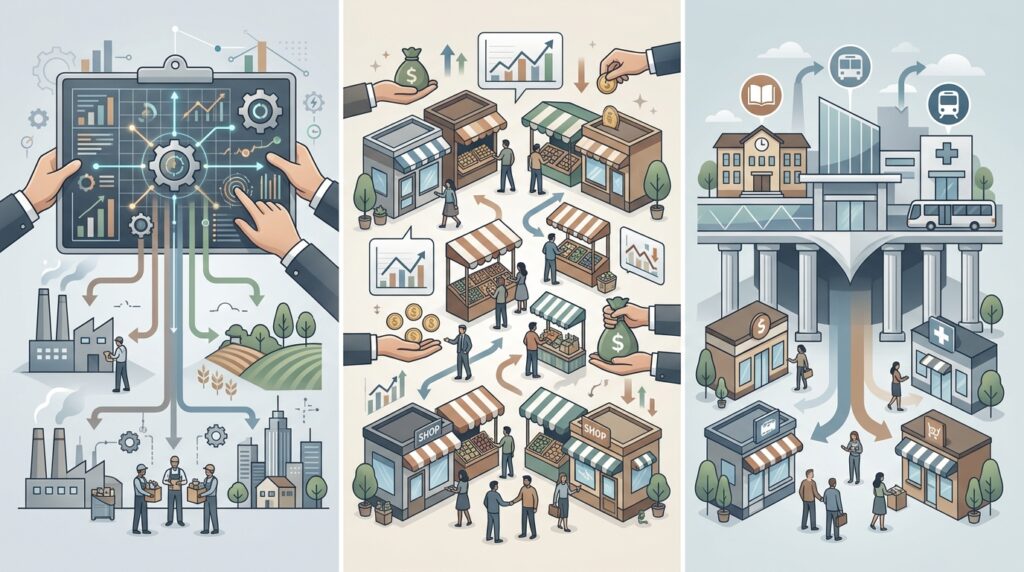
How to answer the question in a test or conversation
For a short-answer question, do not overcomplicate it. Start with the direct effect on private citizens, then add one concrete example to show the reader you understand the mechanism behind the definition.
Here is a strong two-sentence answer you can adapt: “One way a command economy affects private citizens is by limiting their ability to make major economic decisions. The government may decide what goods are produced, what they cost, and which jobs or private businesses are available, so people have less choice as consumers and entrepreneurs.”
For a longer answer, add the difference between price and availability. You could explain that a controlled price may make a good appear cheap, but if the plan does not produce enough, citizens may face waiting lists, rationing, or fewer alternatives.
Common weak answers and how to improve them
- “The government controls everything” is too broad and does not explain the citizen’s real experience. Improve it by naming a decision area, such as pricing, jobs, production, distribution, or private enterprise.
- The statement “People cannot buy anything they want” can be inaccurate because individuals may still make certain household purchases. Improve it by saying that people have less influence over the major choices that determine what is available and which options exist.
- “Low prices mean citizens benefit” misses the important issue of supply. Improve it by asking whether goods are actually accessible, reliable, and available in the right quantity and quality.
- “All government regulation is a command economy” confuses a mixed system with central planning. Improve it by focusing on who makes the core production and allocation decisions across the economy.
My practical rule is this: answer the question with one cause and one lived effect. Central planning is the cause, while narrower consumer choice, restricted business opportunity, administrative job allocation, or rationed access is the lived effect.
Choosing a study resource that actually helps
This topic often appears in school assignments, exam banks, tutoring sessions, and introductory economics courses. If you are comparing a study guide, course, or tutor, choose one that explains the reasoning instead of giving only a memorized sentence.
A worthwhile resource should define the system, distinguish it from ordinary regulation, explain the trade-offs, and show how a policy reaches households. It should identify sources because historical examples are complex and oversimplified comparisons confuse learners.
- Look for a resource that asks who makes the “what, how, and for whom” decisions. This framework works across many economics questions, not only this one.
- Prefer sources that distinguish price from availability and income from access. That distinction produces a stronger answer than a generic definition.
- Avoid answer pages that only repeat a multiple-choice option. They may show expected wording, but they rarely teach you how to apply the idea to a new scenario.
A useful historical perspective also matters. A data guide to historically planned economies can help a learner see why definitions and classifications need context, while a broader account of economic transition and expanded private opportunity shows how changes in ownership, competition, and incentives can alter daily economic life over time.
Expert tips for understanding the topic accurately
Avoid absolute language. Say “can limit,” “often involves,” or “in a strongly planned system” unless you are describing a verified policy, because historical command economies did not all operate in the same way.
Separate intention from outcome. A plan may aim to provide cheap essentials, equalize access, build infrastructure, or secure employment, but the real question is whether it provides enough quality, variety, access, and opportunity to meet changing needs.
Treat time and paperwork as economic costs. If citizens must wait, travel, register, prove eligibility, return repeatedly, or rely on personal connections, those barriers matter even when the cash price is low.
Frequently asked questions
What is one way a command economy affects the lives of private citizens?
It can limit citizens’ ability to make major economic decisions for themselves. When a central authority directs production, prices, jobs, and distribution, people have less control over the choices available to them as consumers, workers, and business owners.
Does a command economy mean citizens have no choices at all?
No, private citizens may still make many personal and household choices. The difference is that the major economic framework, including what is produced, which firms operate, how key goods are distributed, and how many prices are set, is more likely to be decided centrally.
Why can low prices be a problem in a command economy?
Low prices are not automatically a problem and can protect household budgets when supply is sufficient. The difficulty arises when the official price encourages demand beyond what the planned supply can meet, because citizens may then pay by waiting, rationing, reduced quality, or limited availability instead of paying a higher cash price.
Is a command economy the same as government regulation?
No, regulation can exist in a market or mixed economy without removing private ownership and market choice. A command economy involves much deeper central control over core production, allocation, and pricing decisions across the economy.
How does a command economy affect someone who wants to start a business?
It can limit which businesses are permitted, where supplies come from, whether credit is available, how much can be produced, and what price can be charged. The degree of restriction varies, but the entrepreneur usually has less independence than in a system where private firms can freely enter most legal markets and respond to customers.
Final takeaway: connect the system to a real person
The best answer to what is one way a command economy affects the lives of private citizens? is not just “the government makes decisions.” It is that central planning can reduce a person’s power to choose what to buy, what career to pursue, how to run a business, and how to respond when a needed good is scarce.
When you see the topic again, use the decision test: who decides what gets made, how much is available, what it costs, and who receives it? If the answer is mainly a central authority rather than private citizens and competing firms, you are looking at the practical effect of a command economy.
If you want a clearer foundation for related questions about public power, individual rights, and how rules shape everyday life, continue with the linked legal guides above and keep using source-based explanations rather than one-line answer pages. That habit will help you write answers that are both clearer and more accurate.
