


What Is Sexual Battery? Meaning, Laws, and Examples
If you are asking what is sexual battery, the safest short answer is that it is a sexual offense involving intentional and unlawful sexual contact without valid consent. However, that is only a general explanation. The precise conduct covered by the term depends on the law of the state where the alleged incident occurred.
In some states, sexual battery primarily means unwanted touching of intimate body parts, including touching through clothing. In others, the same term covers nonconsensual penetration and conduct that another state might call rape, sexual assault, sexual abuse, or criminal sexual contact.
This distinction is important because the offense’s legal elements, classification, penalties, reporting deadlines, and possible defenses can change substantially between jurisdictions. Always check the current statute and speak to a qualified attorney about a specific incident.
Legal disclaimer: This article provides general educational information and is not legal advice. Sexual-offense laws change and vary by jurisdiction. Anyone dealing with an allegation, investigation, safety concern, or possible criminal charge should obtain advice from a licensed local attorney.
What Is Sexual Battery Meaning in Plain Language?
The phrase generally refers to intentional sexual touching or contact that occurs without the other person’s legally valid consent. The contact may involve intimate body parts, take place over or under clothing, or cause one person to touch another, depending on the applicable statute.
The broader concept fits within the Centers for Disease Control and Prevention’s explanation of sexual violence as sexual activity without freely given consent. Sexual violence can affect people of any sex, gender, age, relationship status, or sexual orientation.
In everyday language, sexual battery may describe conduct such as:
- Intentionally touching someone’s genitals, breasts, buttocks, groin, anus, or another legally defined intimate area without consent
- Touching intimate areas through clothing when the relevant law includes clothed contact
- Making another person touch the offender or a third person
- Sexual touching while a person is asleep, unconscious, unaware, or legally unable to consent
- Sexual contact obtained through force, threats, restraint, coercion, or certain forms of deception
- Nonconsensual penetration in states that use “sexual battery” as the statutory term for that conduct
These are general examples, not a universal list of criminal elements. Conduct called sexual battery in one jurisdiction might be prosecuted under a differently named offense somewhere else.

Why the Legal Definition Changes by State
There is no single state-law definition that applies everywhere. Legislatures use different offense names and divide unwanted touching, penetration, coercion, age-related offenses, and aggravated conduct in different ways.
The variations are not minor wording differences. They can change what the prosecution must prove and whether the alleged conduct is classified as a misdemeanor, felony, or differently named sexual offense.
California: Sexual Touching Against a Person’s Will
California Penal Code section 243.4 covers touching an intimate part against the person’s will for sexual arousal, gratification, or abuse. Different parts of the statute address circumstances such as unlawful restraint, medical incapacitation, institutionalization, fraudulent claims of a professional purpose, and causing another person to engage in intimate touching.
The statute also includes a misdemeanor form of sexual battery. More serious circumstances can lead to felony treatment, but the exact subdivision and alleged facts control the charge.
Florida: Sexual Battery Includes Penetration or Union
Florida uses the term much more broadly and differently. Under the current Florida sexual-battery statute, sexual battery includes specified forms of oral, anal, or genital penetration or union, including certain penetration by an object.
The statute defines consent as intelligent, knowing, and voluntary agreement rather than coerced submission. It also expressly states that a person’s failure to resist physically does not establish consent.
Louisiana: Contact Can Occur Through Clothing
The Louisiana sexual-battery statute includes intentional touching of specified intimate areas, directly or through clothing, when statutory circumstances such as lack of consent are present. It also addresses causing the victim to touch the offender.
This is closer to what many people mean when they use the phrase to describe unwanted sexual touching. Even so, the exact body areas, required circumstances, exceptions, and penalty provisions come from the statute rather than the ordinary meaning of the words.
Federal Law Uses Different Terminology
Federal law generally uses terms such as “sexual abuse” and “abusive sexual contact” instead of creating one universal sexual-battery offense. For example, 18 U.S.C. § 2244 covers specified sexual contact in federal jurisdictions and includes sexual contact without the other person’s permission in certain circumstances.
That federal provision does not replace state criminal law. Which law applies can depend on where the conduct allegedly occurred, the people involved, and whether federal jurisdiction exists.
The legal definition and possible charge can change considerably between jurisdictions. See our detailed state-by-state comparison of sexual battery laws to understand how different states classify the conduct.
| Jurisdictional example | Conduct emphasized | Important distinction |
|---|---|---|
| California | Unwanted intimate touching for a specified sexual purpose | Can include touching through clothing |
| Florida | Defined forms of penetration or union | Covers conduct commonly described as rape elsewhere |
| Louisiana | Intentional contact involving specified intimate areas | May include direct or clothed contact |
| Federal jurisdiction | Sexual abuse or abusive sexual contact | Usually uses different offense names |

What Must the Prosecution Usually Prove?
Every element of a criminal offense must be proven beyond a reasonable doubt. The required elements must come from the exact charging statute, so a generic online definition cannot determine whether a particular crime occurred.
Depending on the jurisdiction, the prosecution may need to establish some combination of the following:
Intentional Contact
The alleged touching generally must be knowing or intentional rather than accidental. Some statutes also require proof that the touching occurred for sexual arousal, sexual gratification, sexual abuse, humiliation, or another specified purpose.
Intent may be evaluated through the alleged conduct, surrounding circumstances, communications, witness accounts, and other admissible evidence. A court does not necessarily require a person to state their intent aloud.
Contact With a Legally Defined Area
Some laws list the genitals, anus, groin, buttocks, breasts, or inner thighs as intimate parts. Other statutes use narrower or broader definitions, and some include contact through clothing.
In jurisdictions where sexual battery refers to penetration, the prosecution must instead prove the form of sexual conduct identified in that statute. Even slight penetration may be sufficient under some laws, while others use different terminology or elements.
Lack of Consent or Inability to Consent
The prosecution may need to show that the contact occurred against the person’s will, without permission, or without valid consent. In other cases, the law focuses on circumstances that make consent legally impossible or invalid.
Such circumstances may include:
- Being asleep or unconscious
- Being physically unable to communicate unwillingness
- Severe intoxication or drug-related incapacitation
- A qualifying cognitive or mental incapacity
- Being below the legal age of consent
- Force, threats, coercion, or unlawful restraint
- Abuse of certain professional or custodial positions
- Deception about a medical or professional purpose
The precise legal threshold for incapacitation, coercion, and age-based offenses varies. It should not be assumed from social-media explanations or general consent slogans.
A Required Sexual or Abusive Purpose
Some statutes require a specific purpose, such as sexual arousal, gratification, or abuse. Other statutes define the prohibited act without requiring that particular form of motive.
This difference can be critical in cases involving medical examinations, caregiving, sports, accidental contact, or other situations where physical touching can have a lawful nonsexual explanation. Many statutes expressly protect legitimate medical or sanitary care while still criminalizing fraudulent or abusive conduct.
What Does Consent Mean?
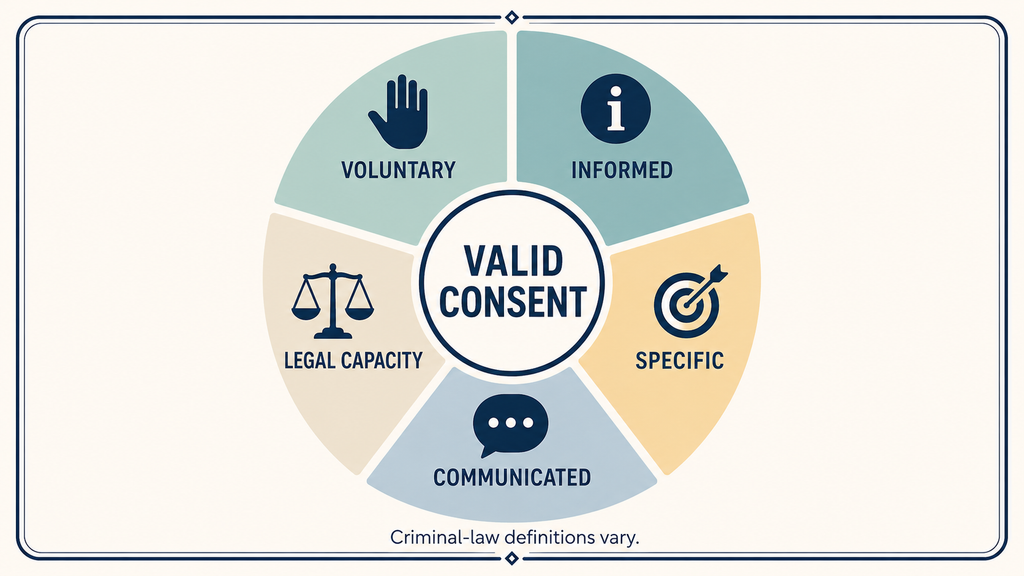
Consent is a voluntary agreement to participate in a particular activity. The CDC explains that sexual violence occurs when consent is not obtained or freely given, but criminal statutes may use more detailed or different wording.
Valid consent generally cannot be inferred merely from:
- Silence
- Freezing or failing to resist physically
- A current or previous relationship
- Prior consensual activity
- Flirting, clothing, or social behavior
- Consent to a different sexual act
- Compliance caused by force, threats, fear, or coercion
A person may also lack legal capacity to consent because of age, unconsciousness, physical helplessness, or a qualifying mental or substance-related incapacity. The Legal Information Institute’s discussion of consent explains that duress, fear, coercion, impairment, disability, and age can affect whether legally valid consent exists.
Consent to one form of contact does not automatically establish consent to everything that follows. However, the wording and proof requirements of a criminal case still depend on the applicable law and evidence.
Sexual Battery vs. Sexual Assault, Rape and Battery
These terms overlap, but they are not interchangeable in every legal system. Their everyday meanings may also differ from their statutory definitions.
| Term | General meaning | Important limitation |
|---|---|---|
| Sexual battery | Unlawful sexual contact, touching, or specified penetration | Exact meaning depends on state law |
| Sexual assault | Broad description for nonconsensual sexual conduct | May be an umbrella term or a specific charge |
| Rape | Commonly associated with nonconsensual penetration | Some states use another statutory name |
| Battery | Intentional harmful or offensive physical contact without consent | Does not necessarily have a sexual element |
| Abusive sexual contact | Term used in federal law and some other legal systems | Applies only where that law has jurisdiction |
Ordinary battery generally involves intentional harmful or offensive contact without consent, according to the Legal Information Institute’s battery definition. Adding a sexual element can create a separate offense, but the statute may require additional proof concerning the body area, purpose, consent, or circumstances.
The word “assault” can also be confusing. In traditional legal terminology, assault may involve placing someone in reasonable fear of imminent harmful contact, while battery involves the contact itself. Many modern sexual-offense statutes do not follow that simple distinction.
Examples of Conduct That May Qualify
The following examples may constitute sexual battery or another sexual offense, depending on the jurisdiction and evidence:
- A person intentionally grabs another person’s intimate area through clothing without permission.
- Someone restrains another person and touches an intimate body part for sexual gratification.
- A person makes someone else touch the offender’s genitals against that person’s will.
- Someone engages in sexual touching while the other person is asleep or unaware.
- A professional falsely claims that intimate touching has a legitimate medical purpose.
- A person engages in prohibited sexual contact with someone legally incapable of consent.
- Nonconsensual penetration occurs in a state that labels such conduct sexual battery.
An accidental touch in a crowded place would not normally satisfy a statute requiring intentional contact and sexual purpose. A legitimate examination conducted with valid consent may also be excluded, although professional boundaries and informed consent still matter.
Is Sexual Battery a Misdemeanor or Felony?
It can be either, depending on the jurisdiction and circumstances. Some states classify basic unwanted intimate touching as a misdemeanor while treating aggravated forms as felonies, but other states classify sexual battery as a felony from the outset.
Factors that may increase the seriousness of the charge include:
- Penetration
- Use or threatened use of force
- Unlawful restraint
- Use of a weapon
- Serious physical injury
- The alleged victim’s age
- Physical or mental incapacity
- Drug-facilitated conduct
- Abuse of a custodial, professional, or authority position
- Prior qualifying convictions
- Multiple alleged offenders
- Commission of another offense during the incident
Potential consequences can include incarceration, probation, fines, protective orders, restrictions on contact, employment consequences, immigration consequences, and sex-offender registration. None of these consequences should be assumed without reviewing the exact charge, classification, conviction, and local law.
Criminal Charges and Civil Claims Are Different
A criminal case is brought by the government and seeks penalties for an alleged offense. The prosecution must prove every element beyond a reasonable doubt, and the accused person has constitutional rights that include due process and the presumption of innocence.
A civil case is brought by the person seeking compensation or another civil remedy. The legal claim might be called battery, sexual battery, assault, intentional infliction of emotional distress, negligence, or another cause of action, depending on the jurisdiction and facts.
The Legal Information Institute explains that a tort is a civil wrong that causes injury or harm for which a court may impose liability. Civil standards of proof, deadlines, damages, privileges, and procedural rules differ from criminal proceedings.
A civil claim may sometimes proceed even when no criminal charge is filed. That does not mean the two systems reach identical findings or apply the same legal standards.
What to Do After a Possible Sexual Battery
If you may have experienced sexual battery, your immediate safety and medical needs come first. You do not need to determine the correct legal name of the offense before seeking help.
1. Move to a Safer Place
If there is an immediate threat, contact emergency services or go somewhere the other person cannot reach you. A trusted friend, relative, advocate, medical professional, or shelter may help you consider immediate safety options.
2. Consider Medical Attention
A healthcare professional can assess injuries, discuss pregnancy prevention and testing or treatment for sexually transmitted infections, and provide referrals. Medical help can still be valuable when there are no visible injuries.
The Department of Justice explains that a sexual assault medical forensic examination may include a medical history, complete examination, injury care, documentation, evidence collection, and information about related health needs.
3. Preserve Options When Possible
If you might want a forensic examination, avoid washing, bathing, changing clothes, brushing your teeth, or cleaning the location when safely possible. Place changed clothing in separate paper bags rather than plastic, and preserve messages, call records, photographs, location data, and social-media communications.
Do not let concerns about lost evidence prevent you from obtaining care. An examination may still be useful after bathing, changing clothes, eating, or waiting, and evidence-collection timeframes vary.
4. Contact a Confidential Advocate
RAINN’s National Sexual Assault Hotline provides confidential support around the clock by phone, text, and online chat. An advocate can help locate appropriate medical care and explain local reporting and support options.
5. Decide Whether to Report
Reporting choices and procedures vary. Someone in immediate danger can contact emergency services, while non-emergency reports may be made through local law enforcement or with help from a hospital or advocate.
Mandatory-reporting rules may apply in cases involving children, vulnerable adults, or certain professional relationships. An advocate or attorney can explain confidentiality and reporting rules before sensitive details are disclosed.

What to Do If You Are Accused
A sexual-battery accusation can lead to an investigation, arrest, protective order, employment action, school proceeding, or criminal prosecution. Do not assume that explaining the situation informally will prevent those consequences.
I recommend taking the following general steps:
- Contact a criminal-defense attorney licensed in the relevant jurisdiction.
- Do not discuss the accusation with police without understanding your rights and obtaining legal advice.
- Follow all court orders, no-contact instructions, bail conditions, and institutional rules.
- Do not contact the complainant directly or through friends, relatives, or social media.
- Preserve messages, photographs, location records, receipts, witness information, and other potentially relevant material.
- Do not delete, alter, fabricate, or conceal evidence.
- Avoid posting about the case online.
- Do not pressure or coach potential witnesses.
Seeking legal representation is not evidence of guilt. It protects the integrity of the process and helps ensure that the applicable law, evidence, and constitutional rights are addressed properly.
How a Sexual-Battery Case May Proceed
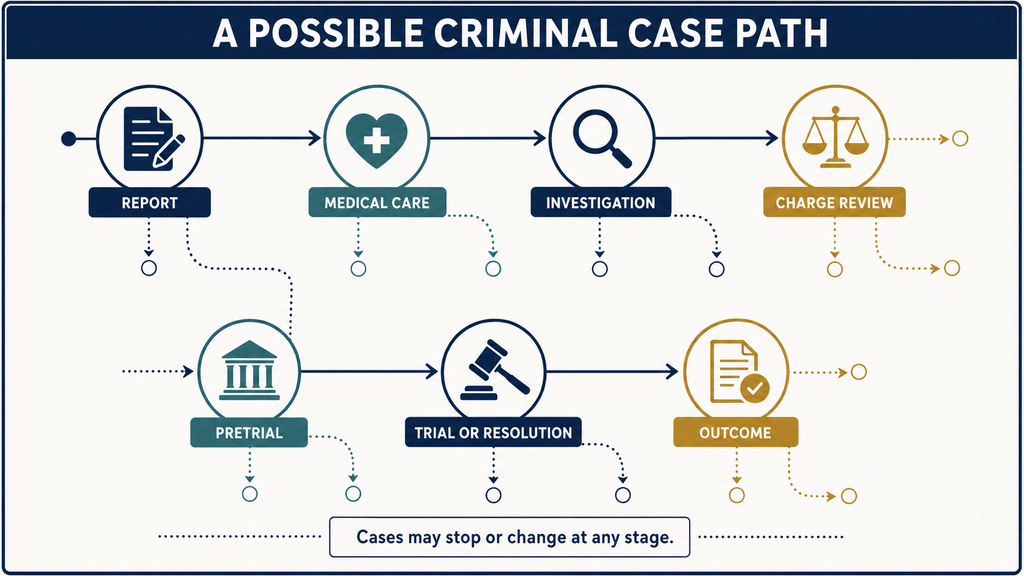
Procedures vary, and not every report results in an arrest or charge. A typical case may involve several stages, but some will stop, change direction, or proceed differently.
- A report or complaint is made.
- Medical or forensic care may occur.
- Investigators gather statements, communications, records, physical evidence, and witness accounts.
- A prosecutor reviews whether the available evidence supports charges.
- The accused may be arrested, summoned, or informed of charges.
- Pretrial hearings and evidence disputes may take place.
- The case may be dismissed, resolved through an agreement, or proceed to trial.
- If there is a conviction, sentencing and possible registration consequences are determined.
A delay in reporting does not automatically prove or disprove an allegation. Likewise, the absence of visible injuries does not by itself resolve whether an offense occurred.
Common Misunderstandings
“There must be visible physical injury.”
Many sexual-battery statutes focus on unlawful contact and lack of consent rather than visible injury. Injury can affect the seriousness of a charge, but its absence does not necessarily prevent prosecution.
“The person must have physically resisted.”
Some statutes expressly reject that assumption. Florida’s statute, for example, states that failure to resist physically is not consent.
“Sexual battery always means rape.”
That is true in some jurisdictions but not all. In other states, the term primarily refers to unwanted intimate touching, while penetration is charged under a different name.
“Contact through clothing cannot count.”
Some statutes specifically include touching through clothing. Whether it qualifies depends on the defined body area, intent, consent, and wording of the applicable law.
“A relationship automatically proves consent.”
A dating, marital, or previous sexual relationship does not itself establish consent to a particular act. The law examines the specific conduct and circumstances at issue.
“A report automatically leads to charges.”
Law enforcement may investigate, but prosecutors decide whether the evidence supports a criminal charge. A report, arrest, charge, and conviction are separate events with different legal meanings.
Frequently Asked Questions
What is sexual battery mean?
The grammatically complete question is “What does sexual battery mean?” Generally, it refers to intentional sexual touching or contact without valid consent, but some states use the term for nonconsensual penetration.
What is sexual battery meaning under criminal law?
Its criminal-law meaning comes from the statute in the state where the conduct allegedly occurred. The prosecution must prove every listed element, which may include intentional contact, a legally defined intimate area, lack of consent, sexual purpose, penetration, or an aggravating circumstance.
Is sexual battery the same as sexual assault?
Sometimes the terms overlap, but they are not automatically identical. Sexual assault may be an umbrella term or a specific charge, while sexual battery may have a narrower or broader statutory definition.
Can touching over clothing be sexual battery?
Yes, in jurisdictions whose statutes include touching through clothing. The prosecution may still need to prove that the contact was intentional, involved a defined intimate area, lacked consent, and occurred for a required sexual or abusive purpose.
Can sexual battery occur without force?
Yes. Some laws cover unwanted sexual contact without proof of physical force, especially when consent is absent, or the person is asleep, unconscious, incapacitated, restrained, deceived, or legally unable to consent.
Is sexual battery always a felony?
No. It may be a misdemeanor or felony depending on the state, statutory subsection, conduct, age, force, restraint, injury, authority relationship, and prior convictions.
Can someone file a civil lawsuit for sexual battery?
A civil claim may be possible even if criminal charges are not filed, but the available cause of action and deadline vary. A civil attorney can assess claims, evidence, damages, privacy concerns, and the applicable limitation period.
Conclusion
The most accurate answer to what sexual battery is is that it is a jurisdiction-specific sexual offense involving prohibited sexual contact without legally valid consent. The term may refer to unwanted intimate touching in one state and nonconsensual penetration in another, so the exact statute matters more than a general dictionary definition.
If you may have experienced an offense, prioritize safety, medical care, and confidential support without waiting to identify the perfect legal term. If you have been accused or contacted by investigators, preserve evidence, avoid direct contact with the complainant, and consult a qualified criminal-defense attorney before making statements about the case.
