

How Long Does a Speeding Ticket Stay on Your Record?
You pay the fine, put the ticket in a drawer, and hope the problem is finished. Then your insurance renewal arrives months later with a higher price. That is often when people search how long does a speeding ticket stay on your record and discover that one ticket can follow several different timelines.
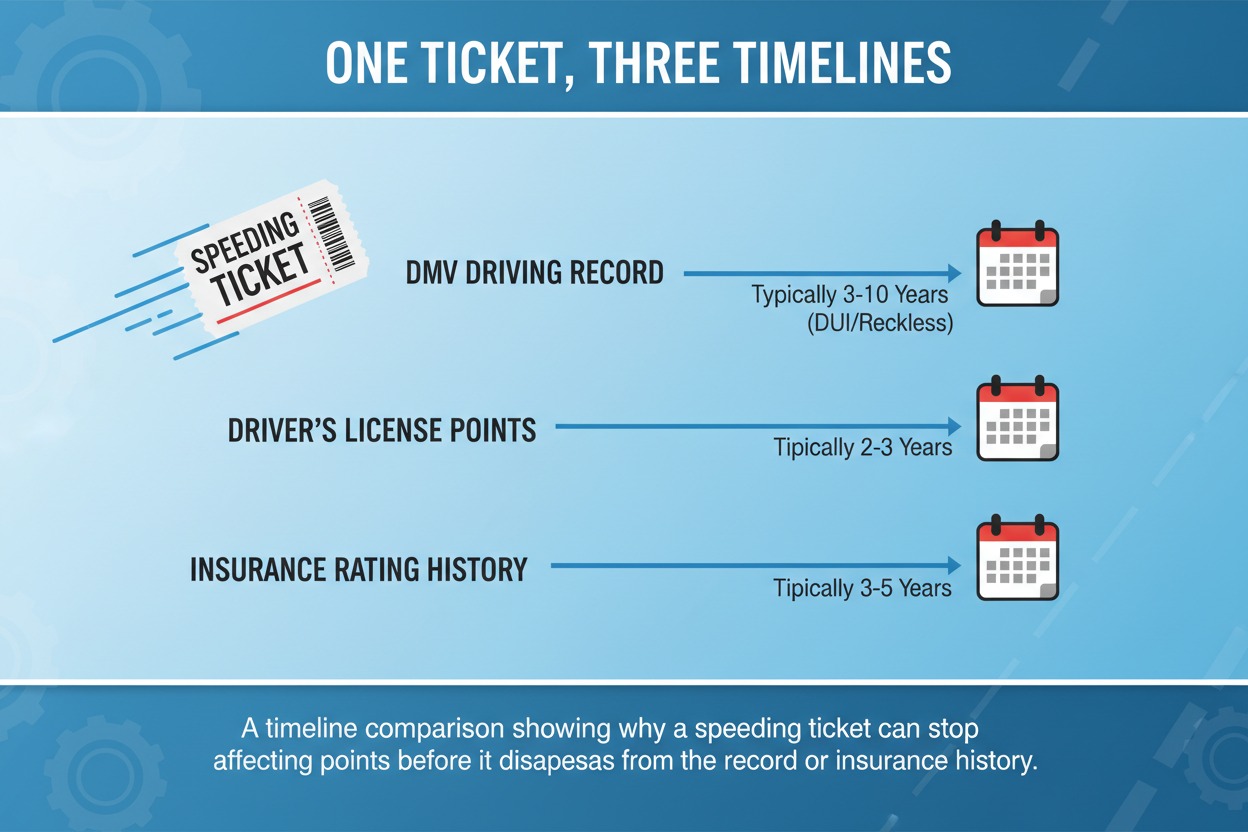
The simple answer is that an ordinary speeding conviction commonly remains visible for about three to five years, but there is no single rule that applies everywhere. Your state decides how long the conviction appears on its motor vehicle record. Your state may use another period for license points, while your insurer may apply its own rating or underwriting look-back period.
When I compared current motor-vehicle agency pages with insurance guidance, I noticed that many articles mix these three timelines together. That creates false promises, such as “your ticket disappears after three years.” It may stop counting toward points after a shorter period, remain displayed on your record for longer, and still affect an insurance renewal under the insurer’s approved rules.
This guide separates each record clearly. It also explains do parking tickets go on your record, how long before an unpaid ticket becomes a warrant, and what you can realistically do before a speeding conviction damages your license or insurance costs.
Quick answer: A standard speeding ticket often remains on a driving record for three to five years. The exact period depends on the state, the speed, the final conviction, and whether the conduct was treated as ordinary speeding or a more serious offense.
| Question | General answer |
|---|---|
| How long is a speeding ticket on your record? | Often three to five years, but state rules differ. |
| When do license points expire? | Sometimes earlier than the conviction disappears. |
| How long does a speeding ticket affect your insurance? | Commonly three years, but some insurers consider three to five years. |
| Does a parking ticket go on your record? | Usually not as a moving conviction, although unpaid tickets can create registration or renewal problems. |
| How long before an unpaid ticket becomes a warrant? | There is no universal number of days. Court action may begin after a missed response, payment, or appearance deadline. |
You can explore related plain-language driving law guides when you need help understanding tickets, road rules, and license consequences. For the financial side, the site’s insurance law and consumer guides provide a useful place to continue your research.
A Speeding Ticket Can Exist on Three Different Records
The first mistake is treating “your record” as one single file. A speeding case can affect your official driving history, your active point total, and the information an insurer uses to calculate your premium.
Those records are connected, but they are not identical. One may stop affecting you while another still shows the same event.
1. Your official motor vehicle record
Your state licensing agency keeps a motor vehicle record, often called an MVR or driving abstract. It can contain convictions, license actions, reportable crashes, suspensions, revocations, and other information allowed by state law.
A police officer does not normally place a final speeding conviction on your record merely by handing you a citation. The important event is usually the final disposition, such as paying the ticket as an admission, pleading guilty, pleading no contest where permitted, or being found guilty.
This distinction matters when a case takes months to resolve. The citation date, court date, conviction date, and point-calculation date may not all be the same.
2. Your driver’s license point total
Many states assign points to moving traffic violations. The number often depends on the severity of the conduct, and too many points within a stated period can trigger a warning, course requirement, suspension, or revocation.
Points can expire before the conviction disappears from the driving record. For example, the current Virginia point guidance states that demerit points remain valid for two years, while ordinary speeding convictions are listed for five years.
That means “the points are gone” does not always mean “the ticket is gone.” An employer, insurer, court, or licensing agency may still see the conviction if it remains within the record period available to that requester.
3. Your insurance rating history
Insurers commonly order an MVR when you apply for coverage and may order another one around renewal. The consumer insurance guidance on driving history says insurers generally ask for three years of driving history, while broader regulator guidance notes that the past three to five years may affect what you pay.
An insurer may therefore stop rating a violation before the state removes it from every version of your record. The reverse can also occur if the company uses another lawful source, prior application information, or a look-back method permitted by state insurance rules.
How Long Do Speeding Tickets Stay on Your Record?
The most accurate answer to how long do speeding tickets stay on your record is that ordinary entries commonly remain for three to five years, but serious offenses can remain for ten years, eleven years, fifteen years, or permanently. You must check the rule for your licensing state and the exact offense shown in the final court disposition.
A low-level speeding infraction is not the same as reckless driving, racing, impaired driving, fleeing, or a crash-related offense. A state may keep those more serious convictions much longer, even when they arose from driving above the speed limit.
Current official examples
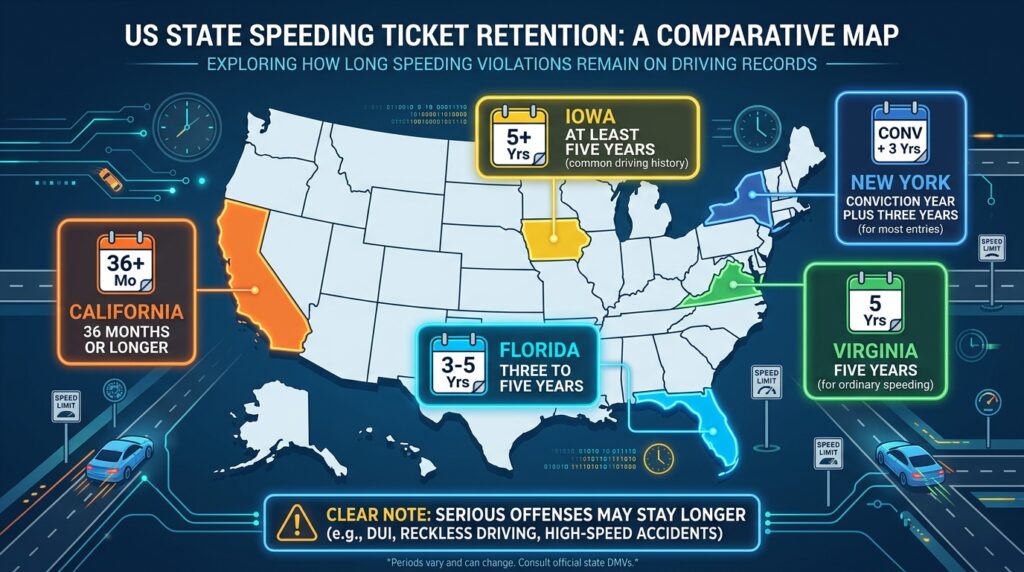
The table below is not a complete fifty-state chart. It shows why a single national answer would be misleading and gives you a reliable method for checking your own state.
| State example | What the official source says | What you should notice |
|---|---|---|
| California | Traffic convictions and collisions generally remain for 36 months or longer, depending on the event. | Three years is a starting point, not a promise for every conviction. |
| Florida | Most guilty dispositions for moving and nonmoving violations have a three-to-five-year retention period. Points remain on the driver record for at least five years from conviction. | The displayed conviction period and point period require careful reading. |
| New York | Most convictions display for the rest of the conviction year plus three additional years. Some convictions display for four or five years, and serious offenses last much longer. | “Four years” may depend on the calendar and conviction date. |
| Virginia | Ordinary speeding entries are commonly listed for five years. Reckless-driving convictions can remain for eleven years. | The final charge matters more than the words printed on the roadside ticket. |
| Iowa | The driving record shows convictions, accidents, and suspensions during at least the previous five years. | A record requested for another purpose may include a longer history. |
These examples show why you should not rely on a generic blog table without checking its date and source. State retention rules, point systems, and record products can change, and some agencies sell different three-year, five-year, ten-year, or complete abstracts.
When does the clock start?
The clock may start on the offense date, disposition date, or conviction date, depending on the rule being measured. Point calculations can use one date, while the record-retention rule uses another.
For example, a ticket issued in December may not be resolved until March. If the state counts the conviction date, the practical record period starts later than you might expect.
I recommend writing down four dates as soon as the case ends:
- The violation date matters for some point calculations. Keep the original citation because it shows when the alleged conduct occurred and may control a rolling point window.
- The payment or plea date may become the disposition date. Paying online can have the same practical effect as entering a guilty plea, depending on the jurisdiction and instructions.
- The conviction date often controls record retention. Confirm this date on your driving abstract rather than assuming it matches the day you were stopped.
- The insurance renewal date controls when the financial effect appears. A ticket may not change your current premium immediately if the insurer does not review the MVR until renewal.
Out-of-state speeding tickets
An out-of-state ticket may follow you home through interstate reporting arrangements and state law. Your home licensing agency may record the conviction, apply its own point treatment, or take action based on the type of offense.
Do not assume that paying a ticket while traveling keeps it away from your home record. Before paying, read the citation, check the issuing court’s options, and review how your home state treats out-of-state convictions.
Why the Final Conviction Matters More Than the Original Ticket
The roadside ticket is an accusation and a notice to respond. The final court result decides what, if anything, becomes a conviction on your record.
This is why two drivers stopped at the same speed can have different outcomes. One may pay an ordinary speeding violation, while another may qualify for a defensive-driving option, deferred disposition, amendment, dismissal, or trial.
Paying the ticket can close your legal options
Many people pay quickly because the fine seems smaller than taking time off work. However, payment commonly acts as an admission or guilty disposition and may trigger reporting to the licensing agency.
Before paying, check:
- Whether the citation offers a court appearance or contest option. The deadline can be short, and ignoring it is much worse than making a timely choice.
- Whether a driver course can prevent or reduce the record effect. Eligibility may depend on your age, speed, license class, recent history, and whether you request the option before paying.
- Whether deferred adjudication or deferred disposition is available. These programs may require a clean period, fees, court approval, and strict compliance.
- Whether the alleged speed creates a more serious charge. High speeds can trigger reckless-driving rules, larger point values, mandatory appearances, or criminal consequences in some states.
Dismissal, reduction, and masking are not the same
A dismissed charge normally creates a better record outcome than a conviction, but the court file may still exist. A reduced charge may avoid the original speeding conviction while creating another reportable violation.
A driver-course program may hide, mask, defer, or prevent a point in one system without erasing the underlying court event everywhere. Read the official program language carefully and do not assume “no point” means “no record.”
How Long Does a Speeding Ticket Affect Your Insurance?
The answer to how long does a speeding ticket affect your insurance is commonly about three years, although a three-to-five-year window is possible. Your insurer, state rules, policy type, speed, prior history, age, location, and renewal timing can all change the result.
A single minor ticket may produce no increase with one company and a meaningful increase with another. Some companies forgive or do not surcharge certain first or low-level violations, while others remove a safe-driver discount even when the direct surcharge is modest.
The increase may not happen immediately
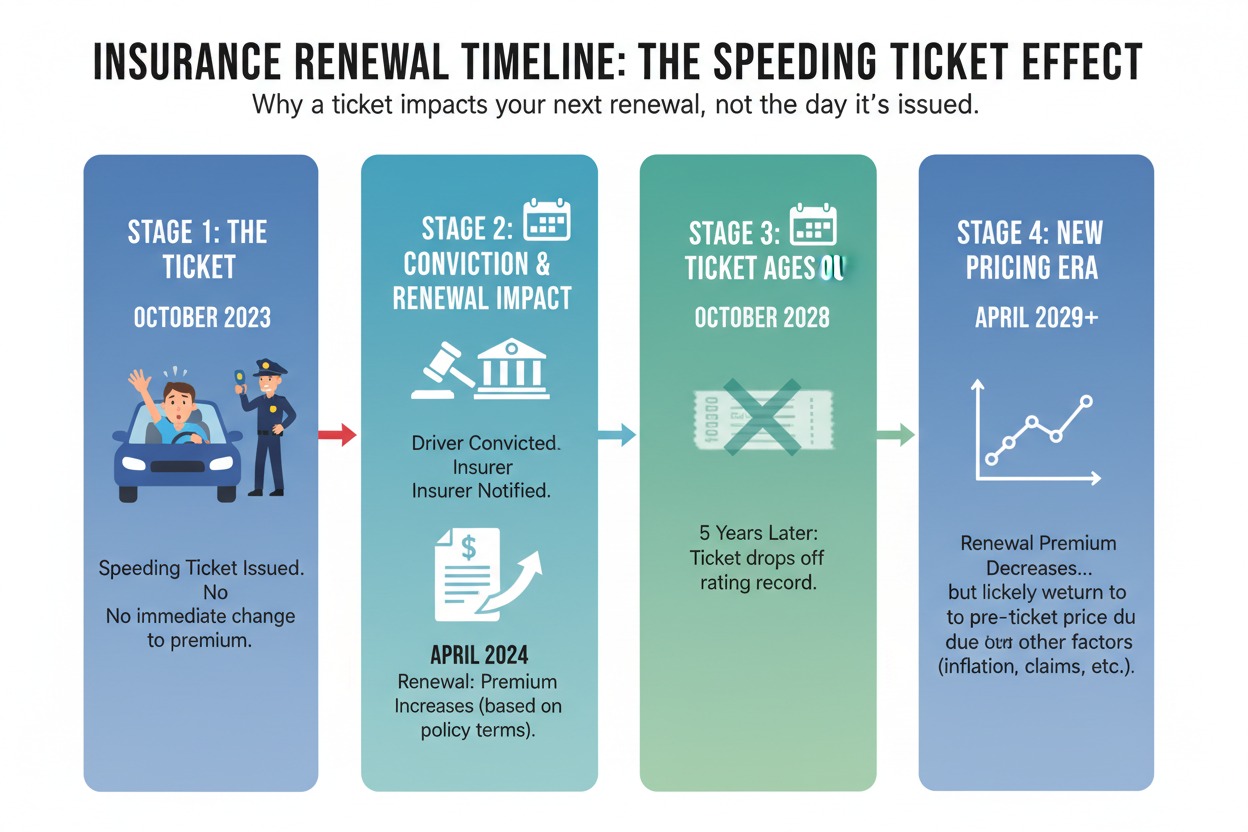
An insurer does not necessarily receive an alert the moment an officer issues a ticket. The event normally needs to become a reportable conviction, and the company then needs to review the relevant record.
The insurance consumer FAQ on traffic-ticket surcharges explains that insurers can use a record of traffic convictions because prior violations can indicate a higher likelihood of future claims. The exact surcharge must still follow the company’s approved rules and applicable state law.
A common sequence looks like this:
- You receive the ticket. Your current rate may remain unchanged because there is no final conviction yet.
- The case is resolved. The court reports the conviction to the licensing agency under the applicable process.
- The insurer reviews your record. This often happens when the policy renews, when you add a driver or vehicle, or when you apply elsewhere.
- The price changes or a discount disappears. The insurer may apply a surcharge, alter a tier, remove a safe-driver benefit, or decide not to renew in a more serious pattern.
What makes the insurance impact larger?
The effect usually becomes more serious when the speed is high, the ticket is recent, or other violations and claims already exist. A youthful driver, commercial driver, or person with several events in a short period may face a stronger response.
Important rating factors can include:
- How far above the limit you were convicted of driving. A five-mile-per-hour violation may be treated differently from a high-speed or reckless-driving conviction.
- Your previous tickets and at-fault crashes. Several recent events create a pattern that can matter more than one isolated mistake.
- The loss of a clean-driver discount. Sometimes the visible price increase comes from losing a discount rather than a line labeled “ticket surcharge.”
- The insurer’s lawful look-back period. Regulator guidance indicates that insurers commonly review three years, while three to five years of driving history may influence pricing.
- The timing of your renewal. Even when the rating period ends, you may not see a lower premium until a future policy term begins and the company rerates the policy.
Will your rate drop automatically?
Not always. The ticket may age beyond the company’s chargeable period while other market factors, claims costs, repair costs, location changes, vehicle changes, or household drivers keep the total premium high.
When the relevant anniversary approaches, order your MVR and ask the insurer which conviction date it is using. Then compare like-for-like quotes with the same drivers, vehicles, limits, deductibles, and optional coverages.
I would not reduce important liability protection merely to erase the visible increase. A cheaper premium can become extremely expensive if it leaves you underinsured after a serious crash.
Do Parking Tickets Go on Your Record?
The usual answer to do parking tickets go on your record is no, not as moving violations on the driver-safety record used for ordinary license points. A parking citation is normally connected to the vehicle, registered owner, municipal account, or plate rather than proof of unsafe driving by a particular person.
The same answer applies to does a parking ticket go on your record when you mean the point-bearing MVR used for speeding and red-light convictions. However, “not on your driving record” does not mean “safe to ignore.”
What unpaid parking tickets can do
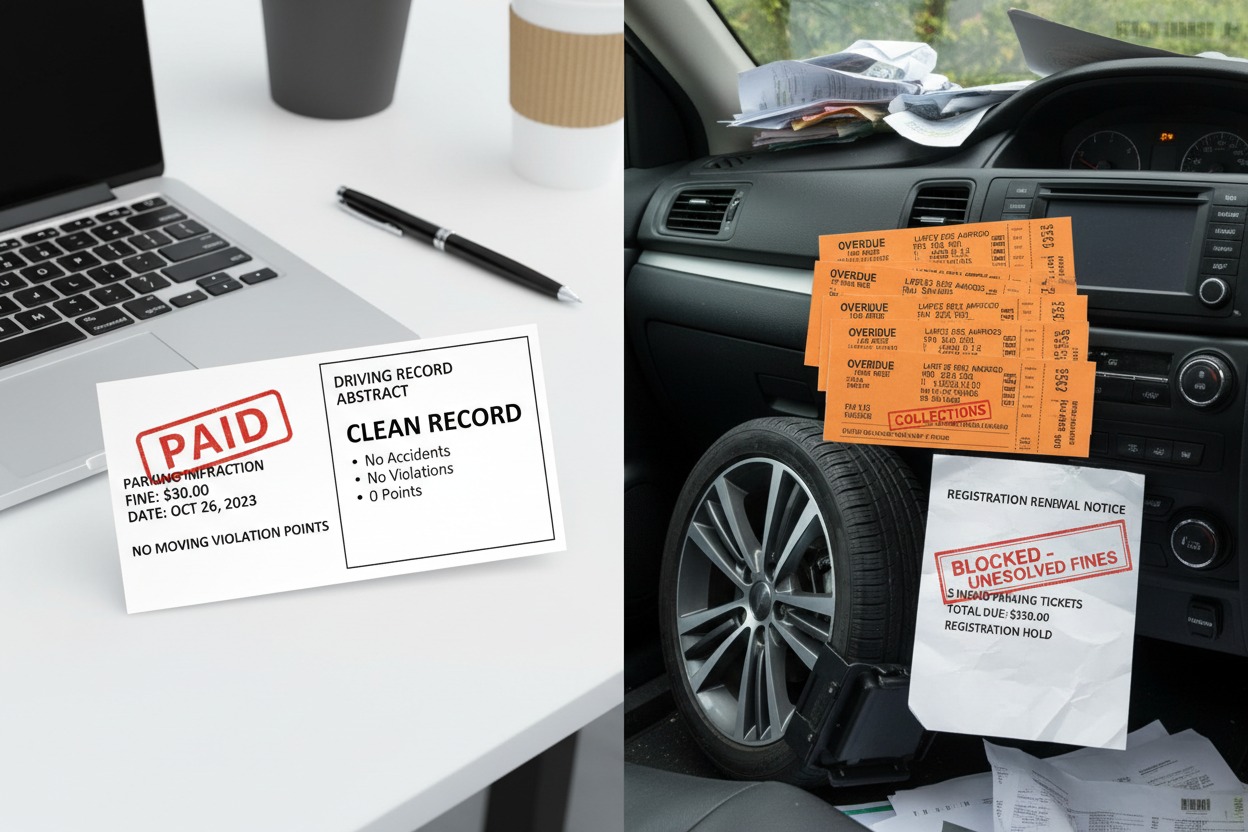
Unpaid parking citations can grow through penalties, collections, towing, booting, registration holds, and renewal restrictions. The exact enforcement method depends on the state and city.
For example, the California registration procedure states that a vehicle’s registration renewal cannot be completed while listed parking or toll violations remain uncleared. The Massachusetts non-renewal program allows participating municipalities to mark vehicle registration records for unpaid parking tickets.
That creates an important distinction:
- A paid parking ticket usually does not add moving-violation points. It generally says little about how safely you operated the vehicle on the road.
- An unpaid parking ticket can affect vehicle administration. You may have trouble renewing the registration or completing another transaction until the debt is cleared.
- A parking incident can become more serious if another law was broken. Parking in a way that creates obstruction, involves fraud, misuses a disability placard, or leads to another charge may carry separate consequences.
Can parking tickets affect insurance?
A normal paid parking ticket does not usually affect auto insurance because it is not a moving safety conviction. Insurers focus more heavily on crashes, moving violations, license actions, fraud, and other risk-related information.
Indirect effects are possible if unpaid citations contribute to registration problems, a suspended privilege under local law, collections, or later violations. The safest approach is to pay or contest the citation within the stated deadline rather than testing how far enforcement will go.
How Long Before an Unpaid Ticket Becomes a Warrant?
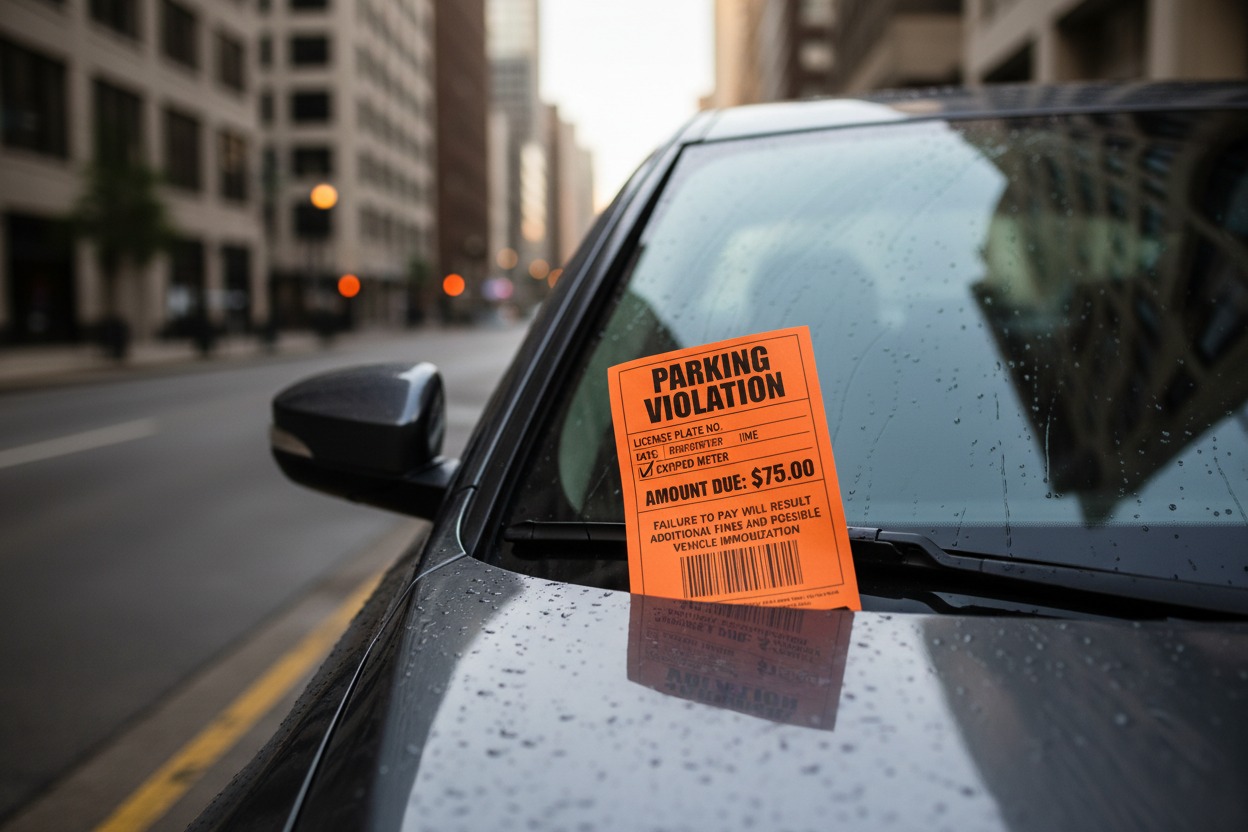
There is no national answer to how long before an unpaid ticket becomes a warrant. A court may act after you miss the response date printed on the citation, fail to attend a required hearing, violate a payment plan, or ignore an order to comply.
The type of ticket also matters. A court may handle a civil traffic infraction through default judgment, late fees, collections, license action, or a registration hold, while criminal traffic charges and missed mandatory appearances can create a more direct warrant risk.
Unpaid and unanswered are not always the same
People often say “unpaid ticket” when the real problem is failure to respond or appear. You may have had a right to contest the allegation, but you still needed to notify the court or appear by the deadline.
Official court pages show the range of possible consequences. New York court guidance warns that failing to respond may lead to a warrant, license suspension, or default judgment. California self-help guidance explains that ignoring a traffic ticket can cause a civil assessment, a failure-to-appear charge, and other court action.
The safest rule is not “I probably have thirty days.” It is “I must follow the exact date and instructions printed on my citation or later court notice.”
A warrant may follow a missed appearance
When a citation requires a court appearance and the defendant does not appear, the judge may have authority to issue a bench or arrest warrant. Some courts first send another notice, impose a default, add fees, or place a hold, but you should not rely on receiving an extra chance.
A warrant can remain active until the court recalls or resolves it. Paying the original fine online may not automatically clear a separate failure-to-appear case or warrant.
What to do when the deadline has passed
Do not ignore the case because you are embarrassed or cannot pay the full amount. Courts may offer payment plans, ability-to-pay review, rescheduling, community service, or a procedure to ask that a warrant be recalled.
Use this order:
- Find the issuing court. Use the court name, citation number, case number, and jurisdiction printed on the ticket.
- Check the case through an official court system. Avoid entering personal data into a random “warrant search” site that charges for incomplete public information.
- Call the clerk and ask what is currently outstanding. Ask whether the issue is a missed response, unpaid judgment, failure to appear, license hold, collections referral, or active warrant.
- Ask how to place the case on a court calendar. The clerk can explain procedure but normally cannot give personal legal advice.
- Speak with a traffic or criminal-defense lawyer when a warrant or criminal charge exists. A lawyer may be able to arrange a hearing or surrender process without an unexpected arrest, depending on local practice.
Your site also has a broader explanation of why warrants do not follow one automatic national timeline. The subject is different, but the same basic lesson applies: court authority, notice, missed obligations, and local procedure matter more than a simple number of days.
Can You Remove a Speeding Ticket From Your Record?
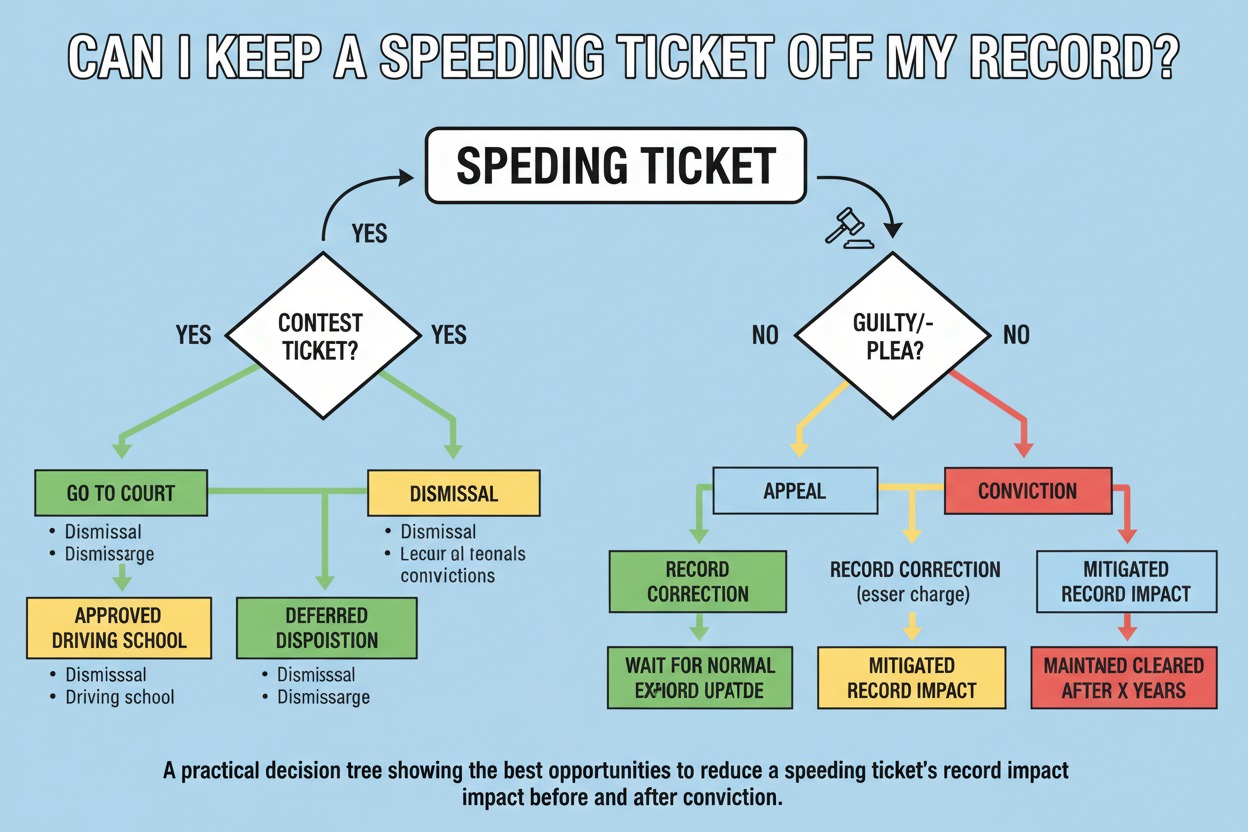
Sometimes, but removal is not automatic and may not mean complete deletion from every database. Your best chance usually comes before conviction, when you can still contest the charge or request an approved alternative.
After conviction, the available options depend on state law. They may include correcting an error, reopening a default, appealing within the deadline, obtaining post-conviction relief, completing an eligible course, or waiting for the ordinary retention period to end.
Defensive-driving courses
Some jurisdictions allow an approved course to avoid points, receive a dismissal, reduce a charge, or qualify for an insurance discount. These are different benefits, and a course that reduces points may not erase the conviction display.
Do not enroll in a random online course before the court approves it. The course may need to appear on an official provider list, be completed within a fixed period, and be available only to eligible drivers.
New York provides a useful example of the distinction. Its point and insurance reduction program can reduce the active point total for certain purposes and provide an insurance benefit, but it does not remove most violations, convictions, or displayed points from the driving record.
Deferred disposition or adjudication
A deferred program may postpone judgment while you complete conditions such as a clean driving period, course, fee payment, or proof of insurance. Successful completion may prevent the original conviction from being entered or reported in the usual way.
The benefit can be valuable, but the details matter. A commercial license holder, high-speed case, school-zone violation, construction-zone violation, collision, or recent prior ticket may be ineligible.
Contesting the evidence
You may have a defense when the wrong vehicle was identified, the speed-measuring process was unreliable, signs were missing or obscured, an emergency applied, or the prosecution cannot prove an element required by law. A legal defense is not the same as asking for sympathy.
Useful evidence can include dashcam footage, photographs, GPS information, calibration or maintenance records obtainable through proper process, witness details, road-design evidence, and the officer’s testimony. The relevance and admissibility of each item depend on the court and the legal theory.
Correcting a record error
Driving records are not immune from mistakes. A conviction can be assigned to the wrong person, reported twice, shown with the wrong speed, or left visible beyond a period when the agency’s rules require removal.
Order an official driving record rather than relying only on an insurer’s verbal explanation. If you find an error, use the agency’s formal correction or review process and keep copies of the certified court disposition.
Expungement is not universal
The word “expungement” is often used too loosely online. Some states do not allow ordinary traffic convictions to be expunged, while others provide limited sealing, set-aside, or record-correction procedures.
Even when a court record is sealed or changed, the motor-vehicle agency and insurer may follow different laws. Ask exactly which record will change, who can still access it, and whether the licensing agency will receive an amended disposition.
How Different Traffic Violations Affect Your Record
Not all traffic violations are equal. A state may treat an equipment issue, seat-belt citation, parking violation, ordinary speeding offense, reckless-driving charge, and impaired-driving offense very differently.
The label on the final conviction controls the record effect. The following categories help you estimate risk, but your local statute and court disposition remain decisive.
| Violation type | Typical record concern |
|---|---|
| Parking or meter citation | Usually no moving points, but unpaid debt can affect registration or collections. |
| Equipment or paperwork violation | May be correctable or nonmoving, depending on the law and proof of correction. |
| Ordinary speeding | Commonly a moving conviction with points and possible insurance impact. |
| High-speed or reckless driving | Longer retention, more points, mandatory court, criminal exposure, or license action may apply. |
| Red-light, stop-sign, or unsafe-lane offense | Usually a moving conviction and may be important after a crash. |
| Driving while suspended | Often treated much more seriously than the original ticket that caused the suspension. |
| Impaired driving | Commonly remains for many years, carries major insurance consequences, and may trigger special filing rules. |
| Commercial vehicle violation | Can create federal and state consequences beyond the ordinary personal-license point system. |
Traffic-signal violations can also affect your driving history. A driver who fails to make a complete stop before turning right at a red light may receive a moving-violation conviction. You can read the full explanation of Georgia’s right-turn-on-red stopping rule to understand when the turn is permitted and when it may lead to a ticket.
Speeding versus reckless driving
A high speed may be charged as reckless driving in some states. That can change a routine infraction into a misdemeanor or other serious offense with a much longer retention period.
Virginia shows why the distinction matters. Its official pages list ordinary speeding for five years, while many reckless-driving convictions remain for eleven years.
Camera tickets
Automated camera citations may be treated as civil, owner-based, or non-point violations in some locations. In others, specific camera or school-bus enforcement laws create different consequences.
Do not assume that “a camera ticket never goes on your record.” Read the issuing authority’s notice and the statute or official FAQ that applies to that specific program.
An Expert Action Plan After a Speeding Ticket
The first few days matter because response deadlines and eligibility windows can be short. A calm, organized review is better than paying instantly or ignoring the envelope.
This is the process I recommend:
Step 1: Read every part of the citation
Check the alleged speed, posted limit, location, statute, court, response deadline, mandatory-appearance box, and officer notes you can see. Confirm that your name, license, plate, and vehicle information are accurate.
Do not write explanations on the citation unless the instructions require it. Keep the original clean and make a separate note of what happened while your memory is fresh.
Step 2: Identify the worst realistic consequence
Ask whether the case could add points, trigger a suspension threshold, affect a commercial license, become reckless driving, violate probation, or raise insurance costs. Your decision should reflect the total risk, not only the face value of the fine.
A $150 fine may be the smallest part of the cost when the conviction removes a discount for several renewal periods.
Step 3: Check court-approved options
Use the official court or state website to review payment, contest, hearing, driving-school, deferral, and payment-plan options. Save a copy of the page because programs and deadlines can change.
Call the clerk when the instructions are unclear. Ask procedural questions and write down the date, time, and name or employee number of the person who assisted you.
Step 4: Order your current driving record
Your existing points and convictions can decide whether a course or negotiated outcome is valuable. An insurer’s report may also contain an error that you will not discover until the renewal price changes.
Order from the official state motor-vehicle agency. Avoid unofficial background-check pages that may use outdated or incomplete information.
Step 5: Compare the cost of representation
A lawyer may not be necessary for a low-level first ticket with a simple course option. Legal advice becomes more valuable when the speed is high, the charge is criminal, the license is commercial, an accident occurred, the driver is under a special restriction, or suspension is possible.
Ask the lawyer what the quoted fee covers. It may include record review, negotiation, court appearance, trial preparation, or only a limited consultation.
Step 6: Protect your insurance position
Do not make false statements on an insurance application. However, you also do not need to guess or volunteer inaccurate information when a question asks only about convictions within a defined period.
Answer the exact question truthfully. When shopping, compare identical coverage rather than choosing a policy with weaker protection simply because the premium looks lower.
Step 7: Confirm the final record
After the court resolves the case and enough processing time has passed, order another official MVR. Verify that the disposition, speed, points, and dates match the court result.
Keep the certified or stamped court paperwork. It is much easier to correct a future error when you can show exactly how the case ended.
Image Prompt 7: Create a seven-step checklist infographic for what to do after receiving a speeding ticket. Include icons for reading the citation, checking consequences, reviewing court options, ordering an MVR, speaking with a lawyer, comparing insurance, and confirming the final record.
Image Description: A printable action checklist that helps a driver protect deadlines, license status, and insurance after a speeding citation.
Suggested ALT Text: What to do after a speeding ticket to protect your driving record and insurance.
Pros and Cons of Paying a Speeding Ticket Immediately
Paying immediately feels simple. It closes the court obligation and may prevent late fees, but it can also create a conviction before you understand the long-term effect.
| Possible advantages | Possible disadvantages |
|---|---|
| You meet the deadline and avoid failure-to-respond problems. | Payment may count as a guilty plea or admission. |
| You avoid taking time off for court. | You may lose access to a course, deferral, reduction, or defense. |
| The immediate cost is clear. | Points and insurance costs may exceed the fine. |
| The case ends quickly. | A high-speed charge may have consequences you did not recognize. |
The better question is not “Can I afford the fine?” It is “What final disposition am I accepting, and what will that disposition do to my license and insurance?”
When Hiring a Traffic Lawyer May Be Worth It
A traffic lawyer may be worth considering when the citation alleges very high speed, reckless driving, a school or work zone, an accident, injury, driving while suspended, or another charge with possible criminal consequences. Representation can also matter when you are close to a point suspension or depend on a commercial license for income.
A lawyer cannot guarantee dismissal. The value lies in identifying defenses, preserving deadlines, explaining local court practice, negotiating an accurate reduction, and preventing a small case from creating a much larger license or employment problem.
For an ordinary first ticket, compare the legal fee with the likely fine, point effect, insurance impact, travel cost, and value of your time. A brief consultation can still be useful when the ticket language or available option is unclear.
Frequently Asked Questions
1. How long does a speeding ticket stay on your record?
An ordinary speeding conviction commonly remains visible for three to five years, but your state may use a shorter or longer period. Serious speeding-related offenses, such as reckless driving, can remain for ten years or longer.
Check the official motor-vehicle agency page for your state and the exact final charge. Do not assume that the period for active points is the same as the period for displaying the conviction.
2. How long does a speeding ticket affect your insurance?
A speeding conviction often affects insurance for about three years, while some insurers and state-approved rating systems consider three to five years of driving history. The increase often appears at the first renewal after the conviction is reported.
Your premium may not return to its old amount automatically because other market and personal rating factors can change. Compare equivalent quotes when the ticket reaches the end of the insurer’s look-back period.
3. Do parking tickets go on your record?
Ordinary parking tickets usually do not appear as point-bearing moving convictions on your driver record. They are generally connected to the vehicle, plate, registered owner, or local parking account.
Unpaid parking tickets can still lead to penalties, collections, towing, a boot, or registration-renewal restrictions. Pay or contest them by the deadline even when they do not add license points.
4. How long before an unpaid ticket becomes a warrant?
There is no universal number of days. The court may take action after the response, appearance, payment, or compliance date stated on the citation or a later order.
Some civil cases lead first to default, fees, collections, or license action, while missed mandatory appearances and criminal traffic charges may create warrant risk. Contact the issuing court immediately when a deadline has passed.
5. Can a speeding ticket disappear from my points but remain on my record?
Yes. Points and conviction retention are separate systems in many states, so the active points can expire while the speeding conviction remains visible on the MVR.
Insurance companies may also use a different period. Always ask whether a quoted timeframe refers to points, record display, suspension calculations, or insurance rating.
Conclusion
So, how long does a speeding ticket stay on your record? For many ordinary convictions, the practical answer is three to five years, but your state, final charge, speed, point rules, and record type decide the real period.
The key is to separate four questions: when the court case ends, how long the conviction displays, how long points remain active, and how long the insurer can use the event. Check those details before paying, respond before the deadline, and order your official record after the case is resolved.
A ticket does not have to become a long-term problem. Treat it as a legal and financial decision, not only a fine, and choose the response that protects your license, your record, and your insurance position.
