

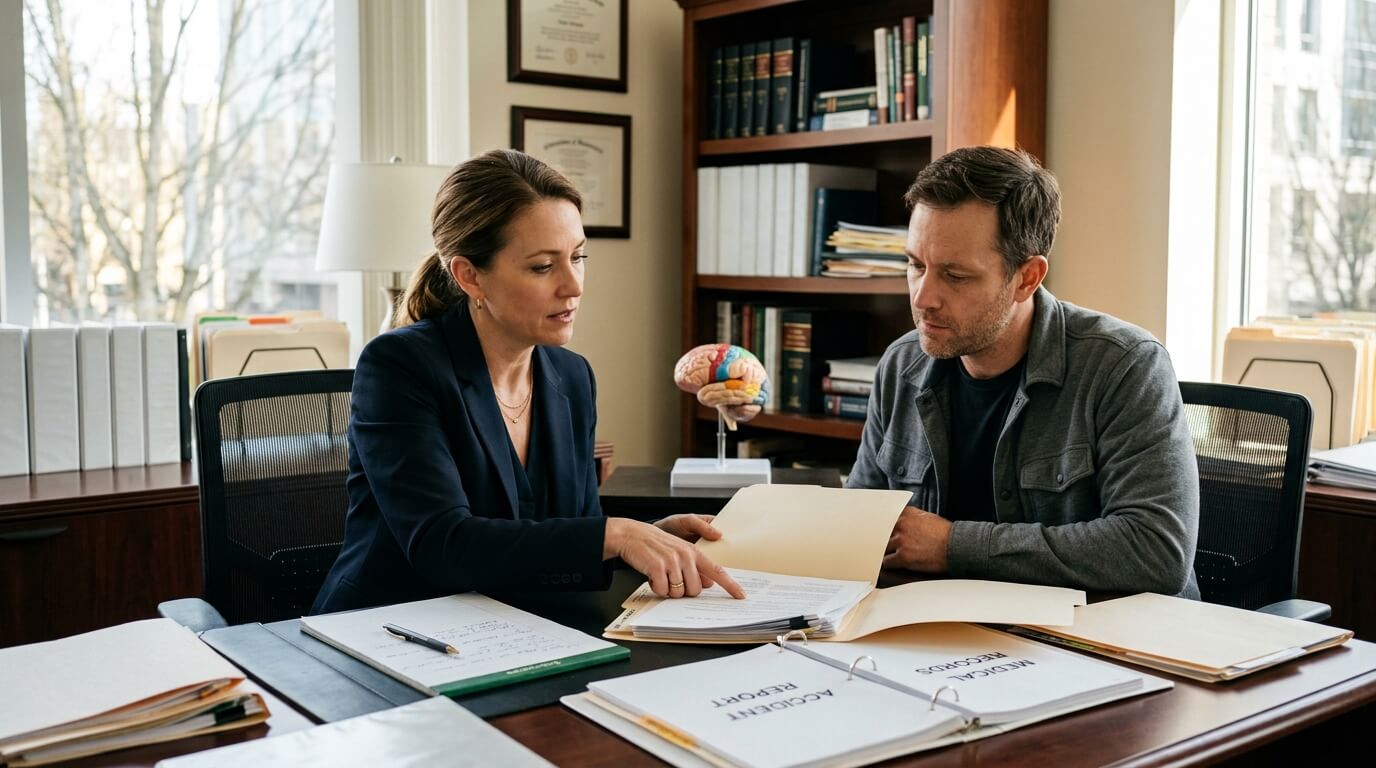
Brain Injury Attorney: What They Do, When You Need One, and How to Choose
A brain injury can change much more than a medical chart.
Someone who appeared physically well after an accident may later struggle with headaches, memory, concentration, balance, sleep, mood, communication, work, or everyday tasks. In some cases, those changes become the most important part of a legal claim even though they are difficult for other people to see.
A brain injury attorney handles cases in which a concussion or another traumatic brain injury may have been caused by another person, business, organization, product, or other legally responsible party.
The lawyer’s job is not simply to prove that an accident occurred. A serious TBI claim may require evidence connecting the event to the injury, explaining how the injury affected the person’s life, identifying who is legally responsible, and measuring both current and reasonably supported future losses.
The Centers for Disease Control and Prevention’s information on mild traumatic brain injury explains that concussion can affect thinking, learning, feelings, behavior, and sleep. Importantly, a person can have a mild TBI even when routine brain imaging does not identify the injury.
What to know about brain injury claims
- A concussion is a traumatic brain injury even though it is classified medically as a mild TBI.
- A normal CT scan does not by itself determine whether a person has a concussion or mild TBI.
- Symptoms can appear immediately or develop hours or days after an injury.
- TBI claims may depend heavily on medical records, symptom history, witness evidence, employment records, and documentation of functional changes.
- Insurers may dispute whether the accident caused particular symptoms, especially when imaging is normal or symptoms developed later.
- Serious cases may require analysis of future medical care, rehabilitation, earning capacity, and long-term assistance.
- There is no single nationwide deadline for filing an ordinary brain injury lawsuit.
What Is a Traumatic Brain Injury?
A traumatic brain injury, or TBI, occurs when an external force disrupts normal brain function.
A blow or jolt to the head can cause one. So can a hit to the body that causes the head and brain to move rapidly back and forth.
A brain injury caused by an external force such as a bump, blow, jolt, impact, or penetrating injury that affects how the brain works. A TBI may be classified as mild, moderate, or severe, and its effects differ substantially from person to person.
A concussion is generally considered a mild TBI, but “mild” describes the initial clinical classification rather than guaranteeing that every person’s symptoms will be minor or disappear immediately.
The CDC notes that mild TBI symptoms can affect physical functioning, thinking and memory, emotions, and sleep. Some appear immediately. Others can develop hours or days later.
Symptoms can include:
- Headaches
- Dizziness or balance problems
- Sensitivity to light or noise
- Vision problems
- Problems concentrating
- Memory difficulties
- Feeling slowed down or foggy
- Irritability or emotional changes
- Sleep problems
- Fatigue
Those symptoms are medically important first. When an injury also becomes the subject of an insurance claim or lawsuit, the timing and documentation of the symptoms may become legally important as well.
When Can a Brain Injury Lead to a Legal Claim?
A diagnosis by itself does not establish that another person owes compensation.
A viable claim generally requires a legally recognized basis for holding another party responsible.
In an ordinary negligence claim, the issues often include:
- Whether the defendant owed a legal duty.
- Whether the defendant failed to meet the required standard of care.
- Whether that conduct caused the injury.
- Whether the claimant suffered legally compensable losses.
The precise elements depend on the jurisdiction and claim.
Brain injuries can arise from situations such as:
- Car accidents
- Commercial truck crashes
- Motorcycle accidents
- Pedestrian or bicycle collisions
- Falls on allegedly dangerous property
- Defective products
- Construction incidents
- Workplace incidents involving third parties
- Assaults
- Sports or recreational incidents
- Medical negligence
A person injured in a vehicle collision may also need to deal with reporting requirements, insurance, evidence preservation, and fault rules. TheLawLearner’s guide explaining what to do after a car accident legally in Kansas provides an example of how those issues interact in one state. However, Kansas-specific rules should not be assumed to apply elsewhere.
Why Brain Injury Claims Can Be Different From Other Injury Claims
A brain injury case can present problems that do not arise as strongly with an easily visible physical injury.
Why brain injury cases can be difficult
Symptoms may be invisible
Memory, concentration, fatigue, emotional changes, headaches, and slowed thinking may seriously affect daily life without creating an obvious external injury.
Symptoms may appear later
The CDC reports that some mild TBI symptoms can develop hours or days after the injury, making an accurate symptom and treatment timeline important.
A scan may not answer everything
Routine imaging is not used to diagnose every concussion. Clinical evaluation and other appropriate medical evidence can therefore matter when imaging is normal.
Long-term losses may be complex
Serious injuries may affect employment, independence, rehabilitation needs, family responsibilities, and future care, requiring more than a review of current medical bills.
The CDC also notes that a person with a mild TBI may not recognize or admit that problems are occurring or may not fully understand how symptoms affect everyday activities.
That makes credible observations from people who knew the injured person before and after the incident potentially important.
Can You Have a Brain Injury if Your CT or MRI Is Normal?
Yes. A normal routine scan does not automatically mean that a person did not sustain a mild traumatic brain injury. This is an area where medical and legal questions are sometimes confused.
According to the CDC’s mild TBI guidance, a brain scan such as a CT is not needed to identify every mild TBI or concussion. CT imaging may instead be used when healthcare professionals are concerned about conditions such as bleeding in the brain.
Current CDC clinical recommendations also state that CT or MRI should not be routinely used solely to diagnose mild TBI. That does not mean every person with symptoms and a normal scan has a TBI. Diagnosis belongs to appropriately qualified healthcare professionals. Legally, however, an insurer cannot reasonably reduce the entire medical question to one statement such as:
“The scan was normal, so there was no injury.”
A claim should be evaluated using the complete medical record and other reliable evidence.
Do You Need to Lose Consciousness to Have a TBI?
Not necessarily. Loss of consciousness can occur in some brain injuries, but it is not required for every concussion or mild TBI. A person may remain conscious and still develop problems with:
- Memory
- Concentration
- Headaches
- Balance
- Sleep
- Mood
- Processing speed
- Daily functioning
The significance of those symptoms in an individual case must be determined medically, not by an insurance adjuster or legal article.
What Does a Brain Injury Attorney Actually Do?
The work of a traumatic brain injury attorney often extends well beyond sending an insurance demand.
How a brain injury attorney may build a case
Determine what happened
The attorney may collect reports, photographs, video, witness information, vehicle data, property evidence, employment records, company documents, or other evidence relevant to liability.
Document the injury
Emergency records, follow-up care, specialist assessments, rehabilitation records, testing, and treatment history may help establish the medical timeline and functional impact.
Identify responsible parties
A lawyer may investigate whether responsibility extends beyond the most obvious person to an employer, property owner, manufacturer, contractor, government entity, or another party.
Measure present and future losses
The analysis may include treatment expenses, income loss, diminished earning ability, future medical or support needs, and other damages permitted by applicable law.
Address disputed claims
Counsel may communicate with insurers, analyze coverage, respond to causation arguments, document damages, negotiate, and advise the client about proposed settlements.
Prepare for court if necessary
If the dispute cannot be resolved, counsel may file suit, conduct discovery, take depositions, work with qualified experts, present motions, negotiate further, and prepare the case for trial.
What Evidence Can Help Prove a TBI Claim?
The evidence depends on how the accident happened and what issues are disputed.
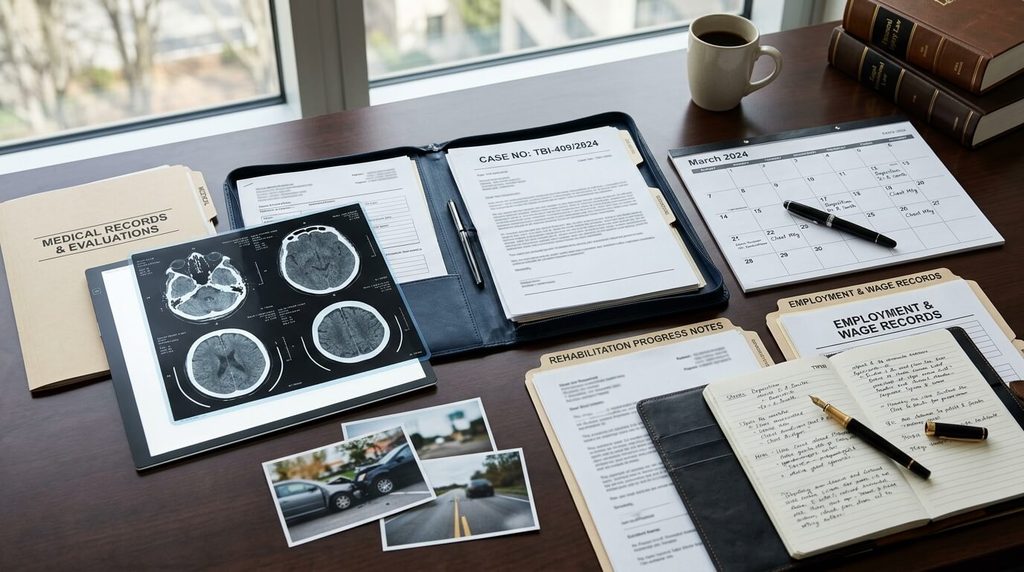
Records that may matter in a brain injury case
- Emergency department and hospital records
- Primary-care and specialist medical records
- Neurology records when applicable
- CT, MRI, or other clinically appropriate imaging records
- Neuropsychological or neurocognitive testing when medically appropriate
- Physical, occupational, speech, or other rehabilitation records
- Accident reports
- Scene photographs and video
- Dashcam, surveillance, or other available recordings
- Witness statements
- Employment and wage records
- Records showing missed work or changed job duties
- Documentation of assistance needed with everyday activities
- Reliable evidence showing changes in behavior, memory, or functioning
Evidence should be preserved rather than reconstructed later whenever possible. Video can be overwritten. Vehicles can be repaired. Property conditions can change. Witness memories can become less precise. That is one reason serious injury investigations may need to begin long before anyone knows whether a lawsuit will ultimately be necessary.
What Insurance Companies May Dispute in a Brain Injury Claim
Not every disputed claim involves bad faith or improper conduct. Insurers are allowed to investigate causation and damages. But understanding common points of disagreement helps explain why TBI cases can become complicated. An insurer may question:
“You never lost consciousness.”
Loss of consciousness is not necessary for every concussion or mild TBI. The complete medical evidence matters.
“Your CT scan was normal.”
Routine imaging does not identify every mild TBI. A normal scan therefore does not resolve the entire diagnostic question.
“You did not report symptoms immediately.”
Some concussion symptoms can appear hours or days later. The timing still needs to be evaluated in the context of the complete medical and factual record.
“You already had headaches, anxiety, or another condition.”
Pre-existing medical history can become relevant. The legal issue may be whether the accident caused a new condition or aggravated an existing one, depending on applicable law and the evidence.
“You went back to work, so you must have recovered.”
Returning to work does not automatically establish that every symptom has resolved. The person’s duties, accommodations, performance, hours, and symptoms may all matter.
“Your symptoms are subjective.”
Some important TBI symptoms depend partly on what the patient reports, which makes consistency across medical records, testing, witness observations, and day-to-day functioning important.
Which Experts May Be Involved in a Brain Injury Case?
Not every case needs an expert witness, and not every serious case requires the same specialists.
Depending on the disputed issues, qualified professionals may include:
Neurologists: May diagnose and treat neurological conditions and explain relevant medical findings.
Neuropsychologists: May assess areas such as memory, attention, processing speed, and executive functioning when clinically appropriate.
Rehabilitation professionals: May address functional limitations, therapy, and recovery needs.
Vocational experts: May evaluate whether an injury affects the person’s ability to perform previous work or other employment.
Economists: May calculate certain future financial losses after receiving appropriate factual assumptions.
Life-care planners: In appropriate serious-injury cases, they may evaluate expected future care and support needs based on medical information.
Accident reconstruction professionals: May address how a collision or other incident occurred when liability or mechanics are disputed.
A lawyer should not use an expert merely to make a claim sound more serious. Expert testimony needs to address a genuine medical, technical, vocational, financial, or factual issue.
What Compensation May Be Available in a Brain Injury Case?
There is no universal TBI settlement amount. Recoverable damages depend on the jurisdiction, cause of action, evidence, injury, available insurance or assets, and other case-specific factors.
Losses that may be considered
| Damage category | Possible examples |
|---|---|
| Past medical expenses | Emergency treatment, hospitalization, physician care, therapy, rehabilitation, medication, and other qualifying treatment costs. |
| Future medical care | Reasonably supported future treatment, rehabilitation, therapy, equipment, or assistance. |
| Lost income | Qualifying wages or earnings lost because the injured person could not work. |
| Reduced earning capacity | Financial loss when the injury limits the person’s future ability to earn income. |
| Noneconomic damages | Pain, suffering, impairment, emotional effects, or loss of enjoyment of life where recoverable under applicable law. |
| Other damages | Additional categories may apply depending on the claim, jurisdiction, relationship of the parties, and legally proven conduct. |
The important distinction in a serious TBI case is between what has already happened and what the evidence reasonably indicates will happen later.
A settlement based only on today’s medical bills may fail to account for future rehabilitation, reduced work capacity, or long-term care when those losses are medically and legally supportable.
How Much Is a Brain Injury Case Worth?
No responsible lawyer can determine the value of a serious brain injury claim from the diagnosis alone. Two people with the same general diagnosis can have very different:
- Symptoms
- Recovery periods
- Jobs
- Income
- Medical histories
- Treatment needs
- Functional limitations
- Family responsibilities
- Future prognosis
Potential case value can be affected by:
- Strength of liability evidence
- Comparative or contributory fault rules
- Injury severity
- Duration of symptoms
- Medical support for causation
- Past medical costs
- Future treatment needs
- Lost wages
- Reduced earning ability
- Permanent impairment when supported
- Need for assistance or care
- Available insurance
- Responsible parties’ assets
- State rules governing damages
- Credibility and consistency of the evidence
For that reason, generic claims about an “average brain injury settlement” should be treated cautiously. They rarely tell a reader what a particular case is worth.
When Should You Consider Speaking With a Brain Injury Attorney?
Not every concussion requires litigation. Speaking with a lawyer may be particularly useful when:
- Symptoms persist or substantially affect daily life.
- Hospitalization or significant treatment was required.
- A person cannot return to the same work.
- Future treatment or rehabilitation may be necessary.
- Fault is disputed.
- Several parties may share responsibility.
- A commercial vehicle or company is involved.
- A government entity may be involved.
- An insurer disputes whether the accident caused the TBI.
- A settlement is offered before the long-term prognosis is clear.
- The injury affects a child.
- The injury may result in lasting cognitive or functional limitations.
- A filing or notice deadline may be approaching.
How Long Do You Have to File a Brain Injury Lawsuit?
There is no single nationwide statute of limitations for ordinary TBI personal injury claims. Deadlines vary by state and claim. For example:
- Texas: Texas Civil Practice and Remedies Code § 16.003 generally provides a two-year limitations period for personal injury claims.
- Massachusetts: Massachusetts General Laws chapter 260, § 2A generally provides three years for tort actions involving personal injuries.
- Washington: RCW 4.16.080 provides three years for specified actions involving injury to the person or another person’s rights.
- Florida: Florida Statutes § 95.11 currently places an action founded on negligence within a two-year limitations period.
These examples demonstrate why a nationwide article should not tell every reader that they have “two years” or “three years.”
How to Choose the Best Brain Injury Attorney for Your Case
Searching for a top-rated brain injury attorney can produce dozens of firms describing themselves as the best. Those claims do not tell you whether a lawyer is right for a particular case.
The Brain Injury Association of America guidance on selecting legal representation recommends considering factors such as experience with similar cases, knowledge of brain injury consequences and treatment, access to appropriate experts, and the resources necessary to handle the case.
How to evaluate a traumatic brain injury attorney
- Verify the license: Confirm that the lawyer is authorized to practice where the claim or lawsuit will be handled.
- Ask about TBI experience: Find out how much experience the lawyer has with brain injury and other serious personal-injury matters.
- Ask who handles the case: Determine who will supervise the file, communicate with you, and make major strategic decisions.
- Discuss medical evidence: Ask how the firm handles disputed diagnoses, normal imaging, delayed symptoms, future care, and expert evidence.
- Evaluate resources: Serious cases can require substantial investigation, medical records, depositions, and expert involvement.
- Understand the fee agreement: Ask about the percentage, litigation expenses, expert costs, and how deductions are calculated.
- Ask about litigation: Determine whether the lawyer is prepared to file and try the case if a reasonable settlement cannot be reached.
- Assess communication: Find out how often clients receive updates and who answers questions during the case.
Questions to Ask a Brain Injury Lawyer Before Hiring Them
A consultation is also an opportunity to interview the attorney. Consider asking:
- How much of your practice involves serious personal injury cases?
- How many brain injury cases have you handled?
- What strengths and weaknesses do you initially see?
- What evidence would you want to obtain?
- Who will be my primary contact?
- Who will actually work on my case?
- How do you approach a TBI claim when routine imaging is normal?
- What kinds of experts might be necessary?
- How are attorney fees calculated?
- Who pays litigation expenses?
- What happens to those expenses if there is no recovery?
- What deadline may apply?
- Are you prepared to take the case to trial if necessary?
The Brain Injury Association of America similarly recommends asking lawyers about their experience with brain injury matters, how much of their practice involves personal injury, who will work on the case, and what strengths and weaknesses they see.
Brain Injury Attorney Fees: How Do Contingency Agreements Work?
Many personal injury lawyers use contingency-fee agreements. In general, that means the attorney’s fee is tied to a financial recovery rather than charged entirely by the hour. But the details can differ. Before signing an agreement, ask:
- What percentage will the attorney receive?
- Does the percentage change after litigation begins?
- Are litigation costs separate from attorney fees?
- Who advances expenses?
- When are expenses deducted?
- What happens to expenses if the case is unsuccessful?
- How are medical liens or reimbursement claims handled?
- Will deductions be explained in writing?
The best brain injury attorney for a particular client should be willing to explain the fee arrangement clearly rather than expecting the client to sign a contract they do not understand.
Do You Need a Brain and Spine Injury Attorney?
Some firms describe their practice using terms such as brain and spine injury attorney, catastrophic injury lawyer, TBI attorney, or personal injury attorney. The title itself is less important than relevant experience.
Brain and spinal injuries can occur in the same accident, but they involve different anatomy, symptoms, treatment, and long-term consequences. If both are present, counsel should understand how to document each injury and how their combined effects may influence:
- Employment
- Mobility
- Cognitive functioning
- Independence
- Rehabilitation
- Future care
Should You Choose a National Lawyer or a Local Brain Injury Attorney?
Local search terms such as California brain injury attorney, Los Angeles brain injury attorney, or San Diego brain injury attorney have a different intent from a general search for information about TBI claims. Location can matter because the relevant state may control:
- Negligence rules
- Comparative or contributory fault
- Statutes of limitation
- Insurance law
- Damage restrictions
- Court procedures
The lawyer must also be legally permitted to handle the matter in the relevant jurisdiction. For that reason, choosing a lawyer solely because a firm appears prominently in a nationwide search is not enough.
What Should You Do After a Suspected Brain Injury?
Medical safety comes before a compensation claim. The CDC advises people with suspected mild TBI or concussion to obtain appropriate medical evaluation.
Seek emergency medical care for danger signs such as worsening headache, repeated vomiting, seizures, unusual behavior or increasing confusion, slurred speech, weakness or numbness, unequal pupils, inability to wake, or loss of consciousness with increasing drowsiness. After urgent medical needs are addressed, reasonable evidence-preservation steps may include:
- Follow appropriate medical instructions.
- Attend medically necessary follow-up care.
- Keep copies of medical records and bills.
- Save accident photographs and videos.
- Preserve relevant damaged property when appropriate.
- Keep witness contact information.
- Save employment and income records.
- Accurately document significant symptoms or functional changes.
- Preserve communications with insurers.
- Determine the applicable legal deadline before assuming there is plenty of time.
Do not obtain unnecessary medical treatment to increase the apparent value of a claim. Treatment decisions should be based on healthcare needs.

Red Flags When Choosing a Brain Injury Lawyer
A lawyer’s advertising budget does not establish legal ability. Consider asking more questions if an attorney or firm:
- Guarantees a particular result
- Promises a specific settlement before reviewing important evidence
- Cannot clearly explain who will handle the case
- Avoids discussing fees and expenses
- Has little experience with serious injury claims
- Pressures you to sign immediately
- Cannot explain how disputed causation would be investigated
- Dismisses the importance of future medical or work limitations
- Has no clear approach to litigation if negotiations fail
No lawyer can guarantee what an insurer, judge, or jury will ultimately do.
Conclusion
A brain injury attorney does considerably more than negotiate a medical bill.
A serious traumatic brain injury claim may require an investigation into fault, careful medical documentation, preservation of accident evidence, analysis of insurance coverage, proof of lost earning ability, evaluation of future treatment and care, and a credible explanation of cognitive or functional changes that may not be visible to outsiders.
That is also why a normal CT scan, lack of loss of consciousness, delayed symptoms, or an early return to work should not automatically decide whether a claim is valid. Each issue must be evaluated using the actual medical evidence, facts, and applicable law.
When comparing a traumatic brain injury attorney, brain and spine injury attorney, or someone advertised as a top rated brain injury attorney, focus less on labels and more on relevant experience, resources, medical understanding, litigation ability, transparent fees, communication, and willingness to discuss weaknesses as well as strengths.
And because filing deadlines differ significantly among jurisdictions and types of claims, determine the law that actually applies rather than relying on a generic nationwide deadline.
What does a brain injury attorney do?
A brain injury attorney investigates liability, gathers medical and accident evidence, identifies responsible parties and available coverage, evaluates current and future damages, communicates with insurers, negotiates potential settlements, and can litigate the case when necessary.
Can I have a concussion if my CT scan is normal?
Yes. The CDC explains that CT imaging is not required to identify every mild TBI or concussion and is not routinely used solely to diagnose mild TBI. A healthcare professional should evaluate the symptoms, history, examination findings, and any testing appropriate to the individual patient.
Do you have to lose consciousness to have a traumatic brain injury?
No. Loss of consciousness can occur with some traumatic brain injuries but is not required for every concussion or mild TBI. Diagnosis should be made by an appropriate healthcare professional based on the individual circumstances.
Can concussion symptoms start later?
Yes. CDC guidance states that some mild TBI or concussion symptoms appear immediately while others may develop hours or days later. Worsening symptoms or recognized danger signs require appropriate medical attention.
What evidence is important in a TBI case?
Depending on the disputed issues, evidence may include medical records, rehabilitation records, appropriate clinical testing, accident reports, photographs, video, witnesses, employment records, income information, and documentation showing changes in the injured person’s everyday functioning.
How much is a brain injury lawsuit worth?
There is no reliable universal amount. Potential value depends on liability, comparative fault, medical evidence, severity and duration of symptoms, treatment needs, future prognosis, lost earnings, earning capacity, applicable insurance, state damage rules, and other case-specific facts.
When should I contact a traumatic brain injury attorney?
Legal advice may be particularly useful when the injury causes continuing symptoms, significant treatment, inability to work normally, future care needs, disputed fault, insurance disagreements, multiple potentially responsible parties, or concern about an approaching filing deadline.
What should I look for in a top rated brain injury attorney?
Do not rely solely on ratings. Consider the lawyer’s brain injury and serious-injury experience, licensing, medical understanding, access to qualified experts when needed, litigation ability, resources, communication practices, and clarity about fees and expenses.
How long do I have to file a brain injury lawsuit?
The deadline depends on the jurisdiction and type of claim. Ordinary personal-injury periods vary by state, and government claims, medical-malpractice cases, wrongful-death actions, claims involving minors, and other matters may follow different rules or additional notice requirements.
Do brain injury attorneys charge contingency fees?
Many personal injury attorneys use contingency-fee arrangements, meaning the attorney’s fee is generally connected to a recovery. Percentages, litigation expenses, expert costs, and responsibility for expenses if the case is unsuccessful can differ, so the written agreement should be reviewed carefully.
Should I accept an insurance settlement after a brain injury?
Whether a settlement is appropriate depends on the evidence, applicable law, prognosis, present and future losses, insurance coverage, liens or reimbursement obligations, and terms of the release. A proposed settlement should be evaluated before the claims it covers are finally released.
