

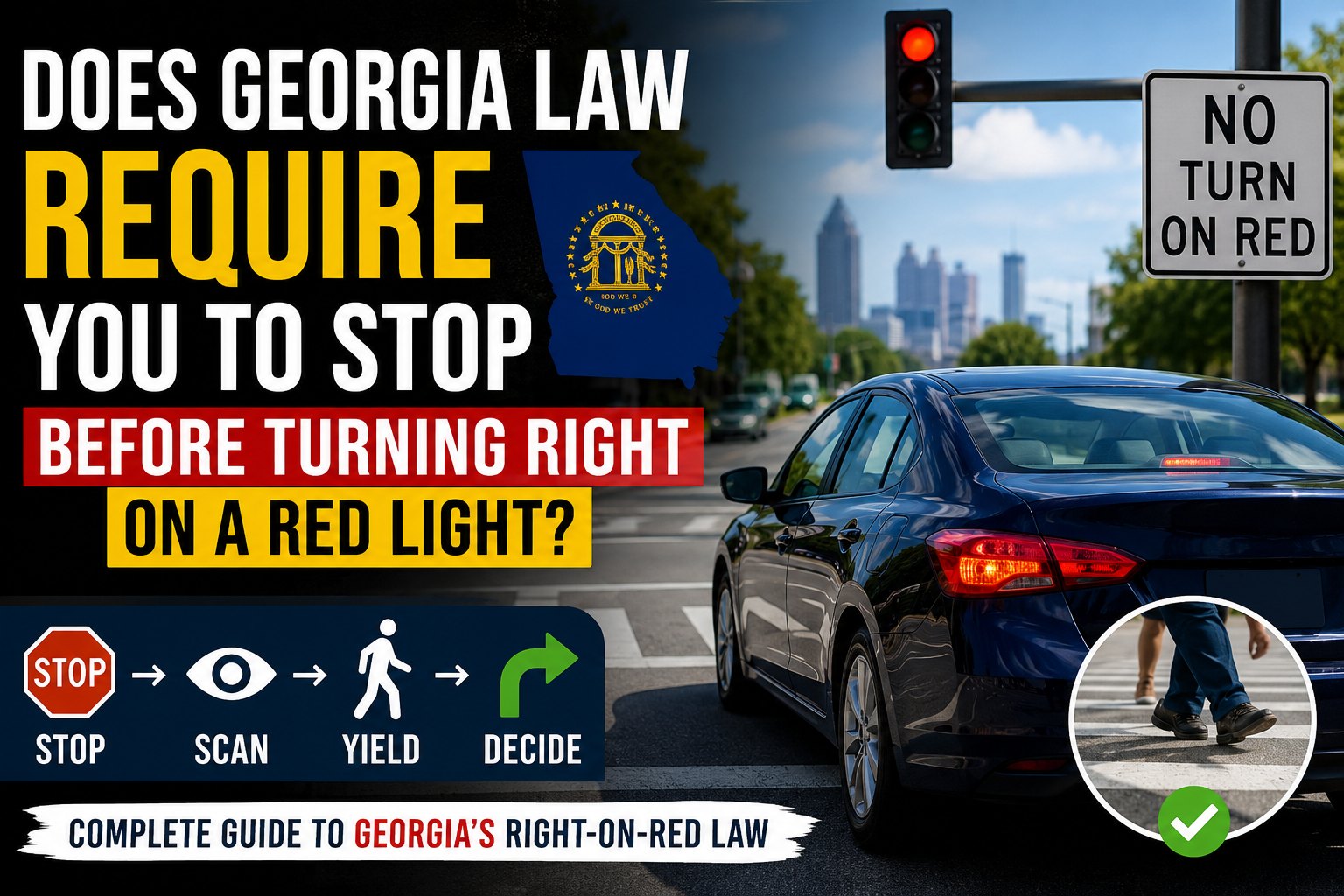
You are sitting at a red light. The road to your left looks clear, the driver behind you is creeping forward, and you only want to turn right. At that moment, one question matters: does Georgia law require you to stop before turning right on a red light? Yes, it does. You must make a complete stop before you enter the crosswalk or intersection, then yield to pedestrians and lawful traffic before turning.
The confusing part is that a right turn on red is allowed at many intersections, so some drivers treat the red light like a yield sign. That is not the rule. Permission to turn does not remove the duty to stop, and a rolling turn can still lead to a citation, points on your driving record, or serious fault questions after a crash.
While researching this guide, I compared the statute, the official driver guidance, lane rules, local restrictions, and common questions drivers ask after a ticket or collision. Most short articles answer only “yes” and stop there. This guide goes further by showing you where to stop, when you must wait, how red arrows differ, when a left turn on red is legal, and why changing lanes inside an intersection can create another violation.
Quick answer: Georgia generally allows a right turn on a steady circular red light only after a complete stop. You must remain stopped for pedestrians, yield to traffic that has the right of way, obey any posted prohibition, and turn only when the movement can be completed safely.
If you are learning how traffic rules fit within state and local authority, this explanation of how state law and local rules interact provides useful background. You can also explore more driving law guides as this topic area grows.
What Georgia Law Actually Says About a Right Turn on Red
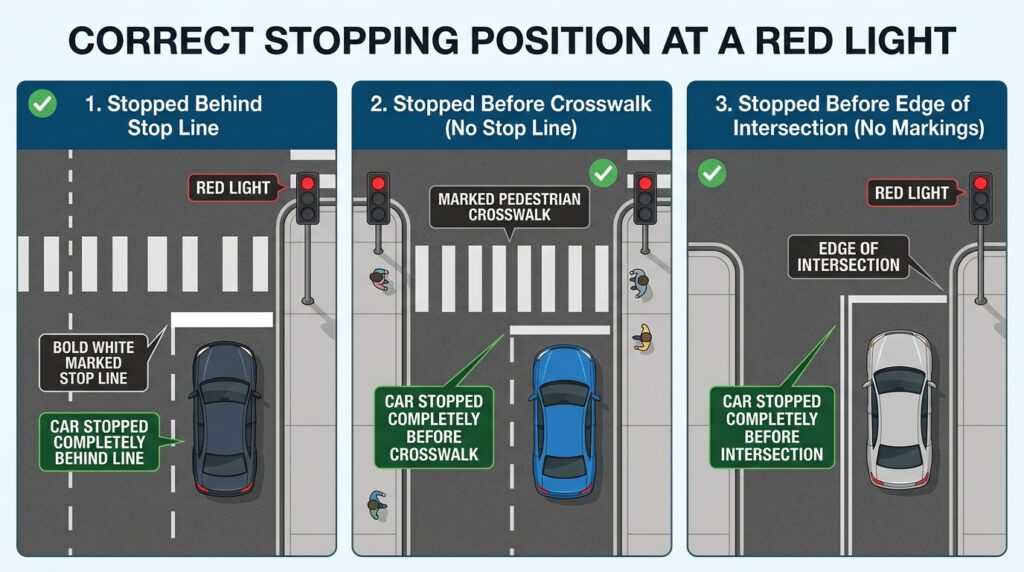
The controlling rule appears in Georgia Code Section 40-6-21. A driver facing a steady circular red signal must stop at the marked stop line. If there is no stop line, the driver must stop before entering the near-side crosswalk, and if there is no crosswalk, before entering the intersection.
After that stop, the law generally allows the driver to enter cautiously and make a right turn. However, the driver must remain stopped for pedestrians lawfully crossing and must yield to other traffic in the intersection. A posted sign prohibiting the turn removes permission completely.
The official driver manual explains the same rule in plain language. It says a right turn on red is permissible unless a sign prohibits it, but only after a complete stop, yielding to traffic and pedestrians, and deciding that the turn can be completed safely.
A red light is not a yield sign
A yield sign allows you to slow down and stop only when necessary. A steady red light requires a stop before the turn, even when no vehicle, bicycle, or pedestrian is visible. The order matters: stop first, observe second, yield as needed, and turn last.
This is where many drivers make a mistake. They slow to two or three miles per hour, look left, and continue around the corner without the wheels fully stopping. That movement may feel careful, but it is still a rolling stop and does not satisfy the full-stop requirement.
Where exactly should you stop?
The legal stopping point follows a clear order. You should use the first location at the intersection, rather than the one that gives you the best view.
- Stop at the clearly marked stop line if one is present. Keep the front of your vehicle behind the line.
- If there is no stop line, stop before entering the crosswalk. A crosswalk may exist even when the paint is faded or missing.
- If there is no stop line and no crosswalk, stop before entering the intersection itself. Do not roll into the path of cross traffic.
Sometimes the proper stop line is too far back to see around a building, a parked vehicle, a hedge, or a large truck. In that situation, make the required stop first. You may then ease forward cautiously for a better view, but you must not block the crosswalk, force a pedestrian to move, or enter the traffic lane before it is safe.
Can You Turn Right on Red in Georgia?
Yes, can you turn right on red in Georgia is normally answered with “yes, after stopping,” but several conditions can turn that yes into a no. The permission applies only to a steady circular red signal, not to every red indication or every intersection.
You may normally turn when all of the following are true:
- You have made a complete stop at the correct place.
- No sign prohibits a right turn on red.
- The signal is a steady circular red, rather than a steady red arrow controlling your movement.
- The crosswalk and your intended path are clear of pedestrians and bicyclists.
- You can yield to traffic that has a green light or otherwise has the right of way.
- You can enter the correct lane without crossing lanes or forcing another driver to brake.
You must wait when any one of those conditions is missing. The fact that a driver behind you honks does not change the law, and you are not required to make a right turn on red merely because it is permitted.
When can you turn right on red?
The safest answer to when can you turn right on red is: only after the intersection has become legally and practically clear. “Clear” does not mean you can squeeze into a small gap. It means your movement will not interfere with a pedestrian, bicycle, motorcycle, or vehicle that already has priority.
Look left for approaching traffic, but do not keep your head turned left while the car is moving. Look right for pedestrians entering from the near curb, check directly in front of your bumper, then look left again before you begin. This left-right-left pattern helps prevent the common crash in which a driver watches traffic from the left and misses a person walking from the right.
Is a right turn on red optional?
Yes. A legal right turn on red is permission, not a command. You may remain stopped until the light turns green when visibility is poor, traffic is fast, the gap is uncertain, a pedestrian is nearby, or you simply cannot confirm that the turn is safe.
My recommendation is simple: do not let pressure from the vehicle behind you make the decision. That driver cannot see every hazard from your position and will not carry your responsibility if the turn causes a collision.
When a Right Turn on Red Is Not Allowed
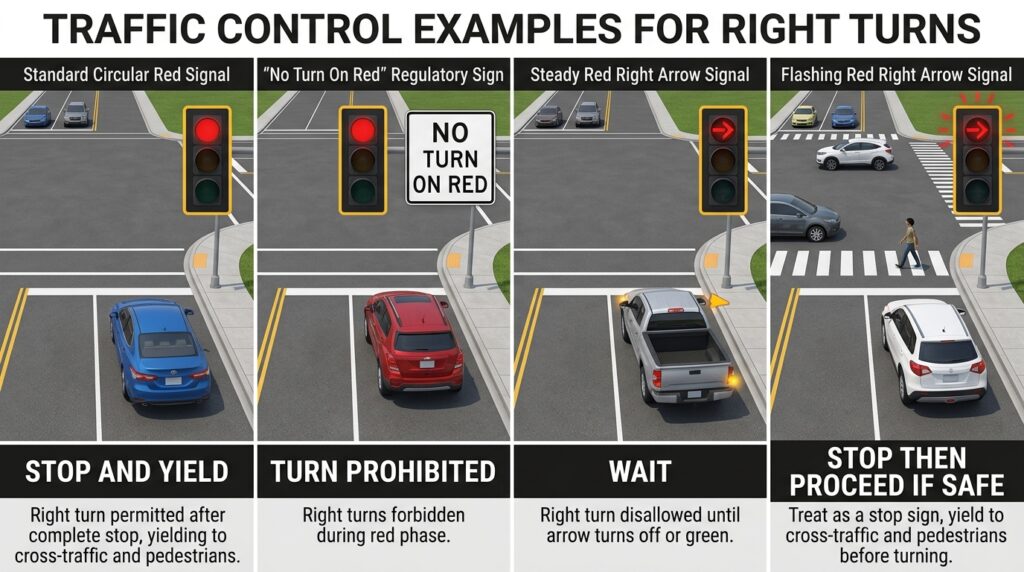
A right turn on red is prohibited when a sign says “No Turn on Red,” when a steady red arrow controls the right-turn movement, or when a police officer or authorized traffic controller directs you to remain stopped. It is also temporarily unavailable whenever pedestrians, bicycles, vehicles, or blocked lanes make the turn unsafe.
The rule is easy to remember as four gates. You need legal permission, a complete stop, a clear right-of-way, and a safe lane. If one gate is closed, you wait.
No Turn on Red signs
A posted prohibition is direct and enforceable. Some signs apply at all times, while others apply only during specific hours, days, or conditions, such as “when pedestrians are present.” Read the entire sign before assuming the restriction is permanent or temporary.
The driver manual’s traffic sign section includes a “No Right Turn on Red After Stop” sign. That wording means a complete stop does not create permission to turn. You must remain stopped until the signal permits the movement.
Steady red arrow versus flashing red arrow
A steady red arrow is stricter than a circular red light. Under the Georgia signal statute, traffic facing a steady red arrow may not enter the intersection to make the movement shown by the arrow until a signal permits it.
A flashing red arrow is different. Georgia law allows a right turn after stopping, remaining stopped for pedestrians, yielding to lawful traffic, and proceeding cautiously. Because signal designs can be unfamiliar, always follow the exact arrow, sign, and lane control facing your lane.
Right turn permitted on red sign
A right turn permitted on red sign confirms that a turn may be made under the stated conditions. It does not usually mean you can roll through the light or ignore pedestrians. Unless the sign gives a different lawful instruction, the full-stop and yield duties still apply.
Treat the sign as permission layered on top of the safety rules. It tells you the turn may be available, but your own observation determines whether it is safe at that moment.
Local restrictions, including parts of Atlanta
State law provides the general rule, but local authorities can restrict turns through properly placed traffic-control signs. Atlanta adopted legislation to prohibit right turns on red in parts of Downtown, Midtown, and Castleberry Hill, with implementation tied to signs at affected intersections. The practical rule for you is to read the sign facing your lane rather than rely on memory of the neighborhood.
This local example also explains why a search result that says “right on red is legal in Georgia” may be incomplete. Statewide permission remains subject to posted restrictions, special signal arrows, temporary traffic control, and the facts present at the intersection.
The Correct Way to Make a Right Turn on Red
Knowing can you turn right on red is not enough. The turn must be completed in a lawful sequence, and that sequence should become a repeatable habit rather than a rushed judgment.
Use this seven-step method:
- Signal early. Activate your right indicator before reaching the intersection so pedestrians, cyclists, and drivers understand your intention.
- Move into the proper lane. Approach as close as practicable to the right curb or right edge, unless signs or pavement arrows direct another path.
- Make a complete stop. Stop behind the line, before the crosswalk, or before the intersection, using the legal order explained above.
- Scan the crosswalk first. Check both sides for people walking, wheelchair users, children, runners, and cyclists who may enter quickly.
- Check traffic and blind spots. Look left, right, left again, then check the passenger-side mirror and blind area before moving.
- Yield for as long as needed. Do not inch into a pedestrian’s path or force a vehicle with a green light to slow down.
- Turn into the proper lane. Complete the turn close to the right edge and establish your position before considering any later lane change.
A useful mental phrase is: “stop, scan, yield, turn.” It is shorter and safer than treating the maneuver as one continuous motion.
Do you need to stop twice?
The law requires the first complete stop at the proper legal point. A second pause may become necessary after you ease forward because the original position did not provide a clear view. That second pause is not a substitute for the first stop.
For example, imagine a delivery van blocks your view to the left. Stop behind the line, check the crosswalk, move forward slowly without blocking anyone, pause where you can see, then turn only after the lane is clear. This method satisfies the legal stop while dealing with the real visibility problem.
Which lane should you enter?
Georgia’s turning rule says a right-turn approach and the turn itself should be made as close as practicable to the right curb or edge. In a normal multi-lane road, that usually means entering the nearest lawful right lane rather than swinging wide into the second or third lane.
A wide turn can surprise a driver who is lawfully using another lane. It may also create an improper turn or an unsafe lane change issue, especially if the driver crosses lane lines while still inside the intersection.
Can You Turn Left on Red?
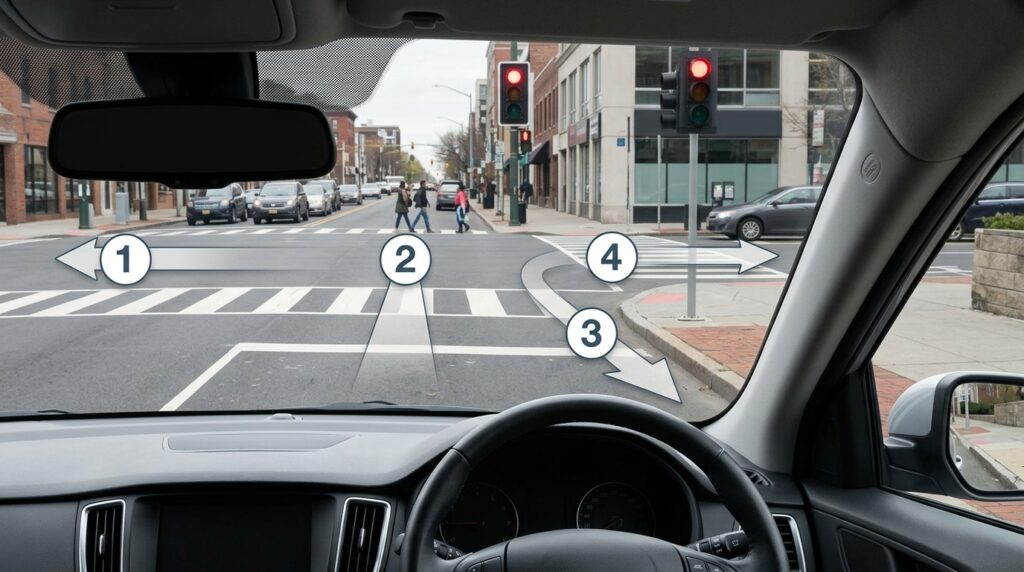
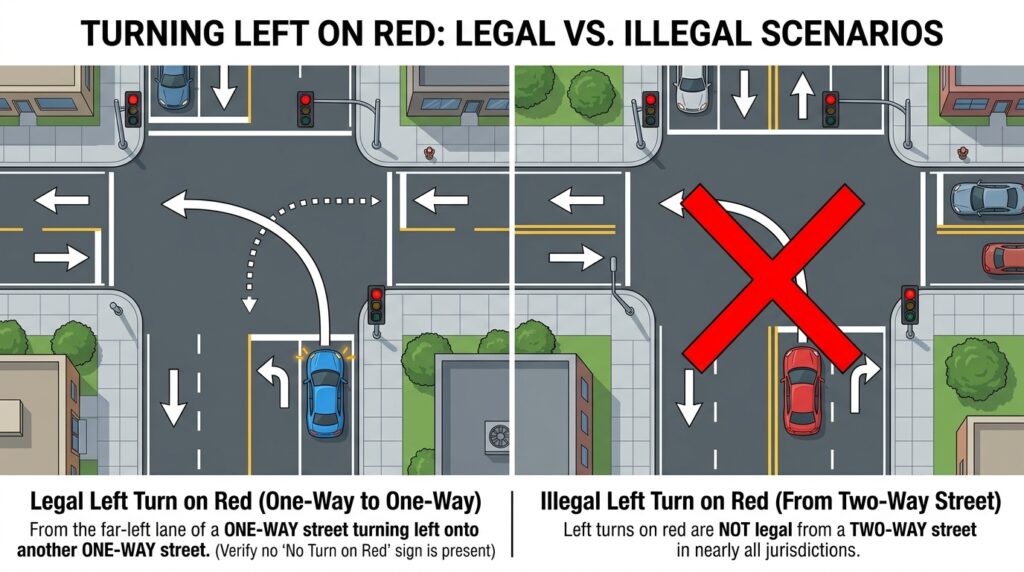
Many drivers assume every red-light turn rule applies only to right turns. Georgia also permits one narrow type of left turn on red, but both the starting and destination roads must be one-way streets.
Under the same signal statute, a driver may turn left from the left-hand lane of a one-way street onto another one-way street where traffic moves toward the driver’s left. The driver must first stop, remain stopped for pedestrians, yield to lawful traffic, obey signs, and proceed only when safe.
Can you turn left on red on a one way?
The complete answer to can you turn left on red on a one way is that one one-way street is not enough. You must be leaving a one-way street and entering a one-way street, and the destination traffic must flow to your left. A left turn from a two-way street onto a one-way street is not included in this permission.
Before making the turn, confirm the destination is truly one-way. Look for one-way signs, lane arrows, parked-car direction, and traffic flow, but give controlling weight to official signs and signals.
Can you make a left turn on red from a two-way street?
No, Georgia’s exception does not allow that movement. When asking can you make a left turn on red, remember the simple formula: one-way to one-way, from the left lane, after a complete stop, with no prohibiting sign.
If either road carries two-way traffic, wait for a green signal or another signal that lawfully permits the turn. Do not copy another driver because that driver may be mistaken or may be following a signal you cannot see from your lane.
When Turning Left at an Intersection
The phrase when turning left at an intersection covers more than the traffic light. A driver must choose the correct approach lane, yield to immediate hazards, follow the proper path, and avoid drifting into another lane during the turn.
Georgia’s left-turn right-of-way rule requires a driver turning left to yield to an oncoming vehicle that is already in the intersection or close enough to create an immediate hazard. A green circular light does not automatically give the left-turning driver priority over oncoming traffic.
Left turn intersection rules you should follow
The main left turn intersection rules can be reduced to these points:
- Approach from the extreme left-hand lane lawfully available for your direction.
- Signal early enough to alert other road users.
- Yield to oncoming vehicles that are in or close to the intersection.
- Yield to pedestrians and bicyclists crossing the road you are entering.
- Keep your wheels straight while waiting, when practical, so a rear impact is less likely to push you into oncoming traffic.
- Follow lane arrows and protected-turn signals.
- In multiple left-turn lanes, exit in the same relative lane in which you entered.
A green arrow generally allows protected movement, but you should still check for pedestrians, bicyclists, blocked lanes, emergency vehicles, or drivers who entered unlawfully. Right of way reduces conflict. It does not make a collision physically impossible.
Do not cut the corner
A left turn should not cross the center too early or enter the wrong side of the destination road. Cutting the corner can place your vehicle in the path of a car approaching its stop line or waiting to turn.
Aim for a smooth path that passes to the left of the intersection’s center when practicable, then enters the proper lawful lane. In multiple turn lanes, follow the pavement guides and maintain your lane through the full turn.
Is It Illegal to Change Lanes in an Intersection?
For Georgia drivers, the answer to is it illegal to change lanes in an intersection is important because older articles and casual driving advice often conflict. Georgia Code Section 40-6-120 states that where multiple lanes travel in the same direction and are safe for travel, a vehicle is not permitted to change lanes after entering the intersection.
The same section says drivers using multiple left-turn lanes must leave the intersection in the same relative lane in which they entered. A driver in the second left-turn lane should therefore exit into the corresponding second lane rather than drifting into the first or third lane.
Why lane changes inside intersections are risky
Other drivers use your entry lane to predict where you will exit. When you switch lanes mid-intersection, a turning vehicle, through vehicle, cyclist, or pedestrian may not have enough time or space to react.
The intersection may also contain faded lane guides, turning arcs, crosswalks, and vehicles entering from several directions. Waiting a few seconds until you have cleared the intersection gives you a more stable view and a normal lane-change process with mirrors, signal, and blind-spot check.
What if your lane is blocked after the turn?
Do not enter an intersection unless you have a safe path through it. If you discover an unexpected obstruction while turning, slow down, avoid a collision, and follow any officer or work-zone direction. Safety comes first, but a planned lane change inside the intersection should not be your normal solution.
When the road is clear, complete the turn in your assigned lane. Signal and change lanes after leaving the intersection, and confirm the new lane is safe.
Can You Turn Right on Red in California?
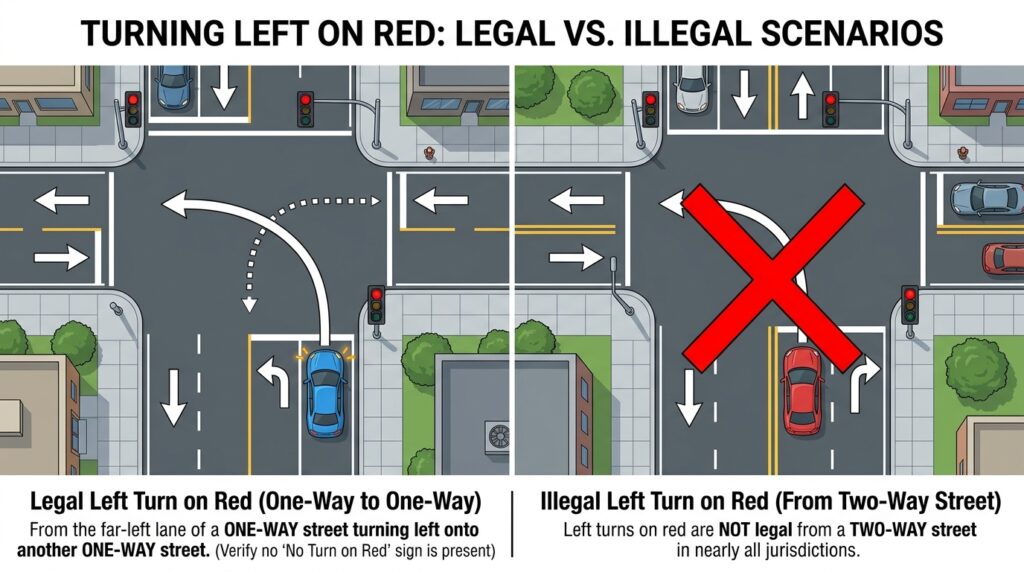
People searching for “can you turn right on red in California” will find a rule similar to Georgia’s basic rule. The current driver handbook says a driver may turn right at a red light when no “No Turn on Red” sign is posted, after stopping at the stop or limit line, yielding to pedestrians, and turning only when safe.
California also treats a red arrow differently. A driver must remain stopped and may not turn in the arrow’s direction until a green signal or green arrow appears. That is broadly consistent with the Georgia distinction between a circular red and a steady red arrow.
Can you turn left on red in California?
California also permits a left turn on red from a one-way street onto a one-way street when no sign prohibits it. The turning guidance instructs drivers to yield to vehicles, pedestrians, and bicyclists who have a green light and to turn only when safe.
The comparison is useful, but do not assume every detail is identical. Dedicated right-turn lanes, local signs, lane markings, and enforcement practices can differ, so the controls at the actual intersection always matter.
| Question | Georgia | California |
|---|---|---|
| Right turn on circular red | Generally allowed after a complete stop and yield | Generally allowed after a complete stop and yield |
| Turn on steady red arrow | Not allowed in the arrow’s direction | Not allowed in the arrow’s direction |
| Left turn on red | One-way street to one-way street, subject to stop and yield | One-way street to one-way street, subject to stop and yield |
| No Turn on Red sign | Must be obeyed | Must be obeyed |
| Pedestrian priority | Driver must remain stopped or yield as required | Driver must yield and turn only when safe |
Common Right-on-Red Mistakes
Most right-on-red violations do not begin with a driver deciding to ignore the law. They begin with a rushed habit, a blocked view, pressure from another driver, or confusion about which signal controls the lane.
These are the mistakes I would watch for most closely:
- Rolling through the stop line: Slowing down is not a complete stop.
- Stopping on the crosswalk: The vehicle may block or intimidate a person who has the right to cross.
- Looking only left: A pedestrian or cyclist may approach from the right, directly in front of the vehicle.
- Turning on a steady red arrow: A circular red rule does not automatically apply to an arrow.
- Ignoring a time-limited sign: A restriction may apply only during school, commuter, or pedestrian-heavy hours.
- Swinging into a far lane: The turn should normally enter the nearest lawful lane.
- Changing lanes before clearing the intersection: Georgia’s turning statute prohibits this in the multi-lane situation described above.
- Assuming a green light makes every movement safe: Crosswalk users and blocked traffic may still require you to wait.
Practical examples
Example 1: The road looks empty. You approach a circular red light at 2:00 a.m. No traffic is visible. You still need to stop fully, check the crosswalk and roadway, and turn only if no sign prohibits it.
Example 2: A pedestrian has the walk signal. You stop, but someone begins crossing the road to the destination. You remain stopped and allow the person to clear your path rather than moving through a narrow gap.
Example 3: Your view is blocked. You stop behind the line, check the near crosswalk, ease forward slowly, pause again where you can see, and turn only after confirming the lane is clear.
Example 4: The right arrow is red. The through signal may be green or another lane may be moving, but your steady red arrow controls your turn. You wait for a signal that permits a right turn.
Example 5: Two left-turn lanes are marked. You enter from the outer left-turn lane. You stay in the corresponding outer lane through the intersection, then change lanes later if it is safe and legal.
Tickets, Points, and Accident Consequences
Failing to stop before a right turn can be cited as failure to obey a traffic signal or related traffic-control violation. The Georgia points schedule lists three points for failure to obey a traffic signal or light under Code Section 40-6-21. Court costs and fines can vary by jurisdiction and by the exact charge written on the citation.
A citation may also affect insurance pricing, employment driving records, or license status when combined with other convictions. Georgia states that a driver who accumulates 15 points within 24 months may face suspension, while younger drivers can face stricter suspension rules for certain point totals or offenses.
What happens if a crash occurs during the turn?
The traffic ticket and the civil claim are related but not identical. An officer may cite one driver, yet insurers and courts may still examine every person’s conduct, including speed, visibility, signal use, crosswalk position, lane choice, distraction, and whether the other road user had an opportunity to avoid the collision.
Evidence becomes important quickly. Traffic-camera video may be overwritten, businesses may delete recordings, vehicles may be repaired, and witnesses may become harder to locate. A clear record can help show whether the driver stopped, which signal was displayed, where the impact occurred, and who occupied each lane.
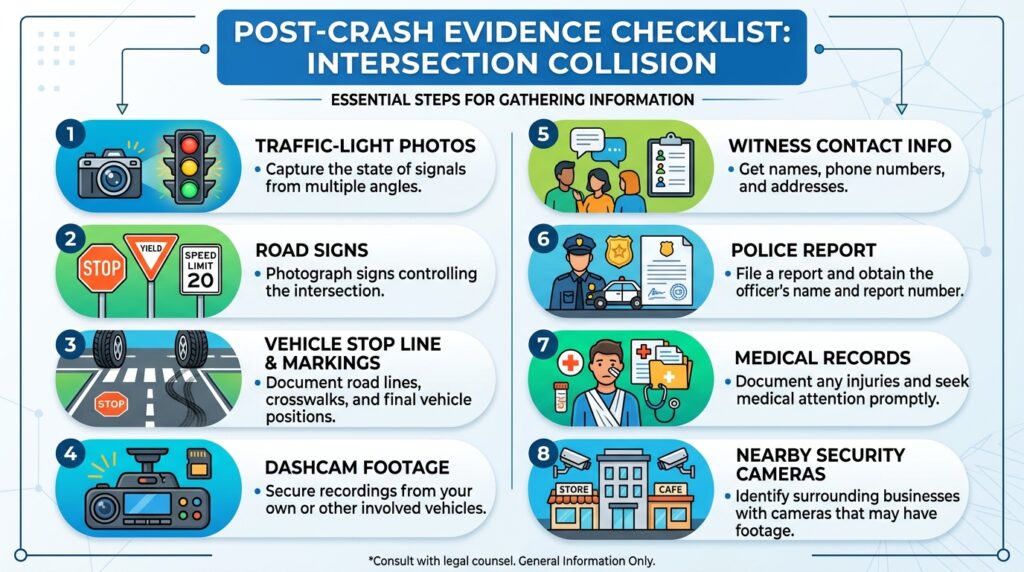
After a crash, consider preserving:
- Wide and close photographs of the intersection, signal heads, signs, lane arrows, stop line, crosswalk, and vehicle positions.
- A short video showing the driver’s actual line of sight from the stop point.
- Dashcam footage from all involved vehicles.
- Names and contact details for independent witnesses.
- The police report number and the exact code section on any citation.
- Medical records, repair estimates, towing documents, and time missed from work.
- Any nearby business or residential cameras that may have captured the event.
Do not alter or selectively edit original files. Save copies, retain timestamps, and provide complete footage when legally required. A short clip can be misleading when it removes the approach, the stop, or the signal phase.
When should you speak with a lawyer?
Legal advice may be useful when the crash caused injury, the fault is disputed, a commercial license or job is at risk, the citation could trigger suspension, or video evidence needs to be preserved quickly. It may also help when an insurance company asks for a recorded statement before you understand the full facts or medical impact.
This article provides general education, not advice for a specific case. A local lawyer can review the citation, municipal court process, police report, insurance policy, and current law that apply to your circumstances.
Safety Data and the Real Risk Behind the Rule
The stop requirement is not a technical formality. Drivers turning right often look left toward approaching vehicles while a pedestrian or cyclist enters from the right. That mismatch in attention creates a predictable point of conflict.
A federal review of pedestrian safety research described studies in which right-turn-on-red pedestrian crashes often involved a driver watching traffic from the left and failing to see a pedestrian approaching from the right. The review also reported that many observed drivers failed to make a full stop where right turns on red were allowed.
Current national figures add context. Pedestrian safety data reports that 7,080 pedestrians were killed and more than 71,000 were injured in traffic crashes in 2024. Not all involved right turns or intersections, but the numbers show why a driver’s crosswalk check deserves the same attention as the search for a gap in vehicle traffic.
Pros and cons of allowing right turns on red
Right turns on red can improve traffic flow and reduce waiting when the intersection is clear. They may also reduce unnecessary idling and allow road capacity to be used more efficiently.
The disadvantages arise when drivers focus on merging rather than crossing safely. Pedestrians, cyclists, children, older adults, and people with disabilities may be harder to see or may need more time, which is why high-foot-traffic areas often post restrictions.
| Potential benefits | Potential risks |
|---|---|
| Shorter delay at clear intersections | Rolling stops and missed crosswalk users |
| Better traffic flow in low-conflict conditions | Drivers looking left while moving right |
| Less unnecessary idling | Confusion about arrows, signs, and lane control |
| Flexible operation outside busy periods | Wider turns and lane conflicts |
The balanced approach is not “always turn” or “never turn.” It is to permit the movement only after a true stop and only when the design, signs, visibility, traffic, and pedestrian conditions make it safe.
Expert Tips for Safer and More Defensible Turns
Good driving is not only about avoiding a citation. It is also about making your actions easy for another driver, witness, officer, insurer, or camera to understand after the event.
Use these habits:
- Create a visible stop. Let the vehicle settle for a moment rather than braking and immediately releasing in one motion.
- Keep the crosswalk open. Stop behind the line so pedestrians can move without walking around your bumper.
- Move your eyes before your wheels. Complete the full scan while stationary whenever possible.
- Check the right side twice. A cyclist or runner can enter the path after your first glance.
- Turn into the nearest lawful lane. Establish your lane before planning the next maneuver.
- Wait when the sight line is uncertain. A few seconds are cheaper than a crash, citation, or injury claim.
- Recheck temporary controls. Construction, events, school hours, and local safety projects can change the normal pattern.
- Ignore social pressure. A horn does not create legal permission or safe visibility.
One habit has helped me simplify this rule while reviewing different scenarios: separate permission from safety. The signal and signs answer whether a turn may be legal. Your stop, scan, yield, and lane choice answer whether it is safe to make it now.
Frequently Asked Questions
1. Does Georgia law require you to stop before turning right on a red light?
Yes. You must make a complete stop at the marked stop line, before the crosswalk if there is no line, or before the intersection if neither exists. After stopping, you may turn only when no sign or steady red arrow prohibits the movement and after yielding to pedestrians and lawful traffic.
2. Can you turn right on red in Georgia after a rolling stop?
No. A rolling stop does not satisfy the complete-stop requirement. Even when the road appears empty, your wheels should stop before you check, yield, and proceed.
3. Can you turn left on red in Georgia?
Yes, but only in the narrow one-way-to-one-way situation. You must start from the left-hand lane of a one-way street, enter a one-way street moving left, make a complete stop, yield, and obey any sign that prohibits the turn.
4. Is it illegal to change lanes in an intersection in Georgia?
Georgia’s turning statute says a vehicle is not permitted to change lanes after entering an intersection where multiple lanes travel in the same direction and are safe for travel. Drivers in multiple left-turn lanes must also exit in the same relative lane in which they entered.
5. Do you have to turn right on red when the driver behind you honks?
No. A right turn on red is optional even when it is generally permitted. You may wait for green when you cannot confirm a clear crosswalk, a safe traffic gap, the correct lane, or an unobstructed view.
Conclusion
So, does Georgia law require you to stop before turning right on a red light? Yes. The legal sequence is a complete stop, a careful crosswalk and traffic scan, a full yield to anyone with priority, and a controlled turn into the proper lane.
Do not reduce the rule to “right on red is allowed.” The more accurate rule is “right on red may be allowed after stopping, unless a sign, arrow, pedestrian, vehicle, lane condition, or local control requires you to wait.” Save this guide, review the signs at the intersection, and choose the safer decision whenever the situation is uncertain.
