


Social Security: The Complete Guide to Benefits, Eligibility, Payments and Retirement
If you search for Social Security, you may be looking for a much simpler answer than the system gives you. You may want to know when you can retire, how much money you could receive, whether your spouse qualifies, what happens if you continue working, or why part of your benefit could be taxable.
I noticed the same problem while researching this guide. The information exists, but it is spread across retirement pages, tax rules, disability programs, family-benefit rules, annual updates, and dozens of individual questions. That makes a simple decision such as “Should I claim at 62 or wait?” surprisingly difficult.
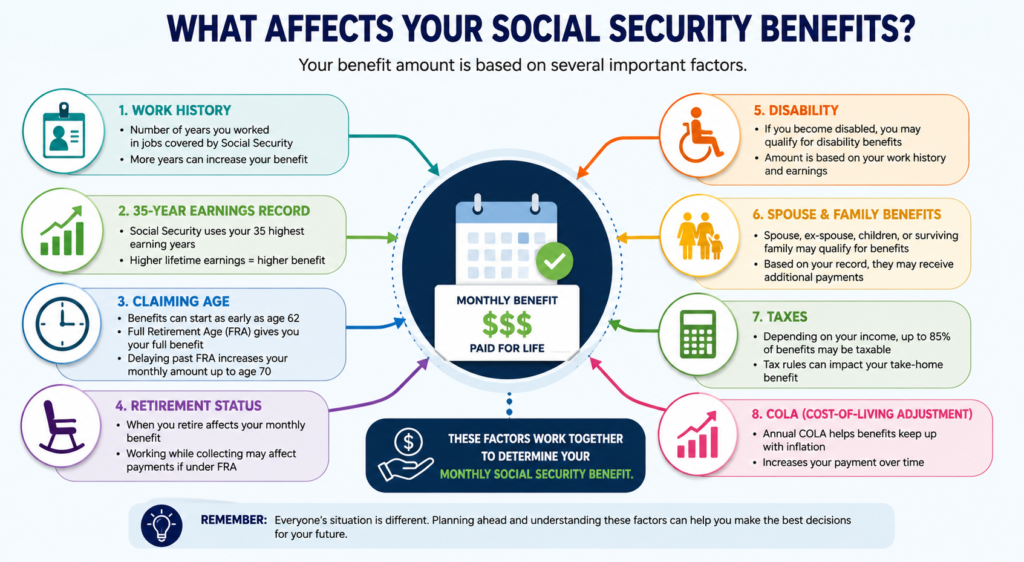
This guide puts those pieces together. Instead of treating Social Security as nothing more than a monthly retirement check, I will show you how your work history, age, family situation, income, taxes, disability status, and even the year in which you claim can affect what you receive.
There are also important 2026 numbers to know. The 2026 cost-of-living adjustment is 2.8%, the Social Security taxable earnings maximum is $184,500, and the estimated average benefit for all retired workers after the COLA is $2,071 per month. The maximum retirement benefit for a worker retiring at full retirement age in 2026 is $4,152 per month, although most retirees receive considerably less.
The most important thing I recommend before making any retirement decision is this: do not judge your situation by somebody else’s Social Security check. Two people of the same age can receive very different amounts because their earnings histories, claiming ages, family circumstances, and benefit types are different.
What Is Social Security?
So, what is Social Security in practical terms?
Social Security is a federal social insurance system. Workers and employers generally pay Social Security taxes while people are working. Those taxes help finance benefits for eligible retired and disabled workers and for certain spouses, children, survivors, and other family members.
This distinction matters because Social Security is much broader than retirement. According to the official benefit types explained by the Social Security Administration, its programs include retirement, disability, survivor, and family benefits. The agency also administers Supplemental Security Income, or SSI, although SSI is different from Social Security benefits based on a worker’s earnings record.
Here is the simple version:
| Benefit | Generally designed for |
|---|---|
| Retirement | Eligible workers who reach retirement age |
| Disability | Eligible workers with qualifying disabilities |
| Spousal/family | Certain spouses, ex-spouses, children and other eligible family members |
| Survivor | Certain family members after an eligible worker dies |
| SSI | Certain people with limited income/resources who are aged, blind or disabled |
One reason I would not describe Social Security as simply a “retirement account” is that your payroll taxes are not sitting in an individual investment account with your name on it. Social Security operates as a social insurance program with benefits determined under federal law.
That difference helps explain something people sometimes find confusing. The amount you eventually receive is not simply the Social Security tax you personally paid, divided into monthly checks. Your benefit is calculated using your covered earnings history and a statutory benefit formula.
If you want to understand broader government rules and programs in plain language, the civil services guides on this site cover other public-system questions using the same practical approach.
How Does Social Security Work?
For most employees, Social Security starts appearing on a paycheck long before retirement becomes a serious thought.
In 2026, the Social Security portion of the payroll tax is 6.2% for employees, with employers generally paying another 6.2%. The combined Social Security and Medicare withholding for employees is 7.65%. Self-employed workers generally pay both the employee and employer portions of self-employment tax, subject to applicable rules and deductions.
For Social Security specifically, the 6.2% OASDI tax applies only up to the annual taxable maximum. That maximum is $184,500 in 2026, up from $176,100 in 2025. Medicare works differently because its basic tax does not use that same earnings ceiling.
A Simple Example
Suppose Maria works for 38 years and pays Social Security taxes on her covered earnings. During those years, her earnings are added to her Social Security record.
When Maria later applies for retirement benefits, the agency does not simply look at her final salary. It uses her earnings history, indexes applicable past earnings, and applies the Social Security benefit formula.
Her claiming age then matters too. If Maria claims before her full retirement age, her monthly retirement benefit is generally reduced. If she delays beyond full retirement age, her monthly retirement benefit can increase until age 70. That is why I think of Social Security as having two separate questions:
- What benefit have your earnings built?
- When should you start receiving it?
People often focus almost entirely on the second question. But a mistake in your earnings record can affect the first one.
Check Your Earnings Record Before Retirement
One practical step that deserves much more attention is reviewing your earnings record before you file.
The retirement preparation tools allow workers to review their record and obtain estimates based on their earnings. The agency specifically recommends checking whether the yearly income recorded for you is accurate.
If I were planning for retirement, I would not wait until age 62 to consider this for the first time. I would review the earnings record periodically, especially after changing jobs, becoming self-employed, or noticing anything unusual in tax records.
A missing or incorrect year can matter because Social Security calculations depend heavily on your lifetime covered earnings.

How Do Social Security Credits Work?
You may hear people say that you need “40 credits” to retire. That statement is useful, but it needs context.
Workers earn Social Security credits through covered work. The earnings required per credit can change annually. In 2026, one credit is earned for each $1,890 in covered earnings, and you can earn a maximum of four credits during the year. That means earning $7,560 in covered earnings during 2026 is enough to earn the maximum four credits for that year.
You cannot earn five or six credits by making more money. Four is the annual maximum. For retirement benefits, a worker generally needs 40 credits, which commonly represents about 10 years of covered work. The official retirement benefit requirements explain that retirement benefits can typically begin at age 62 for someone who has worked and paid Social Security taxes for 10 years or more.
Credits Determine Eligibility, Not Your Benefit Amount
This is an important distinction. Having 40 credits can help establish eligibility for retirement benefits, but earning exactly 40 credits does not mean you will receive the same monthly benefit as another worker who also has 40 credits.
Consider two workers.
Worker A has 10 years of relatively modest covered earnings and then stops working.
Worker B has 35 years of higher covered earnings.
Both may have enough credits to meet the basic retirement eligibility requirement, but their monthly benefits could differ significantly. Your credits help answer whether you qualify. Your covered earnings history helps determine how much you may receive. That is one of the most useful distinctions to remember throughout this guide.
Who Can Qualify for Social Security Benefits?
Social Security eligibility is not limited to someone who worked until retirement and then turned 65. Depending on the program and circumstances, benefits may potentially be available to:
- Retired workers with sufficient covered work history
- Workers who meet Social Security’s disability requirements and work-history rules
- Spouses of eligible workers
- Certain divorced spouses
- Children of eligible workers
- Survivors of deceased workers
- Certain dependent parents
- People eligible for Supplemental Security Income under separate financial and eligibility rules
The exact rules vary by category. That is why hearing that someone “gets Social Security” tells you surprisingly little about the type of benefit they actually receive.
Can You Qualify Without 40 Credits?
Possibly, depending on the benefit involved. The 40-credit rule is generally associated with retirement eligibility based on your own record. Disability benefits use different work-credit rules, which can depend on your age when disability begins.
Family and survivor benefits can also be based on another person’s earnings record. This becomes especially important for a spouse who spent many years outside paid employment while raising children. Having little or no earnings history does not automatically mean that person will never qualify for any Social Security benefit.
We will examine spousal, divorced-spouse, child, and survivor benefits in detail later in this guide.
The Main Types of Social Security Benefits
Many articles jump straight from “What is Social Security?” to retirement age. I think that skips one of the most important steps. Before asking how much you can receive, first identify which benefit you are actually discussing.
1. Retirement Benefits
Retirement benefits are monthly payments based primarily on a qualifying worker’s earnings history. You can generally start retirement benefits as early as age 62, but claiming early can permanently reduce the monthly amount compared with waiting until full retirement age. Delaying beyond full retirement age can increase your monthly retirement benefit up to age 70.
2. Social Security Disability Insurance
Social Security Disability Insurance, commonly called SSDI, provides benefits to eligible people who meet Social Security’s disability criteria and have sufficient work history.
SSDI should not be confused with SSI. That difference matters because someone searching for “Social Security disability” may actually be talking about either program.
3. Family Benefits
Certain family members of a worker who qualifies for retirement or disability benefits may also qualify for payments. Depending on the circumstances, eligible family members can include:
- A spouse
- An ex-spouse
- Children
- In some circumstances, grandchildren
Family-benefit rules include age, marriage, caregiving, disability, and other conditions. They should therefore be checked individually rather than assuming every spouse or child automatically qualifies.
4. Survivor Benefits
Social Security does not necessarily stop helping a family when a worker dies. Certain spouses, ex-spouses, children, and dependent parents may qualify for survivor benefits based on the deceased worker’s record.
This is also one reason claiming decisions between married couples can become more complicated than simply asking which spouse should claim first.
5. Supplemental Security Income
Supplemental Security Income, or SSI, is often grouped into Social Security discussions because the same agency administers it. But SSI is a separate program with different eligibility concepts.
SSI is intended for eligible people with limited income and resources who are aged 65 or older, blind, or disabled. In 2026, the federal SSI payment standard is $994 per month for an individual and $1,491 per month for an eligible couple, before accounting for other factors that can affect actual payments.
The 2026 federal SSI resource limits, as listed by Social Security, remain at $2,000 for an individual and $3,000 for a couple. Not every asset is counted in the same way, so someone evaluating SSI eligibility should review the detailed rules rather than relying solely on a bank balance.
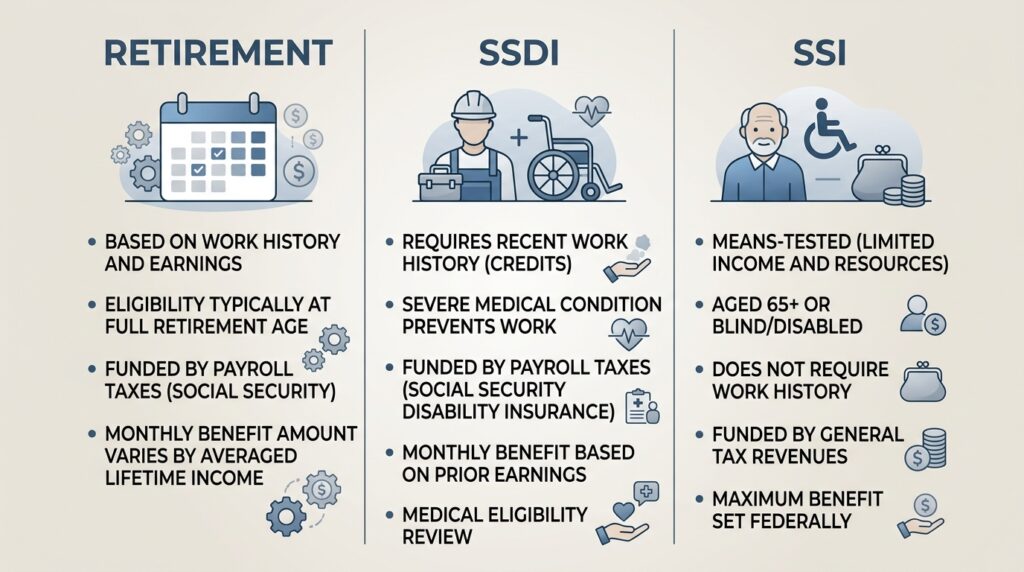
Quick Comparison: Retirement vs SSDI vs SSI
| Feature | Retirement | SSDI | SSI |
| Based on work record | Yes | Yes | No, not in the same way |
| Disability required | No | Yes | Disability/blindness, or age 65+ |
| Can start at age 62 | Retirement can | Not an age-62 retirement program | Age/disability rules differ |
| Financial need test | No general needs test | No general needs test like SSI | Yes |
| Administered by Social Security | Yes | Yes | Yes |
This table is deliberately simplified. Individual eligibility can be more complicated.
How Much Social Security Will I Get?
This is probably the question that matters most to people approaching retirement. Unfortunately, there is no universal answer. Your Social Security retirement payment depends largely on your earnings record and when you claim. Social Security uses a formula based on your indexed earnings and your primary insurance amount (PIA).
Why Your 35-Year Earnings History Matters
For retirement calculations, Social Security generally uses up to your 35 highest years of indexed earnings. This creates a detail that can have a surprisingly large effect. If you have fewer than 35 years of covered earnings, zero-earning years can enter the calculation. Continuing to work may therefore help if a new earnings year replaces a zero or a lower-earning year among the 35 years used.
Imagine two people who both retire at 67.
David worked for 35 years. He has earnings available for every year in the 35-year calculation.
Robert worked for 25 years. His calculation can include 10 years of zero.
Even if Robert earned good money during those 25 years, the missing years can bring his average down. This is why I would never estimate a retirement benefit based solely on someone’s current salary.
What Is AIME?
Social Security adjusts applicable historical earnings for wage changes and uses the relevant years to calculate Average Indexed Monthly Earnings, or AIME.
A formula is then applied to AIME to determine the worker’s primary insurance amount. You do not need to calculate this manually just to plan retirement. Your personal account can provide estimates. However, understanding the basic mechanism helps explain why earnings history matters.
What Is the Primary Insurance Amount?
The primary insurance amount, or PIA, is central to your benefit calculation. It is generally the amount on which the retirement benefit payable at full retirement age is based, before other applicable adjustments. Claiming earlier can reduce the retirement amount. Claiming later can increase it. COLAs can also affect benefit amounts over time.
The official explanation of how COLA applies to retirement benefits shows that the calculation involves the PIA and subsequent adjustments, rather than simply adding a percentage to the amount shown in your bank account.
What Is the Average Social Security Benefit in 2026?
After the 2.8% 2026 COLA, Social Security estimates these average monthly payments:
| Beneficiary category | Estimated average monthly benefit, January 2026 |
| All retired workers | $2,071 |
| Aged couple, both receiving benefits | $3,208 |
| Aged widow or widower alone | $1,919 |
| All disabled workers | $1,630 |
| Disabled worker with spouse and child/children | $2,937 |
| Widowed mother with two children | $3,898 |
These are averages, not guaranteed payments. Your own benefit can be substantially lower or higher.
What Is the Maximum Social Security Benefit in 2026?
The maximum benefit is another figure that can be misleading when taken out of context. For 2026, Social Security lists a maximum benefit of $4,152 per month for a worker retiring at full retirement age.
That does not mean everyone reaching full retirement age can receive $4,152. Maximum benefits generally require a history of earnings at or above the relevant Social Security taxable maximum for many years.
I would therefore treat the maximum benefit as an upper-end reference point, not a realistic estimate for the average worker. Your own Social Security estimate is much more useful.
When Can You Take Social Security?
For retirement benefits, 62 is generally the earliest age to claim. But “eligible at 62” and “best to claim at 62” are completely different statements.
You can generally apply for retirement benefits between ages 62 and 70. The longer you wait within that range, the higher your monthly retirement benefit generally becomes, up to age 70. There is no additional delayed-retirement increase simply for waiting beyond age 70.
Understanding Full Retirement Age
Your full retirement age, or FRA, depends on your birth year. For people born in 1960 or later, full retirement age is 67. People born earlier may have an FRA between 66 and 67, depending on the year of birth. Here is a useful simplified reference:
| Birth year | Full retirement age |
| 1943–1954 | 66 |
| 1955 | 66 and 2 months |
| 1956 | 66 and 4 months |
| 1957 | 66 and 6 months |
| 1958 | 66 and 8 months |
| 1959 | 66 and 10 months |
| 1960 or later | 67 |
The age at which you start receiving benefits can have a permanent effect on your monthly retirement amount.
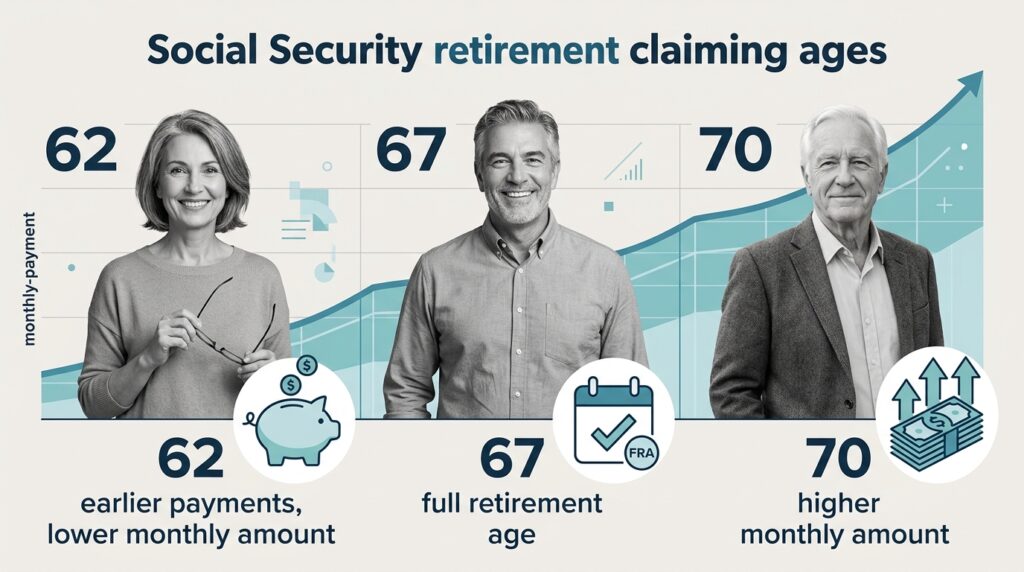
Claiming at 62
Starting at 62 gives you access to benefits earlier, but your monthly payment is lower than if you wait until full retirement age. For someone whose FRA is 67, claiming at 62 can produce a reduction of roughly 30% from the full-retirement-age amount.
That reduction is not simply erased when the person turns 67. This is one of the biggest misunderstandings I see in retirement discussions. People sometimes assume they can claim the smaller benefit at 62 and automatically “graduate” to their full benefit at FRA. That is not generally how the early-claim reduction works.
Claiming at Full Retirement Age
At FRA, you can generally receive your unreduced retirement benefit based on your PIA. FRA is also important if you continue working because the retirement earnings test changes once you reach full retirement age.
Waiting Until 70
If you delay retirement benefits beyond FRA, delayed retirement credits can increase your monthly payment until age 70. For someone with an FRA of 67, delaying until 70 can generally increase the FRA retirement benefit by about 24%, before considering applicable COLAs and other adjustments. That can make delaying attractive, but it does not automatically mean everybody should wait.
Should You Take Social Security at 62, 67 or 70
There is no single best claiming age for everyone. That may sound unsatisfying, but it is far more useful than saying, “Always wait until 70” or “Take your money as soon as possible.”
Your decision can depend on:
- Whether you are still working
- Your current income needs
- Your savings and other retirement income
- Your health and expected longevity
- Whether you are married
- Your spouse’s earnings record
- Potential survivor-benefit consequences
- Whether you have dependents who could qualify for family benefits
- Your tax situation
- Whether delaying would force you to spend assets you would rather preserve
Example: Claiming Early
Suppose Linda’s full-retirement-age benefit is $2,000 per month and her FRA is 67. If she claims at 62, her starting retirement benefit could be approximately 30% lower, or around $1,400 in this simplified example.
She receives payments for five additional years, but accepts a lower monthly amount.
Example: Waiting Until 70
Now suppose Linda waits until age 70. Delayed retirement credits after FRA could increase the $2,000 FRA amount by approximately 24%, producing roughly $2,480 per month before considering COLAs and other factors.
The trade-off is obvious. At 62, Linda starts receiving money much sooner. At 70, Linda receives a substantially larger monthly payment. Neither option can be judged solely by looking at the monthly amount.
Think Beyond the Break-Even Age
You may see online calculators asking for the “break-even age,” meaning the age at which the cumulative value of delayed benefits catches up with the cumulative value of claiming early. That can be useful, but I would not make a decision using that number alone.
For a married couple, the higher earner’s claiming decision can affect the survivor’s income later. Taxes, investment withdrawals, employment, Medicare costs, and personal cash-flow needs can also matter.
Social Security itself recommends considering factors such as your cash needs, health, family longevity, work plans, other retirement income, and survivor protection when deciding when to claim.
The better question is therefore not simply, “Which age gives me the most money?” It is, “Which claiming strategy best fits my household’s financial situation over the rest of my life?”
Can You Work While Receiving Social Security?
Yes. You can work while receiving Social Security retirement benefits. But if you are below full retirement age, your earnings may temporarily affect the amount you are paid.
This is where many people confuse the retirement earnings test with income tax. They are two different issues.
2026 Earnings Limit Before Full Retirement Age
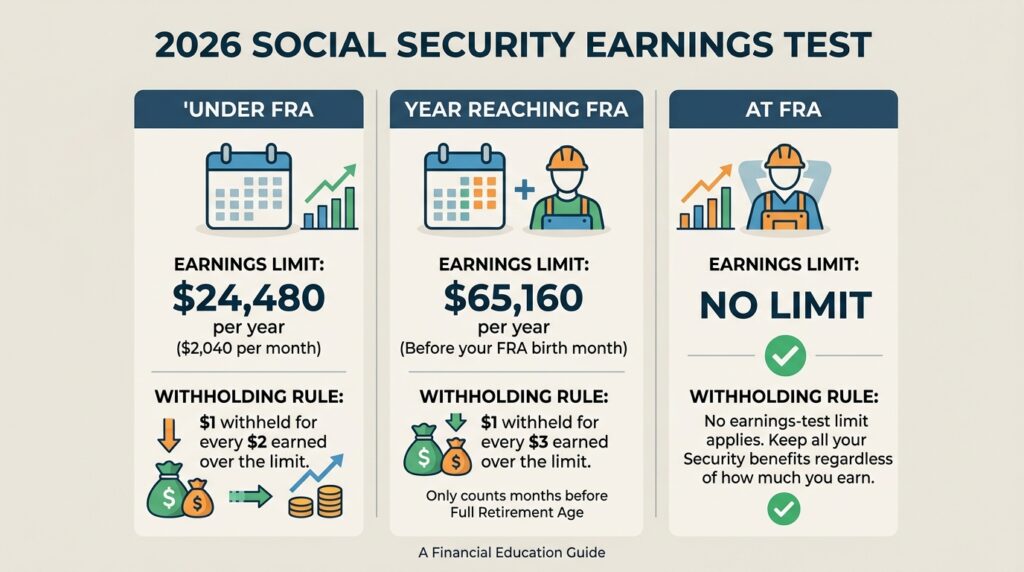
If you are under full retirement age for all of 2026, the annual earnings-test exempt amount is $24,480, or $2,040 per month. Above that limit, Social Security generally withholds $1 in benefits for every $2 of earnings over the limit.
For example, suppose you are below FRA for the entire year and earn $34,480 from work. That is $10,000 above the 2026 annual limit. Under the general rule, $5,000 of benefits could be withheld.
That does not mean your employer is imposing a 50% tax on the extra $10,000. It is a Social Security retirement earnings-test calculation.
The Year You Reach Full Retirement Age
A different limit applies in the year you reach FRA. For 2026, the applicable limit is $65,160, or $5,430 per month, for earnings before the month you reach full retirement age.
The withholding rate is also different. Social Security generally withholds $1 for every $3 earned above the applicable limit. Beginning with the month you reach full retirement age, the retirement earnings limit no longer applies.
Are Withheld Benefits Gone Forever?
This is another point that deserves much more attention. Benefits withheld under the retirement earnings test are not necessarily simply “lost.” Once you reach full retirement age, Social Security can recalculate your benefit to account for months in which benefits were withheld because of excess earnings.
That distinction can completely change how you think about working after claiming.
What Counts as Earnings?
The retirement earnings test focuses on earned income, such as wages and net earnings from self-employment. It should not be confused with the separate rules that determine whether your Social Security benefits are taxable.
For example, taking money from a traditional retirement account can affect taxable income without necessarily being treated as wages for the retirement earnings test.
This is exactly why I recommend separating three questions when planning retirement:
- Will this income reduce my current Social Security payments under the earnings test?
- Will this income increase the amount of my Social Security benefits that are taxable?
- Will this income affect other retirement costs or benefits?
Those are not the same question.
Why Working Longer Can Sometimes Increase Your Benefit
Working after you become eligible for retirement benefits can affect more than the earnings test. Remember the 35-year calculation.
If your newest earnings year is higher than one of the years currently used in your benefit calculation, it may replace a lower year and potentially increase your benefit. This can be particularly relevant if you:
- Have fewer than 35 years of covered earnings
- Had several years of very low earnings
- Took time away from employment
- Earn considerably more now than earlier in your career
That does not mean that working one extra year automatically results in a large increase. The effect depends on your individual earnings record. But it is another reason not to think of Social Security as a fixed number that suddenly appears on your 62nd birthday. Your work history continues to matter.
What Is the Social Security COLA for 2026?
The Social Security COLA for 2026 is 2.8%. COLA stands for cost-of-living adjustment. It is intended to help Social Security and SSI payments respond to inflation.
The 2026 adjustment was based on the increase in the Consumer Price Index for Urban Wage Earners and Clerical Workers, or CPI-W, measured using the applicable third-quarter comparison. For example, Social Security estimates that the average retired worker benefit increased from about $2,015 before the 2026 COLA to $2,071 after the COLA.
That is an estimated average increase of $56 per month, but your payment may not rise by exactly $56. The actual dollar increase depends on your benefit amount and the way Social Security applies COLA calculations and rounding. Medicare premiums and other deductions can also affect the amount that ultimately reaches your bank account.
Does Waiting to Claim Mean You Miss COLAs?
This is another misconception worth addressing. A person does not necessarily need to start retirement benefits just to “lock in” future COLAs. COLAs can be incorporated into the underlying benefit calculation, even for eligible workers who have not yet begun receiving retirement benefits, subject to applicable rules.
So I would not claim at 62 solely because someone told me I would otherwise miss every future COLA. Your claiming-age decision should be based on the broader retirement picture.
A 2026 Social Security Quick-Reference Table
If you only save one section from the first half of this guide, this table is useful.
| 2026 Social Security figures | Amount/rule |
| COLA | 2.8% |
| Social Security employee tax rate | 6.2% |
| Social Security taxable earnings maximum | $184,500 |
| Earnings needed for one credit | $1,890 |
| Maximum credits per year | 4 |
| Earnings test, under FRA | $24,480 |
| Earnings test, year reaching FRA | $65,160 |
| Estimated average retired-worker benefit | $2,071/month |
| Maximum benefit at FRA | $4,152/month |
| SSI federal payment standard, individual | $994/month |
| SSI federal payment standard, couple | $1,491/month |
| SSI resource limit, individual | $2,000 |
| SSI resource limit, couple | $3,000 |
| Non-blind disability SGA amount | $1,690/month |
| Blind disability SGA amount | $2,830/month |
| Trial Work Period service amount | $1,210/month |
These figures come from the official 2026 Social Security changes fact sheet and can change in future years. If you return to this article after 2026, check the current year’s figures before making a financial decision.
For questions involving how Social Security interacts with taxable income, deductions, and retirement income, you can also explore the tax guides on this site. The tax side becomes especially important because an earnings-test reduction and taxation of Social Security benefits are two completely different things.
The Three Social Security Numbers I Would Check Before Retiring
Social Security can quickly become overwhelming because people are presented with dozens of numbers at once. I find it more useful to begin with three personal numbers.
First, check your estimated benefit at full retirement age. This gives you a useful baseline for comparing early and delayed claiming. Second, check your estimated benefit at age 62. This shows the long-term monthly cost of taking retirement benefits as soon as they become available. Third, check your estimated benefit at age 70. This shows the potential value of delaying.
Then compare those numbers with your actual household budget. For example, suppose your estimates were:
| Claiming age | Example monthly benefit |
|---|---|
| 62 | $1,400 |
| 67 | $2,000 |
| 70 | $2,480 |
The question is no longer an abstract debate about whether “62 is too early.” You can now ask practical questions. Could you live comfortably without claiming between 62 and 67? Would you need to withdraw heavily from savings? Are you still earning wages? Is your spouse dependent on your record? Do you expect your Social Security payment to become an important source of guaranteed lifetime income?
Those questions make the decision personal rather than theoretical. The official retirement planning tool lets you compare estimated benefit amounts at different claiming ages and review factors that can affect your retirement plan.
Social Security Is More Than a Retirement Check
At this point, you can see why treating Social Security as one simple retirement benefit creates problems. Your work history determines eligibility and helps shape your benefit. Your 35-year earnings history can influence the calculation. Your claiming age can permanently affect your monthly retirement amount. Continuing to work before full retirement age can temporarily affect payments, while additional high-earning years may potentially improve your record.
Then there is everything we have not yet added to the equation:
- Your spouse may qualify on your record.
- An ex-spouse may potentially qualify.
- Your children may qualify in certain situations.
- Your family may have survivor rights if you die.
- Disability can change which program applies.
- Federal taxes can affect part of your benefits, while state treatment can be completely different.
- And the new senior tax deduction has created considerable confusion around claims of “no tax on Social Security.”
Those are the issues we will tackle next in this guide now.
Are Social Security Benefits Taxed?
Yes, Social Security benefits can be taxed at the federal level, but that does not mean every person receiving benefits pays tax on them. The amount depends largely on your other income and filing status. This is one reason I recommend looking at your entire retirement-income picture rather than asking only, “How much Social Security will I receive?”
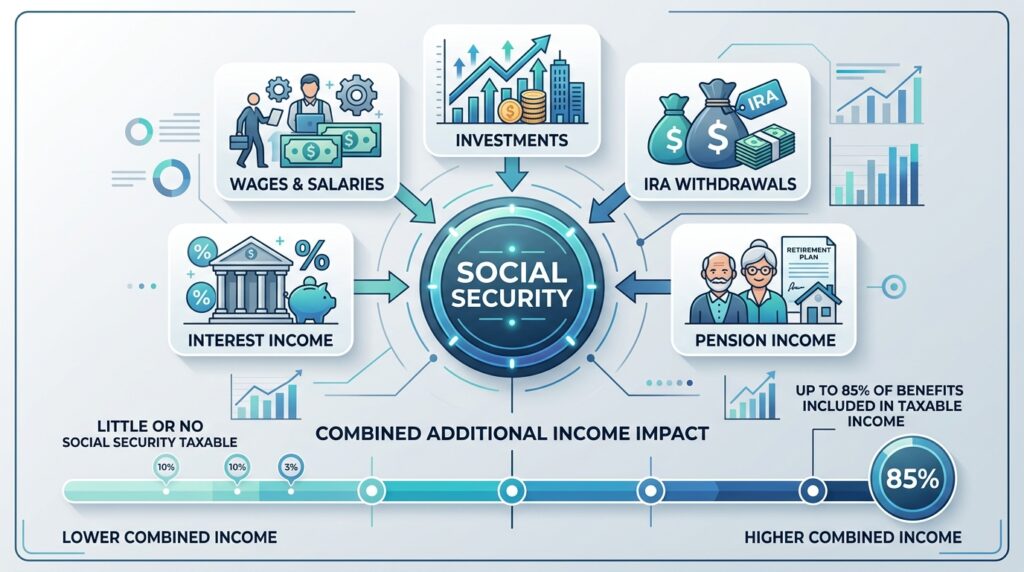
The federal rules for Social Security benefit taxation use a calculation commonly referred to as combined income. Combined income generally includes your adjusted gross income, tax-exempt interest, and one-half of your annual Social Security benefits.
For a single filer, part of your Social Security benefits may become taxable when combined income exceeds $25,000. For a married couple filing jointly, the corresponding starting threshold is $32,000. At higher income levels, up to 85% of your Social Security benefits may be included in taxable income. The higher threshold is generally $34,000 for an individual and $44,000 for a married couple filing jointly.
That does not mean the government takes 85% of your Social Security check. This is an important difference. If 85% of your benefits are taxable, that means up to 85% can be included in your taxable income. You then pay the applicable income-tax rate on that taxable income.
A Simple Social Security Tax Example
Suppose you receive $24,000 per year in Social Security. Half of that is $12,000. Now suppose you also have $30,000 of pension, interest, IRA withdrawals, wages, or other income relevant to the calculation.
Your combined income calculation may therefore exceed one of the Social Security tax thresholds. That does not automatically mean you pay tax on the full $24,000. The actual taxable amount is determined under the federal formula.
For this reason, I recommend using the Social Security benefits worksheet provided in federal tax guidance rather than estimating your tax by multiplying your check by 50% or 85%. This topic also closely connects to other tax rules and explanations, as IRA withdrawals, wages, investment income, pensions, and other sources of income can affect the tax result.
Why Social Security Can Suddenly Become Taxable
This is one of the areas where retirement planning can surprise people. You may retire and initially owe little or no federal tax on Social Security. Then you begin taking larger withdrawals from a traditional IRA, start receiving pension income, sell investments, or return to work. Suddenly, a larger portion of your Social Security can become taxable.
I find it more useful to think of this as an income interaction problem rather than a Social Security problem. Your Social Security benefit may not have changed very much. Your other income changed. That additional income can push you across the federal combined-income thresholds.
The Retirement Withdrawal Trap
Imagine you receive:
- $28,000 in Social Security benefits
- $20,000 from a pension
- $8,000 in investment income
- $25,000 from an IRA withdrawal
A large IRA withdrawal can affect more than your bank balance. It can also increase adjusted gross income and potentially increase the portion of Social Security benefits included in taxable income.
This does not mean traditional retirement accounts are bad. It simply means retirement-income planning should consider the interaction among different income sources.
Why Is Social Security Taxed Twice?
This question comes up frequently because workers pay Social Security payroll taxes while they work and may later owe federal income tax on part of their benefits. At first glance, this feels like the same money is being taxed twice. The actual tax structure is more complicated.
Social Security payroll taxes and federal income taxes are two different taxes. Payroll taxes help finance the Social Security program, while federal income tax applies under separate income-tax rules. Taxation of Social Security benefits began after legislation enacted in 1983, with additional rules added in 1993 for higher-income beneficiaries.
Another important point is that the worker’s own payroll-tax contribution represents only part of the financing tied to an employment record. Employers generally contribute Social Security payroll tax as well. So describing the system as “the government taxes the exact same dollar twice” oversimplifies what is happening.
However, I understand why the question continues to frustrate retirees. People see Social Security deducted from their earnings for decades, only to discover that part of their retirement benefit may later be included in the federal income-tax calculation. That is why tax planning matters before retirement, not just after your first Social Security payment arrives.
When Does the No Tax on Social Security Start?
This requires careful wording because headlines have created considerable confusion. There is not a universal federal law eliminating income tax on all Social Security benefits in 2026. Instead, a new enhanced deduction for qualifying seniors became effective for tax years 2025 through 2028.
People age 65 and older may qualify for an additional deduction of up to $6,000 per eligible person, or up to $12,000 for a qualifying married couple when both spouses qualify. The deduction phases out at higher modified adjusted gross income levels, beginning above $75,000 for an individual and $150,000 for married couples filing jointly. This can reduce or eliminate federal income-tax liability for some older taxpayers.
But it did not repeal the federal formula that can make up to 85% of Social Security benefits taxable. That distinction matters. If you see a headline saying “No Tax on Social Security,” do not automatically interpret that as “Nobody pays federal income tax on Social Security anymore.” Those statements are not equivalent.
Why This Matters for People Under 65
The enhanced senior deduction is age-based. A person who begins Social Security retirement at 62 is not automatically entitled to the same senior deduction simply because they receive Social Security. That is another reason the phrase “no tax on Social Security” can be misleading. Your age, income, filing status, and other circumstances still matter.
Does Oregon Tax Social Security?
No. Oregon does not impose its state personal income tax on Social Security benefits. The state’s retirement-income guidance specifically states that Social Security and Railroad Retirement Board benefits are not taxed by Oregon.
That does not mean all retirement income is tax-free in Oregon. Pension income and other retirement income can be treated differently. You therefore need to separate two questions:
- Is my Social Security taxed by the federal government?
- Is my Social Security taxed by my state?
The answers can be different.
Does Illinois Tax Social Security?
Illinois does not tax Social Security benefits in the same way the federal government can. The Illinois retirement-income rules allow taxpayers to subtract the federally taxed portion of qualifying Social Security benefits when calculating Illinois taxable income.
This means Social Security that appears in federal adjusted gross income can generally be removed under the applicable Illinois subtraction. Illinois also provides favorable treatment for several other qualifying types of retirement income, although you should check the rules for your particular income source rather than assume everything received after retirement is tax-free.
Does Michigan Tax Social Security?
Michigan generally exempts Social Security benefits from state income tax. The state’s retirement and pension guidance states that Social Security and Railroad benefits remain exempt.
Michigan’s broader retirement-income rules have also changed in recent years. For tax years 2026 through 2028, certain Michigan taxpayers age 67 or older who were born after 1952 can claim both the standard deduction and Social Security deduction under updated state rules.
The important takeaway is simple. Do not assume federal tax treatment determines your state tax treatment. Always check the rules in the state where you file your state return.
Social Security Spousal Benefits Explained
Social Security can provide benefits based on a spouse’s work record in certain circumstances. This becomes particularly important when one spouse earned substantially more than the other or spent years outside paid employment. An eligible spouse may potentially receive a benefit based on the worker’s record.
However, receiving a spousal benefit does not generally mean the spouse receives their own retirement benefit plus a completely separate full spousal benefit. Social Security coordinates the benefits. If your own retirement benefit is lower than the amount available under the spouse-benefit rules, Social Security can potentially pay an additional amount so the combined payment reaches the applicable spouse-benefit level.
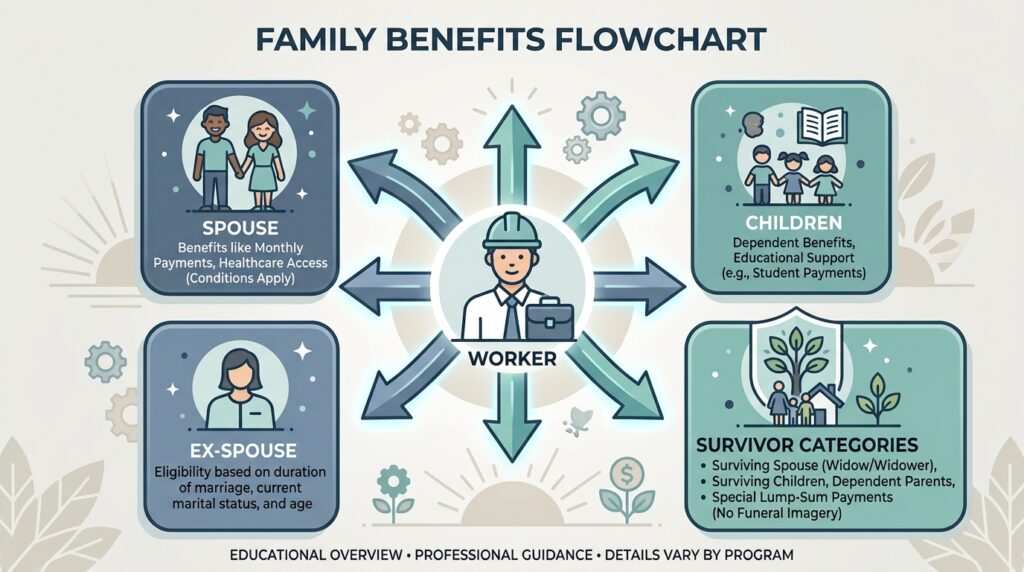
Eligibility depends on factors such as age, whether the worker has filed for benefits, caregiving circumstances, and other rules. The family-benefit eligibility rules state that spouses, ex-spouses, and children may qualify based on the record of someone entitled to retirement or disability benefits.
Can a Spouse Receive Benefits Without Working?
Potentially, yes. A spouse does not necessarily need a 40-credit work history of their own to qualify for a spousal benefit on an eligible worker’s record.
This is particularly important for households where one spouse stayed home with children or spent long periods outside covered employment. However, the exact amount and eligibility depend on the individual’s circumstances.
Social Security Benefits for Divorced Spouses
Divorce does not automatically end every potential Social Security connection between former spouses. An ex-spouse may qualify for benefits based on a former spouse’s earnings record under certain conditions. One major rule is the 10-year marriage requirement for many divorced-spouse benefits.
Age and marital status can also matter. The rules for a living former spouse and a deceased former spouse are not identical, so it is important to identify whether you are asking about divorced-spouse retirement benefits or surviving divorced-spouse benefits. One detail people often worry about is whether claiming on an ex-spouse’s record will reduce the ex-spouse’s own retirement check. Generally, a divorced spouse’s benefit does not reduce the worker’s own benefit.
If you are divorced and approaching retirement, I recommend checking potential benefits under both your own work record and the former-spouse rules, rather than assuming you are limited to one obvious option.
What Happens to Social Security When a Spouse Dies?
Social Security survivor benefits can provide an important layer of financial protection after a worker dies. Certain surviving spouses, divorced spouses, children, and dependent parents may qualify.
For a surviving spouse, benefits may begin as early as age 60 or age 50 in certain disability situations. A surviving spouse caring for the deceased worker’s qualifying child may also be subject to different eligibility rules. Survivor benefits can range from 71.5% to 100% of the deceased spouse’s applicable benefit, depending largely on the survivor’s age at the time of claim.
This creates an important retirement-planning issue for married couples. The higher earner’s claiming decision may affect more than the amount the couple receives while both spouses are alive. It can also affect the survivor’s later income.
Surviving Divorced Spouses
A surviving divorced spouse may also qualify. Under current rules, a surviving ex-spouse generally may qualify beginning at age 60, or at age 50 if disabled, if the previous marriage lasted at least 10 years and other eligibility requirements are met. This is one of those rules many people discover only after a death. I would rather know about it during retirement planning.
The $255 Lump-Sum Death Payment
Social Security also has a one-time lump-sum death payment of $255 that may be payable to an eligible spouse or child under applicable rules. This is separate from ongoing monthly survivor benefits.
SSDI vs SSI: What Is the Difference?
SSDI and SSI sound similar, but they are not interchangeable.
SSDI, or Social Security Disability Insurance, is generally connected to your work history and Social Security-covered earnings.
SSI, or Supplemental Security Income, is a needs-based program administered by Social Security for eligible people who are aged, blind, or disabled and meet income and resource limits.
One of the easiest ways to remember the distinction is:
- SSDI asks heavily about your work record.
- SSI asks heavily about financial eligibility.
Some people can qualify for both.
Does SSDI Depend on Your Income and Savings?
SSDI does not use the same general resource test as SSI. However, your ability to work and earnings can matter because Social Security disability rules consider whether you can engage in substantial gainful activity.
In 2026, the general monthly substantial gainful activity amount is $1,690 for a non-blind disabled individual and $2,830 for a blind individual. Disability rules are much more detailed than one earnings figure, so this should never be treated as a complete eligibility test.
Does SSI Have a Resource Limit?
Yes. For 2026, the federal SSI resource limit remains $2,000 for an individual and $3,000 for a couple. Not everything you own necessarily counts toward those limits. That distinction matters. For example, certain property and resources can receive different treatment under SSI rules.
How to Increase Social Security Disability Payments
There is no legitimate trick that lets you simply ask Social Security for a larger SSDI payment because your expenses have increased. Your SSDI amount is primarily connected to your covered earnings record. However, there are situations where your payment can legitimately increase.
1. Annual COLAs
Social Security disability benefits generally receive the same cost-of-living adjustment applied to Social Security benefits. For 2026, the COLA is 2.8%. You do not need to submit a special request simply to receive the standard annual COLA when it applies.
2. Correct an Incorrect Earnings Record
If covered earnings are missing from your record, your benefit calculation could be wrong. Social Security specifically encourages workers to review their earnings history because incorrect or missing wages can affect future benefits. If you notice missing earnings, gather evidence such as W-2s, tax returns, wage statements, or other employment records and follow the agency’s earnings-correction process.
3. Review Family Benefits
If you receive SSDI, certain eligible family members may potentially qualify for benefits on your record. That does not necessarily increase your personal SSDI amount, but it can increase the total Social Security income available to the household. Family maximum rules can limit the total amount payable on one worker’s record.
4. Appeal an Incorrect Decision
If Social Security calculates your eligibility or payment incorrectly, you have appeal rights. The Social Security appeals process can include reconsideration, a hearing before an administrative law judge, Appeals Council review, and ultimately federal court review when applicable.
In many cases, the deadline for requesting reconsideration is 60 days from the date of the decision. The lesson here is important. Trying to find a “hack” to raise disability payments is the wrong approach. Checking whether the earnings record, calculation, family benefits, COLA, and eligibility decision are correct is the right approach.
How to Apply for Social Security Benefits
The application process depends on which benefit you need. Retirement and disability applications can be started online in many situations.
Before applying, I recommend preparing the information you are likely to need rather than beginning the application and trying to reconstruct decades of personal information halfway through. Depending on the benefit, useful information can include:
- Social Security number
- Birth information
- Marriage and divorce history
- Names and Social Security numbers of certain family members
- Bank details for direct deposit
- Employment information
- Earnings history
- Medical information for disability claims
- Military service information where relevant
- Pension information in some circumstances
For retirement, you can generally apply before the month you want payments to begin. I would also compare the estimated payment at different ages before pressing the final submit button.
What If Social Security Denies My Claim?
A denial is not necessarily the end of the process. Social Security has a structured appeals system. The first major appeal stage is generally reconsideration. If you disagree with that decision, you may potentially request a hearing with an administrative law judge. Additional review can involve the Appeals Council and eventually federal court. For many appeals, you have 60 days after receiving the decision to act. This deadline matters.
I would not put an unfavorable notice in a drawer for two months while deciding whether it seems fair. Read the notice immediately. Identify:
- Why the claim was denied
- What evidence Social Security relied on
- Whether important evidence is missing
- The appeal deadline
- Which appeal form or process applies
For disability cases, medical evidence, treatment history, work limitations, and consistency in the record can become particularly important.
Social Security Payment Schedule
Social Security does not pay every beneficiary on the same day. For many people receiving retirement, survivor, or disability benefits, the payment date depends on the birth date associated with the benefit record. The standard schedule generally works like this:
| Birth date | Typical payment day |
|---|---|
| 1st through 10th | Second Wednesday |
| 11th through 20th | Third Wednesday |
| 21st through 31st | Fourth Wednesday |
The official payment schedule publishes the actual calendar dates for each year. There are exceptions.
For example, people who began receiving Social Security before May 1997 and certain people receiving both SSI and Social Security can follow different schedules. SSI is commonly paid on the first of the month, subject to weekend and holiday adjustments.
If a regularly scheduled payment date falls on a federal holiday or certain non-business days, the payment date may also shift. This is why I recommend checking the year’s official calendar rather than relying on an old screenshot circulating on social media.
How Do I Get a New Social Security Card?
If your Social Security card is lost, stolen, or damaged, you can request a replacement. In many situations, the fastest option is to begin the replacement process online. The replacement Social Security card service notes that a local Social Security office cannot simply print a new card for you while you wait.
Another useful point is that you may not actually need a physical card for every situation. If you know your Social Security number, many routine tasks do not require showing the card itself.
If you do need a replacement and cannot complete the process online, you may need Form SS-5 and acceptable identity or status documents. Social Security generally requires original documents or copies certified by the issuing agency. Ordinary photocopies and notarized copies are generally not accepted for these evidence requirements. There is no fee for a standard replacement Social Security card.
Can You Laminate Your Social Security Card?
No. Social Security recommends that you do not laminate your Social Security card. The reason is not merely appearance. Lamination can prevent detection of security features built into the card. The agency says you may use a removable plastic or similar protective covering as long as it does not damage the card.
If you already laminated an old card, the practical question becomes whether an organization needs to inspect the original card and whether the lamination interferes with acceptance. When a clean replacement is needed, use the official replacement process rather than altering the laminated card.
Can I Print My Social Security Award Letter Online?
Yes, in many situations you can obtain a benefit verification letter online. People sometimes call this an award letter, proof-of-income letter, or benefit letter. Through the online benefit verification service, you can download a personalized PDF showing information about your benefits. A benefit verification letter can be useful for situations such as:
- Loan applications
- Housing applications
- Income verification
- Benefit verification
- Certain financial-assistance programs
Social Security’s online services also allow beneficiaries to access additional records and services through their personal accounts.
I recommend downloading a fresh letter when someone asks for current proof rather than reusing an old version that may show outdated payment information.
Do Amish People Have Social Security Numbers?
There is no universal rule that Amish people do or do not have Social Security numbers. Some members of qualifying religious groups object to participation in government insurance systems for religious reasons.
Federal law provides a process through which members of certain recognized religious groups may apply for exemption from Social Security and Medicare taxes. The relevant application is Form 4029. Approval of Form 4029 can exempt an eligible person from Social Security and Medicare taxes, but it also involves waiver of rights to certain benefits connected to those programs.
The exemption does not automatically exempt the person from federal income tax. It would therefore be inaccurate to say: “Amish people never have Social Security numbers.” Practices and individual circumstances can vary, and some religiously exempt individuals may have different identification histories or tax situations.
Common Social Security Mistakes That Can Cost You Money
After working through all these rules, several mistakes stand out as especially avoidable.
Claiming at 62 Without Comparing Ages
Age 62 is an eligibility milestone, not automatically the best claiming age. Before filing, compare your estimated benefits at 62, full retirement age, and 70.
Assuming Your Benefit Automatically Becomes “Full” Later
If you claim retirement benefits early, the reduction associated with early claiming generally does not simply disappear when you later reach full retirement age.
Ignoring Your Earnings Record
Missing wages can reduce the benefit Social Security calculates for you. Check the record before retirement.
Confusing SSI and SSDI
These programs use very different eligibility rules. A person can make serious planning mistakes by assuming all “disability Social Security” works the same way.
Confusing the Earnings Test With Income Tax
Working while receiving retirement benefits can trigger the retirement earnings test before full retirement age. Separately, your overall income can cause some Social Security benefits to become federally taxable. These are two different calculations.
Believing “No Tax on Social Security” Means Everyone Pays Zero
The new senior deduction can reduce taxable income for eligible seniors, but Social Security tax rules still apply.
Assuming State and Federal Taxes Are Identical
Oregon, Illinois, and Michigan provide examples of states that do not tax Social Security benefits the same way federal law can.
Throwing Away Important Notices
A Social Security denial or overpayment notice may contain a deadline. For many appeals, waiting longer than 60 days can put your appeal rights at risk.
Expert Tips for Managing Social Security
I would approach Social Security as a long-term planning system rather than a form you complete at 62.
- First, create or regularly review your personal Social Security information and verify your earnings history.
- Second, calculate retirement at several ages rather than focusing on a single monthly number.
- Third, if you are married, consider benefits as a household decision.
- Fourth, separate federal tax, state tax, and the retirement earnings test. They solve different questions.
- Fifth, save Social Security notices and benefit verification documents. A simple folder containing benefit statements, earnings corrections, application notices, appeal correspondence, tax forms, and retirement calculations can prevent a surprising amount of confusion later.
- Finally, return to the official rules when something changes.
Social Security figures such as the COLA, wage base, earnings-test limits, SSI amounts, and disability thresholds can change from year to year. For other practical explanations of government-related processes, you can also explore the civil services guides.

Frequently Asked Questions About Social Security
What Is Social Security?
Social Security is a federal social insurance system that provides retirement, disability, survivor, and certain family benefits to eligible people. Workers generally build protection through covered employment and payroll taxes. Retirement benefits are usually based on a person’s earnings record and claiming age, whereas other programs, such as SSI, use different eligibility rules.
Can You Laminate Your Social Security Card?
No. The Social Security Administration advises people not to laminate their cards because lamination can interfere with security features. A removable protective covering may be used if it does not damage the card.
How Do I Get a New Social Security Card?
You can request a replacement Social Security card if your card is lost, damaged, or stolen. In many situations, you can begin the process through the online replacement-card service. You may need identity or citizenship/status documents depending on your situation.
Can I Print My Social Security Award Letter Online?
Yes. A benefit verification letter can generally be downloaded as a PDF through your Social Security account. The benefit verification letter service provides current proof of Social Security, SSI, or Medicare status when applicable.
Are Social Security Benefits Taxed?
They can be. If your combined income exceeds applicable federal thresholds, part of your Social Security benefits may be included in taxable income. Up to 85% of benefits can potentially be taxable for people above the higher income thresholds. Remember that “85% taxable” does not mean an 85% tax rate.
Does Oregon Tax Social Security?
No. Oregon does not tax Social Security benefits under its personal income-tax rules. Other retirement income can receive different treatment.
Do Amish Have Social Security Numbers?
Some do, and some may have different circumstances. Members of certain recognized religious groups can apply for an exemption from Social Security and Medicare taxes using Form 4029 when they meet the legal requirements. Being Amish does not create one universal rule that every person does or does not possess a Social Security number.
Why Is Social Security Taxed Twice?
Social Security payroll taxes and federal income taxes are separate taxes. Workers generally pay payroll taxes as they earn wages, while some retirees later owe federal income tax on a portion of their Social Security benefits, depending on their combined income.
Federal taxation of Social Security benefits began with the 1983 Social Security amendments and was expanded in 1993 to include higher-income beneficiaries.
When Can You Take Social Security?
Retirement benefits can generally begin as early as age 62. However, claiming before full retirement age reduces the monthly retirement benefit compared with waiting. Benefits can generally continue increasing through delayed retirement credits until age 70.
When Does the No Tax on Social Security Start?
There is no universal date when federal taxation of all Social Security benefits ends. A new enhanced senior deduction became available beginning with tax year 2025 and currently applies through 2028. People aged 65 and older may qualify for a deduction of up to $6,000 per person, subject to income phaseouts. The underlying rules that can make up to 85% of Social Security benefits taxable remain in effect.
What Is the Social Security COLA for 2026?
The Social Security COLA for 2026 is 2.8%. The increase applies to Social Security and SSI benefits in accordance with the program’s payment schedule. For the average retired worker, Social Security estimated an increase of about $56 per month after the 2026 adjustment.
Can I Laminate My Social Security Card?
No. The official recommendation is not to laminate the card because lamination can prevent detection of certain security features. A removable protective covering is different in that it can be removed without altering the card.
At What Age Can You Start Drawing Social Security?
You can generally start retirement benefits at age 62. Your full retirement age may be later, and claiming at 62 generally results in a lower monthly retirement payment. Waiting longer can increase the monthly amount up to age 70.
Does Illinois Tax Social Security?
Illinois generally allows taxpayers to subtract federally taxed Social Security benefits when calculating Illinois taxable income. As a result, Social Security benefits are not taxed by Illinois in the same way they may be taxed federally.
How to Increase Social Security Disability Payments
There is no guaranteed method to simply request a larger SSDI payment. Legitimate increases can result from annual COLAs, correction of missing earnings, or correction of an incorrect Social Security decision. Eligible family members may also qualify for separate family benefits on a disabled worker’s record, subject to family maximum rules.
If you believe Social Security made an incorrect calculation, use the formal appeal or correction process rather than relying on online “benefit increase tricks.”
Does Michigan Tax Social Security?
Michigan generally exempts Social Security benefits from state income tax. Michigan’s broader pension and retirement-income rules have changed, so people with pensions or other retirement income should review the current state rules separately.
Do Amish People Have Social Security Numbers?
There is no single answer for every Amish person. Certain members of recognized religious groups can apply for exemption from Social Security and Medicare taxes if they meet federal requirements and waive applicable benefits.
The federal process uses Form 4029. Therefore, it is inaccurate to assume that all Amish people automatically have Social Security numbers or that none of them do.
Social Security Checklist Before You File
Before applying, I recommend checking these items:
- Review your complete earnings history.
- Compare retirement estimates at ages 62, the full retirement age, and 70.
- Check whether a spouse or ex-spouse could qualify for family benefits.
- Consider potential survivor benefits.
- Estimate federal taxation of your benefits.
- Check whether your state taxes Social Security.
- Review your expected retirement income from pensions, IRAs, investments, and employment.
- Check how working may affect benefits if you are below full retirement age.
- Make sure your bank information is correct.
- Save copies of applications, benefit notices, and verification letters.
- Review Medicare timing separately from Social Security retirement timing.
I would not make a claim based solely on what a friend, relative, or coworker did. Their age may be the same as yours. Their Social Security situation may be completely different.
Final Thoughts
Social Security looks simple from a distance. You work, pay Social Security taxes, retire, and eventually receive a monthly check. But once you look closer, you realize that dozens of decisions and personal circumstances can affect how much you receive and when you should start receiving it.
Your earnings history matters, and so do your 35 highest-earning years. Your claiming age can make a significant difference to your monthly benefit. Marriage, divorce, and your spouse’s work history may also affect the benefits available to you. If you continue working after claiming, additional rules may apply. Disability can change the type of program you qualify for, while taxes can affect how much of your benefit you actually keep. Even where you live can make a difference, because state tax treatment varies by state.
That is why my strongest recommendation is to stop thinking of Social Security as a single retirement-age decision. Instead, think of it as one important part of your overall retirement plan. Start by reviewing your earnings record and making sure it is accurate. Then compare your estimated benefits at different claiming ages. Review possible spouse, family, and survivor benefits, estimate potential tax consequences, and check the current rules before submitting your application.
For 2026, important figures include the 2.8% COLA, a $184,500 Social Security taxable wage base, an estimated $2,071 average monthly retired-worker benefit, and updated earnings-test and disability thresholds. These figures will change over time, so I always check the latest official information before making an important retirement or financial decision.
The numbers may change, but the principles behind good Social Security planning remain largely the same. Understand what you qualify for, check that your earnings record is correct, know what happens if you claim early, understand how taxes may affect your benefits, and make your decision using your own financial circumstances, not somebody else’s retirement story.
If you are comparing Social Security with other legal or financial issues, explore our tax guides and civil services guides for more practical explanations.
Important: Social Security and tax rules can change. This guide provides general educational information and should not replace individualized advice from a qualified tax, financial, or legal professional when your situation involves significant financial decisions.
