

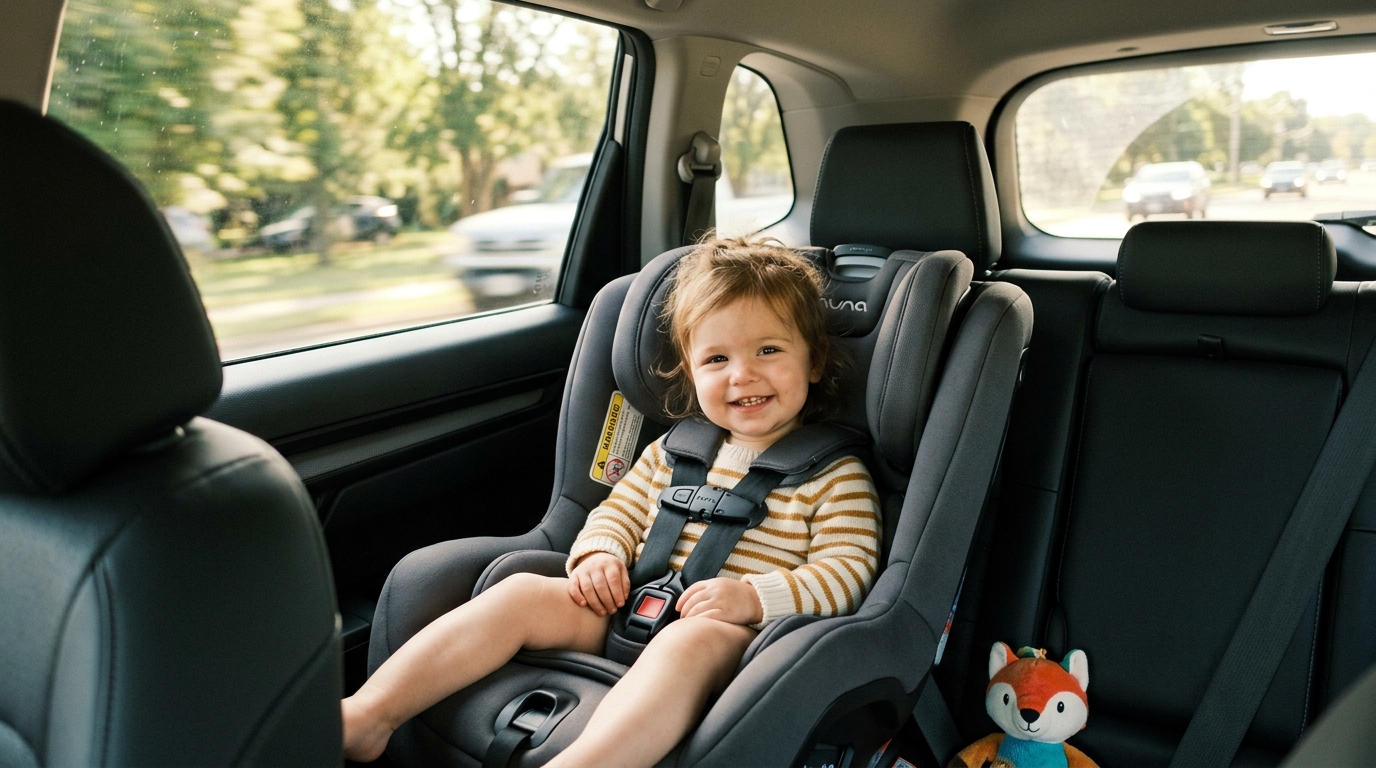
If you have typed how much should a baby weigh to face forward in car seat into Google at midnight while your baby finally naps, you are not alone. I did the exact same search with my first child, sitting in my parked car in a grocery store lot, trying to figure out if I was doing this whole car seat thing wrong. The short answer surprised me, and it will probably surprise you too: weight is only part of the story, and the number most parents assume is the “rule” is actually just the bare legal minimum, not the safest choice.
In this guide, I am going to walk you through the real weight and age numbers, what the law actually says in different states and countries, what car seat makers like Graco build into their products, and what I personally did with my own two kids when it was time to turn their seats around. My goal is that you leave this page actually knowing what to do, not more confused than when you arrived.
The Short Answer: How Much Should a Baby Weigh to Face Forward in Car Seat?
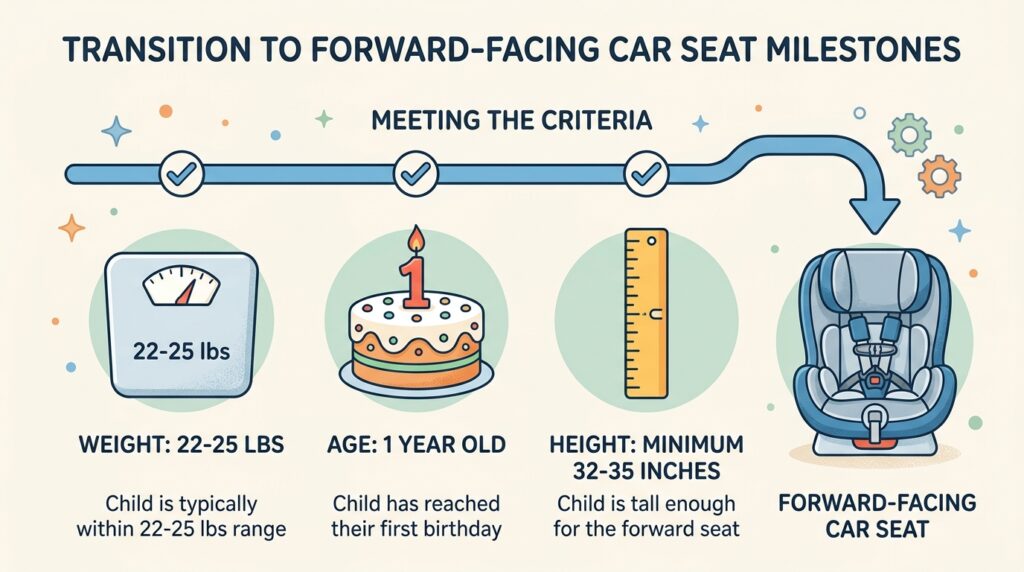
Most convertible car seats let a baby move to forward-facing once they weigh at least 22 to 25 pounds and are at least 1 year old, but that is just the minimum the seat allows. It is not the age or weight most safety experts recommend.
Here is the twist nobody tells you upfront: your baby’s weight, height, and age all have to line up before you flip that seat around. A baby can hit 22 pounds by 9 months and still not be ready, because their torso and head control matter just as much as the number on the scale. I remember weighing my son at his 9-month checkup and thinking, “he’s already past the forward-facing weight,” and then our pediatrician gently told me that hitting a number early isn’t a green light. It is just one of three boxes that need checking.
The three things that actually decide when a baby can safely face forward are:
- Weight — usually a minimum of 22 to 25 pounds on most convertible seats, though some allow forward-facing from 20 pounds.
- Age — most manufacturers and every US state that regulates this set 1 year old as an absolute floor, and many states push that closer to 2.
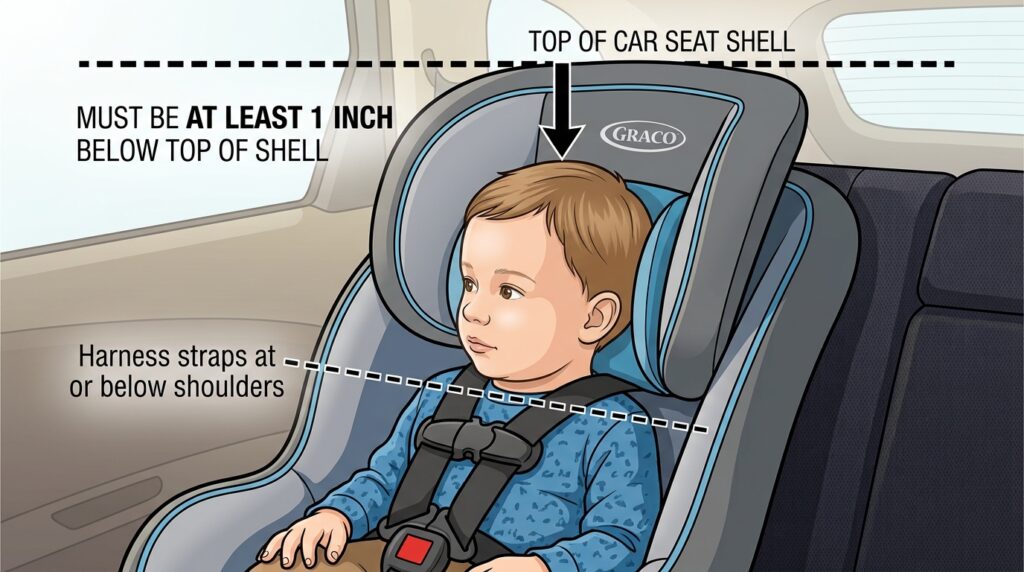
- Height — your baby’s head has to sit at least an inch below the top of the rear-facing shell, and the seat has to have room to accommodate them forward-facing without their ears being above the shell.
Why Doctors and Safety Groups Push Rear-Facing So Much Longer
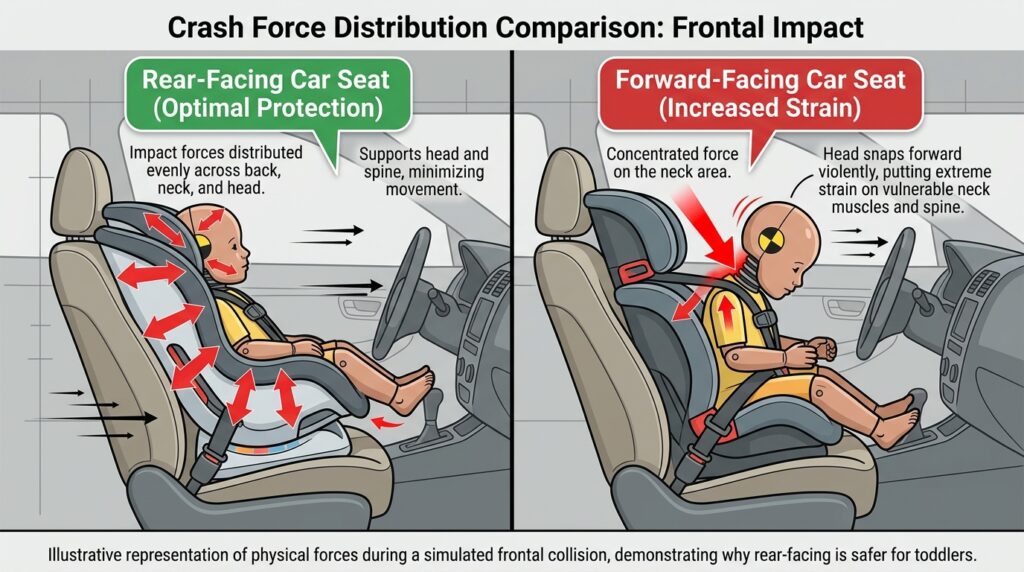
This part genuinely changed how I think about car seats. According to official NHTSA car seat guidance, a child should stay in a rear-facing car seat until they reach the seat’s manufacturer-specified top height or weight limit, not just until they turn 1 or hit 22 pounds. The American Academy of Pediatrics has recommended extended rear-facing for more than a decade now, and it is not just a cautious guideline. It is based on how a young child’s body actually holds up in a crash.
What Actually Happens in a Frontal Crash
Picture a toddler’s head. It makes up about 25 percent of their total body weight, compared to roughly 6 percent in an adult. Their neck muscles, ligaments, and spinal bones are still soft and not fully fused. In a rear-facing seat, a frontal crash pushes the child’s body back into the shell, so the seat absorbs the force across the back, shoulders, and head all at once. In a forward-facing seat, that same crash throws the child’s head forward while their body is held back by the harness, putting enormous stress on a neck that simply is not ready for it.
I actually watched a crash test video with my husband before we decided to keep our daughter rear-facing past her second birthday, and it was eye-opening in a way that no pamphlet had managed. It is one thing to read “rear-facing is safer.” It is another to see how differently a rear-facing dummy’s head moves compared to a forward-facing one during the same impact.
NHTSA and AAP Guidelines Explained, Not Just Repeated
I want to break this down the way I wish someone had broken it down for me, instead of just quoting a chart.
Birth to 12 months: Every baby rides rear-facing, no exceptions, according to NHTSA’s official car seat guidelines. Infant-only seats can only be installed rear-facing anyway, so this stage usually takes care of itself.
12 months to roughly 4 years: This is where families get tripped up. The AAP’s policy, most recently reaffirmed in 2018, recommends children stay rear-facing until they outgrow their seat’s rear-facing limits, which for many convertible seats now means somewhere around 40 to 50 pounds, not 22.
4 to 7 years: Once a child truly outgrows the rear-facing limits, they move to a forward-facing seat with a harness and tether, and stay there until they outgrow that seat’s weight or height limit, often 65 pounds or more.
5 to 12 years: Booster seat, until the vehicle’s own seat belt fits properly without help.
The pattern across it all is the same: age is a floor, not a target. Weight and height limits on your specific seat are what actually decide the switch.
How Much Should a Baby Weigh to Face Forward in a Car Seat, State by State
Since car seat rules are set at the state level in the US, the exact legal minimums differ depending on where you live. None of these numbers are the safest option, just the legal floor, so keep that in mind as you read.
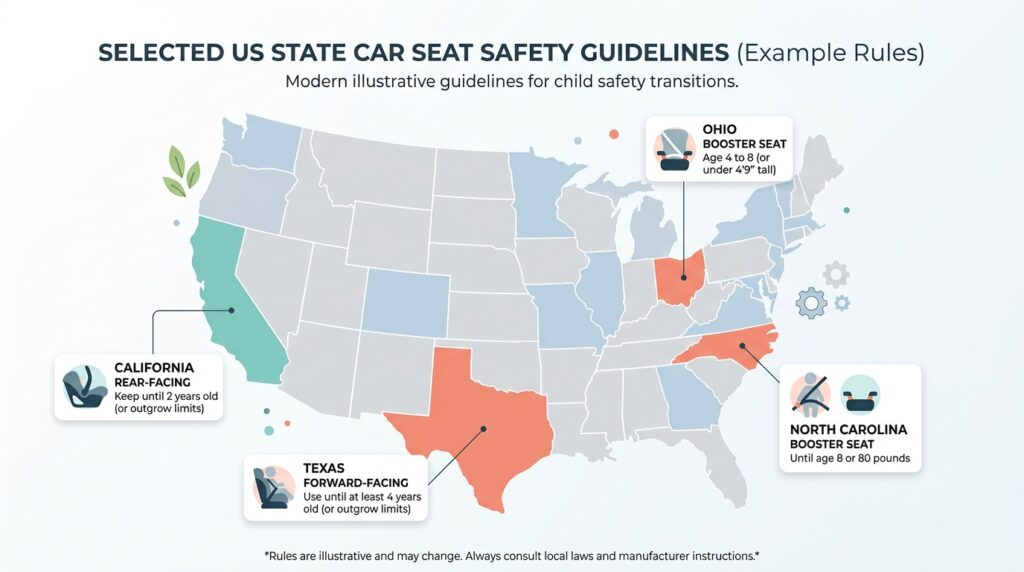
California
California’s rule is one of the stricter ones. Under California Vehicle Code Section 27360, children under 2 years of age must ride in a rear-facing car seat unless they weigh 40 pounds or more, or are 40 inches tall or taller. That means even if your baby is a big 25-pound, 14-month-old, the law in California still requires them to remain rear-facing until one of those two thresholds is met. There is no separate California weight law for graduating to forward-facing beyond that age, since the California Highway Patrol’s child safety seat guidance simply requires the child to stay in whatever restraint meets the manufacturer’s height and weight specifications until age 8.
Texas
Texas takes a different approach and does not specify a rear-facing weight in the statute at all. Instead, Texas law requires any child under 8 (unless they are already 4 feet 9 inches tall) to ride in a car seat that matches the manufacturer’s instructions. In practice, that means Texas parents follow the same manufacturer label most other states point to, and Texas’s own transportation safety office recommends rear-facing until at least 2 years old.
Ohio
Ohio has one of the more specific combined rules. Ohio law requires children under 4 years old or under 40 pounds to ride in an approved child safety seat, and specifically states a baby must not face forward until they are at least 1 year old and weigh at least 20 pounds, whichever standard applies to your child’s current seat. Once your child is in a forward-facing harness, Ohio law requires them to remain in it until they reach the weight or height limit for that seat.
North Carolina
North Carolina’s law reads a little differently from most states because of its age-and-weight structure. Under the relevant section of the state’s general statutes, once a child reaches at least 40 pounds and has outgrown the rear-facing seat, they must move to a forward-facing seat with an internal harness. North Carolina requires children to use some form of car seat or booster until age 8 or 80 pounds, whichever comes first, which is a notably higher weight cutoff than most states use.
(If you are trying to figure out at what age other family-related rules kick in for your kids, our guide on how old you have to be to get a tattoo covers a similar state-by-state breakdown, just for a completely different life stage.)
Car Seat Weight Rules Outside the US
Ontario, Canada
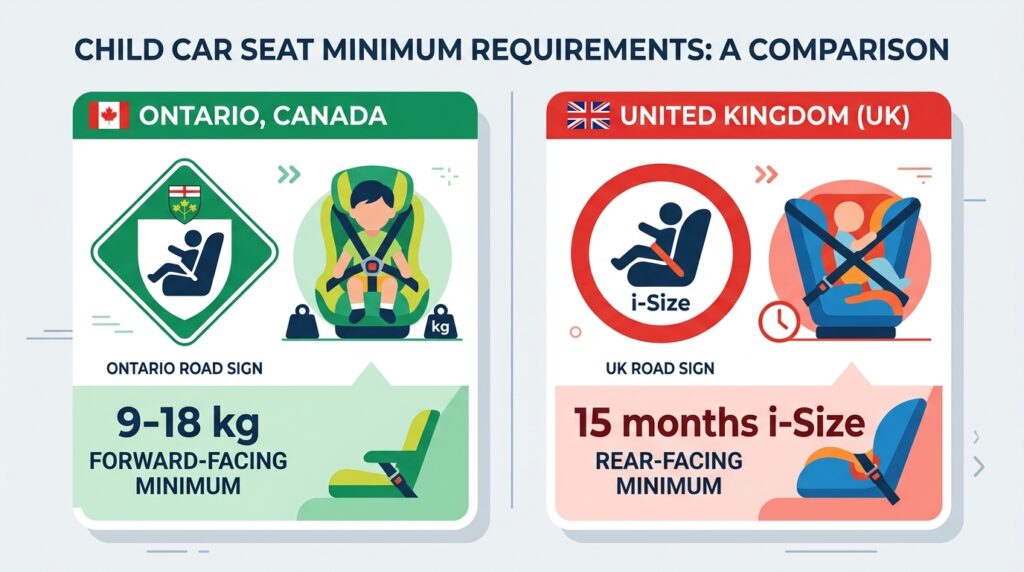
Ontario’s rule is measured in kilograms, which surprises many parents used to thinking in pounds. Under the province’s Highway Traffic Act, infants must ride rear-facing until they weigh at least 9 kilograms (about 20 pounds), and then they can legally move to a forward-facing seat once they weigh between 9 and 18 kilograms (roughly 20 to 40 pounds). The Government of Ontario’s official child car seat page is very clear, though, that a baby can stay rear-facing well past that minimum, right up until they outgrow the manufacturer’s own limits on the seat, and that is what most Ontario pediatricians actually recommend.
The UK
The UK does things differently depending on which type of seat you buy. If you use a height-based i-Size seat, the official GOV.UK child car seat rules require children to stay rear-facing until they are over 15 months old, at which point they can use a forward-facing child car seat. If you use an older weight-based seat instead, the forward-facing threshold is usually 9 kilograms, or about 20 pounds, though very few UK safety advocates recommend making that switch that early.
Where Graco and Other Convertible Seats Fit In
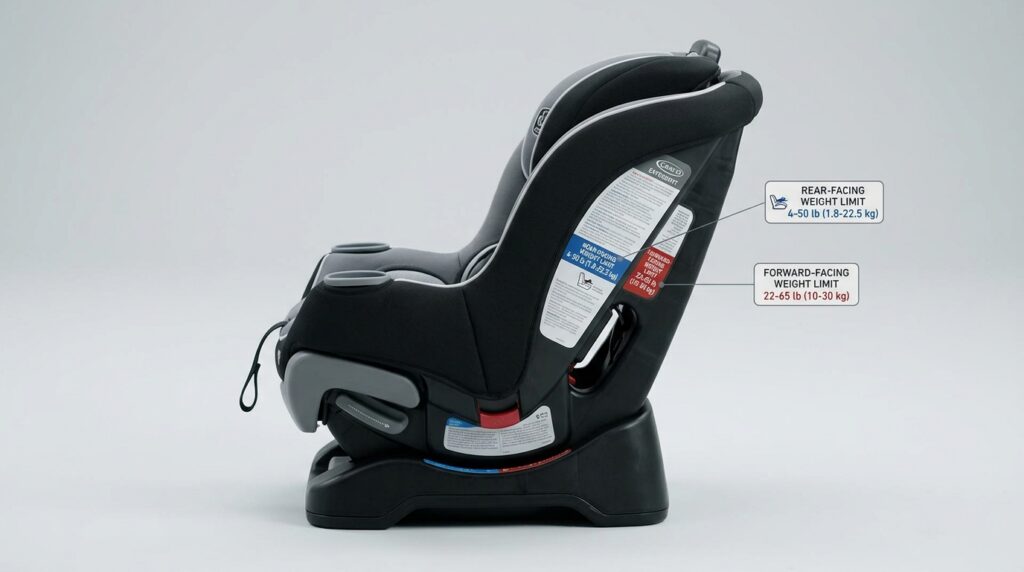
If you own a Graco convertible seat, or you are shopping for one, the actual weight numbers printed on the seat matter more than any state minimum. Graco’s popular Extend2Fit line, for example, allows rear-facing from 4 to 50 pounds and only requires forward-facing from 26.5 to 50 pounds, with the harness usable all the way to 65 pounds. That 50-pound rear-facing ceiling is a big deal, because it means a Graco Extend2Fit can often keep an average-sized child rear-facing until somewhere around their fourth or even sixth birthday, well beyond any state’s legal minimum.
This is exactly the gap I kept running into with my own research. A state might legally allow forward-facing at 20 pounds, but the seat in my trunk was rated for rear-facing until 40 or 50 pounds. When state law and the seat label disagree, always follow the more protective one, which in almost every real-world case is the seat manufacturer’s higher rear-facing limit.
My Own Experience Switching My Kids’ Seats
I will be honest about how messy this decision felt in real life. With my first child, I turned his seat forward-facing right around his second birthday, mostly because he was tall for his age and his feet were touching the vehicle seat back. I felt guilty about it for weeks afterward, second-guessing whether his legs actually needed more room or whether I was just tired of hearing him complain on long drives.
With my second child, I did things differently. I bought a seat with a much higher rear-facing weight limit specifically so the decision would not be forced on us early, and I kept her rear-facing until she was just past 3. Was it a little cramped for her legs by the end? Sure. But toddlers are flexible, and I would rather deal with a slightly bent set of knees than a nervous drive every single time we hit the highway. I will recommend this approach to any parent who asks me: buy the seat with the highest rear-facing weight limit your budget allows, even if it costs more upfront, because it buys you time you cannot get back once you flip that seat.
Signs Your Baby Isn’t Actually Ready to Face Forward
Hitting the minimum weight and age is not the same as being ready. Before you make the switch, check for all of these:
- Your baby’s head is at least 1 inch below the top of the rear-facing shell, since a head that pokes above the shell is no longer protected in a rollover.
- Your baby has met the minimum weight and height listed on their specific seat’s label, not just a general number you read somewhere online.
- Your baby has decent head and neck control and can sit upright for the entire length of your drives, not just for a few minutes.
- You have checked the exact numbers printed on your seat, since two seats at the same price point can have wildly different limits.
Pros and Cons of Turning a Baby Forward-Facing Early
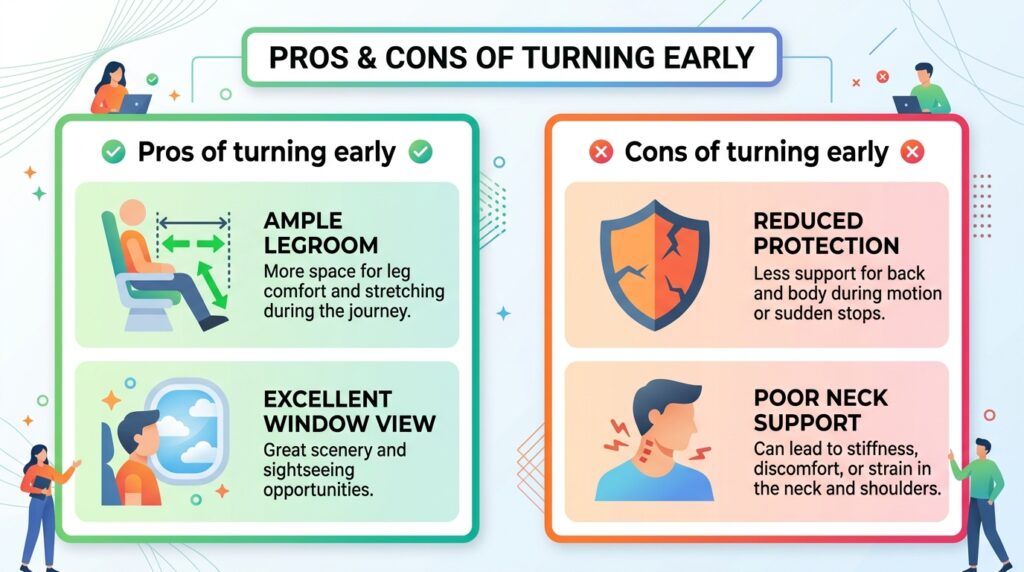
It helps to see this laid out honestly, because there are real trade-offs on both sides.
Reasons parents turn seats around early:
- More legroom for a tall or long-legged toddler.
- Easier for the child to see out the front window, which can reduce car sickness in some kids.
- Simpler for parents to glance at their child in the rearview mirror.
Reasons safety experts advise against it:
- Significantly higher risk of head, neck, and spinal injury in a frontal crash, which is the most common serious crash type.
- Toddlers who look “too big” for a rear-facing seat are often just uncomfortable, not unsafe, since bent legs are not a safety issue.
- Once you switch too early, there is no going back, since most children resist returning to rear-facing.
Expert Tips for Making the Switch Safely
- Read the label on your own seat, every time. Do not rely on what a friend’s seat allows, since limits vary by brand and even by model year.
- Get a professional installation check. Many fire stations and police departments run free car seat inspection events, and a trained technician can confirm your child is genuinely ready.
- Recheck the recline angle after flipping the seat. Forward-facing seats need a more upright angle than rear-facing ones, and getting this wrong reduces the harness’s effectiveness.
- Reweigh and remeasure every few months. Kids grow in bursts, and a seat that fit fine in spring might need adjusting by fall.
- Never place a rear-facing seat in front of an active airbag. This applies in every state and country covered in this guide, no exceptions.
What Happens Legally if You Turn a Seat Around Too Early
This is the part most car seat guides skip entirely, and it is one I only learned about after a friend got pulled over with her toddler facing the wrong way for her age. Every state and province in this guide treats an improperly restrained child as a real traffic violation, not just a suggestion. Fines range from as little as 25 dollars in North Carolina up to several hundred dollars in California and Ontario, and some states add points to your license on top of the fine. That is a separate issue from the safety risk itself, but it matters if you are ever stopped, and it matters even more if you are ever in a collision, since an improperly restrained child can complicate an injury claim afterward.
I bring this up because family responsibilities like this tend to stack up in ways parents do not expect. The same way a missed child support payment can eventually lead to a warrant, small compliance issues around child safety can snowball into bigger legal headaches if they are ignored for long enough. Neither situation happens overnight, but both start with a rule that felt easy to brush off in the moment.
If you already got a citation for an improperly restrained child, most jurisdictions will waive or reduce the fine if you show proof that you fixed the seating position and, in some counties, attended a short car seat safety class. It is worth calling your local court clerk to ask, since policies vary a lot by county.
How Long Should You Realistically Expect to Rear-Face?
Parents ask me this constantly, so let me give you real numbers instead of vague reassurance. If you use a standard convertible seat with a 35-pound rear-facing limit, an average-sized toddler will likely hit that ceiling somewhere between 2.5 and 3.5 years old. If you use a seat like the Graco Extend2Fit with a 50-pound rear-facing limit, that same toddler might not hit the ceiling until closer to age 5 or 6, simply because toddlers gain weight slowly after their second birthday.
Height often becomes the limiting factor before weight does, especially with tall kids. Most rear-facing shells run out of room around 49 inches or when the child’s head gets within an inch of the top of the shell, whichever comes first. This is exactly why two children of the same weight can be ready to switch at very different times. My son hit his seat’s height limit at 2 years and 10 months, while a friend’s daughter, who was shorter but heavier, did not hit her seat’s weight limit until almost 4 years old.
A Quick Comparison Table
| Location | Legal rear-facing minimum | Legal forward-facing floor | Safety-recommended minimum |
|---|---|---|---|
| US (NHTSA guidance) | Birth | 1 year and roughly 22 lbs | Seat’s max rear-facing weight/height |
| California | Under 2 or under 40 lbs/40 in | 40 lbs or 40 in (whichever first) | Seat’s max rear-facing limit |
| Texas | Not specified by statute | Manufacturer’s instructions | Age 2+, seat’s max limit |
| Ohio | Under 4 or under 40 lbs | 1 year and 20 lbs | Age 2+, seat’s max limit |
| North Carolina | Under 2 or under min. forward-facing weight | 40 lbs and outgrown rear-facing seat | Seat’s max rear-facing limit |
| Ontario, Canada | Under 9 kg (20 lbs) | 9 to 18 kg (20-40 lbs) | Seat’s max rear-facing limit |
| UK (i-Size) | Under 15 months | Over 15 months | Manufacturer’s height range |
Common Mistakes Parents Make During This Transition
I have made a couple of these myself, so consider this a judgment-free list. The most common mistake is turning the seat around the moment a child turns 1, purely because 1 year feels like a milestone, without checking the seat’s actual weight limit. A close second is assuming a rear-facing toddler’s bent legs mean they are cramped or unsafe, when in reality leg injuries from rear-facing seats are exceedingly rare. Another one I see constantly is loosening the harness “for comfort” once a child faces forward, which undoes a huge amount of the seat’s protection in a crash.
FAQs
1. How much should a baby weigh to face forward in a car seat?
Most convertible seats allow forward-facing starting around 22 to 25 pounds and 1 year old, but safety experts recommend waiting until your child outgrows the seat’s rear-facing limit, often 35 to 50 pounds, whichever comes later.
2. Can a 20-pound baby face forward?
Only if their specific seat’s label allows it and they meet the minimum age set by your state or country. In places like Ontario, the legal minimum weight is 9 kilograms (about 20 pounds), but most pediatricians still recommend waiting longer.
3. Is it illegal to turn my baby forward-facing at 1 year old?
In most US states, no, as long as your child meets the seat’s minimum weight and height requirements. A handful of states, like California, set a stricter combined age-and-weight standard that keeps children rear-facing past their first birthday regardless.
4. Do Graco car seats have different forward-facing weight limits than other brands?
Yes. Many Graco convertible models, like the Extend2Fit line, allow rear-facing up to 50 pounds, which is notably higher than many competing seats, which cap rear-facing at around 35 to 40 pounds.
5. What happens if I turn my baby forward-facing too early?
Nothing happens immediately, which is exactly why so many parents do it without realizing the risk. The danger only arises in a frontal crash, where a forward-facing toddler’s head and neck absorb far more force than they would in a rear-facing seat.
Conclusion
The honest answer to how much a baby should weigh to face forward in a car seat is this: check your seat’s label, check your state or country’s minimum, and then ignore both of those numbers if you can afford to wait longer. Twenty-two pounds might be legal. Forty or fifty pounds is safer. I turned one of my kids around too early and kept the other one rear-facing as long as her legs would physically allow, and looking back, I only regret the first decision. If you are on the fence right now, that hesitation is worth listening to. Check your child’s height, weight, and your seat’s actual printed limits today, and if you are unsure whether your installation is correct, look up a free car seat inspection event near you before your next long drive.
