


How Much Is It to Adopt a Child in Texas? 2026 Cost Guide
If you are asking how much is it to adopt a child in Texas, the most useful answer is not one statewide price. Your total depends mainly on the adoption path, whether the case is contested, what an agency includes in its fee, and whether the child qualifies for Texas adoption assistance.
In 2026, adopting through the Texas public foster-care system can involve little or no agency or home-study cost. A private domestic adoption typically costs tens of thousands of dollars. A stepparent or relative adoption is usually less expensive when every required party consents, but the legal bill can rise sharply if parental rights are disputed.
This guide focuses on the Texas expenses that a national adoption-cost article cannot answer: DFPS charges, reimbursement rules, adoption evaluations, county court costs, lawful pregnancy-related expenses, and benefits that may continue after a foster-care adoption.
Legal note: This article provides general educational information, not legal or tax advice. Adoption facts, fees, and eligibility rules can change. Obtain a written fee schedule from the agency or attorney you are considering and confirm current requirements for your county and case.
Quick Answer: How Much Does It Cost to Adopt a Child in Texas?
For planning purposes, the cost to adopt a child in Texas may look like this:
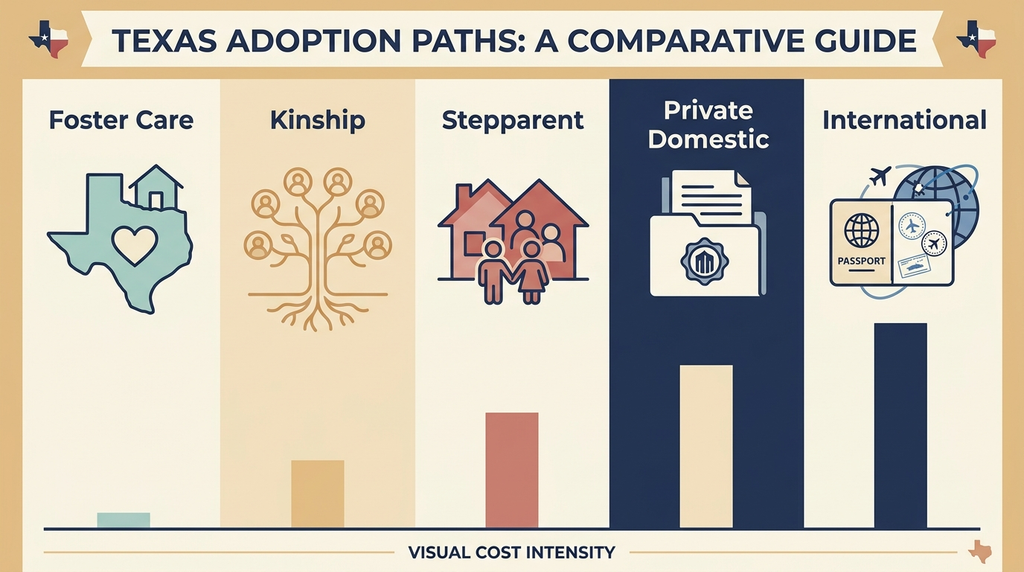
| Texas adoption path | Practical 2026 planning range | Usually drives the cost |
|---|---|---|
| Adoption from Texas foster care | Often $0 to $2,500 before reimbursement | Home-verification items, attorney and court costs |
| Private domestic agency adoption | About $30,000 to $60,000+, sometimes higher | Agency program, matching, legal work, expectant-parent services, home study, post-placement supervision |
| Independent or attorney-assisted adoption | About $15,000 to $45,000+ | Legal work, lawful outreach, home study, counseling, medical or pregnancy-related expenses |
| Stepparent adoption | About $1,500 to $5,000 when uncontested | Attorney, filing, service, records, possible evaluation |
| Relative or kinship adoption outside DFPS | About $2,000 to $8,000+ when uncontested | Attorney, court, evaluation, background checks, consent or termination issues |
| International adoption | About $25,000 to $60,000+, with some programs higher | Accredited provider, immigration, foreign-country fees, dossier, travel and Texas finalization or recognition work |
These are budgeting ranges, not prices set by Texas law. Published Texas provider fees illustrate why quotes vary. One licensed Texas agency lists a $51,500 full-service fee effective February 2026, but excludes the home study, post-placement supervision, adoptive-parent training, finalization, travel, and certain other expenses. A low headline fee is therefore not necessarily a low total fee.
For a broader comparison of every route, read How Much Does It Cost to Adopt a Child in 2026?. The sections below explain how Texas changes the calculation.
Why There Is No Single Texas Adoption Price
Adoption is a legal process plus professional services. The quote may include some of the following and exclude others:
- screening, education, matching, and case management;
- an adoption evaluation, often called a home study;
- criminal-history and abuse or neglect checks;
- counseling and legal services for an expectant or birth parent;
- permissible medical or pregnancy-related support;
- the adoptive parents’ attorney and court work;
- interstate compliance when the child and family live in different states;
- post-placement visits and reports;
- travel, document certification, and translation; and
- support after placement or finalization.
Two Texas families can use the same adoption route and finish with very different totals. One may have an uncomplicated in-state placement with an inclusive agency fee. Another may need interstate processing, extended interim care, additional legal work, or a second match after the first plan does not result in placement.
The sound comparison is therefore expected total cost, not simply the application fee or agency fee.
What Does It Cost to Adopt From Foster Care in Texas?
This is usually the least expensive route. Texas Department of Family and Protective Services states that CPS does not charge a fee to adopt children and does not charge prospective families for a DFPS home study. Required training meetings are also free.
That does not mean every household spends exactly zero. DFPS publishes examples of smaller verification expenses families may encounter, including fingerprints, CPR and first-aid training, fire or health inspections, safety equipment, certified records, pet vaccinations, and home-specific precautions. The amount depends on the household and local requirements.
Texas foster-adoption expenses at a glance
| Item | What Texas says or what to verify |
|---|---|
| DFPS adoption fee | No CPS fee to adopt a child |
| DFPS home study | No fee charged to prospective families |
| Training meetings | No charge |
| FBI fingerprinting | DFPS currently lists an estimated $38.54 per person |
| Fire or health inspection | DFPS lists estimates of $0 to $100 or more, depending on location |
| CPR and first aid | DFPS lists approximately $25 to $50 or more per person |
| Safety supplies and records | Varies by the home and documents needed |
| Attorney and court work | May be reimbursable for an eligible child; otherwise the family pays |
DFPS says legal fees for a child who is not adoption-assistance eligible can be about $1,200 to $1,500 or more. Attorneys set their own fees, and a complicated case can cost more than that published estimate.
For a detailed explanation of public adoption costs outside the Texas-only rules, see How Much Does It Cost to Adopt From Foster Care?.
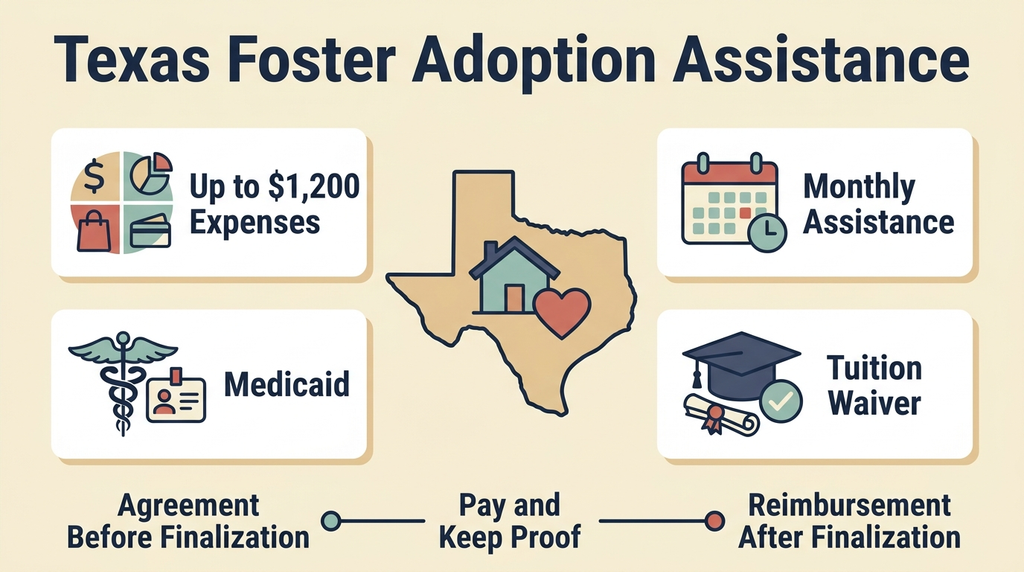
Texas Can Reimburse Up to $1,200 of Eligible Adoption Expenses
An eligible family may seek reimbursement of up to $1,200 per child for reasonable, necessary, nonrecurring adoption expenses. DFPS lists child-placing agency fees, court costs, attorney fees, amicus fees, and other charges directly related to legal completion as possible reimbursable expenses.
Several conditions matter:
- The child must qualify for adoption assistance.
- The child must be placed for adoption by DFPS or placed in Texas by a licensed child-placing agency.
- The adoption assistance agreement must be signed before the adoption is consummated.
- Reimbursement occurs after finalization and after the family provides proof of payment.
- You cannot reimburse the expense from another source.
- A stepparent adopting a stepchild does not qualify for this nonrecurring-expense reimbursement.
The timing rule is easy to miss. Don’t wait until the final hearing to ask whether the child is eligible or whether the agreement is complete.
Adoption assistance may be worth more than the closing reimbursement
For an eligible child, Texas adoption assistance can also include negotiated monthly payments and Medicaid coverage. DFPS materials currently identify maximum monthly payment levels of $400 for basic care and $545 for moderate, specialized, or intense care. Eligibility and the negotiated amount depend on the child’s circumstances and the applicable agreement.
Some children adopted from DFPS care may also qualify for a Texas state college tuition and fee waiver. This is a child-specific benefit, not a cash discount on the adoption itself. Families should obtain the eligibility letter and keep the assistance agreement and final adoption records in a permanent file.
How Much Is a Private Domestic Adoption in Texas?
A realistic planning range for a private domestic adoption is often $30,000 to $60,000 or more. Current published Texas fees support that scale, but no single figure applies to every agency or placement.
The largest parts of a private-adoption budget commonly include:
1. Agency program and matching services
This can cover intake, education, profile development, outreach, screening, case management, coordination with an expectant parent, counseling, placement, and support. Ask whether the fee is flat, staged, or dependent on a successful match.
2. Adoption evaluation and background checks
Texas Family Code requires an adoption evaluation in an adoption suit unless the court waives it under an applicable exception. A private home study can include interviews, a home visit, references, health and financial information, education, and criminal and child-abuse checks. Confirm whether updates are included if the process takes longer than expected.
3. Legal representation
Private placement may require separate legal work for the adoptive family and the child’s parent. The cost can include consents or relinquishments, termination of parental rights, review of medical and social history, interstate documents, the adoption petition, and the final hearing.
4. Pregnancy-related, medical, and counseling expenses
Texas law does not permit buying a child or paying someone in exchange for relinquishment. It does recognize specific lawful payments, including professional fees, reimbursement of legal or medical expenses for the child’s benefit, and necessary pregnancy-related expenses paid by a licensed child-placing agency as permitted by agency standards and state rules.
This area requires agency and attorney supervision. Prospective parents should not make informal cash payments, create their own reimbursement arrangement, or assume that an expense is lawful merely because it appears reasonable.
5. Post-placement supervision and finalization
Some provider quotes exclude required post-placement visits, the report used for finalization, the adoptive parents’ finalization attorney, and court-related charges. One Texas provider’s published 2026 fee specifically excludes home-study and post-placement work, legal finalization, adoptive-parent travel, and contested-termination costs. That is why a written list of exclusions is essential.
Texas Law Creates Financial Risks Before Finalization
In a private infant adoption, you may pay some expenses before the adoption is legally secure. Texas Family Code provides that an affidavit of voluntary relinquishment must be signed after birth and not before 48 hours after the child’s birth. The exact legal effect of a particular document depends on its wording and the facts, so families should rely on their Texas adoption attorney, not a general timeline found online.
The financial point is simpler: a prospective adoptive family may incur agency, legal, travel, home-study, counseling, or pregnancy-related expenses even when a proposed placement does not result in an adoption. Before paying, ask the provider to explain in writing:
- which fees are refundable;
- which fees transfer to a future match;
- whether there is a time limit on a credit;
- who holds and approves expense funds;
- what happens if an expectant parent chooses to parent;
- what happens if legal or medical facts change; and
- whether failed-placement protection is included or available.
Do not describe every unsuccessful plan as a “failed adoption.” Before finalization, it may be more accurate to call it a disrupted match or a placement plan that did not proceed.
How Much Does a Stepparent Adoption Cost in Texas?
An uncontested Texas stepparent adoption often falls around $1,500 to $5,000, with the attorney’s work making up most of the total. Filing, service, certified records, required background work, and an adoption evaluation, if ordered, may add to the bill.
The low range usually assumes that:
- the child’s other legal parent consents or parental rights have already been addressed;
- the child’s identity and parentage are clear;
- service can be completed without unusual effort;
- no party contests termination or adoption; and
- the court waives any requirement it is legally permitted to waive.
If the other parent’s rights must be involuntarily terminated, the case is no longer a simple paperwork matter. Investigation, service by publication, a guardian or attorney ad litem, discovery, evidentiary hearings, or trial preparation can substantially increase the cost.
Also remember that the federal adoption tax credit does not treat adopting a spouse’s child as a qualifying adoption expense, and Texas’s $1,200 nonrecurring-expense reimbursement excludes stepparent adoptions.
What Does a Relative or Kinship Adoption Cost in Texas?
A private relative adoption may cost a few thousand dollars when everyone consents, and the legal history is straightforward. It can cost much more when the case requires termination litigation, locating or serving a parent, resolving parentage, or addressing an existing custody order.
Do not assume that being related to the child eliminates every screening or court requirement. The judge may waive certain requirements where Texas law permits, but waiver is not automatic in every kinship case.
Kinship caregivers involved with DFPS should ask whether adoption assistance or Permanency Care Assistance is available and how choosing adoption instead of permanent managing conservatorship would affect monthly assistance, Medicaid, legal status, and future services. The best choice is not always the option with the largest immediate payment.
Does the Texas County Change the Adoption Cost?
Yes. Texas adoption law is statewide, but the total court bill is not a single statewide sticker price. Filing fees, issuance and service charges, copies, records, local court procedures, and professional fees can vary. The correct amount also depends on whether you file the adoption as a new suit or within an existing suit affecting the parent-child relationship.
Before filing, ask the appropriate district or county clerk for a current civil fee schedule and have the attorney identify:
- the base filing amount;
- citation, service, or publication charges;
- fees for copies and certified orders;
- an ad litem, amicus, interpreter, or evaluator, if applicable;
- electronic filing or payment-provider charges; and
- whether a prior case changes how you file the petition.
Avoid relying on a generic “Texas court fee” quoted by an article. The clerk’s written schedule and your attorney’s case-specific estimate are better sources.
The Six-Month Residence Rule Can Affect the Budget
Texas Family Code generally provides that a court may not grant an adoption until the child has resided with the petitioner for at least six months, although the court may waive that requirement if waiver is in the child’s best interest.
That waiting period can affect the practical budget. Families may need to pay for post-placement visits, updated reports, travel, child care, insurance changes, or professional support before finalization. Ask which of those services are already included and what an extra month or extra visit would cost.
International Adoption Costs for Texas Families
A Texas resident pursuing intercountry adoption must budget for federal immigration rules, the sending country’s process, an accredited or approved adoption service provider where required, travel, and Texas legal work that may be recommended or required after the child enters the United States.
The overall total often reaches $25,000 to $60,000 or more, but country and program differences are too large for a Texas-only estimate to be reliable. For the complete breakdown, use How Much Does International Adoption Cost?.
When comparing an international program, separate the quote into U.S. agency fees, foreign program fees, immigration filings, dossier and authentication, translation, escorts, required travel, medical review, post-placement reporting, and Texas finalization or recognition work.
Three Sample Texas Adoption Budgets
These examples show how to build a budget. They are illustrations, not quotes or promises.
Example 1: DFPS adoption with eligible reimbursement
| Expense | Illustrative amount |
|---|---|
| Fingerprints and required records | $150 |
| CPR, first aid, and household safety items | $250 |
| Attorney and court-related costs | $1,400 |
| Total paid before reimbursement | $1,800 |
| Possible DFPS nonrecurring reimbursement | Up to $1,200 |
| Illustrative net cost after full reimbursement | $600 |
The actual reimbursement depends on eligibility, the signed pre-finalization agreement, proof of payment, and whether another source covers the expense.
Example 2: Uncontested stepparent adoption
| Expense | Illustrative amount |
|---|---|
| Attorney flat fee | $2,500 |
| Filing, service, and certified records | $450 |
| Additional evaluation or document cost | $750 |
| Illustrative total | $3,700 |
If consent or termination becomes contested, this example no longer applies.
Example 3: Private agency adoption
| Expense | Illustrative amount |
|---|---|
| Agency program and placement services | $38,000 |
| Home study, updates, and post-placement reports | $3,500 |
| Adoptive-family legal and finalization work | $5,500 |
| Travel, records, and miscellaneous costs | $2,500 |
| Contingency reserve | $5,000 |
| Illustrative working budget | $54,500 |
An agency’s treatment of expectant-parent expenses, medical costs, disruption, and interstate work can significantly affect this total.
The 2026 Federal Adoption Tax Credit
For tax year 2026, the maximum federal adoption credit is $17,670 per eligible child, and up to $5,120 may be refundable. The credit begins to phase out when modified adjusted gross income exceeds $265,080 and is fully phased out at $305,080 or more.
The credit is not an up-front discount. Rules differ by the type and timing of adoption, and you generally cannot claim reimbursed expenses again. A taxpayer adopting a spouse’s child cannot claim the credit for that adoption. Eligible adoptions of children whom a state has determined to have special needs may receive different treatment from expense-based claims.
Keep invoices, receipts, canceled checks, agency agreements, legal bills, travel records, reimbursement statements, and the final order. Use IRS Form 8839 and consult a qualified tax professional for your situation.
How to Compare Texas Adoption Fee Schedules
Ask every agency or attorney for a written answer to the same questions:
- What is the expected total, not just the initial or program fee?
- Which home-study, background-check, training, and update costs are included?
- Are post-placement visits included, and how many are expected?
- Does the quote include legal work for the adoptive family and the child’s parent?
- How are lawful pregnancy-related and medical expenses approved and paid?
- What is excluded from the quote?
- What could make the fee increase?
- What happens to paid fees if a match does not proceed?
- Can fees transfer to another match, and for how long?
- Does interstate placement add ICPC, travel, or legal charges?
- Who pays for interim care, DNA testing, publication, or an ad litem if needed?
- Which payments are due before matching, at placement, and at finalization?
A provider should be able to explain the fee structure without pressuring you to pay immediately.
A Practical Texas Adoption Cost Checklist
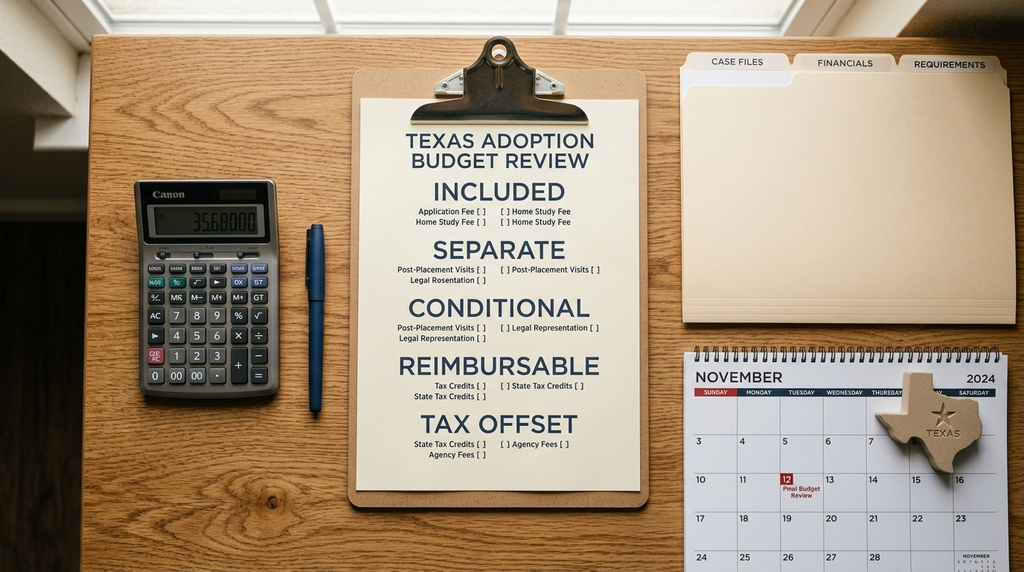
Before signing a contract, build five columns in your budget:
- Required and included: services covered by the quoted fee.
- Required and separate: services you must obtain elsewhere.
- Conditional: interstate work, additional legal proceedings, medical expenses, extra visits, or travel.
- Potentially reimbursable: eligible DFPS nonrecurring expenses or employer benefits.
- After-tax offsets: the federal credit, calculated with professional tax guidance.
Keep a contingency reserve separate from the base quote. For a private adoption, the biggest unknown is often not the advertised fee, but what happens when the timeline, match, medical situation, or legal work changes.
Frequently Asked Questions
How much is it to adopt a child in Texas in 2026?
It can range from little or no agency cost through Texas foster care to $60,000 or more for a private or international adoption. An uncontested stepparent or relative adoption often costs several thousand dollars. The route and case complexity matter more than the county alone.
Is it free to adopt a child from foster care in Texas?
DFPS does not charge a fee to adopt a child and does not charge for its home study. Families can still have smaller verification expenses and legal or court costs. For an eligible child, you may be reimbursed up to $1,200 per child in reasonable and necessary nonrecurring adoption expenses after finalization if you signed the agreement beforehand.
How much money is it to adopt a child in Texas privately?
A private domestic adoption commonly requires a budget of roughly $30,000 to $60,000 or more. Check whether the quote excludes the home study, post-placement visits, finalization, travel, medical expenses, interstate work, or costs arising from a contested matter.
Does Texas pay families who adopt?
Texas may provide adoption assistance for an eligible child, including negotiated monthly payments, Medicaid, and reimbursement of qualifying nonrecurring costs. This is not available in every adoption, and the assistance agreement must be handled before finalization.
Can I pay a birth mother’s living expenses in Texas?
Do not pay expenses informally. Texas law permits certain professional, legal, medical, and necessary pregnancy-related payments under defined conditions. Necessary pregnancy-related expenses described in the law are paid by a licensed child-placing agency under applicable standards and rules. Use a licensed agency and Texas adoption attorney to review every proposed payment.
Is a home study always required in a Texas adoption?
Texas law generally requires an adoption evaluation, but a court may waive it when a statutory basis for waiver applies. Do not assume that a stepparent or relative relationship automatically eliminates the requirement. Ask the attorney what the court is likely to require in your case.
Does an adopted child have to live with me for six months before finalization?
Texas law generally requires at least six months of residence with the petitioner before the court grants the adoption. The court may waive the period if doing so is in the child’s best interest.
Bottom Line
So, how much does it cost to adopt a child in Texas? A foster-care adoption can be close to free, especially when the child qualifies for reimbursement and ongoing assistance. A straightforward stepparent or kinship case often costs a few thousand dollars. A private domestic or international adoption usually requires a five-figure budget and a careful review of exclusions.
The safest way to estimate your total is to choose the route first, obtain an itemized written fee schedule, confirm the current clerk charges for the actual court and filing posture, and identify assistance or tax benefits before finalization. Texas-specific timing and payment rules make that preparation as important as the headline price
Editorial Sources and Fact-Check Notes
These sources are included for the editor. Keep them linked in the published article where useful, or move them to a references section according to The Law Learner’s editorial style.
- Texas DFPS: Requirements for Foster/Adopt Families for public-system requirements, ancillary-cost examples, no DFPS home-study fee, legal-fee estimate, and the $1,200 reimbursement rules.
- Texas DFPS: Adoption Assistance for nonrecurring expense reimbursement, monthly assistance, and Medicaid.
- Texas DFPS: State College Tuition Waiver for education-benefit eligibility information.
- Texas Family Code Chapter 162 for adoption evaluations, the residence period, and other adoption provisions.
- Texas Family Code § 161.103 for timing requirements governing an affidavit of voluntary relinquishment.
- Child Welfare Information Gateway: Regulation of Private Domestic Adoption Expenses in Texas for a federal summary of Texas Penal Code § 25.08 and Family Code § 162.025.
- Texas HHS: Minimum Standards for Child-Placing Agencies for current agency standards.
- IRS: 2026 tax inflation adjustments for the 2026 adoption credit, refundable portion, and annual limits.
- IRS: Adoption Credit for eligibility, qualified expenses, timing, and Form 8839 guidance.
- Adoption Advocates: Published 2026 comprehensive fee as a current Texas-market illustration of the difference between a program fee and total out-of-pocket cost. This is not an endorsement.
