

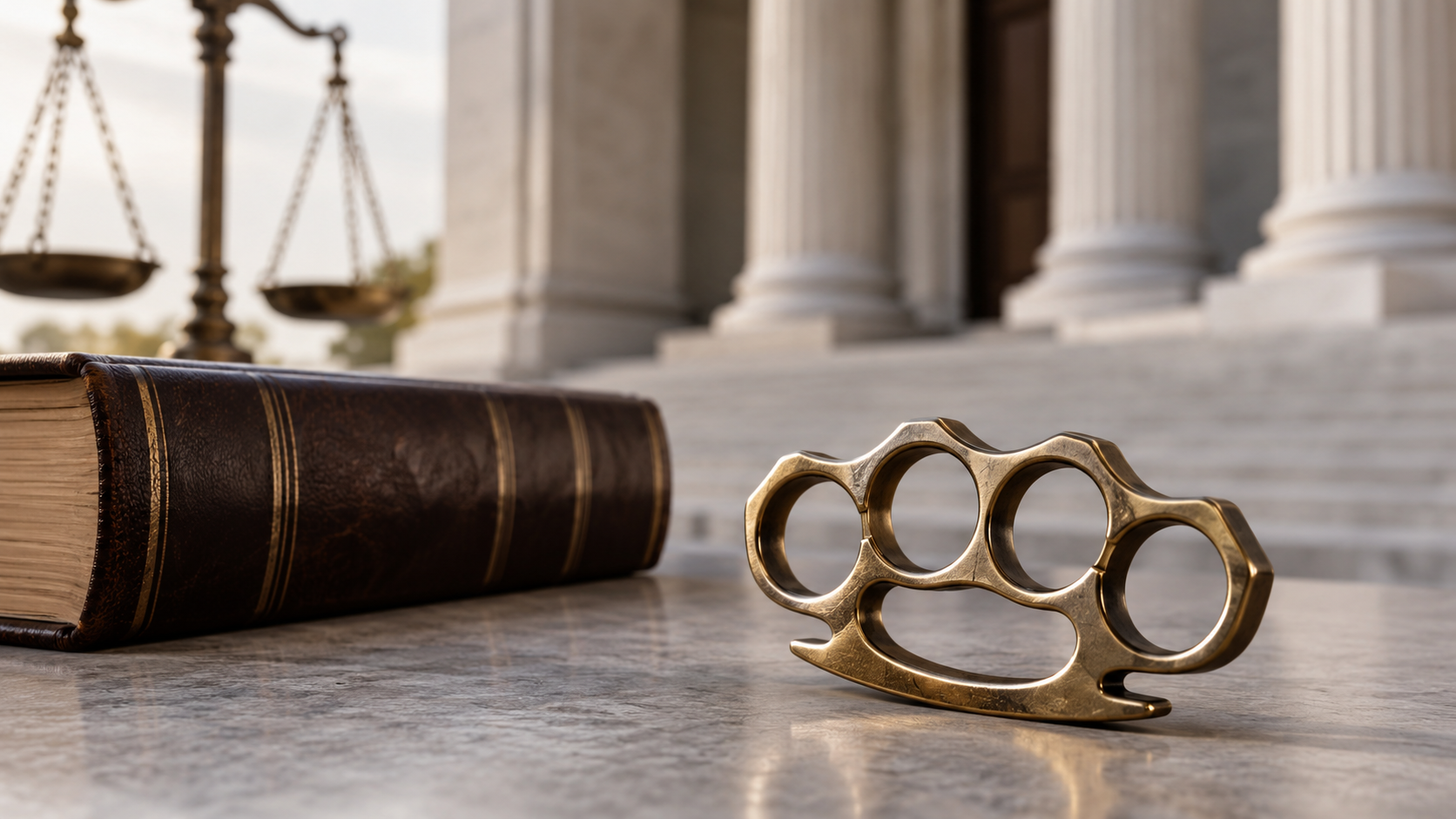
Why Are Brass Knuckles Illegal? Laws, Risks, and Where They Are Banned
Brass knuckles look mechanically simple: a rigid piece of material fits across the fingers so that a punch lands through a hard surface instead of the bare hand. Legally, however, that design is exactly what creates the problem.
In jurisdictions that prohibit them, brass knuckles are generally treated as weapons designed primarily to increase the force or injury caused by striking another person. Their compact size, limited everyday utility, and concealability are additional reasons legislators have placed them in prohibited-weapon categories.
But saying that brass knuckles are illegal everywhere in the United States would be incorrect. No single rule covers ordinary possession in every state. State laws differ substantially, and cities or counties can sometimes impose additional restrictions.
Quick Answer
Brass knuckles are illegal in some jurisdictions because lawmakers classify them as weapons designed to increase the force of a punch and cause serious injury. They are also compact and easy to conceal. However, U.S. law is not uniform: some states broadly prohibit possession or sale, while others impose fewer restrictions. Always check the current state and local law where you live or travel.
Key Takeaways
- There is no simple nationwide rule making brass knuckles illegal in every U.S. state.
- Some states expressly prohibit possessing, purchasing, manufacturing, selling, or carrying metal or other knuckle weapons.
- Brass knuckles are often restricted because their design increases the damaging effect of a punch.
- Some statutes cover not only brass but also steel, plastic, or other hard-material knuckle weapons.
- Gun laws and brass-knuckle laws developed under different statutes and constitutional rules, so one cannot be used as a shortcut for understanding the other.
- Canada, the United Kingdom, and parts of Australia also specifically prohibit or heavily restrict knuckleduster-type weapons.
- Buying an item online does not prove that possessing or carrying it is legal where the buyer lives.
What Are Brass Knuckles?
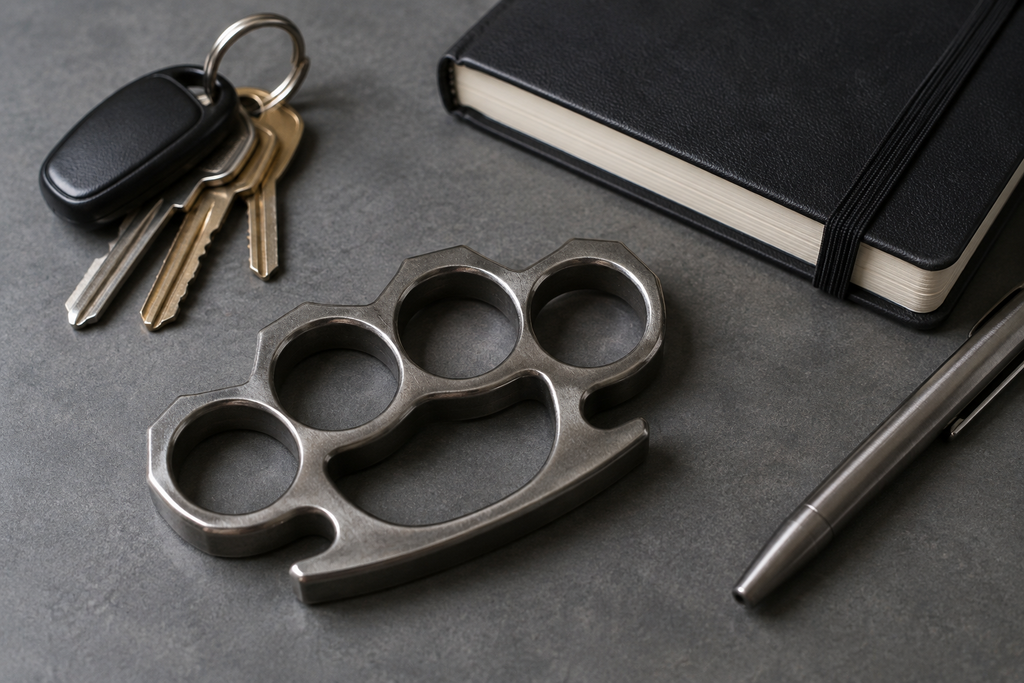
Brass knuckles—also called metal knuckles, knuckledusters, knuckle dusters, knucks, or knuckle weapons—are rigid devices worn across or around the fingers.
Despite the common name, they do not necessarily have to be made of brass.
For example, Illinois law expressly covers “metal knuckles or other knuckle weapon regardless of its composition.” New York’s weapon statute separately identifies both plastic knuckles and metal knuckles.
That distinction matters because replacing metal with hard plastic does not automatically make a knuckle weapon legal.
The statutory definition also varies. Some laws focus on the material, while others focus more broadly on the object’s design or function.
Why Are Brass Knuckles Illegal in Some Places?
No single legislative explanation applies to every jurisdiction. However, several recurring features help explain why brass knuckles appear in prohibited-weapon statutes.
They Are Designed to Increase the Effect of a Strike
Unlike an ordinary object that could become a weapon depending on how it is used, a traditional knuckleduster is specifically constructed for striking.
For example, United Kingdom guidance defines a knuckleduster as a band of metal or another hard material worn on one or more fingers and designed to cause injury. UK law places knuckledusters among specifically prohibited offensive weapons.
That design-focused approach is important. Legislatures often distinguish between:
- an ordinary object that happens to be misused as a weapon, and
- an object manufactured primarily to increase a person’s ability to injure someone.
Brass knuckles generally fall into the second category.
They Can Turn an Ordinary Punch Into a More Dangerous Blow
The hard surface places rigid material between the fist and the person being struck. That can increase the potential seriousness of the impact compared with an unarmed punch.
This does not mean every strike will cause the same injury, and the outcome depends on factors such as force, contact location, material, and circumstances. The legal concern is the weapon’s capacity to increase injury—not a guarantee that a particular injury will occur.
They Are Small and Easily Concealed
Knuckle weapons can generally be carried in a pocket, bag, clothing, or vehicle without being obvious.
Concealability has long mattered in weapons regulation. Some jurisdictions prohibit possession outright, while others focus more heavily on concealed carrying or possession with unlawful intent.
They Have Little Ordinary Utility Compared With Many Other Objects
A kitchen knife has obvious household purposes. A baseball bat has sporting uses. Many tools have legitimate everyday functions even though they can cause serious injuries if misused.
Traditional brass knuckles have a much narrower purpose.
This helps explain why some legislatures place them alongside blackjacks, slungshots, sand clubs, bludgeons, and similar striking weapons.
Michigan is a clear example. Its penal code groups “metallic knuckles” with blackjack, slingshots, billy clubs, sand clubs, sandbags, and bludgeons in its prohibited-weapons provision.

Are Brass Knuckles Illegal in the U.S.?
The accurate answer is: it depends on the state and sometimes the city or county.
U.S. brass-knuckle regulation is largely a matter of state law rather than a single rule that applies everywhere.
That produces very different outcomes.
Washington, for example, makes it unlawful to manufacture, sell, dispose of, or possess weapons commonly known as metal knuckles under RCW 9.41.250.
Michigan prohibits manufacturing, selling, offering for sale, or possessing metallic knuckles under Michigan Penal Code § 750.224. The statute classifies a violation of that subsection as a felony and states a maximum penalty of five years’ imprisonment, a $2,500 fine, or both, subject to the statute’s exceptions.
Illinois law states that a person commits unlawful possession of weapons when the person knowingly sells, manufactures, purchases, possesses, or carries metal knuckles or another knuckle weapon regardless of composition.
New York Penal Law § 265.01 includes both plastic knuckles and metal knuckles in its fourth-degree criminal-possession-of-a-weapon provision.
| Example Jurisdiction | What Current Law Shows | Important Point |
|---|---|---|
| Washington | State law prohibits manufacturing, selling, disposing of, or possessing metal knuckles. | The restriction covers possession itself, not merely violent use. |
| Michigan | Metallic knuckles appear in the state’s prohibited-weapons statute. | The statute also covers manufacture, sale, offering for sale, and possession. |
| Illinois | State law covers metal knuckles and other knuckle weapons regardless of composition. | A non-metal version should not automatically be assumed legal. |
| New York | Both plastic and metal knuckles are specifically listed in Penal Law § 265.01. | The statutory wording is broader than the phrase “brass knuckles.” |
Limitation: This is an illustrative comparison, not a complete 50-state chart. Weapon statutes and local ordinances can change, so current official law should be checked before relying on a legality claim.
Why Are Brass Knuckles Illegal but Not Guns?
This secondary question has a misleading premise because guns are not simply “legal” while brass knuckles are “illegal.”
Firearms are extensively regulated in the United States, and firearm rules vary by weapon type, person, location, licensing requirement, state, and other circumstances.
The difference is that firearms also implicate the Second Amendment.
The Amendment states that the right of the people to keep and bear arms shall not be infringed.
In District of Columbia v. Heller, the Supreme Court recognized an individual Second Amendment right concerning firearms for lawful purposes such as self-defense in the home. Later, New York State Rifle & Pistol Association v. Bruen held that the constitutional right also protects carrying a handgun in public for self-defense subject to constitutional limits on regulation.
The Supreme Court continued addressing the scope of Second Amendment protections in later cases, including a 2026 decision discussing Heller and the constitutional treatment of commonly chosen firearms used for self-defense.
That does not mean every gun, every person, every method of carrying, or every location is constitutionally unrestricted.
Instead, the key point is that firearm regulation operates within a distinct body of constitutional law.
Whether a particular non-firearm weapon such as brass knuckles receives equivalent constitutional protection is a separate legal question and may depend on the statute, jurisdiction, historical evidence, and applicable court decisions.
For readers who want more background on why constitutional rules can control state legislation, The Law Learner’s guide to the supreme law of the land explains the relationship between the Constitution, federal law, state laws, and court decisions.
Why Are Brass Knuckles So Dangerous?
The main concern isn’t simply that brass knuckles are made of metal.
Their structure changes how a strike lands.
A bare fist has soft tissue around the hand’s bones. A knuckle weapon places a rigid object across the striking area. Depending on its design, it can also spread force back through the wearer’s palm while presenting a much harder contact surface toward the other person.
Potential consequences of being struck with a hard impact weapon can include:
- cuts and lacerations,
- fractures,
- facial injuries,
- dental injuries,
- eye injuries,
- head trauma, and
- other serious bodily injuries.
The exact injury depends on where a person is struck and the force involved.
This injury potential is one reason weapon statutes often classify knuckles alongside other purpose-built striking devices rather than treating them like ordinary household items.
Does Self-Defense Make Brass Knuckles Legal?
Not automatically.
This is an important distinction between possession law and use-of-force law.
Self-defense law generally addresses whether a person’s use of force was legally justified in a particular situation.
A prohibited-weapons statute may separately make possession of a particular item unlawful.
That means a person should not assume:
“I am carrying it only for self-defense, so the possession must be legal.”
If a state’s statute prohibits simple possession, the owner’s claimed defensive purpose may not erase the separate possession offense unless an applicable statute or recognized legal defense says otherwise.
The details vary by jurisdiction.
Does Buying Brass Knuckles Online Make Them Legal?
No.
A product’s availability on a website, marketplace, out-of-state seller, flea market, novelty shop, or private seller does not determine whether possession is lawful at the buyer’s destination.
A seller may operate under different laws.
A website might also apply shipping restrictions imperfectly, and laws can change faster than commercial listings.
Before ordering a weapon, the legally relevant questions include:
- Is possession lawful in your state?
- Does your city or county impose another restriction?
- Is purchasing or receiving the item prohibited?
- Does the law distinguish between home possession and public carrying?
- Does the law prohibit concealed carrying?
- Does the material matter?
- Are there restricted places where otherwise lawful possession becomes unlawful?
Are Plastic Knuckles Legal?
Not necessarily.
This is one of the most common misconceptions surrounding these weapons.
Some statutes use a term such as “metal knuckles,” but other statutes deliberately cover a broader category.
Illinois provides a useful example because its law expressly refers to a knuckle weapon regardless of its composition.
New York goes further by separately naming “plastic knuckles” and “metal knuckles.”
Therefore:
Changing the material does not reliably circumvent a knuckle-weapon prohibition.
What matters is the wording of the law that applies in the particular jurisdiction.
Are Brass Knuckles Illegal in Canada?
Canada takes a comparatively direct approach.
Federal regulations classify designated weapons as “prohibited weapons” for purposes of the Criminal Code. The current regulations identify the device commonly known as “Brass Knuckles” and similar devices consisting of a band of metal with one or more finger holes designed to fit over the fingers.
The official regulations cited here were current through 2026 and therefore provide a stronger basis than relying on an older commercial article or forum discussion.
The precise legal treatment of a particular object can still depend on whether it meets the statutory or regulatory definition.
Are Brass Knuckles Illegal in the United Kingdom?
Knuckledusters are prohibited weapons in the United Kingdom under the relevant offensive-weapons framework.
UK Home Office guidance identifies a knuckleduster as a band of metal or other hard material worn on one or more fingers and designed to cause injury.
The Offensive Weapons Act 2019 expanded the law so that possession of specified offensive weapons—including knuckledusters—could also be unlawful in private. UK government guidance explains that manufacture, sale, importation, supply, and public possession had already been prohibited, while the newer provision extended the restriction to private possession.
Government import guidance also lists knuckledusters among weapons that are illegal to bring into the UK, sell, hire, lend, give, or possess privately unless a legal exemption applies.
Are Brass Knuckles Illegal in Australia?
Australian weapon laws are largely determined by state and territory legislation, so a single national yes-or-no answer can be misleading.
New South Wales provides a clear example.
Schedule 1 of the Weapons Prohibition Act 1998 identifies knuckle-dusters and similar hard objects fitted over the knuckles to protect the user’s hand and increase the effect of a punch or blow as prohibited weapons.
Other Australian states and territories have their own weapons legislation, definitions, permits, and exceptions. Someone dealing with a specific Australian jurisdiction should therefore check that jurisdiction’s current law rather than applying the NSW rule nationwide.
| Country / Jurisdiction | General Legal Position Confirmed by Official Source |
|---|---|
| Canada | Federal prohibited-weapons regulations specifically identify brass knuckles meeting the regulatory definition. |
| United Kingdom | Knuckledusters are listed among prohibited offensive weapons, with restrictions extending to private possession subject to legal exceptions. |
| Australia — New South Wales | Knuckle-dusters and qualifying similar articles are listed as prohibited weapons under NSW legislation. |
This table is illustrative rather than a complete worldwide list. Definitions, exemptions, licensing systems, and penalties vary between countries and subdivisions.
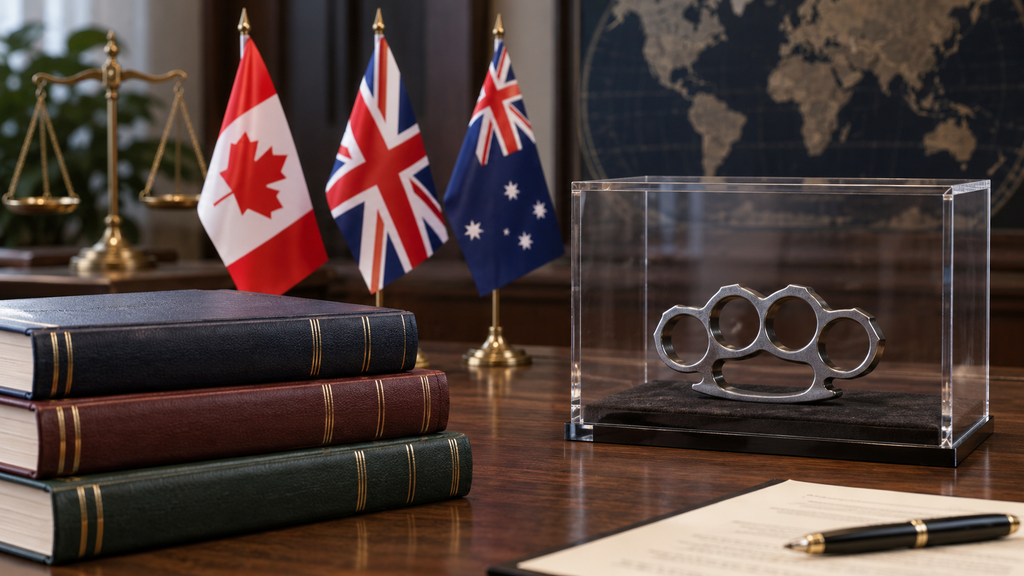
IMAGE PROMPT — IN-TEXT IMAGE
- Filename:
brass-knuckle-laws-around-world.jpg - Prompt: Realistic editorial image showing three neutral law books accompanied by small recognizable but unbranded visual cues representing Canada, the United Kingdom, and Australia, with a metal knuckle weapon resting separately behind a transparent evidence-style barrier, professional legal-information aesthetic, no person using the weapon, no violence, no blood, no written text, no logos, no watermarks.
- Alt text: Legal books representing countries where brass knuckle weapons are prohibited or restricted
- Dimensions: 1200 × 675 px
- Aspect ratio: 16:9
- Placement: After the international law comparison
- Caption: Several countries expressly classify knuckledusters as prohibited weapons.
Can You Carry Brass Knuckles if Owning Them Is Legal?
Not necessarily.
Weapon law often separates several different activities:
- ownership,
- possession,
- purchase,
- sale,
- manufacture,
- transportation,
- open carrying,
- concealed carrying, and
- use.
A jurisdiction might allow possession at home while restricting concealed carry. Another jurisdiction may prohibit the item itself.
Restricted locations can create another layer of law.
Courthouses, schools, government facilities, airports, prisons, entertainment venues, and private properties may be governed by additional statutes or policies.
Therefore, a statement such as “brass knuckles are legal in my state” is incomplete unless the reader knows what activity is being discussed.
What Happens if Police Find Brass Knuckles?
There is no universal penalty.
Possible consequences depend on:
- the applicable state or local law,
- whether possession itself is prohibited,
- where the weapon was located,
- whether it was concealed,
- the person’s criminal history,
- whether another offense allegedly occurred,
- whether the weapon was used or displayed, and
- whether a statutory exception applies.
The difference can be substantial.
Washington classifies a violation of its metal-knuckles provision under RCW 9.41.250 as a gross misdemeanor.
Michigan’s current statutory text, by contrast, classifies violation of its listed prohibited-weapons provision as a felony carrying a stated maximum of five years’ imprisonment, a fine of up to $2,500, or both.
That comparison is exactly why national articles that simply say “you can get a fine or jail time” are not enough for a real legal question.
The governing statute matters.
What If Brass Knuckles Are Kept as a Collectible?
Calling something a collectible does not necessarily change its legal classification.
Where possession of a particular weapon is prohibited based on the physical characteristics of the object, a person’s decision to display it, collect it, or store it does not automatically remove it from the statute.
Some jurisdictions may provide exceptions for antiques, museums, historical collections, theatrical productions, law enforcement, or other specified purposes.
However, exceptions are highly law-specific.
A collector should therefore verify the exact exemption rather than assuming that decorative intent is enough.
What About Brass-Knuckle Belt Buckles, Jewelry, or Novelty Items?
Again, the physical design and statutory definition matter more than the marketing name.
An item advertised as:
- jewelry,
- a paperweight,
- a belt buckle,
- a novelty,
- a costume accessory, or
- a collectible
could still satisfy a prohibited-weapon definition if it is built to function as a knuckle weapon.
Illinois’s “regardless of its composition” language demonstrates how broadly some laws can be written.
The safest legal approach is to examine the statute and the object’s characteristics rather than relying on how a retailer labels it.
How to Check Whether Brass Knuckles Are Legal Where You Live
For a reliable answer, work from primary legal sources whenever possible.
1. Check the Current State Statute
Search the official state legislature or government code for terms such as:
- brass knuckles,
- metal knuckles,
- metallic knuckles,
- plastic knuckles,
- knuckle weapon,
- knuckleduster,
- prohibited weapon, and
- dangerous weapon.
2. Read the Definition Section
Do not stop when you find a phrase that sounds similar.
Definitions can determine whether a law applies only to metal devices or to any hard-material weapon designed to fit over the hand.
3. Check the Prohibited Conduct
Determine whether the statute restricts:
- possession,
- sale,
- purchase,
- manufacture,
- delivery,
- concealed carry, or
- possession with unlawful intent.
4. Look for Exceptions
Law enforcement, historical collections, inherited antiques, theatrical use, sporting purposes, or other circumstances may have narrowly written exceptions in some jurisdictions.
Never assume an exception exists.
5. Check Local Ordinances
City and county rules can sometimes be more restrictive than the general state rule, depending on state preemption law.
6. Verify the Effective Date
A blog post written several years ago can accurately describe the law that existed when it was published and still be wrong today.
Use the version currently in force.
Why Legal Information About Brass Knuckles Is Often Confusing
Three issues repeatedly cause problems.
First, websites sometimes convert complicated weapon statutes into oversimplified “legal/illegal” maps.
Second, laws may use terminology that differs from what people type into Google.
A person searches for brass knuckles, while the statute may say:
- metal knuckles,
- metallic knuckles,
- knuckleduster,
- dangerous weapon, or
- knuckle weapon.
Third, a statement about possession is sometimes mistakenly treated as a statement about carrying, selling, or using the weapon.
These are separate questions.
That is why the better question is not simply:
“Are brass knuckles legal?”
It is:
“Does the current law in this specific jurisdiction prohibit possessing, buying, selling, carrying, or using this specific type of knuckle weapon?”
Conclusion
So, why are brass knuckles illegal?
Where they are prohibited, the main legal rationale reflected in weapon statutes is their nature as purpose-built striking weapons. They fit over the hand, increase the effect of a blow, can be concealed easily, and have relatively little ordinary non-weapon utility.
But brass knuckles are not governed by one universal U.S. prohibition. Washington, Michigan, Illinois, New York, and other jurisdictions have statutes expressly addressing knuckle weapons, while the legal treatment elsewhere can differ.
That also explains why the question “Why are brass knuckles illegal but not guns?” has no simple answer. Firearms are heavily regulated too, but firearm legislation operates within a separate constitutional framework shaped by the Second Amendment and Supreme Court decisions.
Anyone deciding whether to buy, own, transport, or carry brass knuckles should therefore check the current official state and local law, not rely on a retailer, an old article, or a general nationwide list.
Frequently Asked Questions
Why are brass knuckles illegal in the US?
They are not universally illegal throughout the United States. Some states prohibit them because they are classified as dangerous or prohibited striking weapons designed to increase the force of a punch. Other states regulate them differently, so state and local law must be checked.
Why are brass knuckles illegal but not guns?
The comparison is incomplete because firearms are also heavily regulated. Firearm regulation additionally implicates the Second Amendment and related Supreme Court decisions. Brass-knuckle restrictions arise under different state weapon statutes and potentially different constitutional analysis.
Why are brass knuckles so dangerous?
Their hard structure can increase the damaging effect of a punch by placing rigid material across the striking surface. Depending on the circumstances, an impact can cause fractures, cuts, facial injuries, head injuries, or other serious harm.
Are plastic brass knuckles legal?
Not necessarily. New York expressly lists plastic knuckles, while Illinois covers other knuckle weapons regardless of composition. The applicable statutory definition must be checked rather than assuming plastic versions are legal.
Are brass knuckles illegal in Canada?
Canadian federal prohibited-weapons regulations specifically identify brass knuckles and similar qualifying metal devices as prohibited weapons.
Are brass knuckles illegal in the UK?
Yes, knuckledusters are among the offensive weapons prohibited under UK legislation, subject to any applicable statutory exemptions. Restrictions extend to activities including possession, sale, supply, and importation.
Can I keep brass knuckles at home if I never carry them?
That depends on the jurisdiction. Some laws prohibit simple possession, including possession on private property, while other jurisdictions distinguish between ownership and public or concealed carrying.
Does buying brass knuckles online make them legal?
No. A seller’s willingness or technical ability to ship an item does not establish that possessing, receiving, or carrying it is legal at the destination. Check the current official law where the item will be possessed.
