

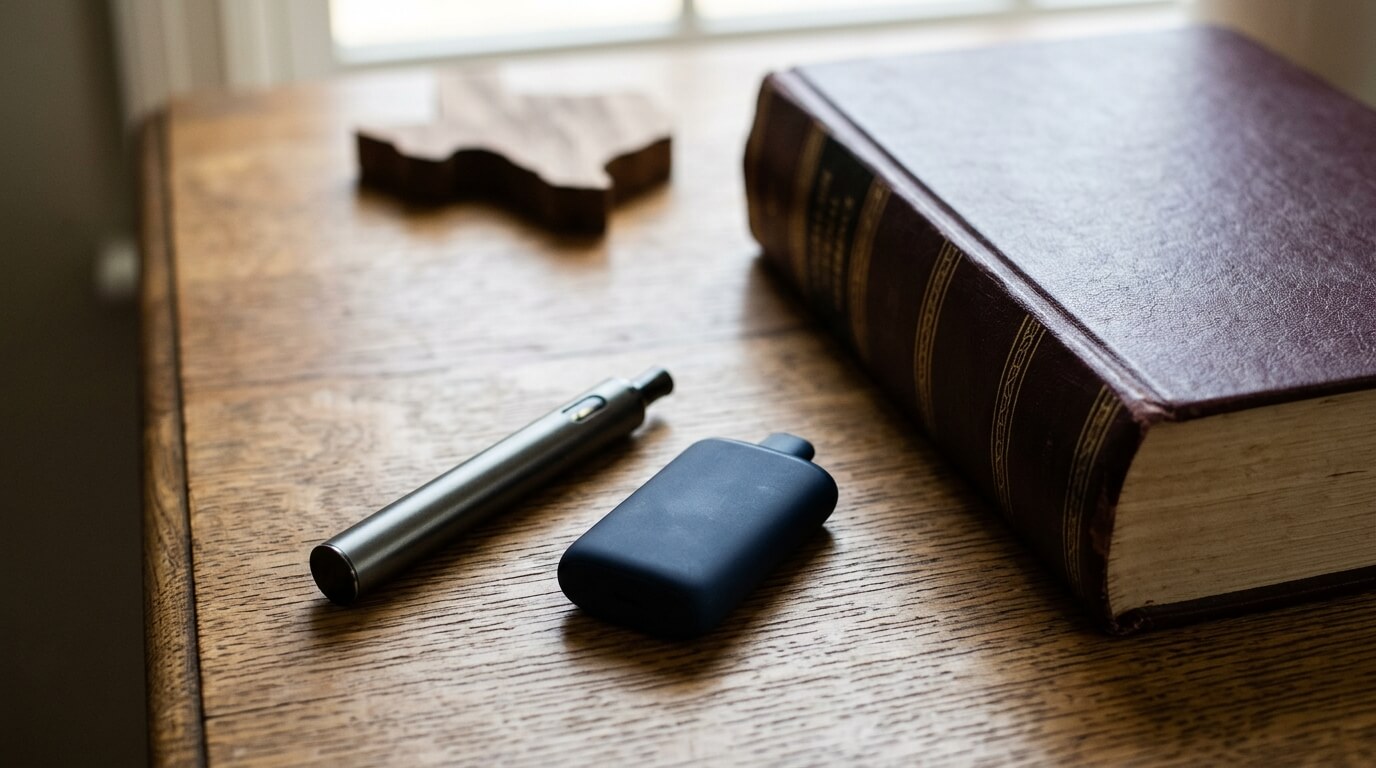
Are Vapes Illegal in Texas? Nicotine, THC, and Vape Pen Laws
No, Texas has not made every vape illegal. Adults 21 and older can generally possess lawful nicotine vapes, although restrictions apply to product sales and where devices may be used. THC and delta-8 cartridges raise separate controlled-substance questions.
Headlines about a “Texas vape ban” often leave out an important distinction. A product being illegal to sell does not automatically mean an adult commits the same offense by possessing it. Underage possession, school discipline, and public use are also governed by separate rules.
If you are asking, “Are vapes illegal in Texas?” the answer depends on more than the device’s appearance. Consider your age, what the product contains, what you are doing with it, and where you are using it. Those details determine which restrictions matter.
The rules that matter most
- Texas has not automatically outlawed every nicotine vape, disposable device, or vape pen.
- Federal law prohibits retailers from selling covered tobacco products to anyone under 21.
- Texas restricts certain vape products based on ingredients, packaging, design, and manufacturing origin.
- Delta-8 controlled-substance restrictions returned to effect on July 31, 2026.
- Possession, sales, public use, and school discipline involve different legal rules.
Which Vapes Are Legal in Texas?
A device’s shape does not tell you whether it is legal. Two similar cartridges can contain different substances and create very different legal issues. Start by identifying the product and separating personal possession from advertising, selling, or other commercial activity.
How Texas treats common vape products
| Product | Main legal issue |
|---|---|
| Nicotine vape | No blanket adult possession ban; sales must satisfy state and federal requirements. |
| Disposable vape | Not automatically illegal because it is disposable; product-specific restrictions apply. |
| THC cartridge | Contents, amount, and lawful authorization determine whether controlled-substance rules apply. |
| Delta-8 vape | Controlled-substance restrictions apply, with a narrow naturally occurring trace-amount exception. |
| CBD vape | The cannabinoid sales restriction applies even to products marketed as nonintoxicating. |
| Nicotine-free vape | Removing nicotine does not automatically exempt the product from Texas e-cigarette restrictions. |
Are Nicotine Vapes Illegal in Texas?
Nicotine vapes are not categorically illegal in Texas. An adult carrying a lawful nicotine product is not automatically committing an offense simply because it is a vape. However, being old enough to buy one doesn’t make every product legal to sell.
The federal Tobacco 21 requirements prohibit retailers from selling covered tobacco products to anyone under 21. Retailers must also check photo identification for purchasers under 30. These federal retail age restrictions have no military exception.
State product restrictions and federal marketing requirements apply independently. A nicotine vape can satisfy one requirement while violating another. For that reason, neither a customer’s age nor a product’s availability on a store shelf answers every legal question.
Are Flavored Vapes Banned?
Texas law does not create a simple rule banning every flavored vape. Certain packaging images are prohibited, including images resembling food, candy, or juice. That differs from prohibiting every product solely because its liquid has a fruit flavor.
Federal requirements must also be considered separately. Meeting a Texas packaging requirement does not establish that a product is authorized for sale under federal law. Retailers need to evaluate the specific product rather than treating “flavored” or “unflavored” as a complete compliance test.
What Did the Texas Vape Law Change?
Senate Bill 2024 expanded the prohibited-product rules effective September 1, 2025. The law addresses specific marketing, advertising, sales, offers for sale, and conduct that causes products to be sold. It does not simply declare that every vaping device is illegal.
The restricted categories include certain packaging aimed at minors and packaging displaying celebrity names or images. The law also covers products disguised as school supplies, electronics, cosmetics, or toys. Additional restrictions address covered products manufactured in designated countries and products containing or marketed as containing cannabinoids or other listed substances.
The statutory definition of an e-cigarette product includes consumable liquid or other material used in a device, regardless of whether it contains nicotine. Prescription exclusions also appear in the definitions. This makes “nicotine-free” an unreliable shortcut for deciding whether the sales restrictions apply.
Are All Vapes With Chinese Hardware Banned?
Saying that every vape with Chinese hardware is banned is too broad. The official manufacturing and labeling guidance explains how the restrictions apply to covered products. For prefilled devices and pods, where the contents were blended, poured, and packaged, this can affect the analysis.
A generic compliance statement does not resolve every manufacturing question. The guidance specifically explains that a “Made in Compliance with SB 2024” statement is not sufficient by itself. Retailers need product-specific information, not assumptions based on a device’s appearance.
Does an Illegal Sale Mean Illegal Possession?
An illegal sale does not automatically establish an illegal possession offense. The restricted-product provision targets specified commercial activities. It does not create a blanket personal-possession offense covering every product that a retailer cannot sell.
Consider an adult carrying a restricted nicotine product purchased from a shop. The retailer’s prohibited sale does not, by itself, establish that the customer committed the same offense by possessing it. If the cartridge contains a controlled substance, however, separate possession laws may apply.
Are THC Vapes Illegal in Texas?
A THC vape can create criminal exposure under Texas controlled-substance law. The answer depends on the substance involved, the amount, and whether a valid legal exception applies. A cartridge’s small size does not make it lawful or guarantee a minor charge.
Labels such as “hemp-derived” or “legal THC” do not settle the issue. A laboratory report or store receipt also does not automatically establish lawful possession. The product’s actual contents and the applicable legal definitions remain important.
For cannabinoid vapes, sales and possession must be considered separately. A product may face the state cannabinoid sales restriction even when someone believes its contents qualify as lawful hemp. Conversely, the absence of a particular sales violation would not automatically resolve a controlled-substance possession question.
Are Delta-8 Vapes Legal in Texas?
Older guidance describing delta-8 as protected by an ongoing injunction is outdated. The current delta-8 scheduling notice explains that the relevant restrictions became effective on July 31, 2026. The stated exception is limited to naturally occurring trace amounts produced by the hemp plant from which the product was manufactured.
That narrow exception should not be read as permission to carry an ordinary concentrated delta-8 cartridge. A “hemp-derived” label does not prove that a product falls within it. Consumers should not rely on pre-July 2026 articles when assessing current delta-8 restrictions.
Can Medical Patients Use Cannabis Vapor?
Texas law provides a separate medical pathway for qualifying patients. Under the medical cannabis inhalation provisions, a participating physician may prescribe pulmonary administration of an aerosol or vapor when medically necessary. Applicable prescription, product, and dispensing requirements still apply.
The Texas patient eligibility and prescription rules involve a qualified participating physician and a licensed dispensing organization. A smoke-shop cartridge does not become an authorized prescription product because someone uses it for pain or anxiety. An out-of-state medical authorization also does not automatically provide protection under the Texas program.

Can Someone Under 21 Possess a Vape?
Texas generally prohibits people under 21 from possessing, buying, consuming, or accepting e-cigarettes. Falsely representing your age to obtain one can also violate state law. Turning 18 therefore does not generally provide the same vaping rights as turning 21.
The underage possession and enforcement rules describe a possible fine of up to $100. Tobacco awareness or community service requirements may also apply. The outcome can depend on the circumstances and whether the defendant completes court requirements.
Narrow statutory exceptions cover certain employment duties and supervised enforcement activities. Texas also has a limited military-related exception. That state exception does not override the federal prohibition on retailers selling covered tobacco products to anyone under 21.
What Happens if a Student Brings a Vape to School?
School discipline and criminal prosecution are separate processes. A student may face school consequences without being convicted of a crime. Parents should therefore review both the school allegation and any citation rather than assuming one determines the other.
Under the updated school discipline guidance, possession or use of an e-cigarette can result in placement in a disciplinary alternative education program, or DAEP. If a first-time offender is not placed in DAEP, the rule requires at least 10 school days of in-school suspension. Older claims that every vaping incident automatically requires DAEP placement do not accurately describe the current rule.
Selling or distributing a device can trigger different provisions from simple possession or use. A cartridge containing an illegal substance can also create additional disciplinary and criminal questions. Parents should request the specific allegation, the applicable policy, and the written disciplinary decision.
Where Can You Legally Vape?
Lawful possession does not give someone permission to use a device everywhere. The Texas public-place vaping statute covers specified locations, including public school facilities, elevators, libraries, museums, hospitals, and certain public transportation. The statute’s exceptions and defenses also matter.
Local ordinances and property policies may add restrictions. A workplace or business can have rules that affect whether vaping is permitted on its premises. Check the requirements for the specific location instead of assuming that adult possession makes public use acceptable.
Can You Vape While Driving?
Rules on smoking a cigarette while driving provide useful background for drivers. Vaping can introduce additional questions because devices may contain nicotine, THC, or other substances. Being inside your own vehicle does not make possession of an illegal substance lawful.
THC use can also create separate impaired-driving concerns. A product’s medical or hemp-related marketing does not establish that driving after using it is lawful. Drivers should not treat vehicle ownership as an exception to substance or impairment laws.
What Penalties Can Apply?
No single penalty covers every incident involving a vape. Underage possession, prohibited commercial conduct, public use, and controlled-substance possession involve different provisions. The exact allegation matters more than the general description “vape offense.”
Prohibited commercial conduct under the restricted-product provision is a Class A misdemeanor. The ordinary Class A misdemeanor punishment allows up to one year in jail, a fine of up to $4,000, or both. That punishment should not be described as the automatic consequence of an adult possessing a nicotine vape.
Underage possession has its own rules and consequences. Controlled-substance cases involving cartridges can carry more serious penalties depending on the substance, quantity, and charge. A product’s small size or retail packaging does not determine how serious the alleged offense is.
What Should You Do After a Citation or School Incident?
Start by identifying what the allegation actually concerns. It may involve age, public use, sales, school conduct, or a controlled substance. Read the paperwork carefully and note every court date, hearing date, and response deadline.
Preserve existing receipts, packaging, product information, and written school notices. These records may help explain what happened, but they do not automatically prove legality. A Texas criminal defense lawyer can assess an arrest or controlled-substance charge, while parents should also review the school’s disciplinary procedures.
A Further Hemp-Law Change Is Scheduled
As of October 29, 2026, a federal hemp-law change scheduled for November 12, 2026 has not yet taken effect. The change may affect products currently sold under hemp classifications. It should not be described as already effective on this article’s review date.
That future development does not erase Texas restrictions already in force. Existing cannabinoid sales restrictions and controlled-substance rules still require separate consideration. Readers purchasing or transporting hemp products after the scheduled date should recheck current official guidance.
Conclusion
Are vapes illegal in Texas? No blanket ban covers every device. Adult nicotine possession, prohibited product sales, THC possession, school incidents, and public use each require a different analysis. The correct answer depends on the product and the conduct involved.
Before relying on a label or headline, check the contents, the person’s age, the activity, and the location. A familiar brand or store receipt cannot answer all those questions. If a citation or arrest is involved, start with the exact offense listed in the paperwork.
Frequently asked questions
Are vape pens illegal in Texas?
No, a device is not automatically illegal because it is shaped like a pen. Its contents, the user’s age, and the activity involved determine which restrictions apply. Where the device is used can create a separate legal issue.
Are disposable vapes banned in Texas?
Texas has not banned every device simply because it is disposable. A particular product may still be prohibited from sale because of its ingredients, packaging, design, manufacturing origin, or other applicable requirements. Personal possession must be evaluated separately from the legality of the sale.
Are nicotine-free vapes exempt from Texas law?
No, removing nicotine does not automatically create an exemption. Texas definitions expressly cover certain vaping materials regardless of nicotine content. A zero-nicotine label therefore does not establish that age or product restrictions are inapplicable.
Are CBD vapes legal because they are nonintoxicating?
The restricted-product sales provision covers cannabinoids rather than only substances that cause a high. Marketing a CBD vape as nonintoxicating does not exempt it from that sales restriction. Whether possession is lawful requires a separate assessment of the product and applicable law.
Can I bring a THC vape from another state into Texas?
Lawful purchase in another state does not establish lawful possession in Texas. An out-of-state receipt or medical card does not automatically provide protection under Texas law. The product must satisfy the requirements and exceptions that apply within Texas.
Does buying a vape in a Texas store prove it is legal?
No, retail availability is not proof of legal compliance. A receipt can document where a product came from, but it does not establish its actual contents. It also does not automatically provide a defense to a possession allegation.
