

How to Get a Gun License in California: A 2026 Guide
If you are searching for how to get a gun license in california, the first thing to know is that the state does not issue one general license simply to own a firearm. For a typical retail purchase, you usually need a Firearm Safety Certificate, or FSC, and must complete the purchase through a licensed dealer. A Carry Concealed Weapon license, usually called a CCW, is a separate authorization for carrying a concealed firearm in public.
To buy a firearm in California, most people must obtain a Firearm Safety Certificate (FSC) by passing a 30-question test with a score of at least 75 percent. You must then complete the purchase through a licensed firearm dealer, provide the required documents, complete the DROS and federal paperwork, pass the eligibility check, wait 10 full 24-hour periods, and perform a safe-handling demonstration. An FSC is not a concealed-carry permit; concealed public carry generally requires a separate CCW license. This guide explains each part, including costs, online options, registration questions, and the special rules for concealed carry and new residents.
Legal disclaimer: This article provides general educational information, not individualized legal advice. Firearm laws, court orders, and local licensing procedures can change. Check the California Department of Justice and your local licensing authority before acting, and consult a qualified California attorney if your eligibility is uncertain.
Is a “Gun License” Required in California?
The phrase “gun license” can refer to several different documents, so using the correct term matters. For most buyers, the relevant document is an FSC. It shows that you passed a basic written test, but it is not a permit to carry a firearm and does not guarantee that a purchase will be approved.
The state and federal purchase checks occur during the dealer transaction. If you want to carry a concealed handgun in public, you generally need a CCW from the appropriate county sheriff or eligible city police department. People who work in armed security may instead need a Bureau of Security and Investigative Services firearms permit, which is a different occupational credential.
| Document or process | Main purpose | Who handles it | Typical validity |
|---|---|---|---|
| Firearm Safety Certificate (FSC) | Qualifies a nonexempt person to acquire a firearm | DOJ-certified instructor, often at a dealer | Five years |
| DROS transaction | Records the transfer and starts the state eligibility review | California-licensed firearm dealer | Applies to that transaction |
| ATF Form 4473 | Federal firearm transaction and eligibility record | Federal firearms licensee | Applies to that transaction |
| CCW license | Authorizes concealed public carry subject to restrictions | County sheriff or qualifying city police department | Confirm locally |
| Certificate of Eligibility (COE) | State eligibility credential for certain licensees, employees, and other specified uses | California DOJ | Commonly renewed annually |
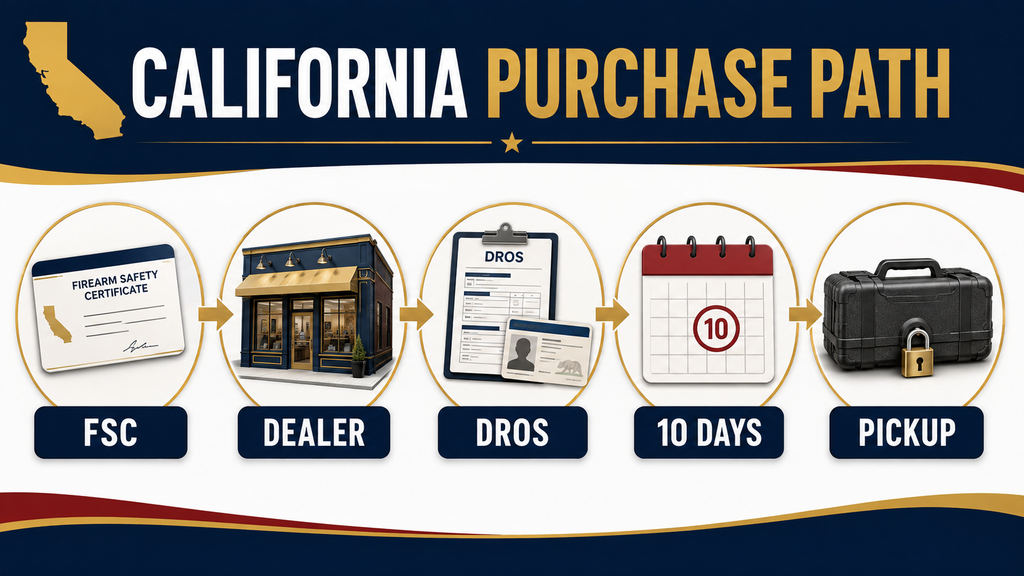
How to Get a Gun License in California Step by Step
1. Check whether you are legally eligible
Do this before paying a dealer or choosing a firearm. Federal and California law prohibit firearm possession for several categories of people, including many people with felony convictions, certain misdemeanor convictions, qualifying restraining orders, specified mental-health commitments, or other disqualifying circumstances. The California DOJ public firearms FAQ provides an overview, while the ATF prohibited-person guidance explains the federal categories.
If you are unsure about your California record, you may request a Personal Firearms Eligibility Check, or PFEC. A favorable PFEC response helps but isn’t a complete guarantee because the state warns it doesn’t include the full federal NICS check. Do not try a purchase simply to test your eligibility, and do not guess about the effect of an old conviction, dismissal, protective order, or mental-health event.
2. Meet the age and identification requirements
An FSC applicant must be at least 18 and present a valid California driver’s license or California DMV identification card. However, being old enough to take the FSC test does not necessarily make you old enough to buy every firearm. California dealers generally may not transfer a firearm to anyone under 21, subject to limited statutory exceptions for certain non-handgun transfers to qualifying people age 18 or older.
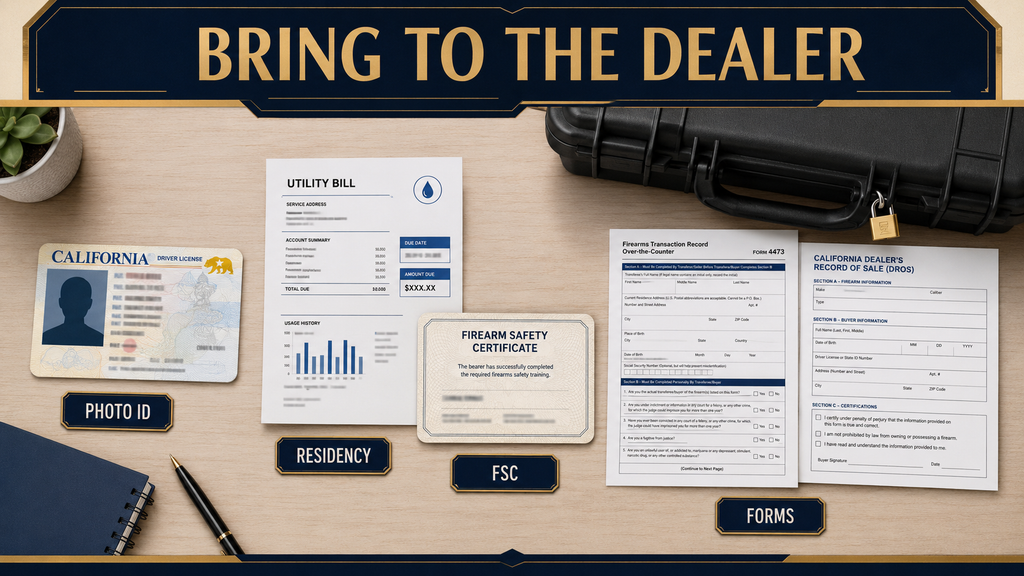
Bring current, nonexpired identification. The California DOJ states that a temporary driver’s license or temporary identification card is not acceptable for this purpose. A handgun purchaser also generally needs additional proof of California residency, such as a qualifying utility bill, residential lease, property deed, or government document.
3. Study for the Firearm Safety Certificate test
Use the free California DOJ Firearm Safety Certificate Study Guide as your primary resource. It covers safe handling, storage, children and firearms, suicide prevention, firearm laws, and basic operation. Commercial quizzes can help you review, but they should not replace the current official guide because third-party questions may be outdated or incorrect.
The official exam contains 30 true-or-false and multiple-choice questions. You need at least 23 correct answers, or 75 percent, to pass. Focus on understanding the principles rather than memorizing an unofficial answer bank.
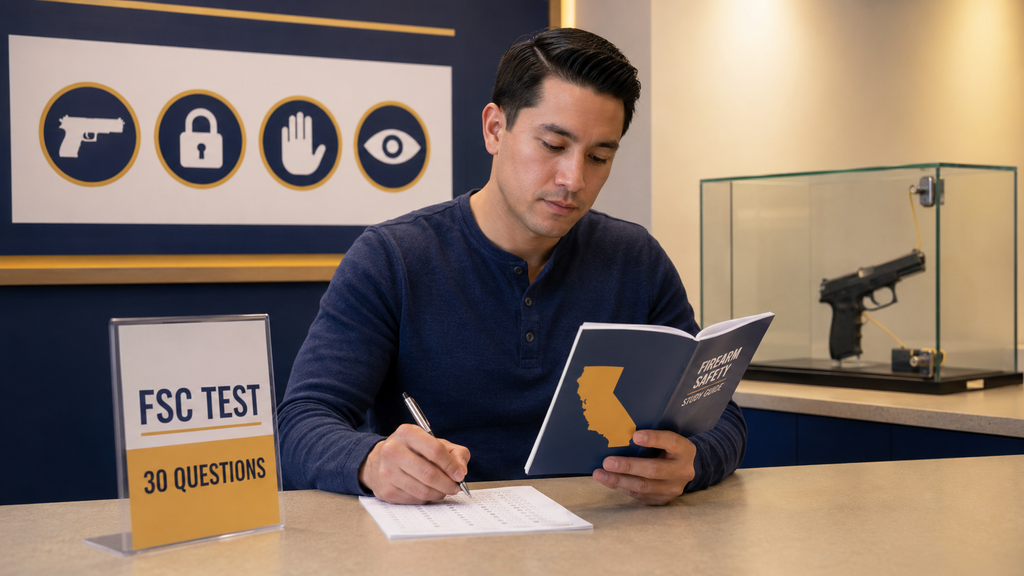
4. Take the FSC test in person
Visit a DOJ-certified instructor, commonly found at a licensed firearm dealership. The FSC fee is $25. According to the official FSC program FAQ, that fee includes two attempts with the same instructor if needed. After an unsuccessful first attempt, you must wait 24 hours before taking another version of the test.
If you pass, the certificate is valid for five years from its issue date. Keep the card secure and retain a photo or record of the issuing instructor. Only the instructor who issued it can replace a lost certificate, and the official replacement fee is $5.
5. Choose a compliant firearm through a licensed dealer
With limited exceptions, purchases and transfers, including private-party transactions and gun-show sales, must go through a California-licensed dealer. For a handgun, check the current DOJ roster of handguns certified for sale, because many retail handgun sales are limited to listed models even though specific exemptions may apply.
One detail I would not overlook is the magazine and configuration. A model that is lawful elsewhere may not be lawful to import, sell, or possess in California. Ask the dealer to confirm the exact model, configuration, magazine capacity, included safety device, and total price before paying.
6. Bring the right documents and complete the forms
The dealer will normally ask for your valid California driver’s license or DMV identification card and your FSC or proof of exemption. A handgun purchase usually requires an additional acceptable proof of California residency. Noncitizens may need additional immigration-status documents, and a federal “Federal Limits Apply” notation or address mismatch may trigger additional documentation requirements.
You will complete ATF Form 4473 and the Dealer’s Record of Sale, or DROS, process at the dealer. Answer every question yourself, fully, and truthfully. Buying a firearm for someone who is the actual intended buyer can constitute an unlawful straw purchase, even if that person could otherwise possess a firearm.
7. Pay the fees and account for taxes
The FSC test costs $25. The California DOJ currently lists the total state firearm-purchase fee as $37.19, consisting of the DROS fee and two additional state fees. For a qualifying private-party transfer, the dealer may charge up to an additional $10 per firearm under DOJ limits.
The firearm’s price, sales tax, dealer charges, safety-device cost, and other applicable charges are separate. California also imposes an 11 percent firearms, precursor-parts, and ammunition excise tax at the retail level, subject to exemptions; the current rate appears in the California Department of Tax and Fee Administration guidance. Ask for an itemized out-the-door quote because the final total can be meaningfully higher than the displayed firearm price.
| Cost | Current general amount | Important note |
|---|---|---|
| FSC test and certificate | $25 | Includes two attempts with the same instructor |
| Replacement FSC | $5 | Must come from the original issuing instructor |
| State purchase fees | $37.19 | Dealer charges and taxes are separate |
| Private-party transfer dealer fee | Up to $10 per firearm | Added to applicable state fees |
| California firearm excise tax | 11% | Calculated under state tax rules; exemptions may apply |
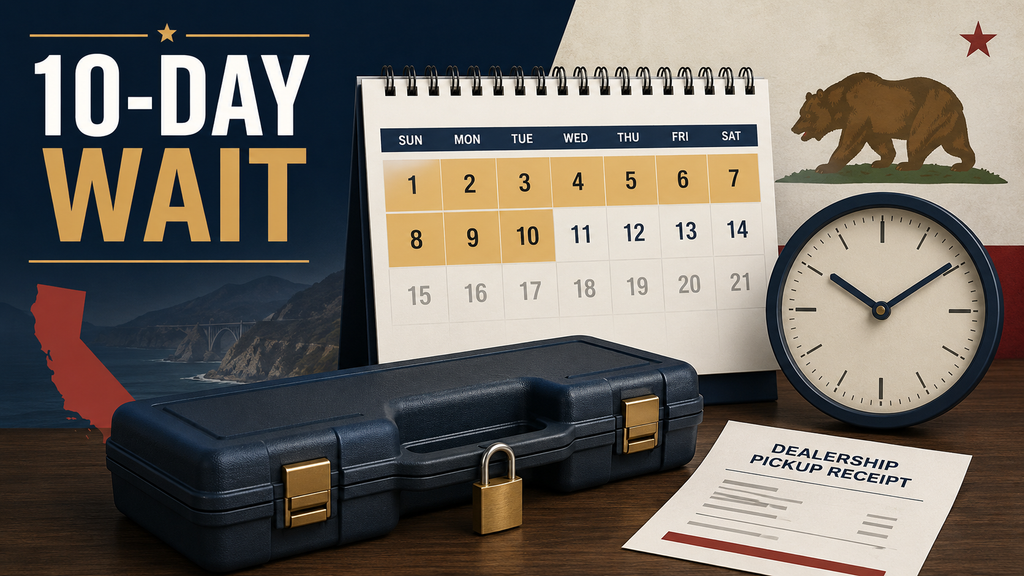
8. Wait 10 full 24-hour periods
California generally requires a waiting period of ten consecutive 24-hour periods beginning when the dealer submits the DROS information. This is not simply “ten calendar dates.” Your dealer should give you the earliest lawful pickup date and time.
The DOJ may approve, deny, reject, delay, or be unable to determine the transaction within the initial period. A delay does not mean an automatic denial. If a record is incomplete or appears to match your identifying details, follow the written process rather than relying on informal explanations from store staff.
9. Complete the safe-handling demonstration and collect the firearm
Before delivery, most purchasers must complete a safe-handling demonstration with the firearm under a DOJ-certified instructor’s supervision. The buyer and dealer sign an affidavit confirming completion. This practical requirement is separate from passing the written FSC test.
Bring the required identification and pickup documents when you return. If you do not take possession within 30 days after the DROS submission, the dealer must cancel the transaction. To proceed later, you generally must begin a new DROS, pay the fees again, and complete another waiting period.
Can I Get a Gun License Online in CA?
You cannot complete the ordinary FSC test entirely online because a DOJ-certified instructor must administer it and verify your identity. You may study online, download the official guide, and contact dealers before visiting. Some reporting and application functions are available through California’s online systems, but those services do not replace the in-person FSC test or dealer transfer process.
A CCW application may begin through an online portal in some counties, yet fingerprints, training, interviews, photographs, or other local steps may still require in-person attendance. Use only the portal linked by your sheriff or city police department. Avoid websites that promise an instant California gun license after an online quiz.
FSC vs. CCW: Do You Need a Carry Permit?
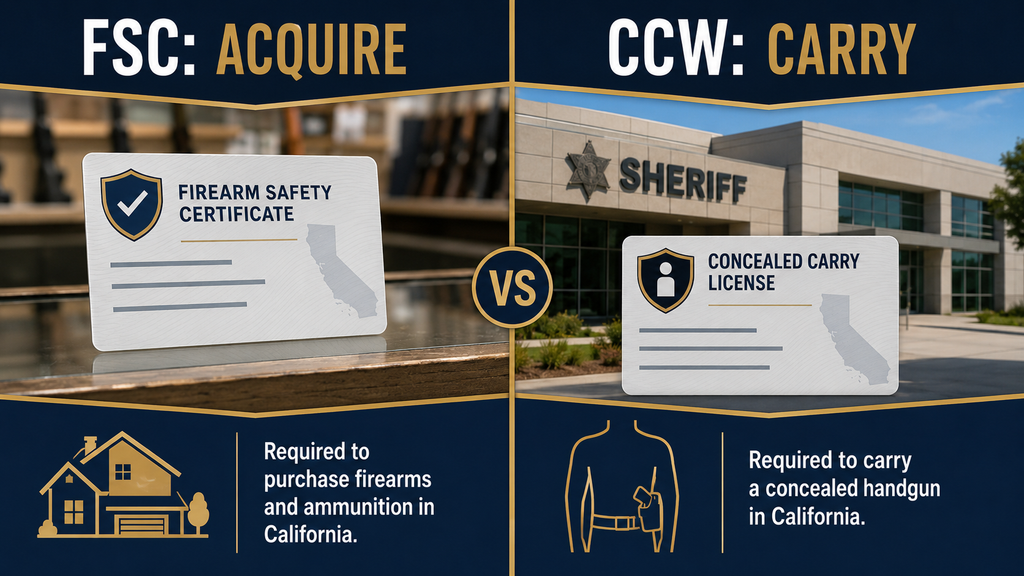
An FSC helps qualify you to acquire a firearm; it does not authorize concealed public carry. A CCW is a separate license issued by a county sheriff or, in some incorporated cities, a police department. California generally does not recognize concealed-carry licenses issued by other states.
Initial CCW applicants generally face a background investigation, fingerprinting, proof of residency, an approved training course, a written assessment, and live-fire qualification. State law sets minimum training requirements, while local agencies publish their own procedures and fees. The DOJ’s CCW instructor and training overview is a useful starting point, but your local licensing authority provides the controlling application instructions.
Understanding how state and federal law interact also helps prevent oversimplification. The Constitution’s Supremacy Clause is explained in this guide to what the supreme law of the land means, but firearm compliance usually requires meeting both applicable federal rules and California’s additional requirements.
What Is the CA Gun Registration Form?
No single form exists for every existing firearm owner to complete just to obtain a general ownership license. A dealer normally submits the DROS information during a California purchase, creating the relevant state transaction record. Do not separately file a Firearm Ownership Report for a newly purchased firearm unless an official instruction specifically applies to your situation.
Different circumstances use different forms. A new resident bringing California-legal firearms into the state generally must take one of the permitted actions within 60 days, commonly filing the New Resident Report of Firearm Ownership, BOF 4010A, and the current fee. Certain intrafamilial or operation-of-law transfers use other forms and deadlines. The California DOJ forms and publications page is the safest place to locate the current version rather than downloading a copy from an unofficial site.
New residents should check legality before bringing any firearm, magazine, or regulated configuration into the state. The DOJ warns that assault weapons, machine guns, and magazines capable of accepting more than ten rounds are subject to major restrictions. The official new-resident guidance explains reporting options and the transportation rule.
Common Mistakes That Delay or Derail a Purchase
Several avoidable problems can lead to extra trips, added fees, rejection, or legal risk:
- Arriving with expired, temporary, or mismatched identification.
- Assuming an FSC is a carry permit.
- Relying on an unofficial practice test instead of the current DOJ study guide.
- Forgetting a second proof of residency for a handgun purchase.
- Giving incomplete or inaccurate answers on Form 4473 or the DROS record.
- Attempting to acquire a firearm for the true benefit of another person.
- Missing the 30-day pickup deadline after the DROS submission.
- Assuming a firearm, magazine, or configuration legal in another state is legal in California.
- Following an old article that still describes the former one-firearm-per-30-days rule. Current DOJ guidance generally states a limit of three firearms cumulatively within a 30-day period, subject to statutory exceptions.
Safe Storage and Transportation After Pickup
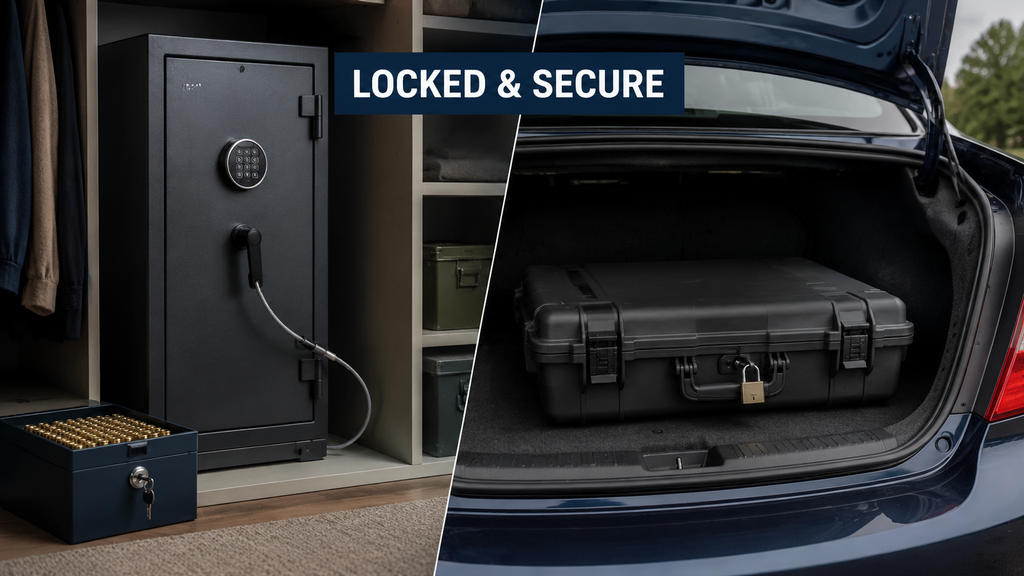
Legal acquisition is only the first step in responsible ownership. The California DOJ recommends storing firearms unloaded in a locked container, using an approved locking device, and storing ammunition separately. California law can impose serious consequences when a child or prohibited person gains access because a firearm was not secured.
For vehicle transport, the California DOJ transportation guide states that a handgun generally must be unloaded and locked in the trunk or in a fully enclosed locked container. A glove box or utility compartment does not qualify as the locked container described by that guidance. Destination restrictions and special rules can apply, so review the current law before each trip.
Frequently Asked Questions
What score do I need on the California FSC test?
You must answer at least 23 of the 30 questions correctly, which is a score of 75 percent. The exam uses true-or-false and multiple-choice questions based on firearm safety and basic California law.
Is there a gun license practice test for CA?
The DOJ provides a free official study guide, which should be your main preparation resource. Third-party practice tests may help you check recall, but verify every disputed answer against the current DOJ guide because unofficial quizzes can contain mistakes or outdated law.
How much does it cost to get a gun license in California?
The FSC test and certificate cost $25, but that is only one part of a purchase. State transaction fees, dealer charges, the firearm price, safety equipment, sales tax, and the 11 percent state firearm excise tax may also apply.
How long does it take to get an FSC?
Many certified instructors can administer and score the FSC test during one visit. Passing the test does not eliminate the separate dealer paperwork, eligibility review, and ten-full-24-hour waiting period for a firearm purchase.
Can I buy a firearm immediately after passing the FSC test?
You may be able to begin a dealer transaction after passing if you have the correct documents and are otherwise eligible. The dealer cannot ordinarily deliver the firearm until the DROS process and required waiting period are complete.
Do I need to register a firearm I already own?
It depends on how and when you acquired it, the firearm type, and whether you moved into California with it. California does not use one universal registration form for every owner, but new-resident, intrafamilial, operation-of-law, and regulated-weapon rules may require specific reports.
How do I apply for a gun permit in Fresno, CA?
For an ordinary purchase in Fresno, follow the statewide FSC and licensed-dealer process described above. For a concealed-carry license, apply through the Fresno County Sheriff or the qualifying municipal police authority for your residence and follow its current local instructions, fees, training, and appointment requirements.
Conclusion
Learning how to get a gun license in california begins with identifying what you actually need. Most ordinary buyers need an FSC and a compliant dealer transaction, while anyone seeking concealed public carry must follow the separate CCW process through the correct local agency.
Start with the current DOJ study guide, confirm your eligibility and documents, and request an itemized price from a licensed dealer. Before paying or transporting a firearm, recheck the California DOJ guidance and your local rules, especially if you have an old record, are moving into the state, or intend to carry in public.
Information checked September 3, 2026.
