

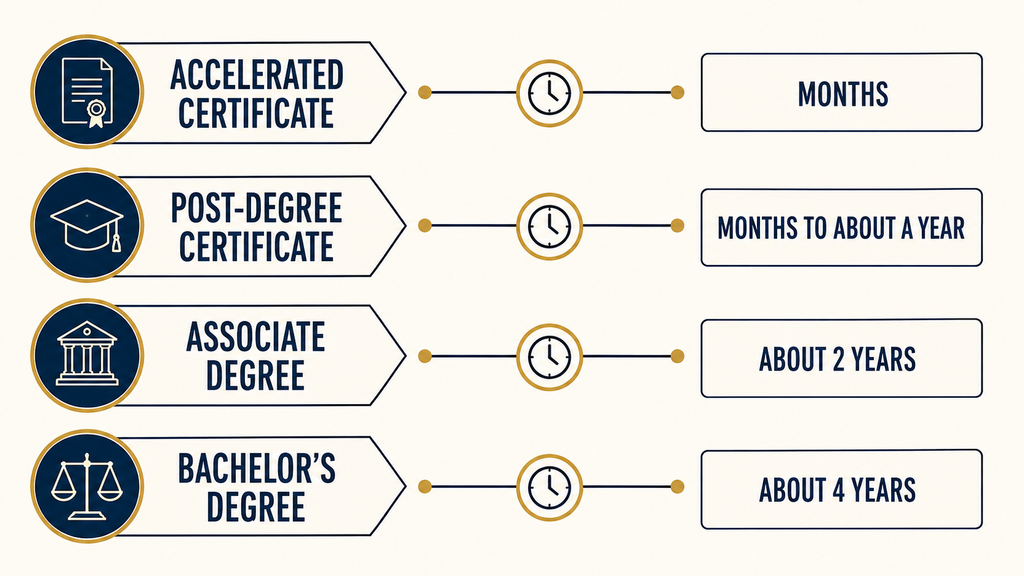
The direct answer to how long does it take to become a paralegal is usually several months to four years. An accelerated certificate may take less than a year, an associate degree commonly takes about two years, and a bachelor’s degree normally takes about four years.
Your actual timeline depends on your current education, the jobs available in your area, the program you select, and whether you pursue voluntary professional certification. Finishing school and becoming competitive for employment are also not necessarily the same date.
Important: This article provides general career information. Education requirements, use of the paralegal title, certification options, and employer standards may vary by state and position.
Quick Answer: How Long Does It Take to Become a Paralegal?
Here are the most common timelines:
| Starting point and route | Typical education time | Who it may suit |
|---|---|---|
| Accelerated paralegal certificate | About 3 to 12 months | Career changers and people seeking focused training |
| Post-degree paralegal certificate | About 4 to 12 months | Applicants who already hold a college degree |
| Associate degree in paralegal studies | About 2 years | Students who want a degree and legal training |
| Bachelor’s degree | About 4 years | Students seeking broader education and access to degree-preferred jobs |
| On-the-job training | No fixed period | Applicants hired into legal-support roles without formal paralegal education |
| Education plus voluntary certification | Program time plus exam preparation | Candidates seeking a separate professional credential |
These are planning estimates, not guaranteed completion dates. Part-time study, course availability, transfer credits, internships, exam preparation, and the job search can make the process shorter or longer.
The Bureau of Labor Statistics’ paralegal career guidance states that paralegals typically enter with an associate degree or a certificate in paralegal studies. It also notes that some employers prefer bachelor’s degrees, while others consider applicants with a high school education and relevant experience.
The Three Timelines Most Articles Mix Together
A useful answer requires separating three different clocks. Many career guides discuss the length of a program but treat graduation as if it guarantees immediate employment and professional certification.
1. Time to Complete Your Education
This is the clearest part of the calculation. It may mean finishing a certificate, associate degree, or bachelor’s degree.
Your schedule can change the result significantly. A program described as one academic year may take longer if you study part-time, begin in the wrong semester, or need prerequisite courses.
2. Time to Meet Local or Employer Requirements
There is no single educational standard used by every employer. One law firm may accept a focused certificate, while another may prefer a bachelor’s degree, prior office experience, or training in a particular practice area.
State-specific rules can also affect the answer. Before enrolling, check the law governing the title and work where you intend to apply.
3. Time to Get Hired
Completing a program makes you eligible to compete for positions. It does not guarantee that an employer will hire you immediately.
Internships, legal-office experience, writing samples, technology skills, and professional contacts can reduce the gap between graduation and employment. I recommend treating employability as part of your training plan rather than something you think about after the final class.
How Each Paralegal Education Route Works
The fastest option is not automatically the most valuable one. Your best path depends on the education you already possess and the expectations of the employers you want to approach.
Accelerated Paralegal Certificate
An accelerated certificate concentrates on practical legal subjects over a relatively short period. Courses may cover legal research, writing, civil procedure, contracts, ethics, litigation support, and document preparation.
Some programs admit applicants with a high school diploma, while others are designed only for students who already hold a degree. Confirm the admission requirement before treating a certificate as your fastest option.
A short course can introduce the work efficiently, but speed creates trade-offs. You may receive less time for internships, electives, writing practice, and relationship-building than you would in a longer program.
Post-Degree Certificate
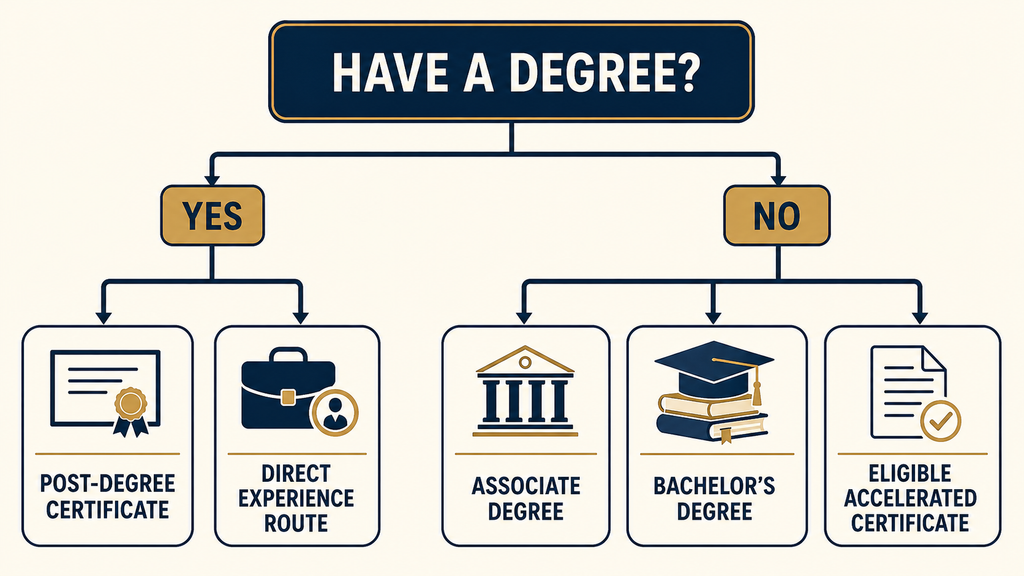
If you already hold an associate or bachelor’s degree, a post-degree certificate may let you add focused legal training without completing another full degree. This is often the most direct route for career changers with education in business, English, criminal justice, political science, finance, healthcare, or another field.
The value comes from combining your existing subject knowledge with legal procedure. A science graduate might pursue intellectual property work, while someone with accounting experience may be useful in corporate, tax, bankruptcy, or financial investigations.
Check whether your target certificate is designed for degree holders and whether it includes practical legal research and writing. A course title alone does not reveal how thoroughly the program prepares students for real assignments.
Associate Degree in Paralegal Studies
An associate degree commonly requires about two academic years of full-time study. It usually combines general education with specialized courses in legal research, writing, ethics, litigation, contracts, and other practice areas.
This route gives first-time college students a broader foundation than a short certificate. It may also provide access to internships, career services, and credits that could transfer into a bachelor’s program.
The main disadvantage is time. Someone who already has a suitable degree may not need to repeat general education and could reach the same target more efficiently through a post-degree certificate.
Bachelor’s Degree
A bachelor’s degree normally takes about four years of full-time study. The degree may be specifically in paralegal or legal studies, or it may be in another field combined with paralegal training.
This path requires the largest time commitment, but it can keep more options open. Some employers prefer bachelor’s degree holders, especially for competitive corporate, government, compliance, intellectual property, or litigation positions.
A four-year degree is not the universal minimum for paralegal employment. Do not assume you need one without examining actual job advertisements in the market where you intend to work.
On-the-Job Training
Some employers hire people into legal assistant, administrative, records, intake, or support positions and train them for increasingly substantive work. The time required depends on the employer, your existing skills, and the complexity of the practice.
This can be a practical route for someone who already understands office systems, deadlines, client communication, or regulated industries. However, it is less predictable than completing a recognized educational program, and the resulting experience may not satisfy every future employer or certification requirement.
Certificate vs. Certification: Do Not Confuse Them
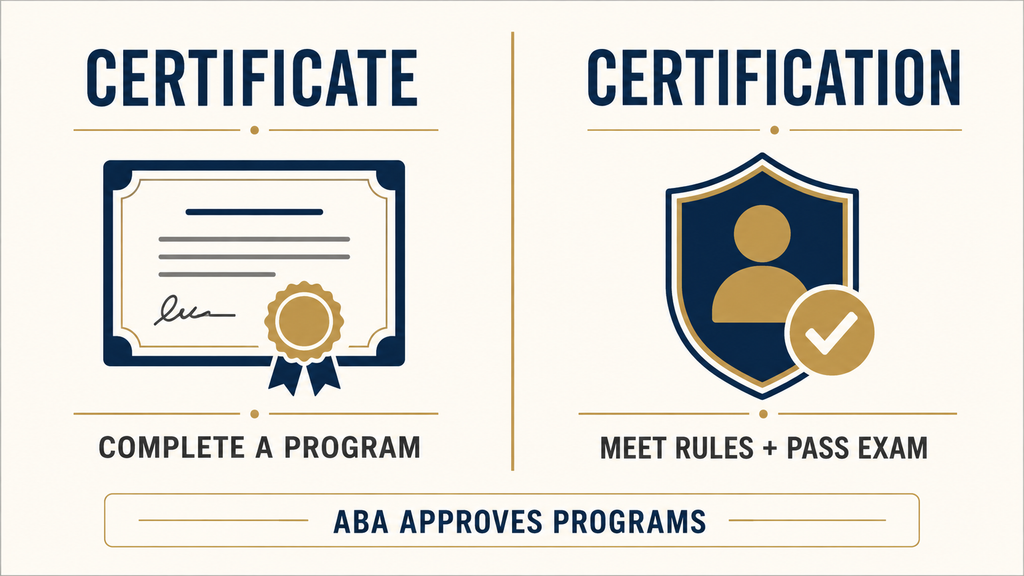
A paralegal certificate and paralegal certification are not interchangeable. Confusing them can lead you to enroll in the wrong course or claim a credential you have not earned.
A certificate is an educational award from a college, university, or training provider. It shows that you completed that institution’s paralegal curriculum.
Certification is a professional credential issued by a certifying organization. It normally requires you to satisfy eligibility criteria, pass an examination, and complete continuing education to maintain the designation.
The American Bar Association’s explanation of certificate versus certification makes another important distinction: the ABA approves qualifying educational programs, but it does not certify individual paralegals. Therefore, describing yourself as an “ABA-certified paralegal” is inaccurate.
NALA offers the Certified Paralegal credential, but applicants must first satisfy one of its approved education or experience routes. Review the current Certified Paralegal eligibility requirements before paying for a course marketed as certification preparation.
| Term | What it means | Who issues it |
|---|---|---|
| Paralegal certificate | Completion of an educational program | School or training institution |
| Certified Paralegal | Professional credential earned after meeting eligibility and examination requirements | Professional certifying organization |
| ABA-approved program | An education program that has completed the ABA approval process | Educational institution with ABA program approval |
| Paralegal license | Government authorization to practice a regulated profession | Generally not the standard model for ordinary paralegal work |
Do You Legally Need a Degree or Certification?
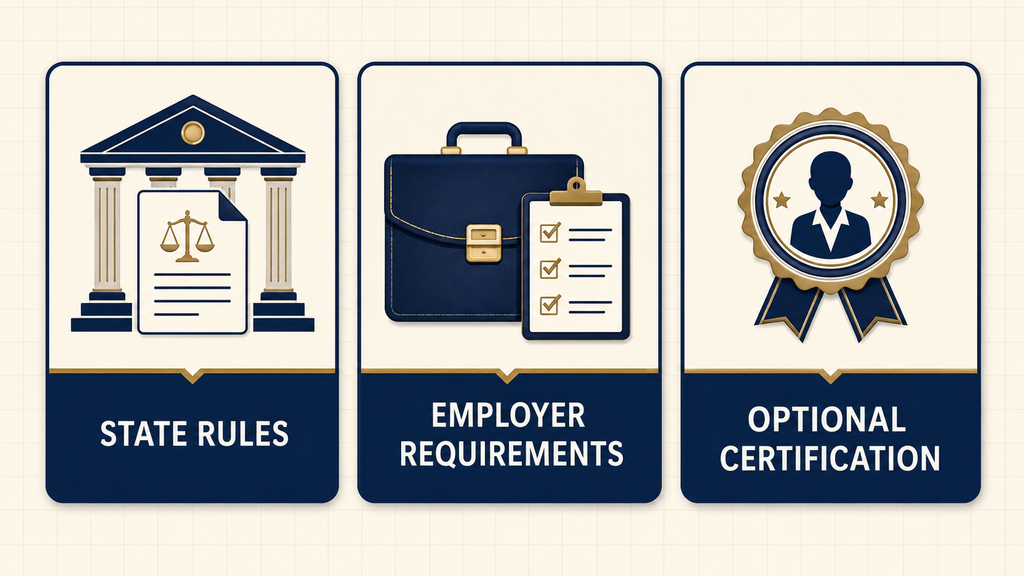
There is no universal rule requiring every paralegal to hold the same degree or pass one mandatory national examination. In practice, employer requirements often decide which candidates can access a particular job.
The ABA’s educational information for paralegals explains that professional certification is different from completing an educational program. It also confirms that the ABA does not certify individual paralegals.
State-specific rules remain important. California’s Business and Professions Code sections 6450–6456 define the paralegal role and establish education, experience, supervision, and continuing-education provisions.
That does not mean every other employer accepts an applicant with no formal training. Legal permission, employer preference, and professional competitiveness are three separate questions.
What Paralegal Training Should Actually Teach You
The length of a program matters less if the curriculum does not teach employable skills. A short course that includes substantial research, writing, and document work may be more useful than a longer program built mostly around passive lectures.
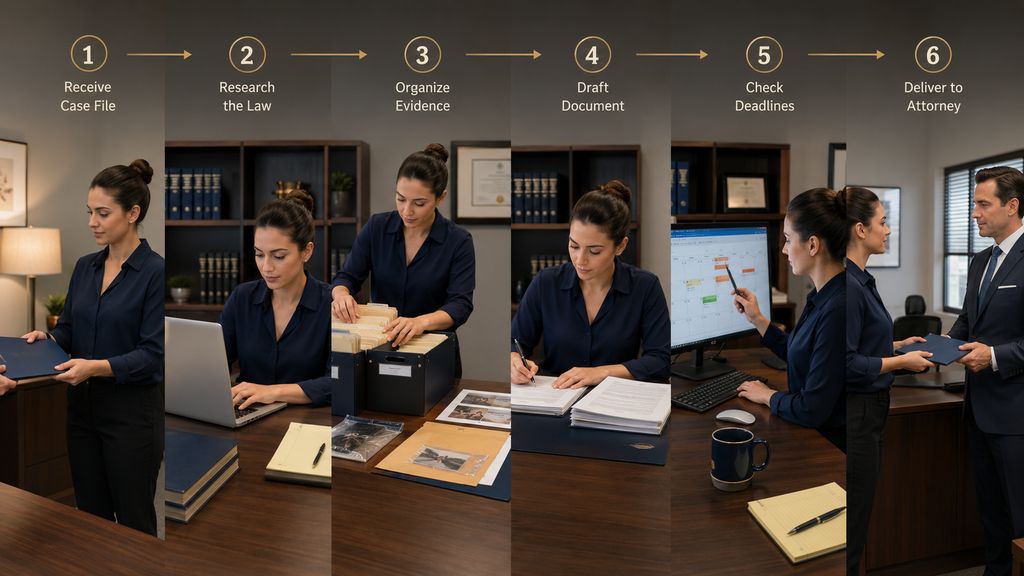
According to the Bureau of Labor Statistics’ description of paralegal duties, paralegals may investigate facts, research laws, maintain case documents, draft correspondence, obtain formal statements, and assist lawyers during hearings or trials.
A practical curriculum should help you develop abilities such as:
- Locating and updating statutes, regulations, and cases
- Reading court rules and filing requirements
- Writing research memoranda
- Drafting correspondence and routine legal documents
- Organizing discovery and evidence
- Calculating and tracking deadlines
- Managing electronic case files
- Reviewing contracts and records
- Communicating professionally with clients and legal teams
- Understanding confidentiality, supervision, and legal ethics
- Using word-processing, spreadsheet, e-filing, and case-management systems
Different practice areas demand different knowledge. A probate paralegal may help organize assets, court forms, and deadlines in matters involving whether an estate must pass through probate.
A criminal-law paralegal may maintain court records, prepare hearing files, and research procedures related to recalling or quashing a bench warrant. These examples show why basic legal research skills need to transfer across more than one type of case.
How to Choose a Program Without Wasting Time or Money
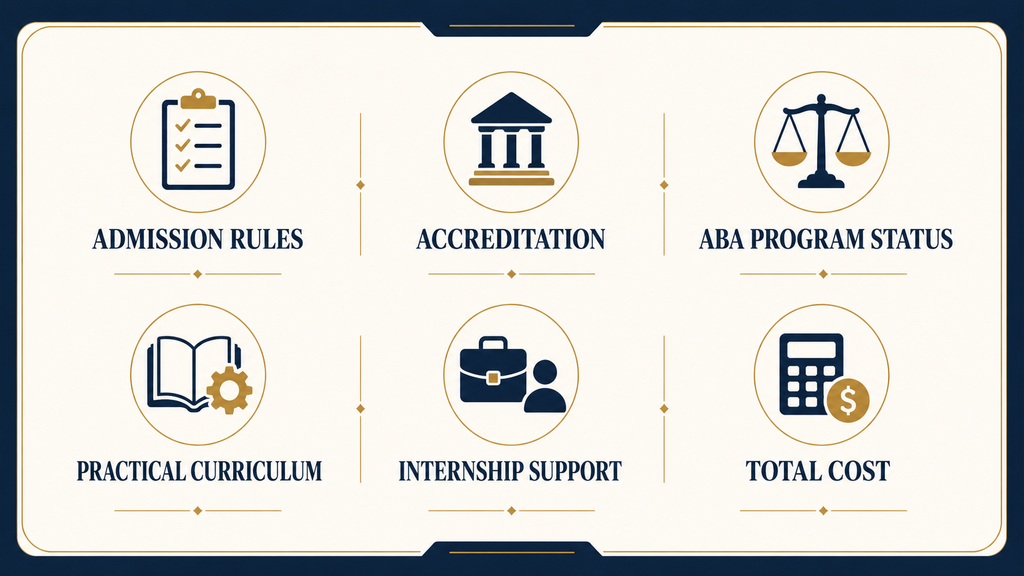
Program duration is only one part of the decision. I would not enroll until I could answer what the program teaches, which students it serves, and whether local employers respect it.
Check the Admission Requirements
Some certificate programs accept applicants directly from high school. Others are post-baccalaureate programs requiring a completed bachelor’s degree before admission.
Do not rely on the word “certificate.” Read the admission page and request written confirmation if your previous education does not clearly match the stated requirement.
Verify Institutional Accreditation and Program Approval
Institutional accreditation and ABA program approval are related to quality review, but they are not the same thing. A school can be institutionally accredited while its paralegal program is not ABA-approved.
The ABA maintains a searchable directory of currently approved paralegal education programs. Programs not appearing in the directory should not advertise themselves as ABA-approved.
ABA approval is not the only factor worth considering. Employers, transfer policies, certification eligibility, cost, format, and local reputation may also affect your decision.
Examine the Curriculum
Look for assignments that require actual research, writing, citation, document preparation, and deadline management. A program should prepare you to produce work that a supervising attorney can review, not merely recognize legal vocabulary in a quiz.
Ask whether students use legal research databases, e-filing simulations, document-management tools, and realistic case files. Technology training matters because much of modern legal support work is electronic.
Investigate Internships and Career Outcomes
An internship can turn theoretical knowledge into evidence that you understand legal-office expectations. Ask whether the institution arranges placements, provides leads, or leaves students to find opportunities independently.
Also ask for specific career information rather than broad statements such as “graduates may work in law.” Useful information includes the types of employers hiring graduates, whether career services continue after graduation, and how the program helps students create legal writing samples.
Calculate the Entire Cost
Tuition is not necessarily the full price. Books, database access, technology charges, certification preparation, examination fees, commuting, childcare, and reduced working hours can affect affordability.
Compare the total cost with the number of credits, supervised practical experience, transferability, and career support. A cheaper course may not be good value if employers do not recognize it or if it leaves you ineligible for your intended certification.
The Fastest Sensible Route Step by Step
If speed matters, begin with the job rather than the school. Selecting the shortest available course without checking hiring standards can save months in education but cost more time during the job search.
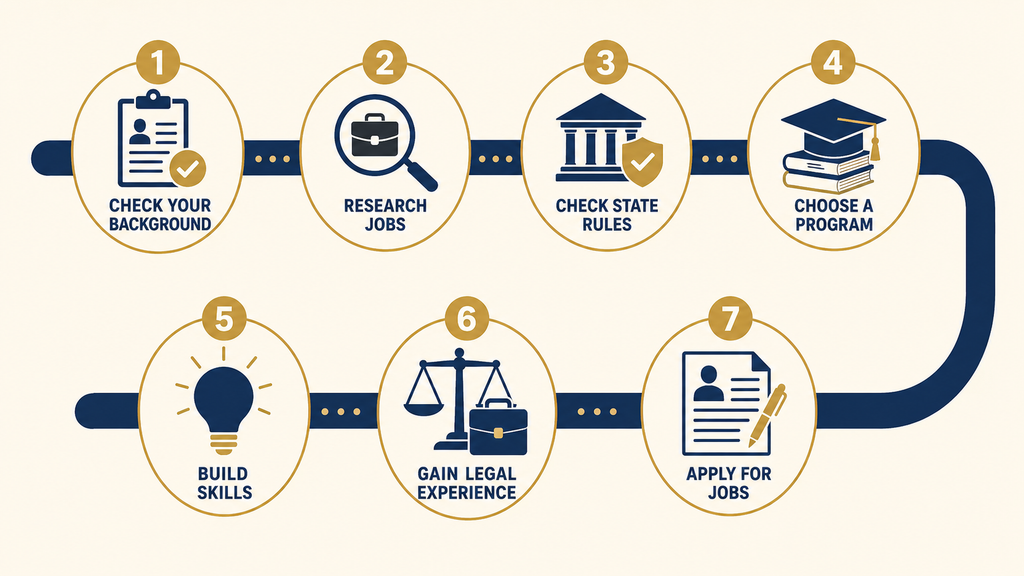
Step 1: Review Your Existing Education
List your completed degrees, credits, office experience, writing ability, technology skills, and knowledge of regulated industries. These may determine whether a post-degree certificate, associate degree, or experience-based route makes sense.
Step 2: Study Real Job Advertisements
Collect at least 15 current paralegal or legal assistant listings within a realistic commuting or remote-work range. Record the education, experience, software, practice area, and certification preferences appearing repeatedly.
This small exercise shows what your actual market expects. It is more reliable than choosing a path based only on a school’s promotional page.
Step 3: Check State Rules
Verify whether the state regulates use of the paralegal title, defines qualification standards, or requires continuing education. Also distinguish ordinary paralegal work under attorney supervision from independent legal-document services or another regulated role.
Step 4: Shortlist Programs
Remove programs that do not match your prior education, schedule, budget, intended certification, or employer expectations. Then compare the remaining options for practical assignments, internship access, and career support.
Step 5: Build Evidence of Skill
Save suitable research memoranda, writing exercises, mock case files, and document samples when program rules allow it. Remove confidential or personally identifying information from anything created in a real workplace.
Step 6: Gain Legal-Office Exposure
An internship, legal receptionist role, records position, intake job, court-clerk experience, or supervised volunteer opportunity may help you understand legal workflow. The work must remain within the role’s permitted scope.
Step 7: Apply Before You Feel Perfect
Begin preparing your résumé and application materials before graduation. You can identify suitable openings, attend professional events, and practice interviews while completing your final courses.
Can You Become a Paralegal Without a Degree?
It may be possible to enter through experience, employer training, or a certificate program that does not require a previous degree. However, the absence of a universal degree requirement does not mean every employer will treat all applicants equally.
A degree or respected paralegal program can make your skills easier for an employer to evaluate. It may also affect whether you qualify for advancement, competitive positions, or voluntary certification.
If you have no degree and need the fastest realistic route, examine local legal assistant and entry-level support jobs alongside paralegal positions. Building experience while completing a suitable program may be more practical than waiting for one employer to provide all training from the beginning.
Is Becoming a Paralegal Worth the Time?
The answer depends on whether the daily work fits your abilities and expectations. Paralegals often handle detailed research, multiple deadlines, confidential information, repetitive document review, demanding clients, and changing priorities.
The Bureau of Labor Statistics reports a median annual wage of $61,010 for paralegals and legal assistants in May 2024. It projects little or no overall employment change from 2024 to 2034, while still estimating about 39,300 openings per year on average, primarily because workers leave the occupation or workforce.
Those figures do not guarantee an individual salary or job. Location, experience, employer, specialty, education, overtime, and job responsibilities can produce significantly different outcomes.
Main Advantages
- Faster entry than becoming a lawyer
- Multiple education pathways
- Opportunities in several areas of law
- Transferable research and document-management skills
- Potential entry into firms, government, corporations, insurance, and nonprofit work
Possible Drawbacks
- Tight and overlapping deadlines
- Work may become repetitive in document-heavy practices
- Career growth can depend on education and specialization
- Some jobs expect experience even at entry level
- Paralegals cannot simply replace lawyers or provide unauthorized legal services
Common Mistakes That Extend the Timeline
Choosing a Program Before Studying the Job Market
A fast program is not fast if it prepares you for jobs that local employers do not offer. Begin with actual hiring requirements and work backward.
Confusing Certificate With Certification
Completing an educational certificate does not automatically make you a Certified Paralegal. Certification has separate eligibility and examination requirements.
Assuming ABA Approval Applies to the Student
ABA approval applies to qualifying education programs, not individual graduates. Never describe yourself as ABA-certified.
Ignoring State-Specific Rules
Generic career articles cannot replace a state-level check. Title restrictions, qualification provisions, supervision rules, and continuing-education requirements may apply.
Waiting Until Graduation to Seek Experience
Students who postpone internships, networking, résumé preparation, and software practice may create an unnecessary gap after school. Career preparation should run alongside education.
Paying for Speed Without Examining Quality
A shorter course can be useful, but only when the curriculum and admission structure fit your goals. Do not sacrifice legal writing, research practice, ethics, technology, or employer credibility merely to finish faster.
Frequently Asked Questions
How long does it take to become a paralegal with no experience?
It may take several months through an accelerated program, about two years through an associate degree, or about four years through a bachelor’s degree. The time needed to obtain the first job depends on local demand, employer standards, internships, and your transferable skills.
What is the fastest way to become a paralegal?
For someone who already holds a degree, a focused post-degree certificate may provide the most direct route. If you do not have a degree, compare eligible certificate programs, associate degrees, and entry-level legal support jobs before choosing.
Do you need a degree to become a paralegal?
Not every position or state uses one universal degree rule. However, many employers prefer an associate or bachelor’s degree, a paralegal certificate, relevant experience, or a combination of these qualifications.
How long does a paralegal certificate take?
Program length varies from intensive courses lasting several months to programs lasting a year or longer. Check whether the advertised duration assumes full-time study and whether the certificate requires a previous college degree.
Is paralegal certification mandatory?
Professional certification is generally voluntary, although an employer may prefer or require a particular credential. State-specific qualification or continuing-education rules may still apply separately.
Can you become a paralegal entirely online?
Many educational programs offer online coursework, but format and approval status differ. Check whether the program includes interactive instruction, research database access, practical assignments, internship support, and any required in-person components.
Can a paralegal become a lawyer later?
Yes, but paralegal experience does not replace the education, admissions, examination, character, or licensing requirements for lawyers. The experience can help you understand legal work before deciding whether law school is appropriate.
Is an associate degree or certificate better for a paralegal?
An associate degree may be more suitable if you do not already hold a college degree and want broader education. A post-degree certificate may be more efficient if you already have a bachelor’s or associate degree and only need focused paralegal training.
Can you work while completing a paralegal program?
Many students study part-time or choose evening and online formats while working. Doing so may extend the completion date, but continued income and relevant legal-office experience can make the longer schedule worthwhile.
Conclusion
So, how long does it take to become a paralegal? A focused certificate may take several months, an associate degree commonly takes about two years, and a bachelor’s degree generally takes about four years. Add time for any internship, certification preparation, and job search that your chosen route requires.
I recommend starting with 15 real job advertisements, checking your state’s rules, and comparing programs against those requirements. Choose the shortest path that leaves you qualified for the jobs you actually want, not simply the shortest course advertised online.
