


Is Dumpster Diving Illegal in Ohio? What State Law and City Ordinances Say
Old dressers, working lamps, copper pipe, boxes of perfectly good food. You’d be surprised what ends up in Ohio dumpsters every week. It’s no wonder so many people are tempted to take a look.
Before you lift that lid, though, it’s worth knowing where the law stands. Short version: Ohio doesn’t ban dumpster diving. The longer version depends on who owns the dumpster, where it sits, and which city you’re in.
What to know
- There’s no statewide Ohio law against dumpster diving.
- Going onto private property without permission can be criminal trespass, usually a fourth-degree misdemeanor.
- Columbus, Toledo, and Cleveland limit taking trash or recyclables left out for city pickup.
- The famous California v. Greenwood case is about police searches. It doesn’t give anyone a right to take your trash.
- Asking the owner first is the easiest way to stay on the right side of the law.
Ohio Dumpster Diving Laws: What State Law Says
Search the Ohio Revised Code for “dumpster diving,” and you’ll come up empty. Lawmakers have never written a rule about it. That’s why you’ll hear people say it’s legal here.
That’s mostly true, but a few general laws still matter a lot.
Criminal trespass is the real risk
Most dumpsters aren’t on public land. They’re behind grocery stores, in apartment parking lots, or tucked inside fenced loading areas. That’s private property.
Under Ohio Revised Code Section 2911.21, you commit criminal trespass if you knowingly enter or remain on someone else’s land without the right to be there. The law also covers people who don’t leave after being told to, whether that’s a manager asking you to leave or a posted sign.
Most trespass cases are fourth-degree misdemeanors. Under Ohio Revised Code Section 2929.24, that means up to 30 days in jail and a fine of up to $250. Those are the maximums, and plenty of cases end with much less. Still, it’s nothing.
Theft, when the “trash” isn’t really trash
Ohio’s theft law, Ohio Revised Code Section 2913.02, makes it a crime to knowingly take someone else’s property without their consent, intending to keep it.
If something was truly thrown away, theft usually isn’t a concern. The gray area is stuff that only looks like garbage. Think stacked pallets a store returns to its supplier, scrap metal set aside for a recycler, or boxes of returns waiting for pickup. Those may still belong to someone.
What California v. Greenwood really decided
Almost every article on this topic mentions California v. Greenwood, 486 U.S. 35 (1988). In that case, the U.S. Supreme Court said people don’t have a reasonable expectation of privacy in trash they leave at the curb, so police can search it without a warrant.
That’s the whole holding. It’s a Fourth Amendment case about what police can do. It doesn’t mean the public is free to take your garbage, and it doesn’t override trespass laws or city ordinances.
Common Myths About Dumpster Diving in Ohio
A lot of the advice floating around online gets the details wrong. These are the claims we see most often, and what the law actually says.What people get wrong about dumpster diving in Ohio
| What you’ll hear | What the law says |
|---|---|
| “Once trash hits the curb, the Supreme Court says anyone can take it.” | Greenwood only lets police search curbside trash without a warrant. Columbus, Toledo, and Cleveland actually restrict the public from taking it. |
| “Columbus doesn’t have a scavenging law.” | It does. Columbus City Code § 1305.05 bans removing waste set out for collection unless you’re authorized. |
| “Trespassing to dive can get you 93 days in jail and a $500 fine.” | Most Ohio trespass cases are fourth-degree misdemeanors, which top out at 30 days and $250. |
| “If it’s on public property, it’s always legal.” | It’s usually lower risk, but cities can still ban taking things from public or curbside bins. |
Is Dumpster Diving Illegal in Ohio Cities?
Here’s the part most people miss. Ohio cities can make their own trash rules, and several of the big ones have. We reviewed the official codes, and here is what we found.
Dumpster diving and scavenging rules in major Ohio cities
| City | Ordinance | What it covers | Penalty |
|---|---|---|---|
| Columbus | City Code § 1305.05 (Scavenging) | Taking waste set out for the city or an authorized hauler, without permission | First-degree misdemeanor (§ 1399.01), plus a $100 civil penalty (§ 1307.03(C)) |
| Toledo | Municipal Code § 733.10 (Scavenging) | Disturbing, collecting, or removing paper or garbage set out for city pickup, and taking recyclables from city bins | Set by § 733.99 |
| Cleveland | Codified Ordinances § 551.081 | Taking recyclables set out on a street or alley for curbside recycling | Minor misdemeanor (§ 551.99) |
| Dayton | R.C.G.O. § 98.04 | Upsetting or tampering with public or private litter receptacles | Class A civil offense (Chapter 61) |
| Cincinnati | No general scavenging ban found | Rules mostly cover containers, set-out times, and commercial haulers | Trespass and theft laws still apply |
| Canton | No scavenging ban found | Rules mostly cover set-out times and where bins go | Trespass and theft laws still apply |
Is dumpster diving illegal in Columbus, Ohio?
Often, yes. You’ll see some articles claim Columbus has no scavenging rule. That’s not what the city’s own Refuse Collection Code (Title 13) says. Here’s the exact wording:
“No person shall remove any acceptable or unacceptable waste placed for collection by the division of refuse collection or an authorized waste hauler under contract with the city unless such person has been authorized to do so by the city, the owner of such waste, or the authorized waste hauler.”
Columbus City Code § 1305.05, Title 13 Refuse Collection Code
Breaking any rule in Title 13 is a first-degree misdemeanor. In Ohio, that can mean up to 180 days in jail and a $1,000 fine, though most cases don’t come anywhere close.
Notice the words “placed for collection.” Once a bin goes out for pickup, it’s covered. The good news is that permission from the trash’s owner counts as an exception.
Is dumpster diving illegal in Toledo, Ohio?
Toledo’s rule is about as broad as they come. Under Toledo Municipal Code § 733.10, nobody, not even people the city licenses, may disturb, collect, or remove paper or garbage set out for city collection. It goes further, too. Separate parts of the rule cover materials left out overnight, between 11 p.m. and 6 a.m., and taking recyclables from city recycling bins without permission.
Is dumpster diving illegal in Cleveland, Ohio?
Cleveland’s rule is mostly about recycling. Under Cleveland Codified Ordinances § 551.081, once recyclables are out on the street or alley for curbside pickup, only city workers, contractors, or agents can take them.
That covers glass bottles and jars, some plastic bottles and jugs, aluminum and tin cans, newspapers, cardboard, and brown paper grocery bags. Cleveland’s penalty section treats this as a minor misdemeanor. In Ohio, that means a fine of up to $150 and no jail time.
What about Cincinnati, Dayton, and Canton?
We didn’t find a general scavenging ban in Cincinnati’s or Canton’s trash codes. Dayton has a rule, § 98.04, that bans upsetting or tampering with public or private trash receptacles or letting their contents spill out. In all three cities, most business dumpsters still sit on private property. So trespass is still the main thing to watch out for.
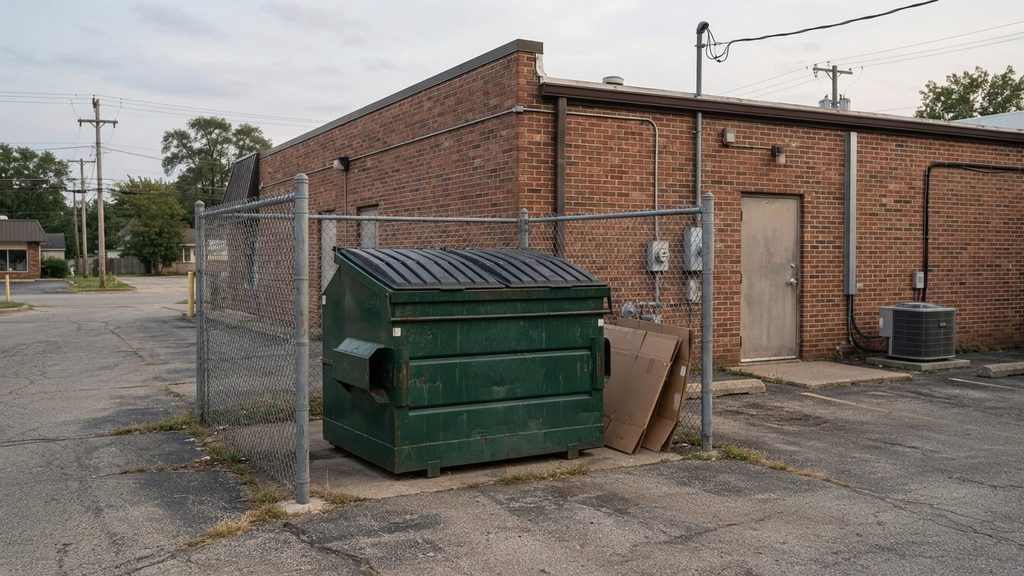
Can You Dumpster Dive Here? Common Ohio Situations
The same dive can be no big deal in one spot and a ticket in another. Here’s a rough guide to how the risk changes. The same trespass ideas show up in plenty of everyday situations, as our guide on whether ding dong ditching is illegal under trespass laws shows.
How legal risk changes by location
| Where you are | What to watch for | General risk |
|---|---|---|
| The owner said yes | Permission usually takes care of trespass and fits the “authorized by the owner” exceptions | Low |
| A curbside bin waiting for pickup | City scavenging rules in Columbus, Toledo, Cleveland, and some suburbs | Moderate to high |
| A store dumpster in an open lot, no signs | Still private property, so staying after you’re told to leave can be trespass | Moderate |
| An apartment complex dumpster | Usually private and meant for residents only | Moderate to high |
| Behind a fence, gate, or “No Trespassing” sign | Clear signs that access is restricted make a trespass charge much more likely | High |
| A locked dumpster or compactor | Forcing it open can add property damage charges, and compactors can kill | High |
A few other laws can trip people up. Leaving a mess around the dumpster can break littering rules. Using someone’s personal information from papers you find in the trash can be a serious crime, no matter where you find them. And a dumpster outside an empty building doesn’t give you the right to go inside, which our article on graffiti laws and abandoned buildings explains.
Can You Keep or Sell What You Find?
Usually, yes. If something was really thrown away and you didn’t trespass or break a local rule to get it, it’s generally yours to keep, use, or sell.
Scrap metal is the one to watch. Under Ohio Revised Code Section 4737.04, scrapyards have to record every seller’s name and address and copy their photo ID. They can’t buy metal from anyone who won’t show ID. So if you’re hauling copper or aluminum to the scrapyard, bring your license.
How to Dumpster Dive Legally in Ohio
If you want to keep diving without trouble, these habits go a long way.
How to lower your legal risk
- Look up your local code: Search your city’s or village’s ordinances online for “scavenging” or “refuse removal.” It takes five minutes.
- Just ask: A lot of managers will happily say yes, especially for cardboard, pallets, or bulky stuff they’d otherwise pay to haul off.
- Respect signs and locks: If a dumpster is locked, fenced, or posted “No Trespassing,” move on.
- Leave when asked: If an owner, employee, or security guard tells you to go, go. Sticking around is how a gray area turns into a charge.
- Clean up after yourself: Put back what you don’t want and never leave trash scattered around.
If you’ve already been cited or charged, talk to a licensed Ohio criminal defense attorney. What happens next depends on the charge, the city, and your record, and some cases can go to diversion programs. Many Ohio counties have public defenders for eligible people.
Conclusion
Is dumpster diving illegal in Ohio? Not under any state law. But trespass and theft laws apply everywhere, and cities like Columbus, Toledo, and Cleveland have their own rules about taking trash and recyclables. Where you’re standing matters more than anything else.
If you remember just three things, make it these: check your local rules, ask before you dive, and walk away from anything locked or posted.Is it legal to dumpster dive in Ohio?
It can be. Ohio has no statewide ban. Diving is generally fine if you have permission or if you’re somewhere public that no local rule covers. It becomes illegal if you trespass, take something that wasn’t really thrown away, or break a city scavenging rule.
Is dumpster diving illegal in Columbus, Ohio?
Often, yes. Columbus City Code § 1305.05 bans taking waste set out for collection unless the city, the trash owner, or the hauler says it’s okay. A violation is a first-degree misdemeanor, and the code also lists a $100 civil penalty.
Is it illegal to dumpster dive at Walmart in Ohio?
There’s no special law for Walmart or any other store. Their dumpsters are almost always on private property, though. Without permission, you can be told to leave, and if you don’t, you could be charged with criminal trespass.
Can you get arrested for dumpster diving in Ohio?
It’s possible. Police can cite or arrest someone for trespass, theft, or a city ordinance violation tied to dumpster diving. Whether that happens depends on where you are, what the owner wants, how local police handle it, and how you act.
Is taking recyclables from a curbside bin illegal in Ohio?
In some cities, yes. Cleveland § 551.081 and Toledo § 733.10 both restrict taking recyclables set out for city pickup, and many suburbs have similar rules. Check your local code first.
Is it legal to dumpster dive for food in Ohio?
No Ohio law bans it specifically, but trespass and local rules still apply, and lots of grocery stores and restaurants lock their dumpsters. Dumpster food can also make you sick. Ohio law protects businesses that donate food to charities in good faith, so local food banks and pantries are a safer bet.
