

If you are wondering how old do you have to be to buy a lighter, the most accurate short answer is that there is no single federal minimum purchase age for an ordinary lighter. Many stores nevertheless require buyers to be 18 or 21, and a state or local rule may restrict certain products, such as butane refills or novelty lighters.
That is why one cashier may sell a standard utility lighter without asking for identification while another refuses the same sale. The product, location, retailer policy, and intended use can all affect the result. This guide explains how to identify the rule that actually applies before you visit a store or place an online order.
Legal note: This article provides general legal information, not legal advice. State statutes, city ordinances, and retailer policies can change, so confirm the current rule where the sale will occur.
The Quick Answer: Is There a Federal Age Limit?
There is no general federal law setting a nationwide minimum age for buying a standard disposable, refillable, electric, or utility lighter. Federal law does regulate lighter design and safety, but a product-safety standard is different from a buyer-age restriction.
The federal age of 21 applies to tobacco products. It does not automatically apply to a lighter sold by itself. The FDA’s explanation of cigar regulation specifically identifies lighters as accessories excluded from the agency’s regulation of covered tobacco products, even though cigarettes, cigars, and e-cigarettes cannot legally be sold to anyone under 21.
The practical answer is therefore:
- A standard lighter has no universal federal purchase age.
- A state or city may impose a narrower restriction.
- Some lighter types may be prohibited regardless of the buyer’s age.
- A retailer may set an 18-or-21 policy and refuse the transaction.
- Tobacco remains age-restricted even when the lighter beside it is not.
This distinction is similar to other legal-age questions where the correct answer depends on the location and the exact activity. The Law Learner’s guides to tattoo age and parental-consent rules and front-seat age and safety guidance show why a simple number can be misleading when state law, private policy, and safety advice overlap.
Why Stores Ask for ID When the Law May Not Require It
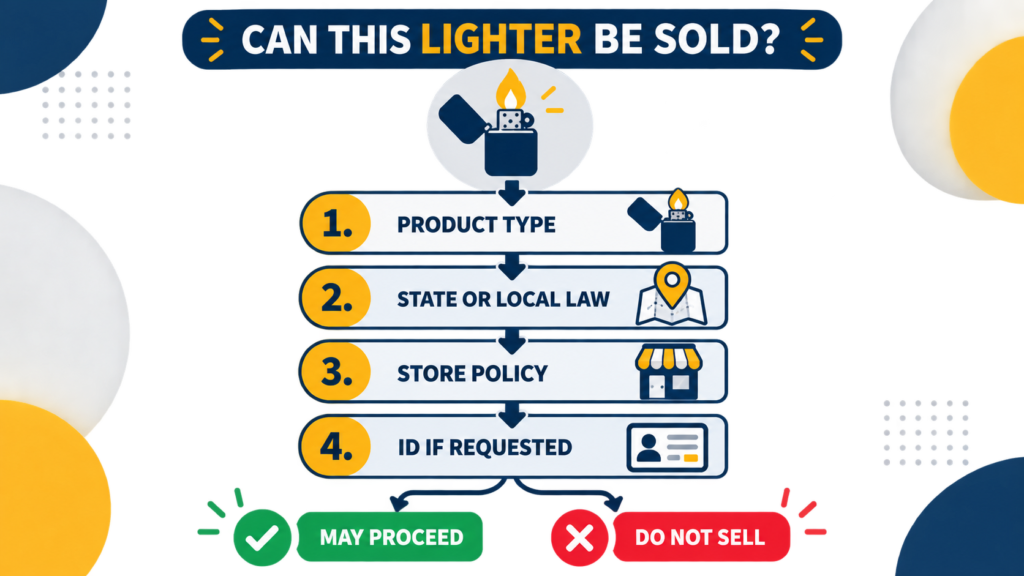
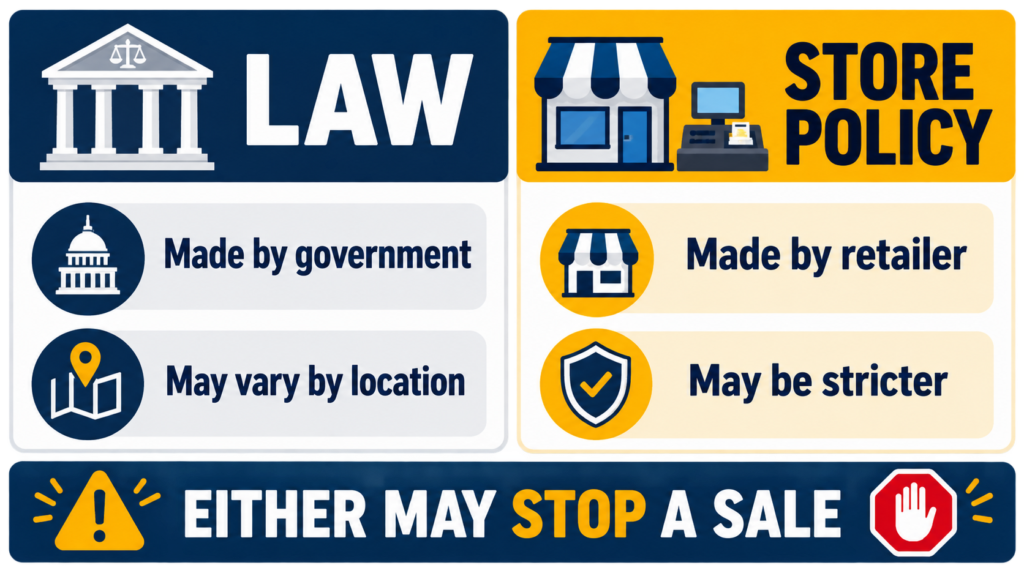
A cashier asking for identification does not necessarily mean a statute requires it. Retailers can adopt rules that are stricter than the legal minimum, provided those policies do not unlawfully discriminate. A store may group lighters with tobacco-related merchandise, program the register to request a birth date, or instruct employees to sell ignition products only to adults.
These policies reduce risk and make staff training easier. A national chain may prefer one consistent rule instead of asking every cashier to distinguish among cigarette lighters, grill lighters, torch lighters, fuel canisters, and local ordinances.
If a store refuses the sale, arguing that no federal age limit exists will rarely change the outcome. The employee may be required to follow the register prompt or company policy. Your practical options are to ask politely whether the restriction is a store policy, speak with a manager, or purchase from another lawful seller if you meet the applicable requirements.
Does an ID check mean you must be 21?
No. An ID check can be used to enforce an age of 18, an age of 21, or simply a retailer’s adult-only policy. It can also appear because the lighter is being purchased with tobacco, in which case the tobacco sale triggers the federal age rule.
Do not assume that “carded” means “regulated as tobacco.” The FDA says tobacco retailers must sell tobacco products only to people 21 or older, but it separately treats lighters as accessories. The difference matters when the lighter is the only item in the transaction.
How Old Do You Have to Be to Buy a Lighter in Different States?
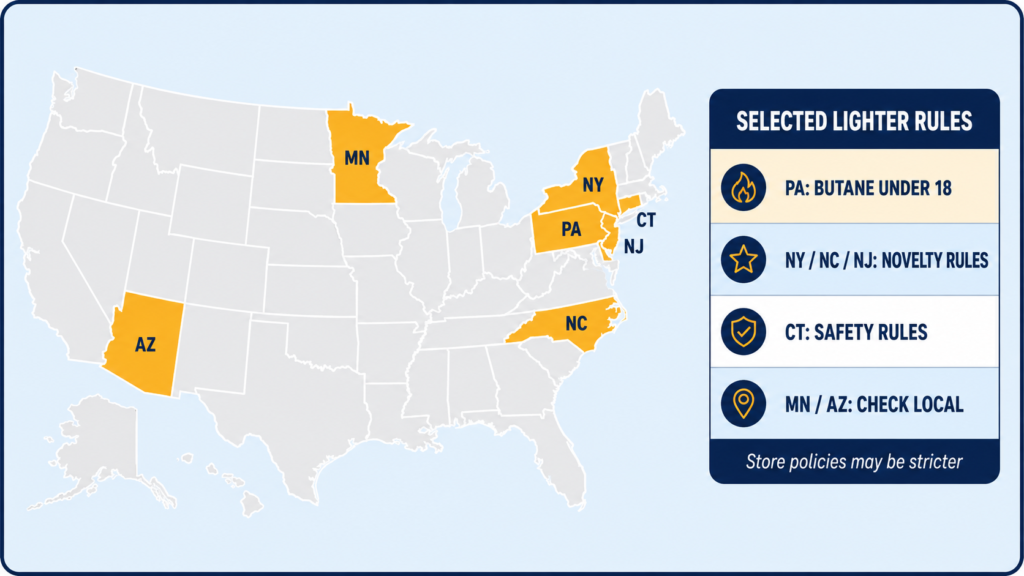
The states most frequently searched do not all use the same approach. Some regulate a particular fuel or ban novelty lighters, while others do not appear to impose a clear statewide minimum age specifically for an ordinary lighter. A city, county, or individual retailer may still apply a stricter rule.
| State | Standard lighter | Important exception or restriction |
|---|---|---|
| Pennsylvania | No clear statewide minimum age identified for an ordinary lighter sold by itself | State law prohibits knowingly selling or furnishing qualifying butane to anyone under 18, subject to limited relationship exceptions |
| New York | No clear statewide minimum age identified for a standard lighter | Novelty lighters may not be sold or offered for retail sale in the state |
| North Carolina | No clear statewide minimum age identified for a standard lighter | Retail sale, offers, gifts, and promotional distribution of novelty lighters are prohibited |
| New Jersey | No clear statewide minimum age identified for a standard lighter | Novelty-lighter and child-resistant design restrictions apply; local or retailer rules may be stricter |
| Minnesota | No clear statewide minimum age identified for a standard lighter | Check local ordinances and retailer policy before relying on the statewide baseline |
| Connecticut | No clear statewide minimum age identified for a compliant standard lighter | Counterfeit and unsafe lighters are prohibited; product-safety rules apply regardless of buyer age |
| Arizona | No clear statewide minimum age identified for a standard lighter | Check municipal rules and the seller’s policy, especially for torches or fuel products |
The phrase “no clear statewide minimum age identified” should not be read as a promise that every minor can complete a purchase. It means the general statewide rule reviewed for this guide does not create a simple lighter-specific age threshold comparable to Tobacco 21. You still need to check local ordinances, fire codes, product classifications, and private policies.
How old do you have to be to buy a lighter in PA?
Pennsylvania has an important fuel-specific rule. Under 18 Pa. Cons. Stat. § 6315, a person commits a summary offense by knowingly selling or furnishing qualifying butane to someone younger than 18, subject to exceptions involving a parent, guardian, or adult instructor.
The statute defines butane as a product containing at least 90 percent by weight of n-butane, isobutane, or both. It excludes products in which those substances are only a secondary component, solvent, or propellant. Because the law is written around the substance rather than a universal category of all lighters, the exact item matters. A butane refill canister presents a clearer restriction than an ordinary lighter whose classification is uncertain.
How old do you have to be to buy a lighter in NY?
New York does not use a straightforward statewide age number for every ordinary lighter. It instead prohibits the sale and distribution of novelty lighters under New York General Business Law § 391-s.
The statute covers lighters that appeal to children because they resemble toys, cartoon characters, guns, watches, animals, food, vehicles, or similar objects, or because they produce music, sounds, or flashing lights. A standard disposable or refillable lighter with ordinary artwork or a logo is excluded if it does not otherwise resemble a novelty lighter.
How old do you have to be to buy a lighter in NC?
North Carolina similarly focuses on the product’s design rather than imposing a statewide age limit for all standard lighters. North Carolina General Statutes § 66-16.1 prohibits the retail sale, offer, gift, or promotional distribution of novelty lighters.
The law excludes certain pre-1980 collectibles, devices primarily used for fireplaces or grills, and standard lighters that merely carry artwork or branding. A seller therefore cannot make a prohibited novelty lighter lawful simply by restricting it to adult buyers.
What about NJ, MN, CT, and AZ?
For New Jersey, Minnesota, Connecticut, and Arizona, the safest answer is to check both the exact product and the locality instead of relying on a single age quoted online. Connecticut, for example, prohibits counterfeit and unsafe lighters under Connecticut General Statutes § 29-371. That is a product-compliance rule, not a general minimum purchase age for a compliant standard lighter.
New Jersey Revised Statutes § 2A:65C-1 also prohibits the sale or offer for sale of novelty lighters, while local governments and retailers may add further controls. If a search result claims that every buyer in one of these states must be 18 or 21, look for a current statute or municipal code that says so. Many pages confuse tobacco restrictions with lighter restrictions.
How Old Do You Have to Be to Buy a Lighter Online?
No single age rule applies to every online lighter purchase. An online seller may require buyers to be 18 or 21, request age verification, restrict delivery locations, or refuse to sell certain lighter types. Those conditions may come from the seller’s policy, payment processor, insurer, marketplace rules, or the law where it’s delivered.
Online availability also depends on shipping restrictions. A fueled lighter is a regulated hazardous material, not an ordinary parcel. The USPS packaging instruction for fueled lighters says domestic mailing is permitted only by surface transportation, with prior written approval and compliant packaging, while international mailing is prohibited.
This means an online order may be canceled or limited even when the buyer is old enough under the seller’s policy. A shipping restriction is not itself a buyer-age law, but it can determine whether the transaction can be completed.
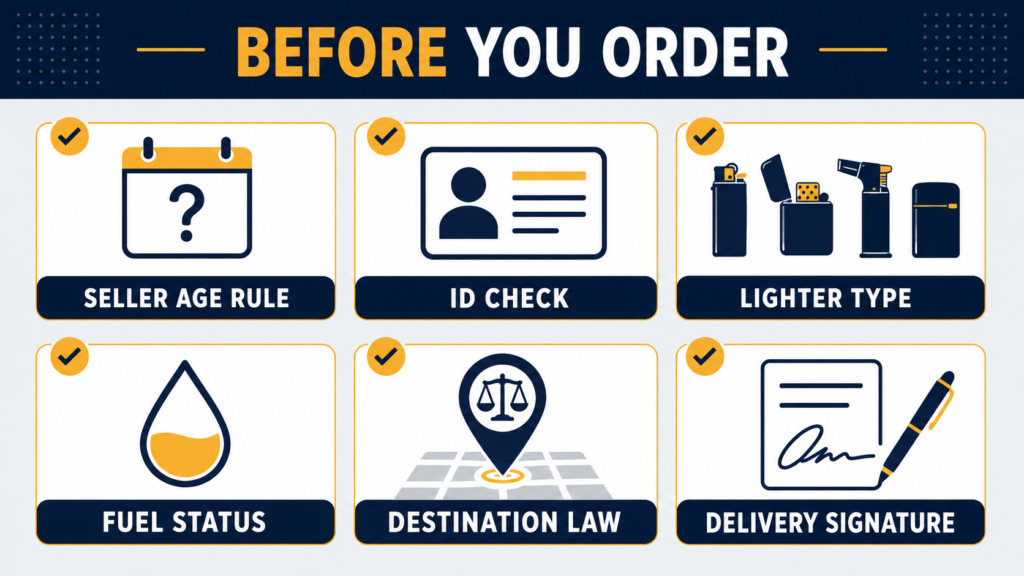
Before ordering, check:
- The minimum age stated in the seller’s terms.
- Whether the seller verifies age at checkout or delivery.
- Whether the lighter is shipped fueled or empty.
- Whether the item is a standard, utility, torch, or novelty lighter.
- Whether the destination has a state or local restriction.
- Whether an adult signature is required.
Never enter a false birth date or use another person’s identification. Even where the product itself has no statutory minimum age, misrepresentation can violate the seller’s terms and create additional legal or account problems.
Standard, Utility, Torch, and Novelty Lighters Are Not the Same
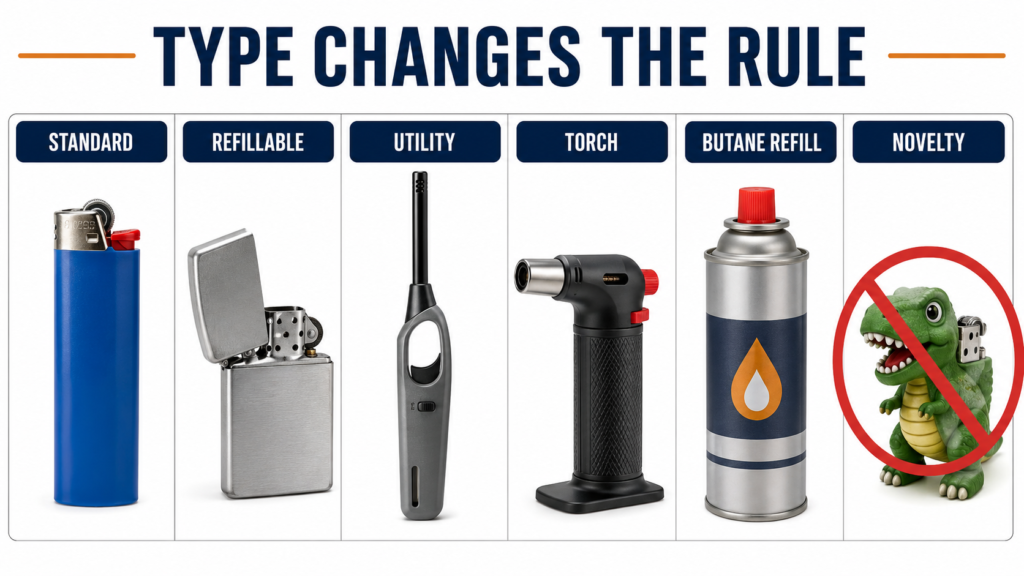
The word “lighter” covers products with different designs, fuels, and uses. Laws and store systems may classify them differently, so identifying the item is often more useful than starting with the buyer’s age.
| Product type | Common use | Rule to check first |
|---|---|---|
| Standard disposable lighter | Candles or smoking materials | State and local age rules plus store policy |
| Refillable pocket lighter | Repeated general use | Fuel, refill, and retailer restrictions |
| Utility or grill lighter | Candles, grills, fireplaces, pilot lights | Product-safety rules and store policy |
| Butane torch | Cooking, crafts, repairs, or high-heat use | Fuel rules, local fire code, and retailer age policy |
| Butane refill canister | Refilling a lighter or torch | Substance-specific age and hazardous-material rules |
| Novelty lighter | Flame device shaped like a toy or entertaining object | State prohibition, which may apply to all buyers |
| Electric or plasma lighter | Rechargeable ignition without liquid fuel | Store policy and any applicable local rule |
Federal product-safety rules remain relevant even when no purchase age applies. The Consumer Product Safety Commission’s lighter guidance explains that covered cigarette and multipurpose lighters must use child-resistant mechanisms and meet testing, labeling, reporting, and certification requirements.
“Child-resistant” does not mean childproof. It describes a tested safety mechanism, not permission to leave the product within a child’s reach. A compliant lighter still creates a fire and burn risk if it is misused or stored carelessly.
Common Mistakes to Avoid
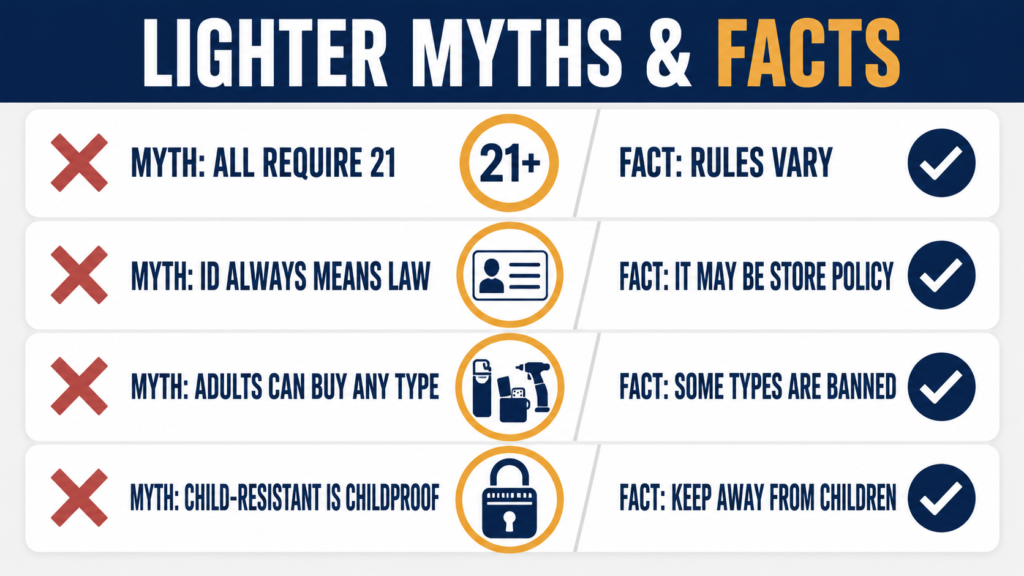
The most common error is assuming that the tobacco age and the lighter age are always identical. Tobacco products are subject to a federal minimum age of 21. A lighter sold separately is treated differently, although a retailer can voluntarily use the same threshold for both.
Other mistakes include:
- Treating a company policy as if it were a criminal statute.
- Assuming an 18-or-21 rule in one city applies statewide.
- Believing an adult may buy a prohibited novelty lighter simply because age is not the issue.
- Ignoring the difference between a lighter and a butane refill canister.
- Assuming an online listing guarantees legal delivery to every address.
- Relying on an old forum answer without checking the current code.
- Thinking child-resistant means safe for a child to handle.
One detail I would not overlook is the wording on the package. Terms such as “butane fuel,” “torch,” “refill,” or “novelty” can move the product into a different legal or store-policy category. If you are uncertain, ask the retailer which rule its system is enforcing before attempting the purchase.
What to Do If a Store Refuses to Sell You a Lighter
Start by staying calm and asking what rule applies. The cashier may be following a company instruction they can’t override at the register. A respectful question will usually produce a clearer answer than debating federal law at the counter.
Use this approach:
- Ask whether the restriction comes from law or store policy.
- Confirm whether the rule applies to that lighter type or to all ignition products.
- Show valid identification if requested and if you choose to proceed.
- Ask a manager to clarify the policy if the employee is unsure.
- Check your city or county code if the retailer cites a local law.
- Do not pressure an employee to bypass a register prompt.
A retailer generally does not have to complete every proposed sale. Even if you believe you meet the legal requirements, the simplest resolution may be to leave and verify the rule independently. If you are a retailer, use current legal guidance for every place you operate and train employees to distinguish product restrictions from tobacco rules.
Lighter Safety Matters More Than the Minimum Age
Whether the buyer is 18, 21, or older, treat a lighter as a fire-producing tool. Store it out of children’s sight and reach, keep it away from heat, do not puncture or burn it, and never leave it in a hot vehicle. Follow the manufacturer’s warnings and dispose of damaged or leaking products safely.
Check the CPSC lighter recall listings if a lighter appears defective or lacks a functioning child-resistant mechanism. Stop using a leaking, cracked, overheating, or malfunctioning lighter rather than trying to repair it casually.
Frequently Asked Questions
Can you buy a lighter at 16?
Possibly in a place with no applicable minimum age, but many retailers will refuse the sale to anyone under 18 or 21. State or local rules may also restrict the product, and Pennsylvania specifically restricts the sale of qualifying butane lighters to people under 18.
Can you buy a lighter at 18?
In many locations, an 18-year-old can buy a standard lighter, but that is not guaranteed. A store can apply a 21-and-over policy, and certain products may be restricted or prohibited regardless of age.
Do you have to be 21 to buy a Bic-style lighter?
There is no general federal rule requiring a buyer to be 21 for a standard lighter sold by itself. A retailer or local law may still impose that threshold, so the checkout policy can differ from one store to another.
How old do you have to be to buy a lighter online?
The seller may require buyers to be 18 or 21 and may use age verification at checkout or delivery. The law at the delivery address, the lighter type, and hazardous-material shipping rules can also affect whether the order is accepted.
Is a lighter considered a tobacco product?
The FDA regulates tobacco sales to people 21 and older but describes lighters as accessories excluded from its regulation of covered tobacco products. A lighter can still be regulated under product-safety, state, local, and retailer rules.
Can a store legally refuse to sell a lighter even if there is no age law?
Generally, a retailer can adopt a stricter sales policy and direct employees not to sell lighters below a chosen age, as long as the policy is applied lawfully. The absence of a specific age statute does not force a private store to complete the transaction.
Are novelty lighters legal for adults?
Not always. Several states prohibit novelty-lighter sales because toy-like shapes, lights, or sounds can appeal to children. Where the product itself is prohibited, the buyer’s adult status does not make the sale lawful.
Conclusion
So, how old do you have to be to buy a lighter? No universal federal minimum age applies to a standard lighter, but 18 and 21 are common retailer thresholds. State rules may target butane, novelty designs, or unsafe products, while cities and stores can add further restrictions.
Before buying, identify the exact product, check the law where you’re buying or receiving it, and read the retailer’s policy. Bookmark this guide for reference, and explore The Law Learner’s other plain-language legal-age resources whenever a simple number does not tell the whole story.
