

Why Is Canola Oil Banned in Europe? The Real Answer
If you have ever typed why is canola oil banned in Europe into Google at midnight while staring at the bottle in your own pantry, you are not alone. I did the same thing a while back, right after a friend forwarded me a post claiming Europeans had outlawed the stuff for being toxic. So let me save you the scroll: canola oil is not banned in Europe. It is sold on grocery shelves across the continent, usually under a different name, and the real story behind the rumor is a lot more interesting than the myth itself.
I ended up spending a weekend digging through EU food safety regulations, talking to a friend who cooks professionally in Germany, and testing a few oils in my own kitchen just to see what all the fuss was about. What I found surprised me. There is a real regulatory story here, just not the one that gets passed around on social media. Let me walk you through it properly.
What Is Canola Oil, Really? (And Is It a Seed Oil?)
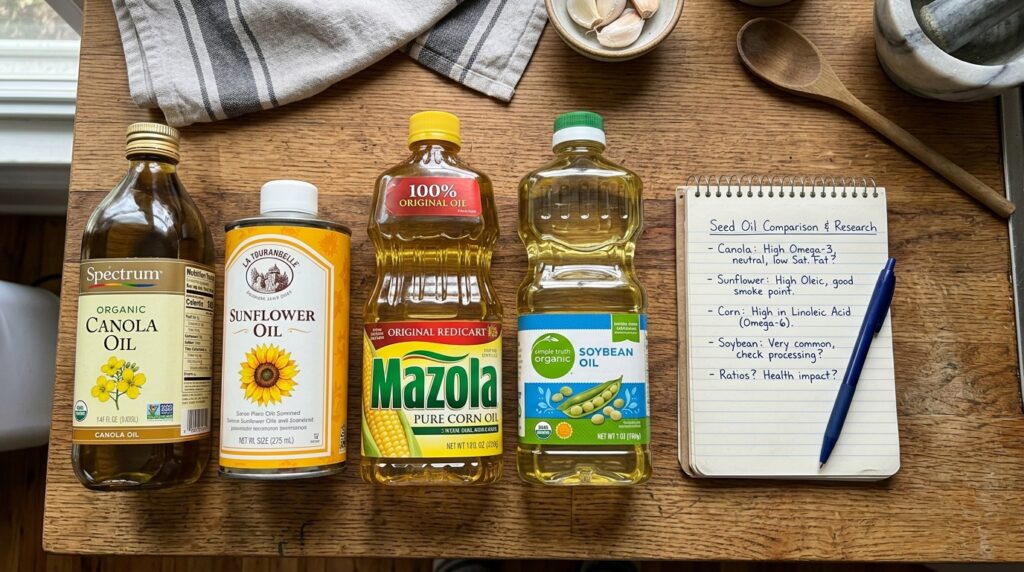
Canola oil comes from the seeds of a plant called rapeseed, specifically a low-toxin variety that was bred in Canada in the 1970s. The name itself is a mashup of “Canada” and “ola,” which is a nod to where the modern version was developed. So yes, canola oil is a seed oil, and it is usually grouped with sunflower, corn, soybean, safflower, grapeseed, cottonseed, and rice bran oil as one of what nutrition writers sometimes call the eight main seed oils used in everyday cooking, according to the American Heart Association.
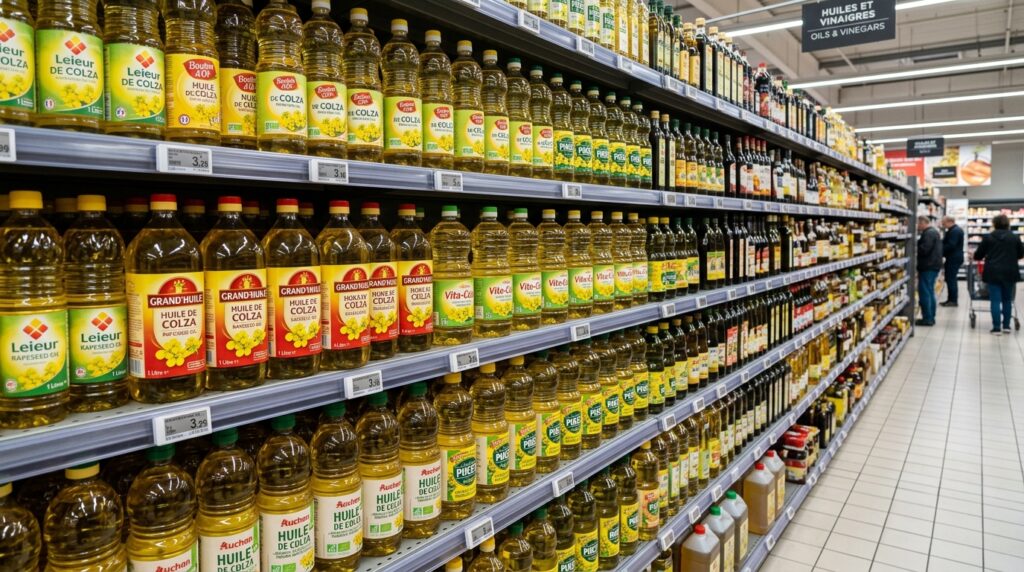
In Europe, you will rarely see the word “canola” on a label at all. It is almost always sold as rapeseed oil, because that is simply the older and more common name for the crop in that part of the world. This one detail alone explains a huge chunk of the confusion. Someone sees “rapeseed oil” everywhere in a European supermarket and “canola oil” nowhere, and jumps to the conclusion that canola must be banned. In reality, they are looking at the same plant family and, in most cases, nearly the same oil.
I remember standing in a Berlin supermarket a couple of years back, looking for canola oil and finding nothing labeled that way. It took me a solid five minutes of squinting at bottles before a friend pointed at the rapeseed oil section and laughed at me. That mix-up is basically the whole myth in miniature.
A Quick History: How Canola Oil Was Developed
It helps to know a bit of backstory here, because the history explains almost every regulation that exists today. Rapeseed has been grown and pressed for oil in Europe and Asia for centuries, mostly for lamp fuel and industrial lubricants rather than cooking. The old varieties carried a heavy load of erucic acid, which made them a poor choice for the dinner table even before anyone had modern lab equipment to measure exactly why.
In the early 1970s, plant breeders at the University of Manitoba in Canada crossbred rapeseed strains to sharply cut the erucic acid content and another undesirable compound called glucosinolates. That new, food-safe crop needed its own name to distinguish it from the old industrial rapeseed, and “canola” was trademarked shortly after to signal that it met specific low-toxin standards. So in a real sense, canola was never a separate species. It is simply the edible, deliberately bred version of a plant Europeans had already been growing for generations under the older name.
That timeline matters because it means the food safety story and the naming story are two different things that happened to overlap. Europe kept using its historic name, rapeseed, for the newer edible varieties, while North America adopted a fresh brand name for the same breeding breakthrough. Once you see that, the “banned in Europe” claim starts to look a lot more like a labeling mix-up than a genuine safety verdict.
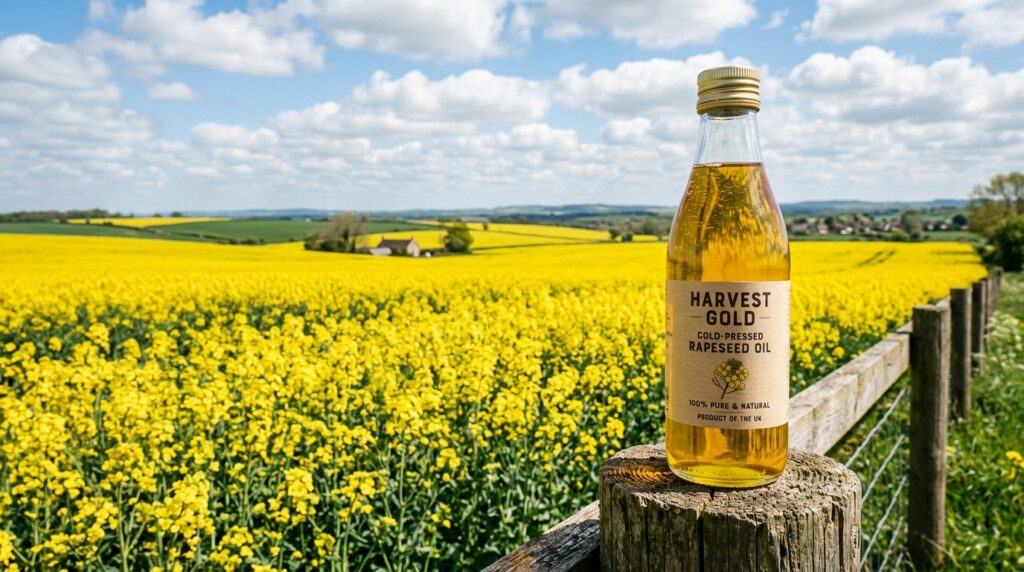
So, Is Canola Oil Actually Banned in Europe?
No, it is not. You can walk into supermarkets in Germany, France, Poland, Spain, or pretty much anywhere in the EU and buy a bottle of rapeseed oil without any trouble. In fact, Europe is not just permitting this oil; it is one of the biggest producers of it on earth. Germany alone accounted for roughly 47 percent of all rapeseed oil produced in the European Union in a recent market year, with France coming in second.
That is not what a banned product looks like. A genuinely banned ingredient does not get grown on millions of hectares of farmland and shipped across borders as a major agricultural export. Countries like Belgium, Germany, and Denmark actually have some of the highest per-person rapeseed oil consumption rates in the world, which tells you everything about how “forbidden” this oil really is over there.
What is true, and what I think gets flattened into “banned” by clickbait headlines, is that Europe applies noticeably tighter food safety rules to this oil than some other regions do. Tighter regulation and an outright ban are two very different things, and mixing them up is where this whole myth comes from.
Where Did This Rumor Even Come From?
From what I could trace, the “canola oil is banned in Europe” claim really picked up steam around 2018, spreading through wellness blogs and social media posts claiming the EU had labeled the oil carcinogenic and toxic. There has never been a credible European regulatory statement that says anything close to that. What likely happened is that people ran into three separate, legitimate facts and mashed them together into one dramatic headline.
First, older, non-food-grade rapeseed varieties did contain high levels of a compound called erucic acid, and those varieties were genuinely unsuitable for human consumption decades ago. Second, Europe restricts genetically modified crops far more heavily than places like the United States or Canada do, and much of the canola grown in North America is genetically modified. Third, the EU periodically tightens food safety limits, and any regulatory tightening tends to get reported online as if it were a ban.
Put those three threads together, strip away the nuance, and you get a viral claim that sounds true but is not. I think this is honestly one of the more common patterns in food misinformation. A real, narrow regulatory detail gets stretched into a sweeping, scary headline that travels a lot faster than the boring, accurate version ever could.
The Real Reason Europe Watches Canola Oil Closely: Erucic Acid
Here is the part of the story that actually holds up under scrutiny. Erucic acid is a naturally occurring fatty acid found in rapeseed and related plants like mustard. At high doses, animal studies have linked it to fatty buildup in heart tissue, a condition called myocardial lipidosis, according to Germany’s federal risk assessment institute, the BfR.
Modern canola varieties were specifically bred to have very low erucic acid content, generally under 2 percent, which is why health authorities on both sides of the Atlantic consider today’s canola oil safe for regular cooking. But Europe still keeps a formal legal ceiling on how much erucic acid is allowed in food, and it updates that ceiling as new research comes in.
Here is a simple side-by-side look at how the numbers actually compare:
| Regulation Detail | European Union | United States |
|---|---|---|
| Legal basis | EU Regulation on erucic acid limits, amending Regulation (EC) No 1881/2006 | 21 CFR 184.1555 (FDA) |
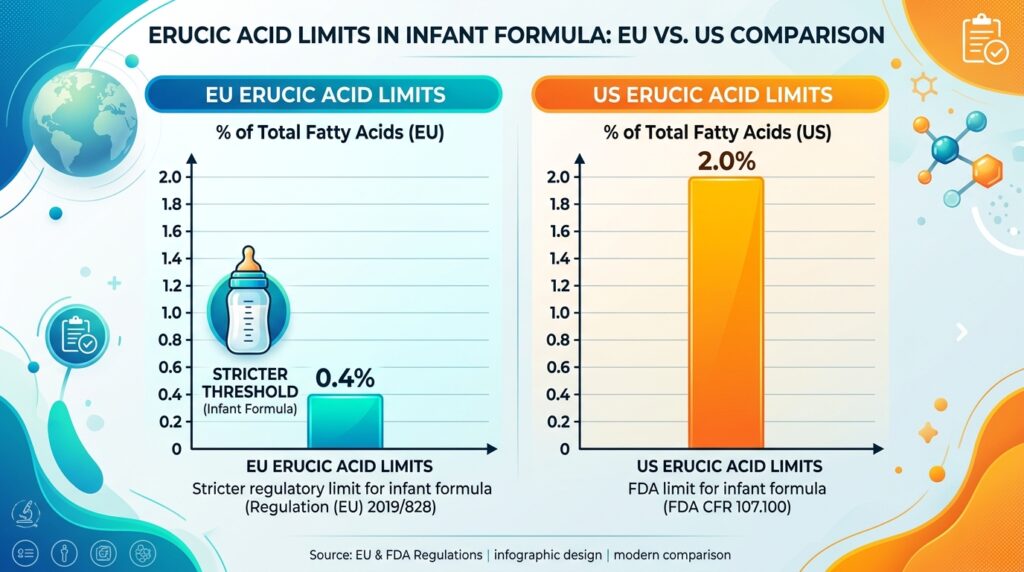
| Max erucic acid in general edible oils | 50 g/kg (5%) under current rules, with EFSA having proposed tightening this to 2% | 2% of total fatty acids for “low erucic acid rapeseed oil” |
| Max erucic acid in infant formula | 10 g/kg (1%) | Rapeseed oil is not permitted in infant formula at all |
| Tolerable Daily Intake (EFSA) | 7 mg per kg of body weight per day | No separate TDI published by the FDA |
A couple of things jump out when you sit with this table for a minute. Europe’s baseline limit is not actually stricter than the American one on paper, since both land in a similar range for everyday cooking oil. What is stricter is the European approach to infant formula, where the ceiling drops sharply, and the oversight from bodies like the European Food Safety Authority is notably more cautious.
That caution around baby food is probably the single most defensible, evidence-based part of Europe’s stance. I actually think it is a reasonable policy, not a red flag. Children have lower body weight and less established metabolic tolerance, so a stricter buffer for formula makes basic scientific sense.
Is Canola Oil Illegal in Europe? What EU Law Actually Says
This is a slightly different question from “is it banned,” and it deserves its own honest answer. Illegal would mean it is against the law to sell, buy, or possess the oil, and that is not the case anywhere in the European Union. Rapeseed oil, including the low-erucic-acid canola type, is a fully approved, legally traded food product under EU law.
What is more heavily regulated is not the oil itself but certain versions of the crop it comes from. According to research from Cano-ela, an industry information source that tracks canola and GMO policy, no GMO canola variety has been approved for cultivation anywhere in the EU, even though roughly 95 percent of canola grown in the United States is genetically modified. That is a real, meaningful legal distinction, and it is probably the closest thing to a “ban” that actually exists here. Still, it applies to growing a specific genetically modified crop in EU soil, not to buying a bottle of oil at the store.
Meanwhile, the European Commission still approves certain genetically modified rapeseed varieties for import and processing into food and animal feed, provided they pass a safety review by EFSA. The USDA’s Foreign Agricultural Service documented one such approval round in 2021, where the EU authorized a GMO rapeseed variety for import alongside several corn, soybean, and cotton events. So the picture is nuanced: cultivation of GMO canola is essentially off the table inside EU borders, but imported GMO rapeseed oil can still legally enter the food supply if it passes review.
Is Canola Oil Banned in Other Countries?
Once you start digging, the pattern holds up almost everywhere. I could not find a single country with a full, blanket ban on canola or rapeseed oil for human consumption. It is a mainstream cooking oil across Canada, the United States, India, China, Australia, and most of Europe, and it shows up in FAO agricultural production data as one of the most widely grown oilseed crops on the planet.
What varies a lot from country to country is the GMO cultivation policy, not the oil itself. A 2015 wave of EU opt-out decisions let a group of member states, including Germany and France, block cultivation of newly approved biotech crops within their own borders, according to the Genetic Literacy Project‘s tracking of global GMO policy. Individual countries like Austria, Hungary, and Poland have gone further, restricting or prohibiting cultivation of specific already-approved GMO crops on their own territory using a legal mechanism called the safeguard clause.
None of that touches ordinary, non-GMO canola or rapeseed oil sitting on a supermarket shelf. If you are buying a standard bottle for your kitchen almost anywhere in the world, you are very unlikely to run into an actual legal barrier.
Where Is Canola Oil Banned?
Honestly, nowhere, at least not for the finished cooking oil that ends up in your pantry. I want to be direct about this because I know it is one of the exact phrases people search for, hoping for a clean list of countries. There simply is not one to give you, because a true, product-level ban does not exist for canola or rapeseed oil anywhere I could find credible evidence for.
The closest real-world example of a restriction is Austria’s use of an EU safeguard clause back in the 2010s to prohibit the import, processing, and feed use of one specific genetically engineered rapeseed variety, known as GT73, within its own borders. Even that was reviewed by EFSA’s GMO panel, which found no new scientific evidence supporting the restriction, and it applied to one lab-developed GMO event, not to canola oil as a category.
So if someone tells you a specific country outright bans canola oil, ask them for a source. In my experience chasing this claim down, that source never actually materializes.
Why Are People Avoiding Canola Oil?
This is where things get more about culture and social media than about actual law, and honestly it is the more interesting half of the story to me. Over the last couple of years, a loose but loud online movement has targeted what it calls the “hateful eight” seed oils, canola included, blaming them for everything from inflammation to chronic disease, as the American Heart Association put it when pushing back on the trend.
Part of the pressure came from a high-profile source. U.S. Health Secretary Robert F. Kennedy Jr. has publicly described vegetable oils like canola and soybean as harmful, which NPR reported gave the seed oil skepticism movement a significant boost in visibility. That single comment from someone in a major public health role did more to spread the “avoid canola oil” message than years of quieter blog posts ever managed.
I will be honest, when I first started researching this topic, I half expected to find strong scientific backing for the panic. Instead, what I found was a pretty consistent gap between viral claims and what mainstream nutrition researchers actually say. Researchers at Johns Hopkins Bloomberg School of Public Health pointed out that a lot of the anti-seed-oil argument rests on a misunderstood ratio between omega-6 and omega-3 fats, and that the fix experts actually recommend is eating more omega-3s, not fearing omega-6s.
That said, I do not think the skepticism is coming from nowhere. Processed food is genuinely everywhere, people are right to want more control over what they eat, and canola oil shows up in an enormous share of packaged snacks and fast food. Wanting to cook with fewer heavily processed ingredients is a completely reasonable instinct, even if the specific “banned in Europe” claim attached to it turns out to be false.
What Are the Side Effects of Canola Oil?
Let’s get specific, because vague fear is not useful to you. Here is what the actual concerns are, and what the research says about each one.
- Omega-6 fatty acid content. Canola oil does contain omega-6, but at a ratio that researchers at Harvard’s Nutrition Source describe as one of the more favorable among common cooking oils, since it also carries a meaningful amount of omega-3 alpha-linolenic acid.
- Processing with hexane. Most commercial canola oil is extracted using a solvent called hexane, which sounds alarming, but the Nutrition Source notes that trace hexane residues left in the finished oil have not been shown to pose a health risk in the amounts actually found in food.
- Heat sensitivity during refining. Repeated high heat during processing can degrade some of the oil’s natural omega-3 content and, in poorly controlled conditions, contribute to trans fat formation, which is a legitimate quality concern tied to processing method rather than the crop itself.
- Limited micronutrients. Outside of vitamin E and vitamin K, canola oil does not bring much else to the table nutritionally, so it should not be treated as a meaningful source of vitamins in your diet.
- Rare allergic reactions. True canola allergies are uncommon but have been documented in a small number of case reports, so if you notice symptoms after using it, it is worth mentioning to a doctor.
To be fair to both sides of this debate, here is a quick pros and cons breakdown:
Pros
- Low in saturated fat compared to butter, lard, or tallow
- Contains a useful amount of plant-based omega-3 fat
- High smoke point, so it holds up well for everyday cooking
- Backed by major health organizations, including the American Heart Association, as a safe cooking fat
Cons
- Usually highly refined and chemically extracted rather than cold-pressed
- Frequently derived from genetically modified crops outside the EU
- Contributes to a diet that is already relatively high in omega-6 for a lot of people
- Not a significant source of vitamins or minerals beyond E and K
Canola Oil vs Olive Oil: A Quick Comparison
People often ask me which one they should just default to, so here is a simple breakdown based on how each oil is actually produced and used.
| Factor | Canola Oil | Olive Oil |
|---|---|---|
| Extraction method | Usually heat and solvent extracted | Extra virgin type is cold-pressed, no chemicals |
| Smoke point | Around 400°F, good for high-heat cooking | Extra virgin type is lower, better for light sautéing |
| Dominant fat | Polyunsaturated and monounsaturated mix | Mostly monounsaturated |
| Flavor | Neutral, blends into any dish | Distinct, fruity or peppery depending on type |
| Typical price | Generally lower cost | Extra virgin type usually costs more |
Neither one is a villain, and neither one is a miracle food. I personally keep both in my kitchen and just pick based on what I am cooking: extra virgin olive oil for a salad dressing or a quick sauté, and a neutral oil like canola for higher-heat tasks like roasting or stir-frying, where I do not want the flavor to compete with the dish.
My Own Experience Testing Canola Oil in the Kitchen
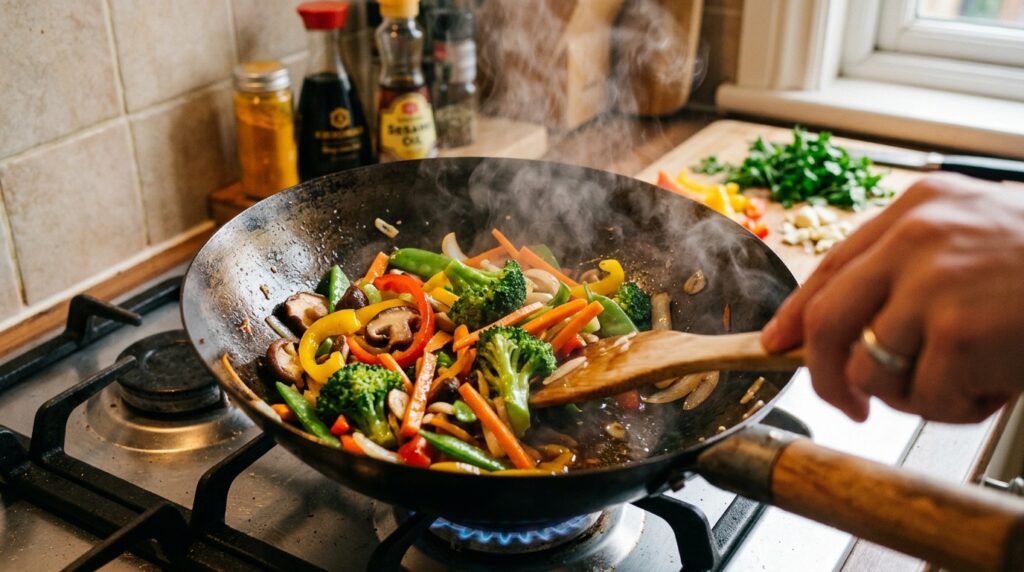
I will admit I went into this research a little biased against canola oil, mostly because of everything I had absorbed from social media over the years. So I decided to actually test it properly instead of just reading about it. I bought a bottle of standard refined canola oil and a bottle of a cold-pressed, non-GMO version that a specialty grocer near me carries, and I cooked the same stir-fry recipe with each one, on separate days, using the same vegetables and seasoning.
Honestly, I could barely tell the difference in taste, which matched what most food scientists say about canola’s famously neutral flavor. What I did notice was that the cold-pressed version had a slightly more golden color and a faint nutty smell straight out of the bottle, while the standard refined oil was almost completely colorless and odorless. Neither one smoked or burned at my usual stir-fry heat, and neither one left any weird aftertaste on the vegetables.
If you are someone who wants to avoid heavily processed ingredients on principle, I would genuinely recommend seeking out a cold-pressed or expeller-pressed canola oil, since it skips the hexane extraction step entirely. It costs more and can be harder to find, but it addresses the one processing concern from that side effects list above that actually has some legitimate weight to it.
Expert Tips for Choosing and Using Canola Oil Wisely
Based on everything I found in the regulatory research and my own kitchen testing, here is what I would actually suggest if you want to make an informed choice rather than an emotional one.
- Look for “cold-pressed” or “expeller-pressed” on the label if avoiding solvent extraction matters to you personally.
- Check for a “non-GMO” certification if that is a priority, since standard commodity canola in North America is very likely genetically modified.
- Store your bottle away from direct sunlight and heat, since polyunsaturated fats like canola’s are more prone to oxidation than saturated fats.
- Do not rely on any single oil as your only fat source. Rotating between canola, olive, and something like avocado oil gives you a broader nutrient profile overall.
- If you are shopping in Europe and specifically want canola-style oil, search for “rapeseed oil” or “huile de colza,” since that is how it is almost always labeled there.
FAQs
Is canola oil banned in other countries?
No. Canola and rapeseed oil are legally sold and widely consumed across North America, Europe, Asia, and Australia. The only meaningful restrictions that exist anywhere relate to cultivating specific genetically modified crop varieties in certain countries, not to selling or buying the finished oil.
Is canola oil a seed oil?
Yes. Canola oil is extracted from the seeds of a rapeseed plant variety, which places it firmly in the seed oil category alongside sunflower, corn, soybean, and safflower oil.
Is canola oil illegal in Europe?
No, it is completely legal. It is sold across the EU, most commonly labeled as rapeseed oil rather than canola oil, and it meets the same food safety standards applied to other edible oils.
Why are people avoiding canola oil?
A mix of social media claims, a broader “seed oil” skepticism movement, and public comments from figures like U.S. Health Secretary Robert F. Kennedy Jr. have driven a wave of concern, even though mainstream nutrition researchers at institutions like Harvard and Johns Hopkins have not found strong evidence to support avoiding it.
What are the side effects of canola oil?
For most people, none of major concern. The main points critics raise are its omega-6 content, hexane solvent extraction, and heat sensitivity during processing, all of which current research treats as minor or manageable rather than dangerous.
Conclusion
So, why is canola oil banned in Europe? It isn’t, and after spending real time inside the regulations, the market data, and my own kitchen, I feel pretty confident saying this is one of those food myths that sounds plausible but falls apart the moment you check the primary sources. What is true is that Europe applies genuinely careful rules around erucic acid limits and GMO cultivation, and those rules are worth understanding on their own terms rather than through a distorted headline.
If this cleared up some confusion for you, do yourself a favor and check the label next time you are shopping, whether that is “canola” at home or “rapeseed oil” if you happen to be in Europe. And if you are still deciding which cooking oil fits your kitchen and your health goals, it is worth reading a bit further into how different oils compare before you swap anything out completely.
Also Read: Is It Illegal To Talk To Dolphins? The Real Legal Test
