

1st Car Accident: Which Crash Was Actually the First?
The 1st car accident cannot be assigned a universally accepted date because the answer depends on what counts as a car.
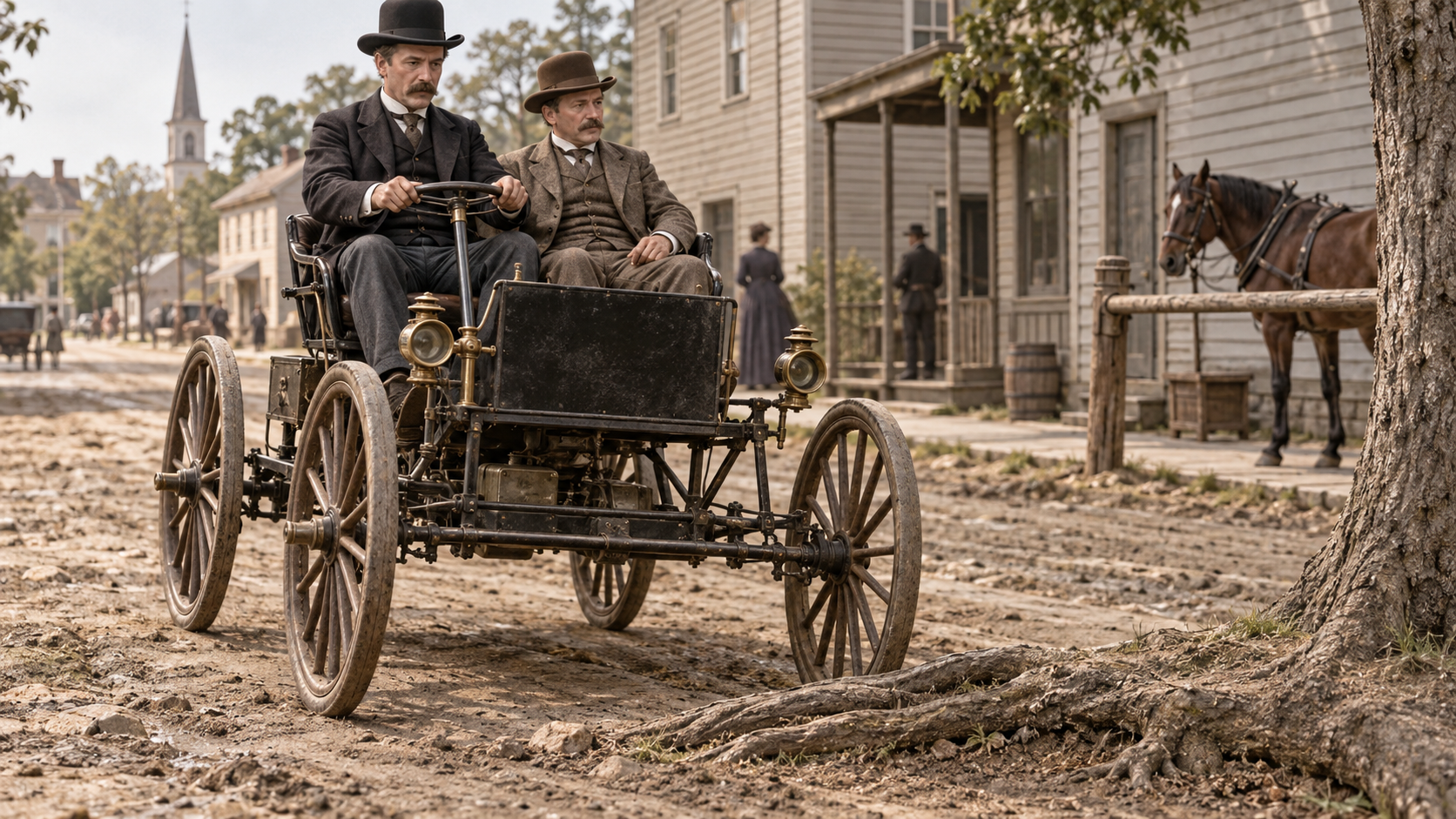
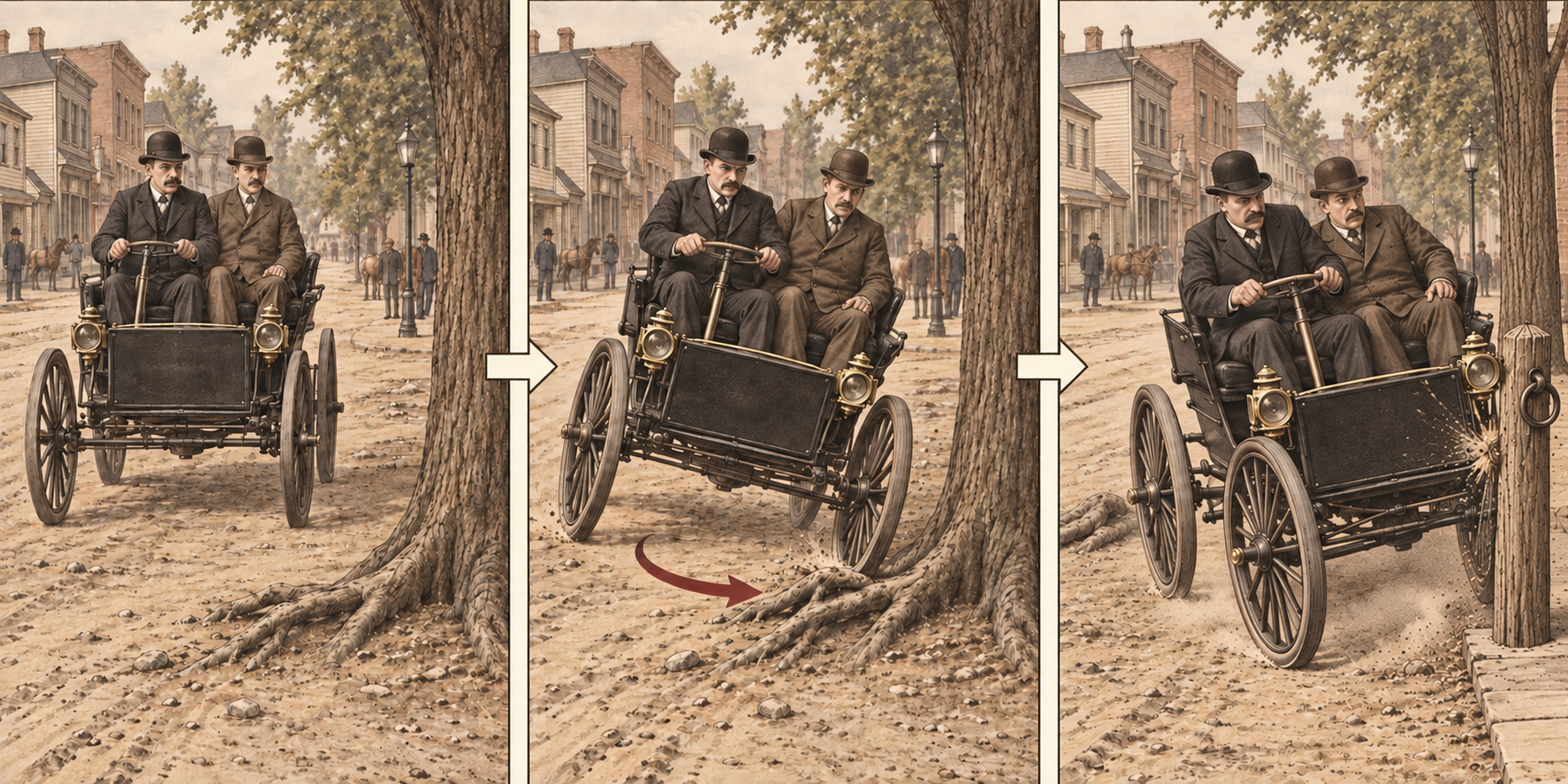
The most widely recognized first gasoline-car accident in the United States occurred in 1891 in Ohio City, Ohio. Inventor John William Lambert was testing his experimental gasoline buggy when it struck a tree root, swerved, and hit a hitching post. Lambert and his passenger, James Swoveland, suffered nonfatal injuries.
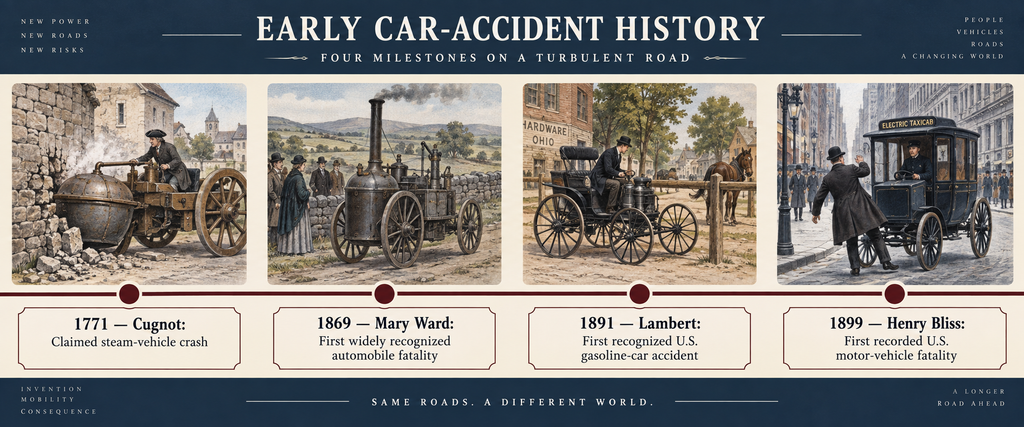
However, this was not necessarily the world’s first accident involving a self-propelled road vehicle. A French steam vehicle may have crashed as early as 1771, while the first widely recognized automobile fatality occurred in Ireland in 1869.
Quick answer: John William Lambert’s 1891 crash is generally recognized as the first U.S. accident involving a gasoline automobile. The broader claim that it was the world’s first car accident is inaccurate because steam-powered road vehicles were involved in earlier incidents.
The major firsts in car-accident history
| Year | What happened | Historical significance |
|---|---|---|
| 1771 | Nicolas-Joseph Cugnot’s steam vehicle allegedly hit a wall in France | Earliest claimed self-propelled vehicle crash |
| 1869 | Mary Ward fell from a steam vehicle and was run over in Ireland | First widely recognized automobile fatality |
| 1891 | John William Lambert’s gasoline buggy crashed in Ohio | First widely recognized U.S. gasoline-car accident |
| 1899 | An electric taxicab struck Henry Hale Bliss in New York | First recorded U.S. motor-vehicle fatality |
These events do not necessarily contradict one another. Each represents a different type of “first,” based on the vehicle, country, and outcome involved.
What happened in the 1891 car accident?
John William Lambert was an American inventor working on one of the country’s earliest practical gasoline-powered automobiles. His experimental vehicle became known as the Buckeye Gasoline Buggy.
During a test drive through Ohio City in 1891, one of the buggy’s wheels struck an exposed tree root. The impact caused the vehicle to swerve into a hitching post beside the road.
Lambert was driving, and James Swoveland was his passenger. Both men were injured, but neither suffered life-threatening injuries. No second vehicle was involved.
The account preserved in Ohio Memory’s history of Ohio’s early automobile industry identifies Lambert and Swoveland and describes the tree root and hitching-post impacts.
Key details of Lambert’s first accident
- Driver: John William Lambert
- Passenger: James Swoveland
- Location: Ohio City, Ohio
- Year: 1891
- Vehicle: Experimental Buckeye Gasoline Buggy
- Cause: The buggy struck a tree root and swerved
- Second impact: A roadside hitching post
- Outcome: Both occupants survived with relatively minor injuries
Some online accounts incorrectly call the driver “James Lambert.” That appears to combine John William Lambert’s name with the first name of his passenger, James Swoveland.
Lambert’s crash is therefore best described as the first widely recognized gasoline-powered automobile accident in the United States, rather than the first car crash anywhere in the world.
Was there a car accident before 1891?
A much earlier collision may have occurred in France, although the historical evidence is less certain.
French military engineer Nicolas-Joseph Cugnot built a large steam-powered vehicle during the late 1760s. Known as the fardier à vapeur, it was designed to transport heavy artillery rather than passengers.
According to a frequently repeated story, Cugnot lost control of the vehicle in 1771 and struck a stone or brick wall. If the account is true, it could qualify as the world’s first accident involving a self-propelled road vehicle.
The difficulty is that no known contemporary record clearly documents the crash. The story appeared in writing decades later. The Engineering and Technology History Wiki’s account of Cugnot’s steam-powered fardier notes that there is uncertainty over whether the wall collision happened.
For that reason, the 1771 event should be called the earliest claimed automobile accident, not an undisputed historical fact.
The distinction between Cugnot and Lambert is straightforward:
- Cugnot’s alleged accident involved a steam-powered military vehicle in France.
- Lambert’s documented accident involved an early gasoline buggy in the United States.
- The Cugnot account is older but historically disputed.
- The Lambert account is more widely accepted but belongs to a narrower category.
Who was the first person killed in a car accident?
Mary Ward is widely recognized as the first person killed in an accident involving a vehicle resembling a self-contained automobile.
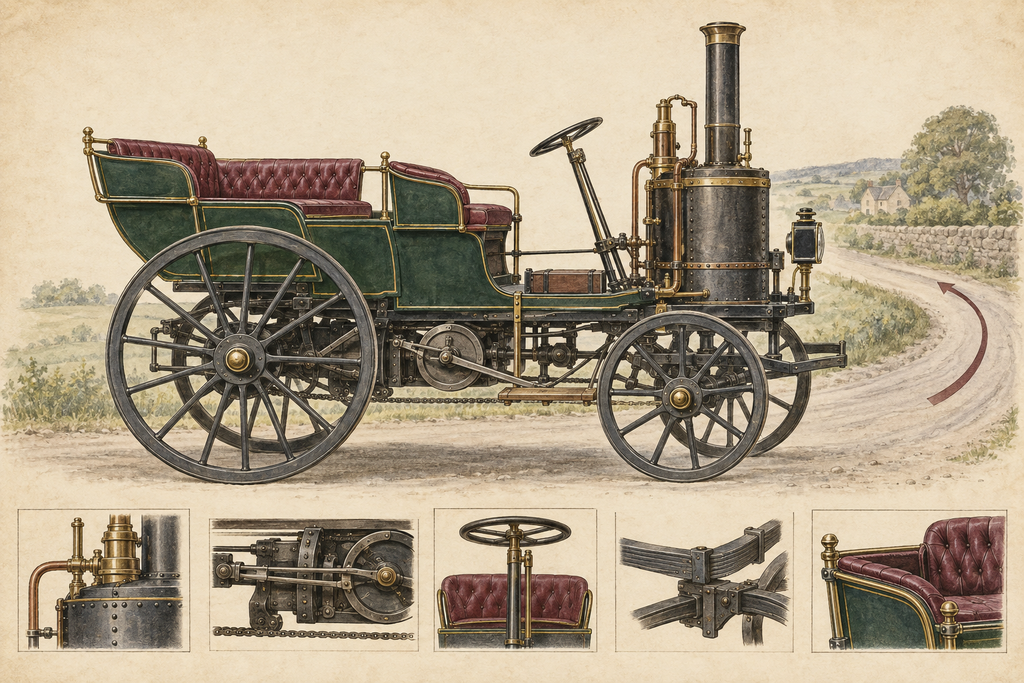
Ward was an Irish scientist, author, artist, and microscopist. On August 31, 1869, she was riding in an experimental steam-powered road vehicle near Parsonstown, now called Birr, in County Offaly, Ireland.
As the vehicle rounded a bend, Ward was thrown from her seat and fell beneath one of its heavy iron wheels. She died from her injuries.
The Dictionary of Irish Biography’s account of Mary Ward records the circumstances of her death. A medical-history paper indexed by the National Library of Medicine as The World’s First Automobile Fatality also identifies Ward as the first widely recognized victim of a fatal automobile accident.
There had been an earlier fatal steam-carriage incident in Scotland. In 1834, a passenger carriage designed by engineer John Scott Russell overturned, and its boiler exploded, killing four passengers.
That disaster is often excluded from lists of the first automobile fatalities because it involved a commercial steam carriage and the deaths followed a boiler explosion. Ward’s death is usually treated as the first fatality involving a self-contained vehicle more closely resembling an early automobile.
Who was the first person killed by a car in the United States?
Henry Hale Bliss was the first recorded person killed by a motor vehicle in the United States.
On September 13, 1899, Bliss stepped down from a streetcar at West 74th Street and Central Park West in New York City. An electric taxicab struck him as he attempted to cross the roadway. He died from his injuries the following day.
The driver was arrested and initially faced a manslaughter charge, but the case did not establish that he had acted with criminal intent or negligence. Smithsonian’s account of the Henry Bliss collision identifies Bliss as the first American known to have been fatally struck by an automobile.
The vehicle’s electric motor is a revealing detail. Steam, gasoline, and electric cars competed during the automobile’s early development. Gasoline was not yet the only important source of automotive power.
Bliss’s death also involved an enduring traffic-law issue: the way motorists, pedestrians, and public transportation share the same streets. Today, the legal duties of drivers and people crossing roads depend on state and local rules. Our guide to jaywalking laws, fines and pedestrian right-of-way explains those modern rules.
Why do sources give different answers?
Different sources use “first car accident” to mean different things.
Some count any self-propelled road vehicle, including an experimental steam tractor. Others begin with gasoline-powered cars. Certain accounts discuss the first nonfatal crash, while others mean the first death or the first collision involving a pedestrian.
Geography also changes the answer. The first claimed accident in the world is not the same event as the first recognized accident in the United States.
The most accurate way to describe the record is:
- 1771: Earliest claimed self-propelled road-vehicle crash
- 1869: First widely recognized automobile fatality
- 1891: First widely recognized U.S. gasoline-car accident
- 1899: First recorded U.S. motor-vehicle fatality
Clear labels are more reliable than forcing every event into a single “first” category.
How early accidents influenced traffic regulation
When Lambert tested his gasoline buggy, American roads were primarily used by pedestrians, horses, bicycles, and horse-drawn carriages. Rules created specifically for automobiles had not yet become widespread.
That changed as motor vehicles became more common. According to the National Museum of American History’s vehicle-licensing history, New York became the first state to require automobile registration in 1901. By 1918, every state required license plates.
Registration, speed limits, driver licensing, and right-of-way rules gradually created the legal framework for determining who was responsible after a crash.
Frequently asked questions
When did the first car accident happen?
The earliest claimed accident occurred in France in 1771 when Nicolas-Joseph Cugnot’s steam vehicle allegedly hit a wall. Because no clear contemporary record confirms the event, John William Lambert’s 1891 Ohio crash is the more widely accepted answer for the first gasoline-car accident in the United States.
Was the 1891 accident the world’s first car crash?
Not under the broadest definition. Steam-powered vehicles were involved in earlier incidents, including Cugnot’s disputed 1771 wall collision and Mary Ward’s fatal 1869 accident. Lambert’s crash is more accurately described as the first widely recognized U.S. gasoline-automobile accident.
Was James Lambert the driver in the first U.S. car accident?
No. The driver and inventor was John William Lambert. His passenger was James Swoveland. Some retellings appear to have mixed their names together.
Did anyone die in the 1891 Lambert accident?
No. Lambert and Swoveland were injured, but both survived. Mary Ward’s 1869 death is widely recognized as the first fatal automobile accident, while Henry Hale Bliss became the first recorded U.S. motor-vehicle fatality in 1899.
Conclusion
John William Lambert’s 1891 collision is the best answer when “1st car accident” means the first widely recognized crash involving a gasoline automobile in the United States.
It was not the first possible motor-vehicle accident worldwide. That distinction belongs to Cugnot’s disputed 1771 collision. Mary Ward’s 1869 death and Henry Bliss’s 1899 death represent separate milestones in the history of automobile fatalities.
Using these precise categories provides a clearer and more accurate answer than assigning the entire history of early car accidents to a single event.
