


How Much Does It Cost to Adopt a Child in 2026?
Adopting a child can cost anywhere from little or nothing to more than $60,000, depending on the type of adoption, the state, the agency and the circumstances of the placement. Public foster care adoption is usually the least expensive route. Private domestic and international adoptions normally involve substantially higher agency, legal, travel and placement-related expenses.
The wide range is why the question “How much is it to adopt a child?” does not have one universal answer. A quoted agency fee may cover only part of the process, while another organization may present a more inclusive estimate. Prospective parents should compare written fee schedules carefully and ask which costs can increase, which payments are refundable and what happens financially if a placement does not proceed.
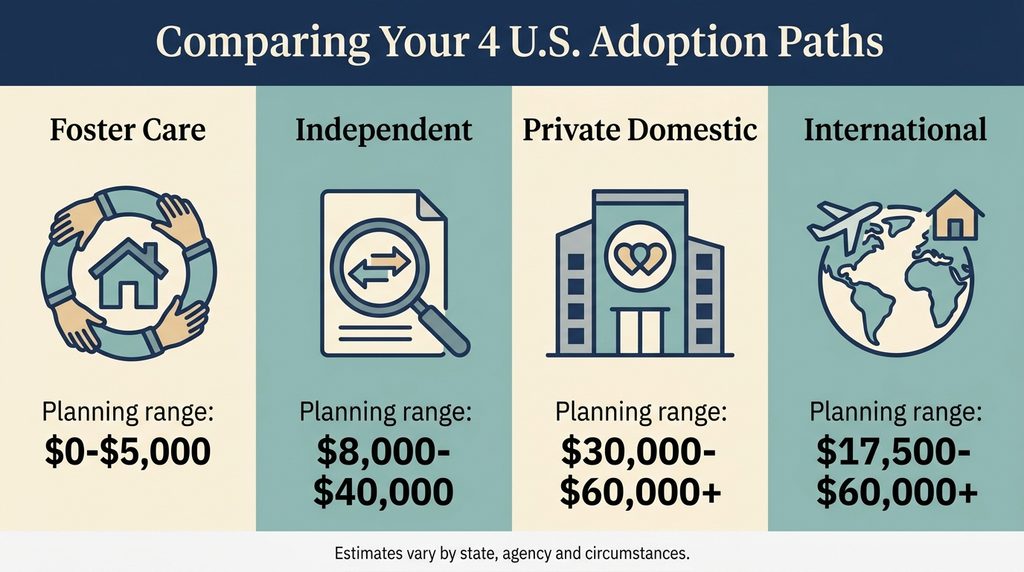
Quick answer: In 2026, adopting from public foster care commonly costs $0 to $5,000 and many qualifying expenses may be reimbursed. An independent adoption involving an attorney may cost approximately $8,000 to $40,000. Private domestic and international adoption commonly require budgets in the tens of thousands of dollars, with some cases exceeding $60,000. These are planning estimates, not fixed prices.
Adoption Cost at a Glance
| Type of adoption | Approximate planning range | Principal expenses |
|---|---|---|
| Public foster care adoption | $0 to $5,000 | Clearances, medical examinations, legal finalization and incidental costs, often subsidized or reimbursed |
| Independent or attorney-assisted adoption | About $8,000 to $40,000 | Attorney fees, home study, court costs, matching or advertising, permitted birth-parent expenses |
| Private domestic agency adoption | Often $30,000 to $60,000 or more | Agency services, matching, counseling, home study, legal work, post-placement supervision and permitted expenses |
| International adoption | Roughly $17,500 to more than $60,000 | Agency and foreign program fees, immigration filings, documents, travel, legal work and post-adoption reporting |
| Stepparent or relative adoption | Frequently hundreds to several thousand dollars | Filing, service, background checks and attorney fees, particularly if the case is contested |
These figures are broad estimates. No national adoption price list exists. Costs vary by state law, agency practices, travel, legal complexity, and the services included in a particular program.
Why Does the Cost of Adoption Vary So Much?
Adoption is a legal process, but it also involves professional assessment, child-welfare safeguards and services for multiple parties. The final price depends first on the path a family chooses.
A public agency may fund the training, home study and placement of a child from foster care. A private agency arranging a domestic infant adoption may need to provide counseling, matching, case management and post-placement supervision. An international case can involve two legal systems, immigration requirements, document authentication and overseas travel.
The child’s circumstances also matter. An uncontested relative adoption may be comparatively straightforward. A private placement involving another state, disputed parental rights, or additional court proceedings can require much more legal work.
How Much Is It to Adopt a Child From Foster Care?
Adoption from public foster care is generally the most affordable option. AdoptUSKids explains that most foster care adoptions are free and that minimal out-of-pocket expenses are often reimbursable. A family may still encounter costs for background checks, medical examinations, document preparation, travel or legal finalization.
Families using a private agency for a foster care placement may be charged for services that a public agency would otherwise provide. The amount and reimbursement rules differ by state. Parents should confirm the arrangement before paying a private provider.
Low cost does not mean that foster adoption is simple or guaranteed. Child-welfare agencies ordinarily work toward reunification when it can be achieved safely. Don’t treat a foster placement as a promise that adoption will follow.
Our separate guide explains how much it costs to adopt a child from foster care, including subsidies, reimbursement and foster-to-adopt considerations.

How Much Does Private Domestic Adoption Cost?
Private domestic adoption frequently requires a budget of approximately $30,000 to $60,000 or more. Actual charges vary considerably, and some agency programs fall outside that range.
Private adoption expenses may include:
- Application and program fees
- Adoptive-parent education
- Home-study preparation
- Matching and outreach services
- Counseling and support for expectant parents
- Legal representation and court filings
- Medical or living expenses permitted by state law
- Interstate Compact on the Placement of Children work when states differ
- Post-placement visits and reports
- Travel and temporary accommodation
State law controls which birth-parent expenses may be paid, for how long and whether advance court approval is required. Make payments only through lawful, documented channels recommended by the agency or attorney. Paying money directly without legal guidance can create serious ethical and legal problems.
Prospective parents should also ask how the agency handles an unsuccessful match. Some charges may transfer to a later opportunity, while others may be nonrefundable once a particular service has been performed.
What Does an Independent Adoption Cost?
An independent adoption is generally arranged without a full-service placement agency, although attorneys and other licensed professionals remain involved. AdoptUSKids provides a broad attorney-assisted estimate of approximately $8,000 to $40,000 and notes that these adoptions have historically averaged around $10,000 to $15,000.
Treat those figures as general context rather than a current quote. Independent adoption costs can rise when a family pays for matching services, extensive legal work, interstate compliance, travel, counseling or birth-parent expenses allowed by state law.
Independent adoption is not permitted or structured the same way in every state. A lower advertised cost should never take priority over lawful consent procedures, professional counseling and protection for the child and birth family.
How Much Is It to Adopt a Child From Another Country?
International adoption, also called intercountry adoption, commonly costs tens of thousands of dollars. Recent National Council For Adoption analysis citing federal fiscal year 2024 data reported a total-cost range of approximately $17,500 to $62,263 for adoptions from Hague Convention countries. Individual programs can fall outside this range.
An international budget may need to cover:
- U.S. agency and program fees
- Foreign-country fees
- Immigration petitions and visa processing
- Fingerprinting and background checks
- Translation, notarization and document authentication
- Medical reviews
- Legal representation in one or both countries
- One or more overseas trips
- Accommodation and in-country transportation
- Post-placement or post-adoption reports
The phrase “adopting from an orphanage” is often used informally, but it is not a separate U.S. adoption category. A child living in an institution is not necessarily legally eligible for intercountry adoption. U.S. immigration law and the child’s country of origin must both permit the adoption.
See our detailed guide to international adoption costs before comparing agencies or country programs.
How Much Does a Home Study Cost?
A home study evaluates whether prospective parents and their household are prepared to provide a safe and stable home. It generally involves interviews, records, background checks, education and at least one home visit.
AdoptUSKids estimates that a private-agency or independent-social-worker home study may cost approximately $1,000 to $3,000. The quoted amount may include application fees or required training, but families should confirm exactly what is covered.
Public foster care agencies often provide the home study without charge. A family may need to pay for updates if the study expires, the household changes, or a different provider must review it.
Other Adoption Expenses Families May Overlook
The placement or agency fee is not the only cost. Less obvious expenses can include:
- Fingerprinting and criminal-record checks
- Physical examinations and medical forms
- Certified birth, marriage and divorce records
- Training courses
- Counseling or psychological assessments
- Process-service and publication costs
- Court filing fees
- Separate attorneys for different parties
- Interstate travel and lodging
- Home-study updates
- Post-placement supervision
- Document translation or apostilles
- Unpaid time away from work
- Additional legal proceedings if consent or parental rights are disputed
Ask each professional for a written schedule that separates mandatory, estimated, optional and potentially refundable costs.
Can the 2026 Adoption Tax Credit Reduce the Cost?
For tax year 2026, the maximum federal adoption credit is $17,670 per eligible child. Up to $5,120 may be refundable, subject to the applicable rules. The credit begins to phase out when modified adjusted gross income exceeds $265,080 and is completely phased out at $305,080 or more, according to the IRS.
Qualified adoption expenses can include:
- Adoption fees
- Attorney fees
- Court costs
- Adoption-related travel, meals and lodging
- Home-study fees paid before a child is identified
- Other reasonable and necessary expenses directly related to the legal adoption
The credit does not mean that every family receives $17,670 in cash. Eligibility, timing, income, the type of adoption, employer reimbursement and the expenses actually paid can affect the result. Special rules apply to foreign adoptions and the adoption of a child determined to have special needs. A stepparent adoption does not qualify for the federal adoption credit.
Taxpayers use IRS Form 8839 to calculate the credit and any qualifying employer-provided adoption benefits. Families should keep invoices, receipts, payment records, and finalization documents, and seek individual tax advice when needed.

Can an Employer Help Pay Adoption Expenses?
Some employers offer reimbursement, paid leave or other adoption assistance. For 2026, qualifying employer-provided adoption assistance may be excluded from income up to the applicable federal limit, subject to income and tax rules.
Ask the employer’s human resources department about:
- Reimbursement limits
- Eligible expenses
- Documentation requirements
- Whether benefits apply before or after finalization
- Paid or unpaid adoption leave
- Whether a failed placement remains eligible
You generally can’t use the same expense twice to claim both an employer exclusion and an adoption credit. A tax professional can help allocate expenses correctly.
Questions to Ask Before Paying an Adoption Agency
Before signing a contract or paying a substantial fee, ask:
- Is the agency licensed in the relevant state and accredited when intercountry accreditation is required?
- What is included in the quoted total?
- Which third-party fees are excluded?
- Which payments are refundable or transferable?
- What happens financially if a match ends?
- Can any fee increase after the contract is signed?
- How are expectant-parent expenses approved, paid and documented?
- Are legal services included for all required parties?
- How many post-placement visits are required?
- What grants, reimbursements, subsidies or employer benefits may apply?
A provider should be willing to explain its fees in writing. Families should be cautious about pressure to pay quickly, guarantees of a particular child or promises that appear to bypass lawful consent and child-welfare safeguards.
Adoption Costs by State
State law can affect filing fees, home-study requirements, allowable expenses, subsidies and the professionals who may arrange an adoption. Use the appropriate state guide for local information:
- Texas adoption costs
- Florida adoption costs
- California adoption costs
- Ohio adoption costs
- North Carolina adoption costs
Confirm all amounts with the relevant court, public agency, licensed adoption provider and attorney before making a financial commitment.
Frequently Asked Questions
How much money is it to adopt a child in the United States?
The total can range from little or nothing for a public foster care adoption to more than $60,000 for some private domestic or international cases. The adoption route usually affects the total more than any single fee.
Is it free to adopt a child?
Many adoptions from public foster care involve few or no fees. Families can still face incidental expenses, although qualifying costs may be reimbursed. Private domestic and international adoptions are not ordinarily free.
Why is private adoption expensive?
Private adoption fees may fund screening, education, matching, counseling, case management, home studies, legal compliance and post-placement supervision. Some costs also arise from travel and birth-parent expenses permitted under state law.
Can you pay adoption expenses in installments?
Some agencies divide payments by milestones such as application, home-study approval, matching and placement. Payment schedules and refund policies differ, so review them before signing.
Does health insurance pay adoption fees?
Health insurance does not normally pay agency, legal or court expenses. It may cover eligible medical care after placement and, depending on the policy and circumstances, certain medical services connected with the child or pregnancy. Confirm coverage directly with the insurer.
Do you need an attorney to adopt?
Requirements differ by state and adoption type. Even when personal representation is not legally mandatory, an experienced adoption attorney can help with consent, parental rights, expenses, interstate compliance and finalization.
What is the cheapest way to adopt a child?
Adoption through a state or county foster care system is generally the least expensive route. Many public-agency services are free, and some finalization expenses may be reimbursed.
The Bottom Line
How much it costs to adopt a child depends mainly on whether the family adopts through public foster care, a private domestic arrangement, an independent placement or an international program. A realistic budget can range from almost nothing to more than $60,000.
Cost matters, but consider it alongside legal safeguards, ethical practice, support for the child and birth family, professional credentials, and the family’s readiness for the adoption path. Obtain an itemized written estimate, verify the provider’s licensing and check available reimbursement, tax and employer benefits before proceeding.
This article provides general educational information and is not legal, tax or financial advice. Adoption laws, fees and assistance programs differ by state and can change. Consult qualified professionals about your circumstances.
Sources for Editorial Verification
- AdoptUSKids: What is the cost of adoption from foster care?
- AdoptUSKids: Completing a home study
- IRS: Adoption Credit
- IRS: Tax year 2026 inflation adjustments
- IRS: About Form 8839, Qualified Adoption Expenses
- Child Welfare Information Gateway: Regulation of Private Domestic Adoption Expenses
- U.S. Department of State: Intercountry Adoption
- National Council for Adoption: International relative adoption and reported cost ranges
