

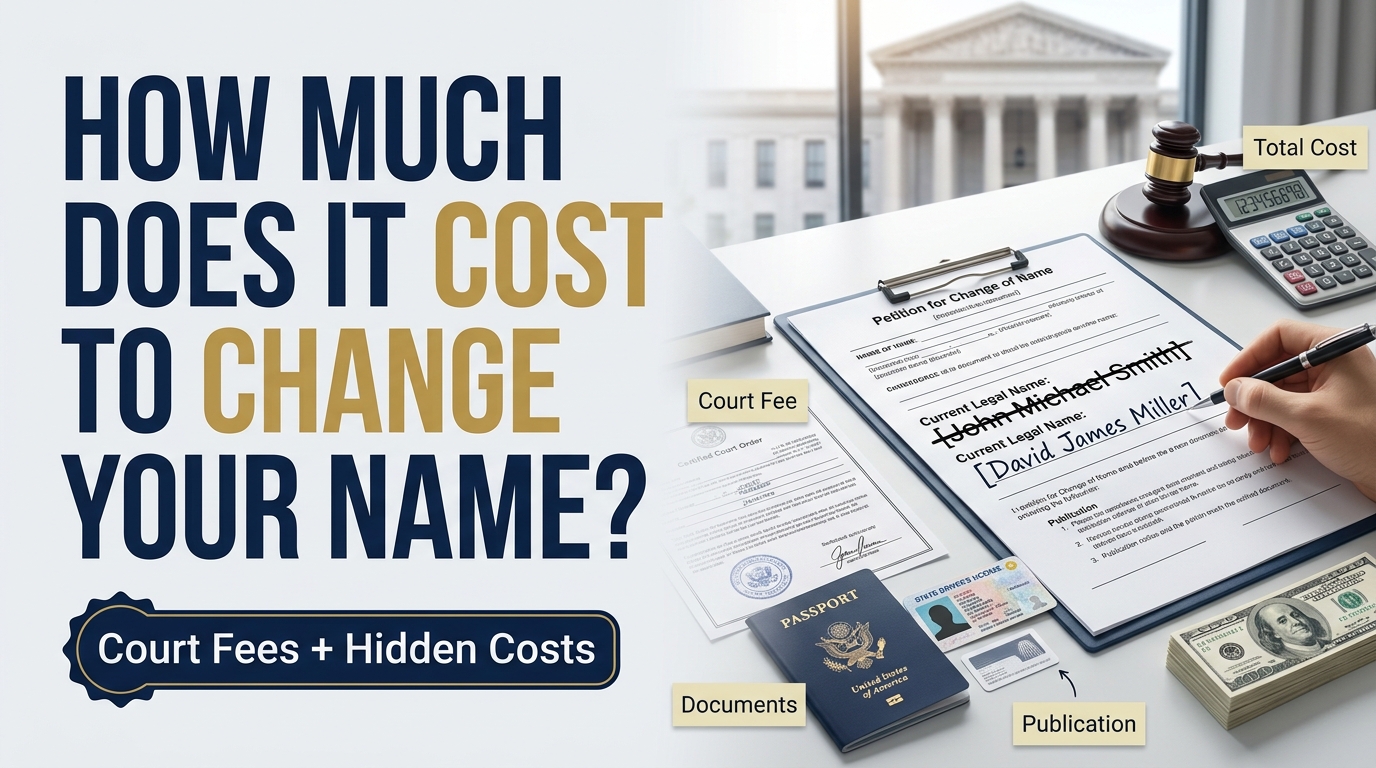
If you are asking how much does it cost to change your name, the court filing fee is only the first number you need. A simple marriage-related update may cost less than $100, while a court petition can reach several hundred dollars after publication, fingerprints, certified copies, and replacement documents are added.
When I first mapped out this process, I wrote down only the filing fee. That gave me a clean answer, but it was not a useful one. The real cost appears when you follow the name from the courthouse to your Social Security record, driver’s license, passport, bank accounts, tax records, and professional licenses.
For a routine adult court petition, a sensible planning range is often $250 to $600 before attorney fees. Some cases cost less. A contested child case, a high-fee county, repeated service attempts, or an urgent passport update can push the total much higher.
This guide gives you a full cost stack rather than a single misleading national average. It also explains when a separate court petition may not be needed, how county fees can differ inside the same state, and which costs you can sometimes avoid.
You can also review related family law guides as you prepare. For help understanding public records and government procedures, the site’s civil services information may also be useful.
Editorial note: Court fees and local procedures can change. Use this guide to build your budget, then confirm the exact amount with the clerk who will receive your filing.
Quick Answer: How Much Money Does It Cost to Change Your Name?
For a normal adult name-change petition, a practical starting budget is $250 to $600. That amount can cover the filing fee, fingerprints or a background check, public notice, certified copies, and one or two updated identification documents.
Your total may fall into one of these broad ranges:
- Marriage or divorce name update: Often $0 to $200, depending on certified certificates, driver’s license fees, passport status, and replacement records. A separate court petition may not be required when your marriage certificate or divorce decree authorizes the change.
- Uncontested adult court petition: Commonly $150 to $600. The filing fee is usually the highest cost, but publication and document updates can add another $50 to $250.
- Minor child name change: Commonly $200 to $1,000 or more. The amount may rise if another parent must be served, cannot be found, objects, or hires an attorney.
- Contested or complicated case: The cost may exceed $1,000. Attorney fees, repeated service attempts, hearings, evidence, and publication can make the case much more expensive.
Official guidance explains that most people seeking a general legal name change must file a petition with their local court and may need to appear before a judge. The exact process is controlled locally, which is why there is no single national price.
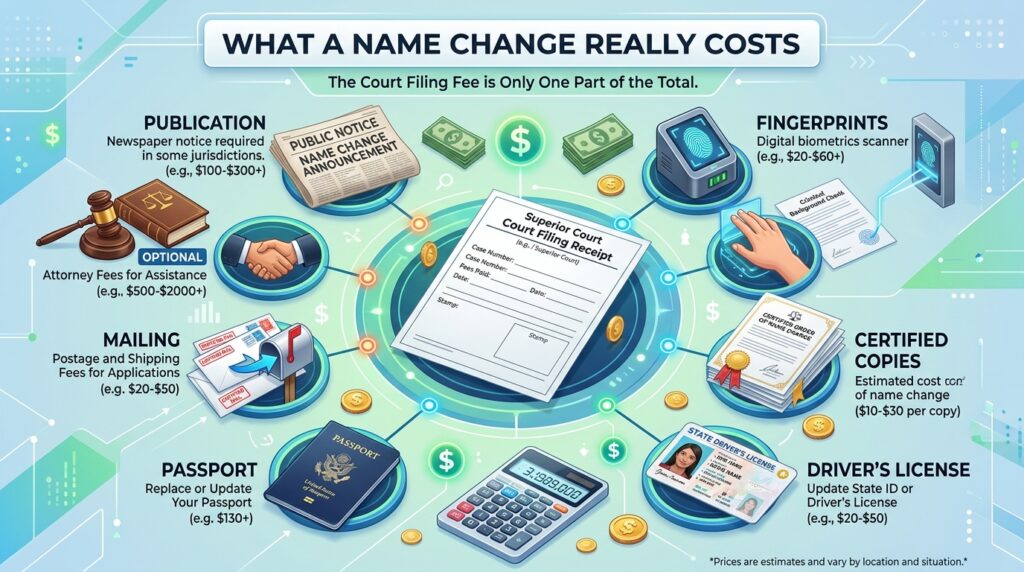
How Much Money Does It Cost to Change Your Name in Total?
Divide the bill into required, conditional, and optional expenses. This makes it easier to see which costs the court requires and which services you can choose.
1. Court Filing Fee
The filing fee opens the case and may be called a petition fee, civil fee, or special proceeding fee. Some states use one amount, while counties in other states add local charges.
Ask the clerk for the “total amount due at filing, including all local charges.” This is more useful than asking only for the base fee.
2. Newspaper Publication or Public Notice
Some courts require notice in an approved newspaper. Publication may cost nothing when it is not required, or it may add $40 to $200 or more.
Privacy or safety exceptions may be available when public notice creates a serious risk. Ask the clerk before assuming publication is mandatory.
3. Fingerprints and Background Checks
A court may request fingerprints or a criminal history report to check for fraud, debt avoidance, or other unlawful purposes. The extra cost often falls between $20 and $100, but charges from approved vendors vary.
4. Service of Process
Service is common when another person has a legal right to notice, especially in a child’s case. A sheriff or private process server may charge for each attempt, and publication may be needed when a parent cannot be found.
5. Certified Copies of the Final Order
Many agencies require a certified order carrying the clerk’s seal. Some courts include copies in the filing fee, while others charge per document and page.
Ask each agency whether it returns the order. This helps you avoid buying too many or delaying an update because you bought too few.
6. Replacement Identification and Records
Your replacement Social Security card is free. The replacement-card instructions confirm that there is no charge, although you still need acceptable proof of identity and the legal change.
Passport costs depend on when the passport was issued and which form applies. A qualifying correction within one year may have no standard fee, while a later renewal can require the normal passport charge. The current passport name-change instructions explain the form and evidence rules, and expedited processing currently adds $60.
Driver’s license, vehicle title, birth certificate, and professional-license fees vary. These costs are easy to miss because they are not listed on the court page.
7. Small Expenses That Become a Real Bill
Notary fees, photos, mail, printing, parking, and travel can add another $30 to $150. I recommend adding a 10 to 20 percent cushion for an extra copy, second visit, or local charge.
How Much Does It Cost to Legally Change Your Name?
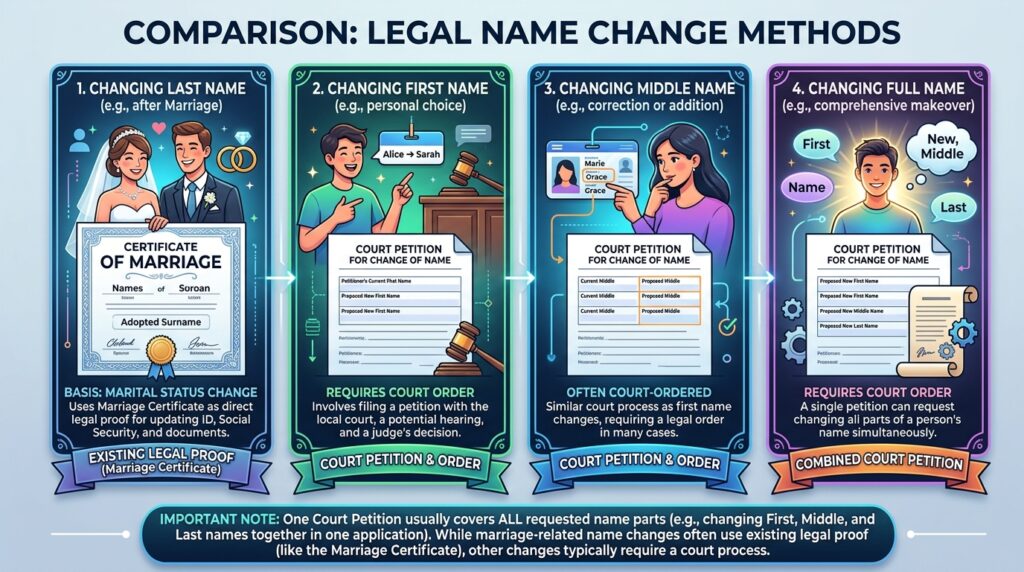
A general court petition usually costs more than a name update based on marriage, divorce, adoption, or another existing legal event. In a court petition, you are opening a new case and asking a judge to approve a different legal identity.
A routine self-filed adult case often lands between $150 and $600. Filing location, notice, fingerprints, and replacement records matter more than the number of name parts changed.
How Much Does It Cost to Change Your Name Legally With a Lawyer?
A lawyer is optional in many uncontested adult cases. Full representation can add $1,000 or more, while a limited review may cost several hundred dollars.
Advice becomes more valuable when someone objects or criminal history, immigration, or safety issues exist. A focused consultation may be enough.
How Much Does It Cost to Change Your Last Name?
A last-name update after marriage may not require a separate petition when the certificate supports the exact surname. You may still pay for certified copies, licenses, passports, vehicle records, and professional credentials.
An unrelated or newly created surname may require a court petition. Ask the major agencies whether your marriage document is sufficient before replacing the records.
How Much Does It Cost to Change Your First Name?
A first-name change normally requires a court order unless it is completed through another legally recognized process. The court usually charges one petition fee rather than a special “first-name fee.”
For an uncontested case, budget roughly $150 to $600 before optional legal help. Publication, fingerprints, and high local filing fees can move the total toward the upper end.
How Much Does It Cost to Change Your Middle Name?
A middle-name change usually follows the same court process as a first-name change. Changing only one word usually does not reduce the filing fee because the court still opens and processes the full case.
Marriage-based rules may sometimes support moving a surname into the middle-name field. Do not assume every agency will interpret the marriage document the same way, especially when you are creating a new middle name rather than restoring an old one.
How Much Does It Cost to Change Your Full Name?
Changing your first, middle, and last name together does not normally mean paying three filing fees. A single petition can usually request the full set of changes for one person.
The judge may ask additional questions when the requested name differs significantly from the current one. However, the total cost is still driven mainly by local filing fees, notice, record checks, certified copies, and replacement documents.
How Much Does It Cost to Change Your Child’s Name?
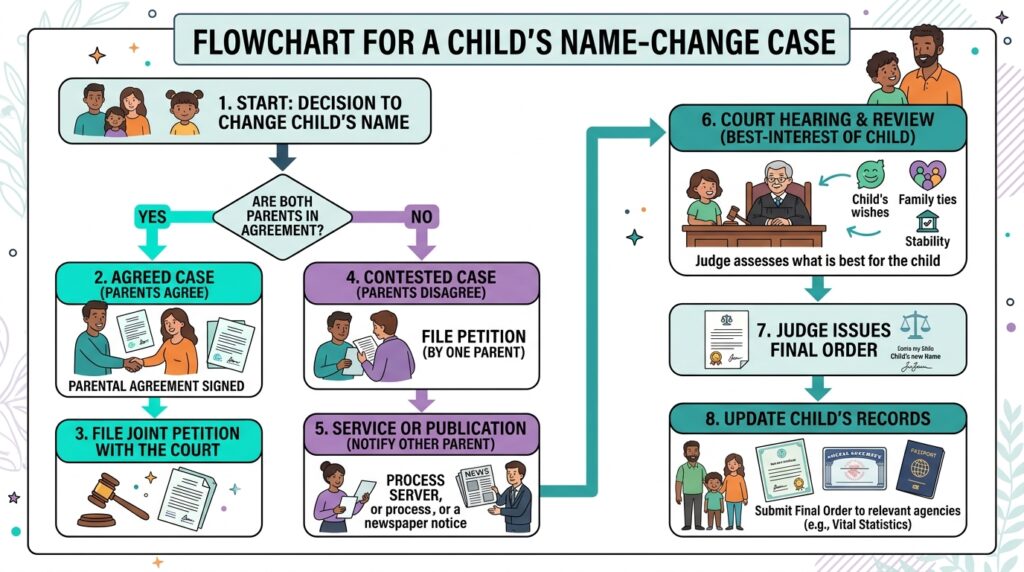
A child’s petition may use the same filing fee as an adult case, but consent, service, publication, and a best-interest hearing can raise the total. The lowest-cost situation is usually one in which both parents agree and can be easily notified.
A child name-change budget may include the costs below. Notice is often the largest variable:
- Filing and local court charges. Some courts allow siblings in one case, while others require separate petitions or fees. Ask this before preparing multiple applications.
- Notice and service. A sheriff or process server may need to deliver the papers to the other parent. If that parent cannot be located, the court may require a search, an affidavit, or publication.
- Legal representation. A disputed best-interest hearing may require evidence, witnesses, and legal argument. Attorney fees can move the total from hundreds of dollars to several thousand.
- Updated child records. After approval, you may need to change school, medical, insurance, passport, birth certificate, and Social Security records. The document requirements for a child’s Social Security record explain the types of legal proof that may be requested.
Read the consent and notice rules carefully. A correct petition can still be delayed when the other parent did not receive valid notice.
Name-Change Costs by State and County
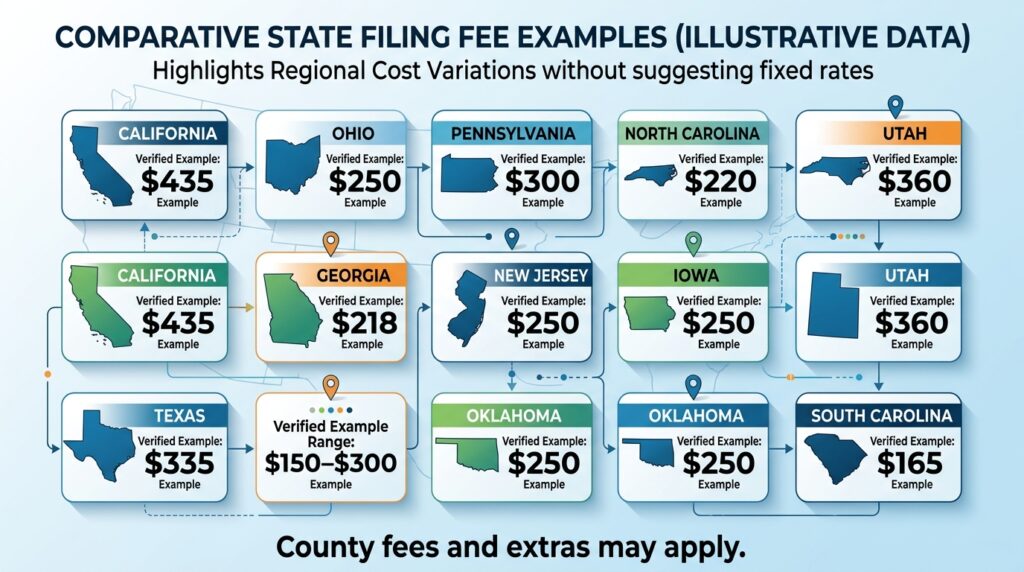
A state comparison can mislead when the amount is county-specific or excludes publication and copies. The official examples below are starting points, so confirm local surcharges with your clerk.
How Much Does It Cost to Change Your Name in Ohio?
Ohio name-change petitions are generally handled through probate court, and local fees can differ. An official Crawford County rule lists a $100 deposit for an adult or minor name-change application.
A practical Ohio budget may be $100 to $300 after adding publication, certified copies, and identity-document updates. Use the official probate name-change forms, then confirm the total deposit with your county probate clerk.
How Much Does It Cost to Change Your Name in PA?
Pennsylvania is a strong example of county-level variation. Current Philadelphia instructions list a $349.23 filing fee, require fingerprint and publication steps, and warn that the full process can exceed $900.
A current Washington County packet lists $139.75, including an $8 judgment search, which is far lower than the Philadelphia starting amount. Check the official Philadelphia petition instructions or your own county packet before budgeting.
How Much Does It Cost to Change Your Name in NC?
North Carolina handles an adult name change as a special proceeding. One current county court-cost page lists $120 for a name change, but local requirements and related record costs can affect the total.
Start with the official adult application and review the current court-cost guidance. A planning budget of $150 to $300 gives room for record checks, notice, copies, and identification updates.
How Much Does It Cost to Change Your Name in Utah?
Utah’s current fee schedule lists $375 as the fee for an original complaint in the relevant general category. Certified copies are priced at $4 per document plus $0.50 per page.
The official name-change instructions explain the filing process and fee-waiver option. A reasonable total budget is $400 to $550 after copies and document replacements.
How Much Does It Cost to Change Your Name California?
California’s current self-help instructions list a filing fee of $435 to $450 for an adult petition. The same guidance explains that a qualifying person may request a fee waiver.
Read the official filing steps and fee information before submitting your forms. Publication, certified orders, license replacement, and passport processing can push the full total above $500.
How Much Does It Cost to Change Your Name Georgia?
Georgia petitions are filed as civil actions in superior court, so county schedules matter. Fulton County currently lists $218 for a general civil action, which provides a useful official example but is not a statewide promise.
Review your county’s civil fee schedule and publication rules before filing. A practical Georgia budget may be $275 to $500 after newspaper notice, certified copies, and replacement records are included.
How Much Does It Cost to Change Your Name in Iowa?
Iowa’s current civil court fee page lists $215 as the fee for a name change. It also states that the name change is included in the dissolution filing fee when it is requested as part of that case.
This is why restoring a former name during divorce can save a separate filing fee. Check the current civil court fee schedule instead of relying on older third-party charts.
How Much Does It Cost to Change Your Name in NJ?
New Jersey’s current adult name-change packet lists a $250 filing fee. The court also provides a financial waiver process for qualifying applicants.
Use the official adult name-change packet to review the filing and judgment steps. Add certified copies, mailing, and identification updates when building your final budget.
How Much Does It Cost to Change Your Name Oklahoma?
Oklahoma costs can differ by county and by what the quoted amount includes. Oklahoma County lists $190.39, including publication, while Cleveland County lists $160.39 without an attorney, with publication paid separately.
Ask the clerk whether the amount includes newspaper notice, local surcharges, and a certified final order. A practical budget of $200 to $400 is safer than assuming the filing number is the complete cost.
How Much Does It Cost to Change Your Name in SC?
South Carolina’s current family-court schedule lists $150 for a name-change or birth-record-correction action. Official guidance also describes criminal history and document requirements that may add external costs.
Review the current family-court fee schedule and ask about fingerprints before filing. A realistic total may be $225 to $400 after checks, certified copies, and identification updates.
How Much Does It Cost to Change Your Name Texas?
Texas filing fees vary by county. Current legal-aid guidance places the adult filing fee at about $150 to $300, with separate fingerprinting charges and possible criminal background check expenses.
The step-by-step adult petition guide also explains the fee-waiver option. A self-filed routine case may total $200 to $450 once fingerprints, copies, and new identification are included.
Three Realistic Name-Change Budgets
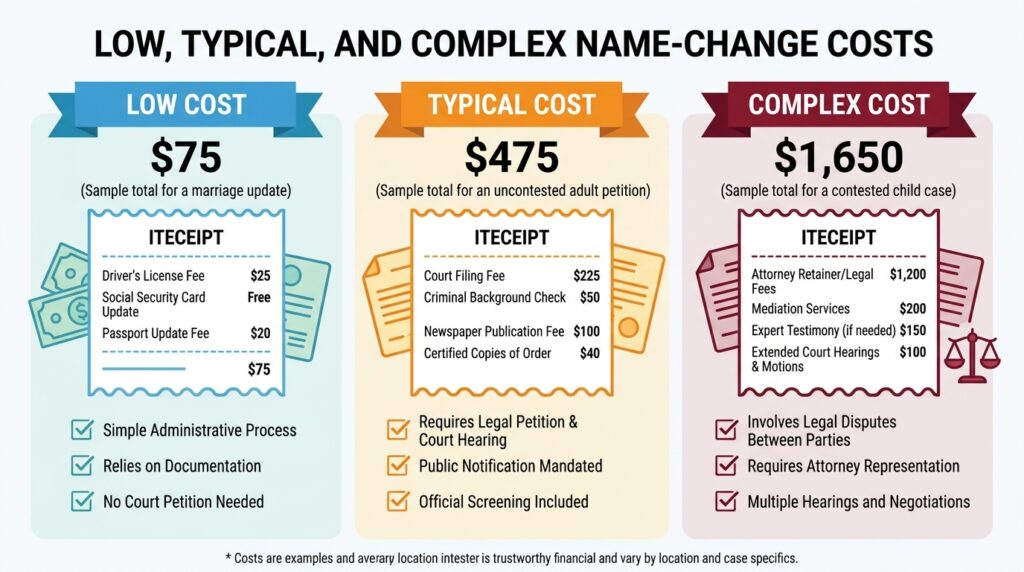
These sample budgets are not official quotes. They show how common expense categories can build the final total.
Budget Example 1: Marriage-Related Last-Name Update
Assume that your certified marriage certificate reflects your selected surname and that no separate petition is required. Your Social Security update is free, and you only need a replacement license, photos, mailing, and one extra certificate.
| Expense | Sample amount |
|---|---|
| Extra certified marriage certificate | $15 |
| Driver’s license replacement | $30 |
| Passport photo or document photo | $15 |
| Mailing and copies | $15 |
| Estimated total | $75 |
The total rises with a paid passport renewal, title change, or professional licenses. Check each agency first.
Budget Example 2: Uncontested Adult Court Petition
Assume a $250 filing fee, an $80 publication bill, $40 for fingerprints, four certified copies, and a replacement license. Add a small amount for printing, parking, and mailing.
| Expense | Sample amount |
|---|---|
| Court filing | $250 |
| Newspaper publication | $80 |
| Fingerprints | $40 |
| Certified copies | $40 |
| Driver’s license | $30 |
| Printing, mailing, and travel | $35 |
| Estimated total | $475 |
This budget allows for common extras without assuming legal fees. It still needs local verification.
Budget Example 3: Contested Child Name Change
Assume a $250 filing fee, two service attempts, publication after the parent cannot be located, certified records, and limited attorney help. The case also requires more than one court appearance.
| Expense | Sample amount |
|---|---|
| Court filing | $250 |
| Service attempts | $150 |
| Publication | $120 |
| Certified documents | $60 |
| Limited attorney assistance | $1,000 |
| Travel, copies, and mailing | $70 |
| Estimated total | $1,650 |
The objection itself does not carry one fixed charge. It incurs costs by adding services, evidence, hearings, and professional time.
DIY Filing, a Form Service, or a Lawyer?
Self-filing is usually cheapest, but legal risk should guide your choice. Complex cases need more support.
| Option | Typical added cost | Best suited to | Main drawback |
|---|---|---|---|
| DIY filing | $0 beyond required costs | Simple, uncontested adult case | You must follow every local rule |
| Form-preparation service | About $40 to $200 | People who want organized paperwork | It may not include legal advice |
| Limited lawyer review | Several hundred dollars | One difficult issue or document check | Scope must be clearly defined |
| Full representation | Often $1,000+ | Contested, sensitive, or complex case | Highest total cost |
Pros and Cons of Filing Yourself
Free court forms keep your expense close to required charges. The risk is that the wrong court, an outdated form, or a missed notice rule can force you to repeat a paid step.
Pros and Cons of a Form Service
A form service can organize routine paperwork, but document preparation is not legal representation. Check whether the price covers only forms or also filing, publication, copies, and support.
Pros and Cons of Hiring a Lawyer
A lawyer can address objections, safety issues, missing parents, and unusual records. Ask about a flat fee, limited-scope service, or one-time consultation before choosing full representation.
How to Lower the Cost Without Creating More Risk
The largest savings usually come from avoiding a second case or repeated step. Check these options before paying.
- Request the change during divorce when appropriate. Restoring a former name in the final decree may avoid a later petition. Check the spelling before the decree is entered because agencies will rely on that wording.
- Apply for a fee waiver if you qualify. Courts may review income, public benefits, assets, household expenses, and dependents. A waiver may cover the court fee without covering publication, private fingerprints, passport charges, or every copy.
- Confirm whether marriage documents support the exact name. Common surname changes may be accepted without a new case, but a creative combination or new first name may not be. Ask the major agencies before ordering replacement records.
- Order a sensible number of certified copies. Three to five may be enough for many people, especially when agencies return the document. Ask each agency whether it needs an original certified copy before buying a large bundle.
- Ask about publication exceptions. Some courts permit sealed proceedings, waived notice, or other methods when publication poses a genuine safety concern. Never skip a required notice step without written court approval.
- Separate mandatory charges from convenience fees. Expedited processing, private couriers, document services, electronic payment fees, and extra copies may be optional. Knowing the difference helps you protect your budget.
Use This Clerk Call Script Before Filing
A brief clerk call can prevent a petition from being rejected or a budget from being incomplete. Asking only for the cost may produce just the base filing fee.
Ask these questions in one call. Write the answers beside your budget:
- “What is the total amount due on the day I file?” Ask whether that number includes local surcharges, technology charges, and required deposits.
- “Is publication required, and is it included?” Request the approved newspaper, the exact wording of the process, and the number of weeks.
- “Do I need fingerprints or a background report?” Ask which vendors and report dates the court accepts.
- “How much is each certified final order?” Confirm whether any certified copies are included in the filing payment.
- “Can I request a fee waiver?” Ask whether the waiver can cover publication, service, or copies in addition to the court fee.
- “Is electronic filing required?” Ask whether the platform or card processor adds a separate charge.
This script turns a broad estimate into a usable local budget. Keep the answers with your forms.
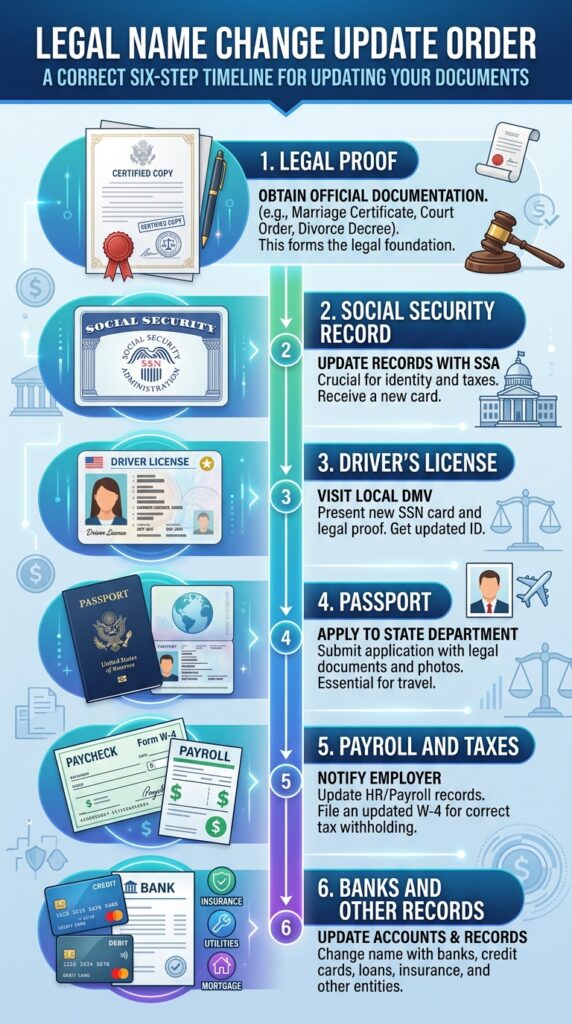
The Best Order for Updating Your Records
The order does not automatically update every database. The sequence matters because agencies may compare records.
Step 1: Get Certified Legal Proof
Your proof may be a marriage certificate, divorce decree, adoption decree, naturalization document, or signed court order. Make sure the document shows the exact new name.
Check spelling, spaces, hyphens, and suffixes before leaving. One error can spread through every later record.
Step 2: Change Your Social Security Record
Start with your Social Security record because payroll, tax, and licensing systems may compare against it. The official record-change process explains when an online start or an office visit may be required.
There is no charge for the replacement card. Current guidance says the card is generally mailed within 5 to 10 business days after the request is completed.
Step 3: Update Your Driver’s License or State ID
After that record has processed, update your driver’s license or identification. Ask whether vehicle title and registration changes require separate fees.
Step 4: Update Your Passport
Choose the correct form based on the passport’s issue date, the date of your name change, and whether the passport has limited validity. Use the current passport fee calculator instead of relying on a flat, outdated estimate.
Do not book travel under the new name until the ticket and identification you will use can match. A valid court order does not fix a mismatch at check-in.
Step 5: Update Payroll and Tax Information
Tell your employer after the Social Security record is corrected. The name connected to your wages and tax return should match the name tied to your Social Security number.
The official tax-name matching guidance warns that a mismatch can delay return processing or a refund. Check the record before filing.
Step 6: Update Financial, Medical, and Professional Records
Next, update banks, insurance, medical records, utilities, leases, voter registration, schools, and licenses. Keep a checklist so an important account does not stay under the old name.
For future changes, monitor legal updates rather than relying on a saved chart. Recheck fees before filing.
Expensive Mistakes That Can Make You Pay Twice
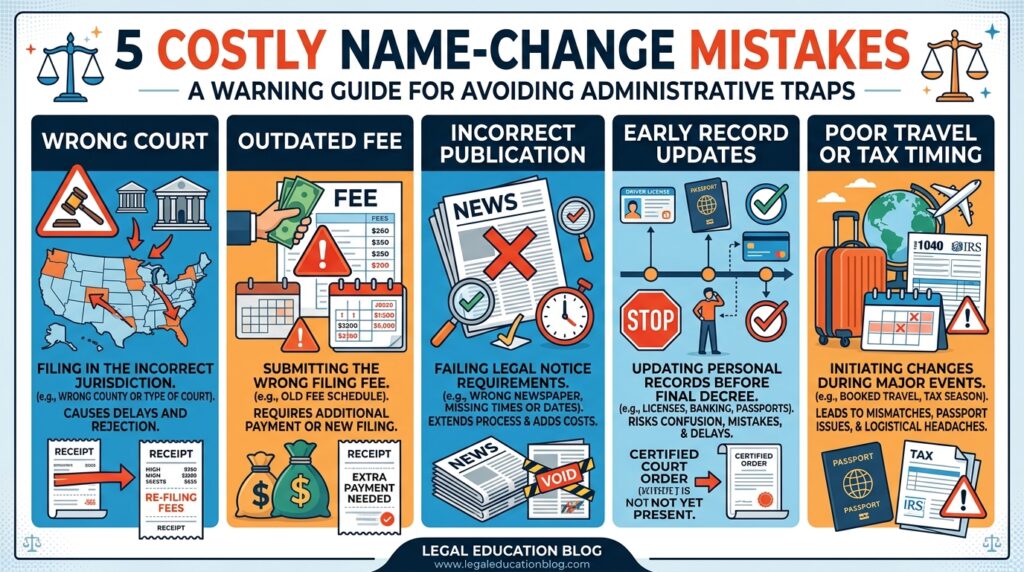
Repeating publication, fingerprints, service, or identification updates can create a real loss. Check the following mistakes early.
Filing in the Wrong Court
The correct court may be probate, superior, district, civil, or family court. Confirm the court type and residency period before paying, as a dismissal may require a new filing.
Trusting an Old State Fee Chart
Fee tables can stay online for years. Use the newest dated court schedule, call the clerk when pages conflict, and save the amount you relied on.
Publishing Notice Before Receiving Instructions
Do not pay a newspaper until the court confirms the wording, approved paper, and schedule. Ask whether the newspaper files proof directly or gives you an affidavit to file.
Updating Records Before the Order Is Final
A filed petition is not an approved change. Wait until the final order is entered and certified copies are available before updating agencies.
Ignoring Travel and Tax Timing
The name on your ticket should match the identification used for travel, and your tax filing should match your Social Security record. Plan around major travel and tax dates.
Expert Tips for a Smoother Name Change
Build your budget from the court outward. Verify the filing amount, then add required steps before pricing optional help.
- Create one master spelling line. Write the new full name exactly as it should appear, including spaces, punctuation, suffixes, and middle names. Copy from that line when completing every form.
- Keep a cost and document tracker. Record each agency, fee, submission date, required evidence, and status. This makes the process easier when several updates are moving at once.
- Protect at least one certified copy. Do not mail your last certified order unless the agency specifically requires it. Ask whether a photocopy can be used for preliminary review.
- Get focused help when the case is not routine. A one-hour consultation may be enough to resolve a difficult question. Full representation is more appropriate when another person objects or when the case poses serious legal risk.
- Verify fees again shortly before filing. Court schedules can change after you prepare your forms. A final check prevents an underpayment from delaying acceptance.
Frequently Asked Questions
1. How Much Does It Cost to Legally Change Your Name Without a Lawyer?
A self-filed adult petition often costs about $150 to $600 after notice, fingerprints, copies, and identification are included. A lawyer is not usually required for a simple uncontested case, though limited review may help with unclear instructions.
2. Is It Free to Change Your Name After Marriage?
A court petition may not be necessary if your marriage certificate reflects the selected surname, but updating documents still incurs fees. A first-name change or unrelated surname may require a petition, so confirm the accepted proof first.
3. Does It Cost More to Change Your First, Middle, and Last Name Together?
A single petition can generally request changes to the first, middle, and last names of one applicant. Additional evidence and replacement records can increase the bill, but the number of name parts is rarely the primary cost driver.
4. Can I Get the Name-Change Court Fee Waived?
Many courts allow applicants with limited income to request a financial waiver. Ask whether it covers publication, service, fingerprints, certified copies, and outside document fees.
5. How Many Certified Copies of My Name-Change Order Do I Need?
Three to five copies are a practical starting point, but ask whether each agency returns the document. Buy only what you need and keep at least one protected certified copy.
Final Answer: What Should You Budget?
So, how much does it cost to change your name? A marriage-related record update may stay under $100, while a routine court petition often reaches $250 to $600 after hidden expenses are included.
A child’s case or contested petition can cost much more because service, publication, hearings, and legal help may be required. The smartest step is to verify the local filing fee, background-check rule, publication charge, and certified-copy price before you submit anything.
Use the clerk call script, apply for a waiver if you qualify, and update your records in the right order. That approach will not remove every fee, but it can prevent repeat payments, missed deadlines, and weeks of avoidable frustration.
